
The worst place to make life decisions is from inside a toxic lab. But that is exactly where you are — and you’re thinking about jumping to an MD–PhD.
Let me be blunt: staying in a toxic PhD environment just because you are scared to pivot is a bad strategy. But blindly trying to “MD–PhD transfer” as an escape hatch is also a bad strategy. You need a plan, not a fantasy.
This is that plan.
Step 1: Get Very Clear on Your Actual Problem
First, separate three things that are currently tangled in your head:
- Your lab environment (toxic vs healthy)
- Your interest in research vs clinical work
- Your desire for an MD–PhD specifically vs “I need out”
If you mix those, you’ll make bad decisions.
Ask yourself, in concrete terms:
- If my lab were healthy, would I still want to do an MD or MD–PhD?
- Do I actually enjoy research questions, reading papers, designing experiments — just not in this lab?
- Or do I mostly find myself drawn to direct patient care, physiology, clinical reasoning, and I’m forcing myself through research because I started this PhD?
If the honest answer is “I like research, just not in this hellscape of a lab,” your moves will be different than if the answer is “I want to practice medicine, and staying in this lab is killing years I could be training clinically.”
You do not have to say this out loud to anyone yet. But you do need to be honest with yourself.
Step 2: Understand What “MD–PhD Transfer” Actually Means
There is no formal “transfer” pipeline from a toxic PhD lab into a cushy MD–PhD slot. That’s a myth people cling to.
You’re really talking about one of these:
| Path | What It Actually Is |
|---|---|
| Apply MD–PhD from PhD | Finish or near-finish PhD, then apply to MSTP/MD–PhD as new applicant |
| Apply MD only | Use PhD as academic strength, apply straight MD |
| Leave PhD, post-bacc then MD | Exit with or without a master’s, rebuild record, apply MD |
| Switch labs/programs | Stay PhD trajectory, fix toxicity without changing degrees |
| Dual-degree add-on | Rare institutional pathway to add MD after starting PhD |
What does not exist: some mid-PhD lateral transfer into an existing MD–PhD program where you “carry over” your current slot like course credits.
Typical MD–PhD realities you’re up against:
- They want a clear story of sustained research interest, not “my PI is a nightmare so I want out.”
- They care about:
- Your publication trajectory or at least solid research output
- Strong letters from research mentors (this is key and hard in a toxic lab)
- MCAT and GPA that match MD–PhD competitiveness (often MCAT ≥ 515 for top MSTPs)
- They may or may not value your in-progress PhD as much as you think. A completed PhD is stronger than “all but dissertation in a mess of a lab.”
So before you imagine you can “convert” your current PhD into an MD–PhD spot, accept this: you’d be applying basically as a new MD–PhD applicant, just with a lot more research than the average candidate.
Step 3: Stabilize Your Situation Before You Blow It Up
When you’re in a toxic lab, your first instinct is escape. That’s human. It’s also how people burn bridges, destroy letters, and tank their future options.
Your short-term goal is not “get into MD–PhD tomorrow.” Your short-term goal is:
- Protect your mental health
- Protect your reputation
- Preserve optionality
Concrete moves:
Quietly document what’s happening
Keep a dated record (personal, not on lab computers) of:- Unreasonable demands (e.g., “7 days a week, 12-hour days, no vacations allowed”)
- Abusive comments (wording, date, context)
- Withheld authorship or threats You’re not building a lawsuit. You’re building clarity and, if needed, evidence to justify a lab switch or program support.
Identify one safe faculty ally
Not your PI. Someone like:- A committee member
- Graduate program director
- Another PI who’s known to be decent with trainees
Your first conversation is not: “I want to leave for MD–PhD.”
Your first conversation is: “My current lab environment is unsustainable; I need advice on next steps within the program.”
Get your mental health supported
Use university counseling, an external therapist if you can afford it, or at least one trusted person outside your program. Toxic labs wreck your sense of self. If your brain is in constant fight-or-flight, you will not make good long-term decisions.
Step 4: Map Out Your Real Options (Not the Fantasy Ones)
Let’s break down the actual forks you might choose. Think in 6–18 month horizons, not “rest of my life.”
Option A: Stay in PhD but Switch Labs / Environments
If you still like research and you’re early enough, this is often the smartest move.
You’d choose this if:
- You don’t hate research itself — you hate this lab.
- You can plausibly get out with the support of your program.
- You are not financially or visa-wise locked to this PI.
Your steps:
- Talk to grad program leadership frankly about fit, burnout, and productivity being tanked by the environment.
- Frame it as: “I want to be productive and graduate. This lab is making that impossible. I’d like to explore other labs.”
- Do not make your whole case about how evil your PI is. Make it about mismatch, lack of mentoring, poor fit.
If you can successfully move labs:
- You stabilize your PhD.
- You get new letters from a healthier PI.
- Later, you can still apply for MD or MD–PhD with a much cleaner story.
This is often the “least dramatic but highest leverage” option.
Option B: Finish the PhD, Then Apply MD or MD–PhD
You’re already deep. You’re 3–4+ years in. Bailing now with nothing to show is painful.
You’d choose this if:
- You can see a path to defending within 1–3 years.
- You can keep your sanity together enough to get out.
- You know you want medicine (MD or MD–PhD), and the PhD will be a completed asset, not a half-finished trauma.
What you do now:
- Ruthlessly simplify your PhD. Minimum viable thesis. Not a magnum opus.
- Identify what data is enough to graduate. Lock your committee into that.
- Protect at least 1–2 letter writers who can say you’re productive, resilient, and scientifically strong — even if your PI is not your biggest cheerleader.
Then you plan for MD or MD–PhD applications:
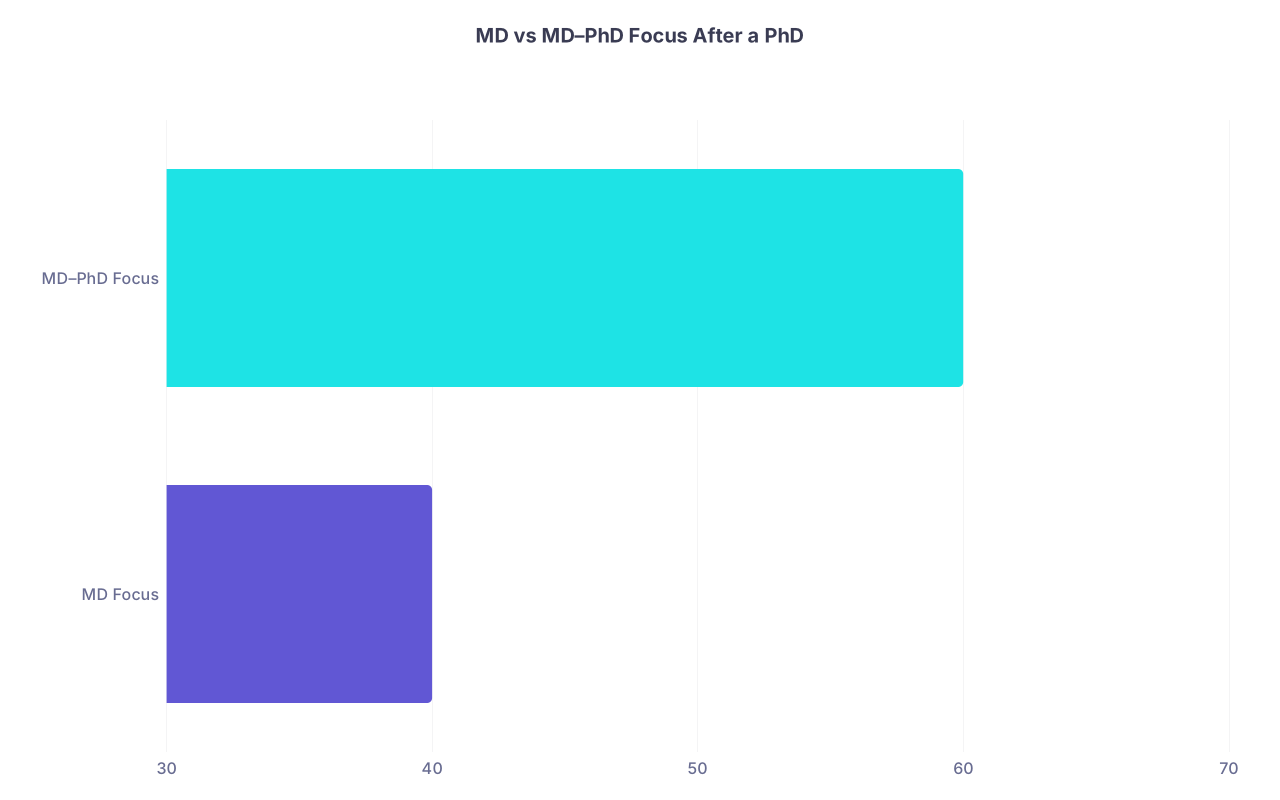
| Category | Value |
|---|---|
| MD Focus | 40 |
| MD–PhD Focus | 60 |
MD only:
- Easier to get letters: you can pitch clinical interest plus strong research background.
- You can still build a research-heavy career (physician–scientist) with MD alone.
- Often more realistic if your publication record is modest.
MD–PhD:
- Better if you truly want a protected research-heavy career (e.g., 70% research, 30% clinical).
- Programs will expect:
- Strong independent work
- At least some publications or meaningful progress
- Clear articulation of how your PhD experience motivates, not just traumatizes, you
In your essays, you do not write: “My PhD lab was toxic so I ran toward medicine.” You write:
- How dealing with hardship clarified what kind of scientific and human environment you want to build.
- How you developed grit, independence, and clarity around patient-centered questions you now want to tackle as a physician–scientist.
Option C: Exit the PhD Early (With or Without a Master’s) and Pivot to MD
This is the move when the environment is bad enough that finishing is actively harmful — to your mental health or your timeline — and you are committed to clinical training.
You’d choose this if:
- You’re early-ish (1–3 years) and not close to meaningful thesis completion.
- The toxicity is extreme (screaming, harassment, retaliation, sabotage).
- Your program has a mechanism for a terminal master’s or soft landing.
Your steps:
Quietly explore: Can I convert to a master’s?
Check:- Graduate handbook
- Talk to program director, not PI, first
- Ask about policies in neutral terms: “If a student needs to change trajectory, what are the options?”
Decide: fight to salvage vs cut losses
If fighting for a new lab will take another year and your heart is already 90% in medicine, leaving with a master’s and moving forward can be rational, not “quitting.”Build the MD story
Now you’re not “failed PhD student.” You are:- Someone who realized early that your path is clinical
- Someone with solid scientific training
- Someone who left a misaligned path intentionally, not impulsively
You will need:
- A rebuilt GPA narrative if grad grades are messy (usually they’re fine, pass/fail, or A-heavy)
- MCAT plan
- At least one strong rec letter from someone who can say: “They are not running from difficulty; they made a thoughtful decision.”
MD–PhD from a dropped PhD is possible but much harder, because committees will ask: “Will this person actually finish our dual degree?”
Option D: Stay in PhD, Skip MD Entirely, Fix Career Another Way
You might discover that what you actually hate is not “PhD vs MD” but “PhD in this place, with this PI, on this project.”
I’ve watched people:
- Switch to computational work, remote-friendly, sane mentors.
- Move into industry research roles after graduating, with more collaborative teams.
- Pivot into policy, consulting, regulatory science, data science.
If medicine is mostly showing up in your brain as “anything but this,” pause. You do not commit to a decade-plus of training just because your PI is a jerk.
Step 5: Reality Check Your Competitiveness for MD / MD–PhD
You cannot skip this part. Wanting out is not enough.
You need a clear-eyed snapshot:
| Factor | MD | MD–PhD |
|---|---|---|
| GPA (undergrad) | ≥ 3.5 helpful | ≥ 3.6–3.7 usual |
| MCAT | 510–515+ competitive | 515–520+ common at MSTPs |
| Research output | Helpful, not required | Basically required, plus strong letters |
| Story | Why medicine? | Why physician–scientist specifically? |
Then ask:
- Do I already have clinical exposure (shadowing, volunteering)?
- Have I actually explored patient care, or am I idealizing it from afar?
- Can I get letters that say “future doctor” and not just “burned-out grad student trying to escape?”
If you’re early in this thought process, your immediate job is not to submit applications; it’s to quietly build competitiveness while you stabilize your current situation.
Step 6: Use Time Deliberately, Not Desperately
You’re probably asking: “How long should I stay before making a move?”
There’s no single number, but think in phases.

| Step | Description |
|---|---|
| Step 1 | Right Now - Toxic Lab |
| Step 2 | Plan lab change |
| Step 3 | Stabilize, then reassess MD or MD PhD interest |
| Step 4 | Finish PhD, then apply MD or MD PhD |
| Step 5 | Explore exit with masters, plan MD path |
| Step 6 | Stay, aim for non MD career after |
| Step 7 | Can lab switch fix it? |
| Step 8 | Close to PhD completion? |
| Step 9 | Want medicine enough to leave? |
Rough guidance:
- If you’re within 1–2 years of defending: finish if you can do it without breaking yourself.
- If you’re 2–4 years out and the environment is truly toxic: switching labs or exiting may be smarter than “just push through.”
- If you’re early (year 1–2) and already miserable: do not sink five years into something you know is wrong just to avoid the discomfort of changing course.
Step 7: Handle Your PI Strategically, Not Emotionally
Toxic PIs can wreck your letters, your reputation, and your mental health if you leave badly. You need strategy.
Things that usually go badly:
- Emotional blow-ups (“I’m done, this is abuse, I’m leaving.”)
- Long accusatory emails that get forwarded to everyone in the department.
- Threats: “If you don’t sign off on my thesis, I’ll go to the dean.”
Things that go better:
- Calm, vague language about “fit,” “mentoring style,” “different goals.”
- Explicit focus on your need to be productive and graduate.
- Keeping conversations short, documented, and sometimes witnessed (committee member CC’d on key emails, for example).
If you’re planning to apply to MD or MD–PhD later, ask yourself:
- Do I need this PI’s letter at all?
- MD only: maybe not, if you have other strong letters.
- MD–PhD: it’s more complicated; they expect a main research letter.
If your PI is truly unstable or abusive, admissions committees will understand if you handle it this way in your application:
- You do not go into lurid detail.
- You simply say something like: “My primary PhD mentor and I had a significant mismatch in expectations and mentoring style, and I ultimately completed my thesis under the supervision of my committee and secondary mentor, Dr. X, who can better speak to my work.”
Let your new letter writers imply the rest.
Step 8: Design a One-Year Plan From Where You Are Right Now
You need a concrete next-12-months plan, not a ten-year fantasy.
Example: You’re 3rd year, hate your lab, thinking “MD–PhD?”
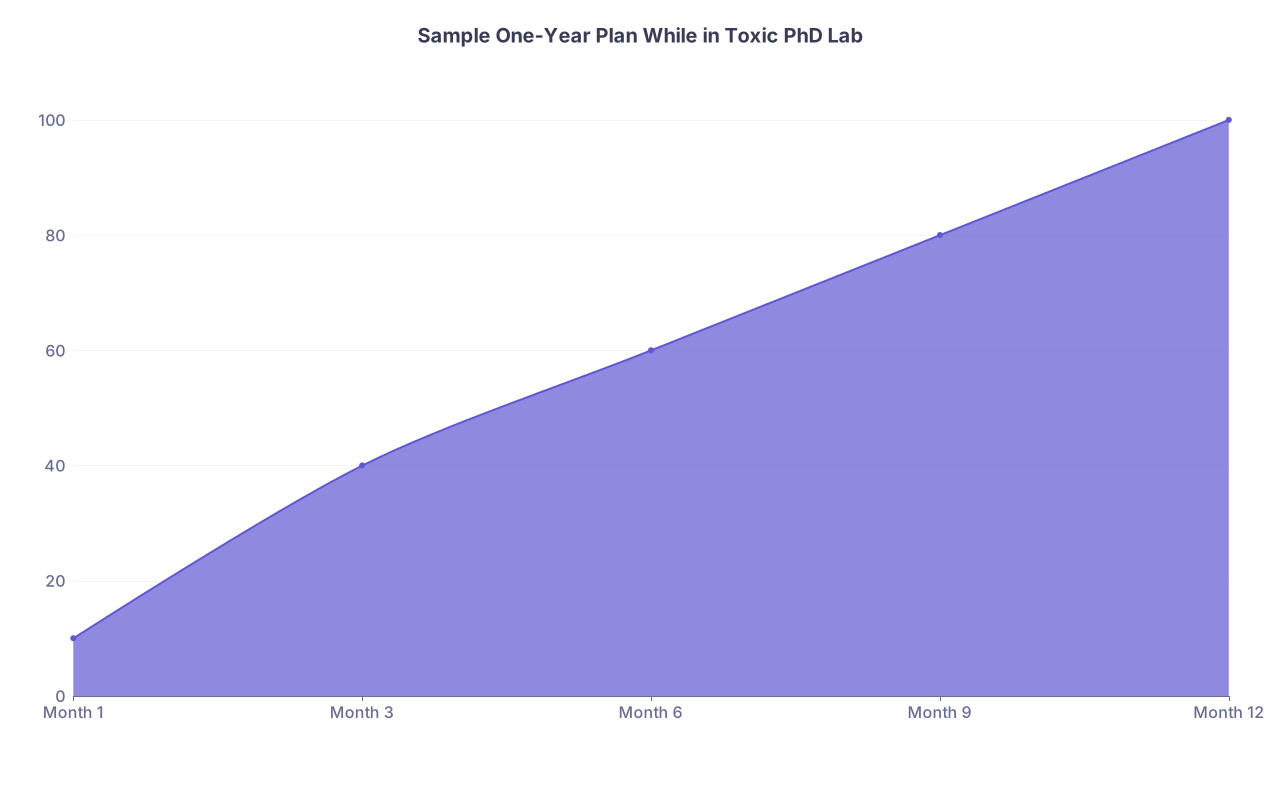
Your one-year plan might look like:
| Category | Value |
|---|---|
| Month 1 | 10 |
| Month 3 | 40 |
| Month 6 | 60 |
| Month 9 | 80 |
| Month 12 | 100 |
Month 1–2:
- Start documenting lab issues.
- Meet with grad program director.
- Explore lab switch quietly.
- Start MCAT content review or basic clinical exposure (if time/mental health allow).
Month 3–6:
- Either commit to lab switch or decide to exit with master’s/finish as fast as possible.
- Improve mental health supports.
- Shadow monthly or volunteer clinically if medicine still seems right.
Month 6–12:
- If staying to finish PhD: lock in graduation plan with committee.
- If exiting: define last semester, coursework, and off-ramp.
- Begin serious MCAT preparation with a scheduled test date.
- Start building relationships with potential letter writers outside your PI.
The point: every month should move you either closer to a safer PhD situation or closer to a realistic MD/MD–PhD application — not just “survive and complain.”
Step 9: Protect Your Identity From Your Current Situation
Toxic labs make you believe things about yourself that are not true:
- “I’m slow.”
- “I’m not cut out for science.”
- “Everyone else can handle this; I’m weak.”
- “If I leave, I’m a failure.”
Do not let a dysfunctional PI become your permanent narrator.
Clinical medicine has its own toxicity, by the way. Residency can be brutal. Some attendings are just as bad as your PI. So if your only reason for wanting MD–PhD is “I want to be respected and treated well,” you will be disappointed. There is no path in academic medicine that is free of difficult people.
Your goal is not to find a world without toxicity. Your goal is to:
- Stop tolerating objectively abusive environments as “normal.”
- Build leverage: skills, degrees, connections that give you options.
- Choose your next institution, mentor, and path with open eyes.
Step 10: When to Actually Pull the Trigger on MD–PhD Applications
You’re ready to apply MD–PhD (or MD) when:
- You have a coherent story that doesn’t sound like pure escape.
- You have at least two strong, specific letters:
- One research-heavy (not necessarily the toxic PI)
- One clinical/teaching/character-focused
- You’ve done clinical exposure that convinces you, not just a committee, that patient care is where you want to be.
- You’re not in such an acute mental health crisis that an application cycle will destroy you.
If you’re not there yet, that’s fine. You use your remaining PhD time — in a fixed or new lab — as staging ground. Not purgatory.
Final Takeaways
- Do not make a decade-long MD–PhD decision from inside a crisis. Stabilize your environment, your story, and your support first.
- There is no magic “transfer” from toxic PhD lab to MD–PhD; you are essentially reapplying with your PhD as one part of your profile.
- Your smartest moves now are the unglamorous ones: documenting, finding allies, possibly switching labs, and quietly building a credible path to MD or MD–PhD — not blowing everything up in one dramatic exit.