You’re in a lab office, not a dorm room. There’s a stack of published papers with your name on them, a PI who leans on you to keep the project afloat, and a DS‑2019 on file with the international office. Your badge says “Postdoctoral Scholar,” your I‑94 says “J‑1,” and your brain won’t stop saying “What if I went to med school here?”
Then you start Googling. Two‑year home residency. No dual intent. NRMP match rules. In‑state vs out‑of‑state. Waivers. It all looks like a regulatory hairball designed to scare you off.
It’s not impossible. But it is technical, slow, and unforgiving if you get a step wrong.
This is the situation: you’re on a J‑1 doing (or finishing) a PhD or postdoc, and you want a US MD (or DO) and probably US residency after that. Let’s cut the philosophy and go straight into: What is actually possible, what is not, and if you’re going to try, how to structure it so you don’t wreck your immigration status or your career.
1. The Hard Wall: J‑1 And The Two‑Year Home Residency Requirement
Let me start where people get burned.
Most J‑1 research scholars and many PhD students are subject to the two‑year home residency requirement (INA 212(e)). If you are, then:
- You must either:
- Spend an aggregate of 2 years physically in your home country, or
- Obtain a waiver
- Until one of those happens, you cannot:
- Change status to H‑1B, L‑1, or permanent resident (green card) inside the US
- Get those visas issued abroad either
And no, being brilliant, critical to the lab, or “really wanting to be a doctor” doesn’t override the statute.
How to know if you’re subject
Check three things, not just the stamp scribble:
- Your DS‑2019: Look for the 212(e) section.
- Your visa foil (sticker) in passport: Often annotated “Bearer is subject to 212(e).”
- The actual law:
You’re subject if any of these apply:- You receive US or home‑government funding for your J‑1 program
- Your field is on the “skills list” for your home country
- You came for graduate medical education (not you, you’re research, but listing for completeness)
If any of those are true, assume you’re subject unless and until an experienced immigration lawyer tells you otherwise in writing.
Why this matters for MD
Med school itself is usually on F‑1, not J‑1. So the key questions:
- Can you switch from J‑1 to F‑1 in the US if you’re 212(e)‑subject?
Sometimes, yes. 212(e) blocks H‑1B/L/PR, not F‑1. The issue is separate: whether USCIS will approve a change of status (COS) from J‑1 to F‑1 while you’re still in J‑1 and subject to 212(e).
It’s been done. I’ve seen J‑1 PhDs switch to F‑1 for a second degree. But it’s not automatic and can be slow. - If COS is not approved, can you get an F‑1 visa abroad?
You may be able to get an F‑1 visa stamp even while 212(e)‑subject, because 212(e) doesn’t ban F‑1 issuance. But a consular officer can question your intent or worry you’ll try to move later to H‑1B despite 212(e).
So the home residency requirement is not a brick wall for attending med school. It’s a brick wall for what comes after med school (residency on H‑1B / green card) unless you plan to do your residency on J‑1 or you get a waiver.
Keep that framing in mind. You’re not planning “MD then happy attending life.” You’re planning “MD → GME on J‑1 or waiver path → then maybe H‑1B or PR.”
2. PhD on J‑1 → US MD: What’s Actually Logistically Possible
Let’s map the path you’re probably imagining.
The cleanest (but rare) scenario
You’re on J‑1, not subject to 212(e) (e.g., private funding, not on skills list). Then:
- You finish or leave the J‑1 program
- You apply to US MD/DO
- Once admitted, you either:
- Do a COS to F‑1 inside the US
- Or leave, get F‑1 stamped abroad, and return
This looks almost like a standard international pre‑med to med path, just with a PhD under your belt.
Most people reading this are not that lucky.
The more common scenario: J‑1 with 212(e)
You’re subject. That means:
- You can still apply to med school while on J‑1
- You can still matriculate on F‑1 while subject to 212(e)
- You cannot transition directly from F‑1 to H‑1B or PR until you:
- Either do your 2‑year home country time, or
- Get a 212(e) waiver
That has direct implications down the road:
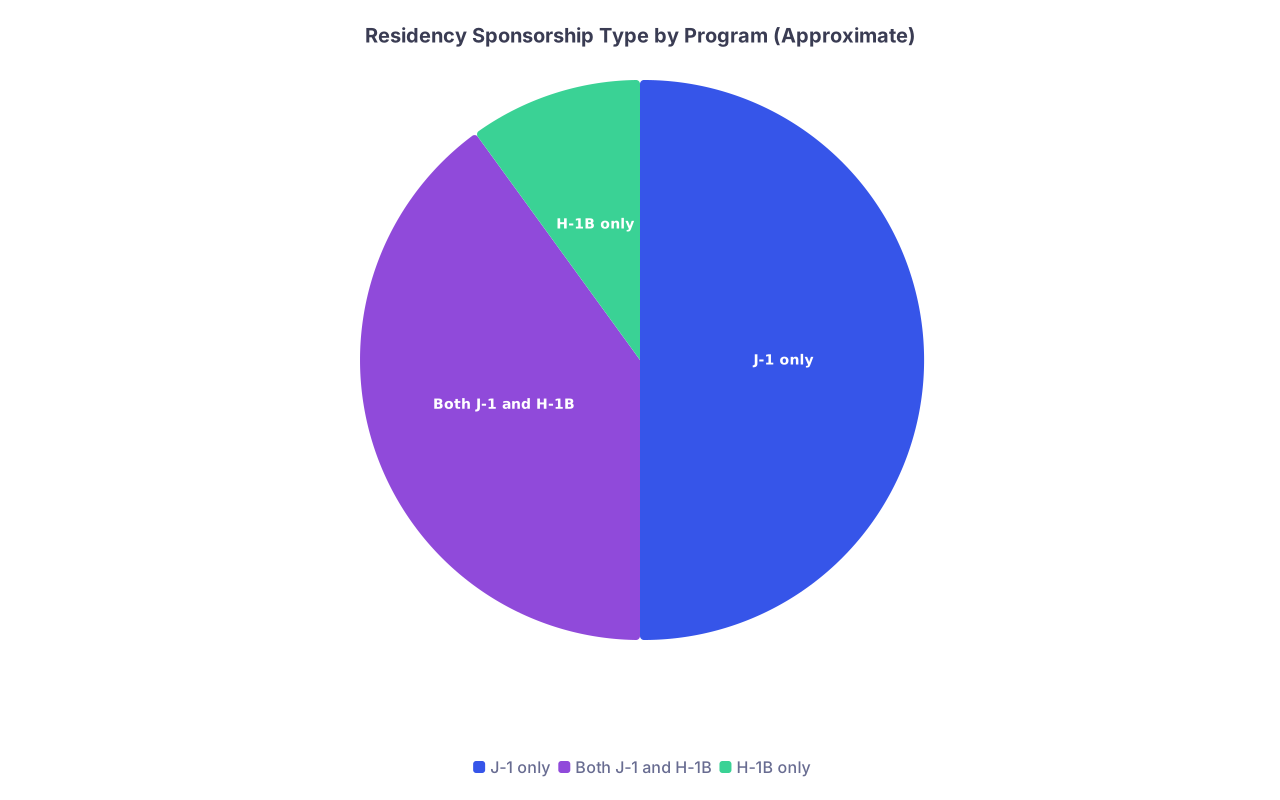
- Many residencies sponsor J‑1 (ECFMG), fewer sponsor H‑1B
- You could do residency on J‑1 even while subject (J‑1 medical education category has its own 212(e), by the way – you’ll stack or deepen the problem)
- You’ll eventually need a J‑1 waiver (usually via Conrad 30, hardship, persecution, or IGA) to stay long‑term
Is this insane? Not necessarily. International physicians do this constantly. But you need to go in eyes wide open.
3. Getting Into US Med School as a J‑1 PhD: Practical Barriers
Forget immigration for a minute. Admissions alone is a separate beast.
You’re not a normal applicant
You’re older, on a research visa, with a PhD. That cuts both ways.
Positives:
- You have deep scientific training and probably publications
- You understand biomedical research at a level most M1s never touch
- Some schools genuinely like non‑traditional candidates
Negatives:
- Schools worry about:
- Visa/financial complexity
- Commitment: “Will this 32‑year‑old actually practice clinical medicine or bail back to research?”
- Age vs training length optics (no one says this out loud, but committees think it)
The foreign vs US degree problem
Admissions offices sort applicants along these lines:
- US/Canadian undergrad vs foreign undergrad
- Citizens/PR vs temporary visa vs unknown status
You probably fall in this bucket:
- Possibly foreign undergrad
- PhD at US institution
- On J‑1
Many MD schools are firm: they want most or all pre‑reqs done at a US/Canadian college, regardless of your PhD. A US PhD can help, but it doesn’t erase a foreign bachelor’s in their eyes.
So you need to check, one by one, which schools:
- Accept international students
- Accept significant foreign coursework if supplemented with US coursework
- Accept someone on a nonimmigrant visa
- Require full escrow of 4 years’ tuition (some do this for nonimmigrants)
| School Type | International Accepted | US/Canada Prereqs Required | Loans Available |
|---|---|---|---|
| Top private (e.g., HMS) | Yes, very limited | Strongly preferred | Rarely |
| Mid-tier private | Sometimes | Often required | Sometimes |
| Public (state schools) | Rarely (nonresidents) | Usually required | No |
| DO schools | Some | Often flexible | Limited |
You can spend hours fantasizing about residencies; don’t. First question: can you even get one US MD or DO admission that will take your money and your visa?
4. Visa Mechanics: Timing a Shift from J‑1 to F‑1
Once you’ve decided you’re serious enough to apply, you have to think about timing.
Scenario A: Apply while still on J‑1, matriculate straight to F‑1
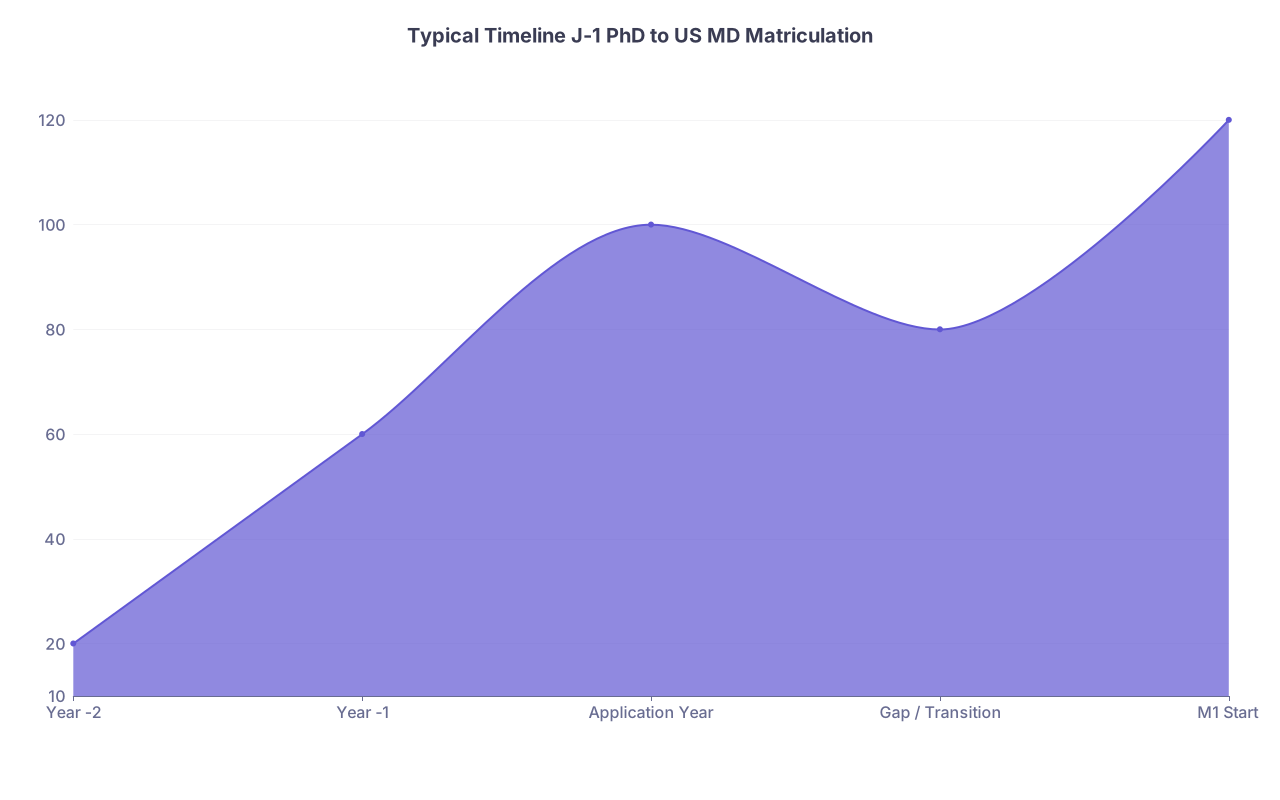
Timeline might look like:
- Year 0–1: On J‑1 doing PhD/postdoc, you study for MCAT, do clinical shadowing, prep apps
- Summer Year 1: Submit AMCAS/AACOMAS, still on J‑1
- Fall–Spring Year 1–2: Interviews while working in lab on J‑1
- Spring Year 2: Get an acceptance
- Spring–Summer Year 2: Work with med school and DSO to issue I‑20 for F‑1
- July/August Year 2: COS or new F‑1 visa stamp; start M1
Key pitfalls:
- COS can take months. If USCIS moves slow, you risk late approval. Some schools will let you start while it’s pending; many won’t.
- Leaving to get the F‑1 stamped is a risk if your J‑1 history and 212(e) make the consular officer nervous
Scenario B: Finish J‑1, leave US, restart with F‑1
Cleaner on paper, but you lose continuity and possibly your US presence for a while.
If your J‑1 ends June 2026 and you want to start med school August 2027, you’ve got a gap year. That gap might involve:
- Returning to home country (which chips away at your 2‑year requirement, good)
- Or getting some other status elsewhere
This can be smart if:
- You want to seriously start burning down that 2‑year requirement clock
- You don’t want to deal with COS complexity
But it makes maintaining US clinical exposure harder.
5. The Financial Reality: You’re Mostly on Your Own
You know this from grad school: money rules everything.
As an international nonimmigrant:
- You most likely will not qualify for US federal loans (FAFSA, etc.)
- Many private loans require a US co‑signer with strong credit
- Many med schools require international admits to:
- Prove funding for all four years up front
- Or put 4 years of tuition in escrow before matriculation
I’ve watched brilliant J‑1 PhDs get acceptances they had to walk away from because they just couldn’t show funds or secure a co‑signer. That’s how brutal this part is.
You need a concrete answer to:
- Who’s paying, and how?
- Do you have family funds? A reliable co‑signer? A home‑country scholarship that will survive the visa complexity?
Do not kick this question down the road and hope “it works out.” Med schools will absolutely rescind or block matriculation if you cannot prove ability to pay.
6. What About Residency After MD? J‑1 vs H‑1B vs 212(e) Again
You don’t need all this nailed down on day one, but you should at least know the chessboard.
Path 1: MD/DO → Residency on J‑1 (ECFMG)
This is the classic international physician path.
Pros:
- Many programs are used to J‑1 residents
- ECFMG handles sponsorship process (logical, structured)
Cons:
- You will be subject to yet another 2‑year home residency at the end of J‑1 clinical training
- To stay in US to practice post‑residency, you’ll need a J‑1 waiver (Conrad 30, IGA, hardship, etc.)
- That usually means working in an underserved area for several years
If you’re already 212(e)‑subject from your research J‑1, you can end up stacking obligations. You need an immigration lawyer keeping an eye on that mess.
Path 2: MD/DO → Residency on H‑1B
This is what a lot of foreign grads fantasize about.
Reality hits:
- Not all residencies sponsor H‑1B. Many flatly refuse.
- They often require:
- All USMLE Steps done before the start date
- No attempts wasted
- 212(e) will block you from changing to H‑1B unless:
- You’ve satisfied or waived it
So if you remain 212(e)‑bound when you finish med school, your realistic first step is J‑1 residency, not H‑1B.
When to deal with the waiver
You’ve got three main decision points:
- Now, while still research J‑1: attempt a waiver tied to your current skills (IGA, home country no objection, etc.)
- During med school: less common, but possible if an agency wants you
- During/following residency on J‑1: most people attempt Conrad 30 or IGA tied to clinical service
If your home country is strict about “no objection” letters, you might not get a research J‑1 waiver easily. That’s a political question, not just legal.
7. Building a Strategy That Isn’t Career Suicide
You’re not 19. You can’t “figure it out later” for a decade. You need an actual plan.
Step 1: Get a hard yes/no on 212(e) and waiver feasibility
Not from Reddit. Not from your PI. From:
- Your university’s international office (initial assessment)
- Then an experienced immigration attorney who regularly handles J‑1 and physician waivers
Questions to get answered:
- Am I definitely 212(e)‑subject? On what basis? Can it be challenged?
- What waiver paths might be realistic for me now or later?
- Does my home government usually issue “no objection” letters?
- Have they seen J‑1 research → F‑1 med school COS approved in recent years?
Step 2: Reality check on med school odds as an international PhD
You need to know:
- Are your undergrad transcripts acceptable or will you need more US coursework?
- Are your MCAT/GPA competitive among international applicants, not just domestic?
- Which specific schools:
- Accept international students
- Have ever taken someone like you (international, J‑1/PhD)
This is where you email admissions deans. Not generic info@. Actual humans. Briefly lay out:
- International status
- Foreign undergrad, US PhD (field)
- Visa type (J‑1)
- Desire to apply in [year]
Ask straight: “Is this a profile you would consider, and what are your nonnegotiable requirements (US coursework, funding, visa constraints)?”
Some will give you a flat no. Good. That’s data.
Step 3: Decide whether to invest in the MD route or pivot
If:
- Waiver prospects are poor
- Funding is shaky
- Very few schools even consider your profile
You need to ask if beating your head against this wall is the smartest move. A US MD is not the only way to have a meaningful clinical/translation impact with your PhD.
If, on the other hand:
- You have a credible funding path
- A handful of schools say “yes, in principle”
- You have plausible waiver options down the road
Then you structure everything around a clear timeline:
- MCAT date
- Application year
- J‑1 program end
- COS or consular strategy for F‑1
8. Tactical Moves While You’re Still on J‑1
Assuming you choose to proceed, here’s how to not blow it.
Protect your current status
- Do not let your J‑1 go out of status while you daydream about med school.
- Keep your SEVIS records clean, DS‑2019 updated, and any transitions (new host institution, extended funding) documented.
A status violation now can wreck F‑1 or later J‑1/H‑1B chances.
Build US‑flavored clinical exposure
Your PhD/postdoc doesn’t count as “clinical” in the eyes of med schools.
Start:
- Shadowing US physicians (yes, even unpaid)
- Volunteering in clinics/hospitals if possible
- Getting some direct patient‑adjacent experience: free clinics, hospice, EMT, etc., depending on what your visa permits
Check with your international office about what is legally allowed on J‑1. Unpaid shadowing is usually fine; anything that smells like work is a problem.
Keep your research narrative coherent
Adcoms don’t like chaos. The story cannot be, “I hate the lab; I want out.”
It has to be something like:
- “My research in [X field] showed me the gap between bench and bedside”
- “I found myself drawn again and again to patient‑facing questions”
- “I want to integrate rigorous science with clinical decision‑making”
You’re not abandoning your PhD; you’re leveraging it.
9. When It’s Actually a Bad Idea
Let me be blunt about a few cases where I’d tell you to seriously reconsider:
- You’re already several years into a research career, and realistic MD age at graduation is 38–40+, with loans and visa constraints still unresolved.
- Your home country absolutely refuses “no objection” letters, and your field is on a rigid skills list. Waiver odds are near zero.
- You have no plausible way to fund $250–$400k of tuition and living costs without wrecking your family’s finances.
- You’re moderately interested in clinical work but passionately interested in research, and you’re mostly looking at MD because you feel “lesser” as a PhD. (Bad reason. Wrong reason.)
In those cases, look at:
- MD‑equivalent pathways in your home country + later US fellowships
- Clinical research roles that give you patient contact but don’t require MD
- Industry translational jobs where your PhD is already gold
10. If You Decide to Go For It: A Compact Game Plan
Here’s what an actually sane sequence looks like if you move forward.

| Step | Description |
|---|---|
| Step 1 | J1 PhD or Postdoc |
| Step 2 | Confirm 212e Status |
| Step 3 | Consult Immigration Lawyer |
| Step 4 | Check Med School Policies |
| Step 5 | Prepare MCAT and US Clinical Exposure |
| Step 6 | Apply MD or DO |
| Step 7 | Receive Acceptance |
| Step 8 | Plan F1 Status - COS or Consular |
| Step 9 | Start Med School |
| Step 10 | Plan for Residency Visa Path |
During J‑1 phase:
- Get a legal opinion on 212(e) and waiver options
- Identify 10–20 med schools where:
- International students are admissible
- Your background isn’t an automatic no
- Map prerequisites gaps and fill them if needed (community college, extension schools – but confirm acceptability)
- Plan MCAT timing so score will be valid for the cycle you target
- Build documentable US clinical and service exposure
During application cycle:
- Stay fully compliant with J‑1 status
- Be transparent but not melodramatic about immigration in secondaries/interviews. You’re not an immigration case to them; you’re an applicant. They care that you can matriculate and function, not about every detail of your long‑term visa war.
After acceptance:
- Coordinate early with med school’s international student office
- Decide: COS vs travel for F‑1
- Get financial certification squared away months before matriculation
- Keep your PI in the loop enough to finish your J‑1 program cleanly
| Category | Value |
|---|---|
| Year -2 | 20 |
| Year -1 | 60 |
| Application Year | 100 |
| Gap / Transition | 80 |
| M1 Start | 120 |

11. Quick Word on DO Schools and Alternative Angles
Don’t ignore DO schools. For many international candidates, especially with unusual backgrounds, some DO programs are:
- More flexible on nontraditional applicants
- Slightly more open to international students than many public MD schools
But:
- Visa and funding problems don’t magically disappear
- Residency competitiveness is specialty‑dependent; if you dream of neurosurgery, adding layers of difficulty is probably unwise
Another angle: combined or accelerated programs targeting people with prior graduate work. Rare, but a few places have tailored options. Always verify if they accept international/non‑PR applicants.
| Category | Value |
|---|---|
| J-1 only | 50 |
| Both J-1 and H-1B | 40 |
| H-1B only | 10 |

Bottom Line: 3 Things to Walk Away With
- J‑1 with 212(e) does not prevent you from attending US med school on F‑1, but it massively complicates what comes after. You must understand the waiver landscape before you commit years and money.
- As an international PhD on J‑1, your biggest practical barriers are: school policies on foreign degrees, visa logistics (J‑1 → F‑1), and financing. Admissions committees are the least of your problems if you cannot clear those three.
- If you’re going to do this, treat it like an experiment with high stakes: gather hard data (lawyer, admissions deans, financial options), map a realistic multi‑year timeline, and be willing to walk away if the regulatory and financial math simply does not add up.