
The usual MD vs PhD advice ignores one thing: you are not a free agent—you are a parent with real obligations.
If you have kids, the MD vs PhD question is not “What’s more prestigious or intellectually pure?” It’s:
Which path lets you support your family, stay present as a parent, and still build a career you can live with in 10–20 years?
I’m going to walk you through this like we’re sitting at your kitchen table with a calendar, a calculator, and your kids in the next room. We’re not doing abstract. We’re doing: “Can I afford daycare in year 3?” and “Will I ever eat dinner with my family?” and “What happens if another baby comes?”
Step 1: Get brutally clear on your real constraints
Before you even touch MD vs PhD, you need to be honest about your situation. Not aspirational. Actual.
Here are the questions that matter:
- How old are your kids, and will you have more?
- What’s your partner situation?
- Dual-income? Single parent? Partner in training too?
- What’s your financial baseline?
- Debt already? Savings? Any help from family?
- Where do you live, and how flexible are you about moving?
- How much time can you realistically be out of the workforce?
If you do not anchor your decision in those constraints, you will chase a fantasy path and pay for it in burnout, resentment, or a wrecked relationship.
Let’s name some common situations I see:
Single parent with minimal support
You need relative financial stability as early as possible and predictable childcare windows. Risky, low-pay, endless-training paths are brutal here.Partner with stable income + benefits
You get more flexibility. You can tolerate a longer runway (e.g., PhD or MD-PhD) if the household can survive on one main salary.Both partners in training / unstable income
You need to minimize years of intense, low-income, high-hour work overlapping. Coordination becomes everything.Older parent (mid-30s to 40s) starting over
Your horizon is shorter. Spending 8–10 more years “in training” before decent income hits very differently than it does for a 22-year-old.
We’ll keep coming back to these, because they completely change what “makes sense.”
Step 2: Understand what MD, PhD, and MD-PhD actually look like with kids
Forget the generic descriptions; I’ll give you the parent version.
MD (Medical Doctor – clinical path)
Timeline (roughly):
- 4 years med school
- 3–7 years residency (depends on specialty)
- Optional fellowship 1–3 years
Money:
- Med school: You’re paying tuition, living on loans/savings/partner income
- Residency: $60–75k/year in most places, often with bad call schedules
- Attending: Jumps significantly (low 200s to 500k+ depending on specialty and geography)
Lifestyle with kids:
- Preclinical years: Study-heavy but somewhat flexible. You can sometimes control when you study (late nights after bedtime, early mornings).
- Clinical years: Rotations, early mornings, call, weekends. Hard on childcare, especially if your partner isn’t 9–5.
- Residency: Often the hardest period for parents.
- 60–80 hour weeks are common
- Nights, 24-hr calls, weekends
- Less control over schedule
- After residency: Highly dependent on specialty and practice type (some jobs become quite family-friendly, others not even close).
Key upsides for parents:
- Clear, relatively high earning potential
- The endpoint is stable and respected; easier to justify sacrifices to your family
- Many hospitals offer benefits (health insurance, maternity/paternity leave, childcare subsidies)
Key downsides:
- The worst years (residency) often overlap with your kids’ prime childhood years
- You will miss stuff: school events, bedtime, holidays
- If you’re older, you may not hit full earning potential until your 40s
PhD (Doctor of Philosophy – research/academic path)
Timeline (typical):
- 5–7 years PhD (sometimes more)
- 2–6 years postdoc (if you stay in research)
- Then: faculty track, industry, government, or non-research roles
Money:
- PhD stipend: ~$25–40k/year depending on field/location, often barely livable in big cities
- Postdoc: ~$50–70k/year
- Long-term salary:
- Academia: Wide range, often $80–200k but not guaranteed, and getting a stable faculty job is highly competitive
- Industry (e.g., biotech, data science): Often higher and more stable
Lifestyle with kids:
- PhD years:
- Usually more weekday flexibility than MD or residency
- Nights/weekends depend on lab culture and advisor
- But pressure to produce (papers, experiments) often pushes people into working constantly
- Postdoc years: Similar, sometimes more intense
- Industry jobs: Often more regular hours than clinical medicine, with good benefits
Key upsides for parents:
- You’re not taking on massive tuition debt; you’re getting a (small) paycheck
- Greater daily flexibility during PhD compared to clinical training (sometimes you can shift hours to align with childcare)
- Some research/industry roles can be excellent for family life once you’re established
Key downsides:
- Income is low for a long time
- Career path is uncertain; no guarantee of a stable, well-paying job at the end
- Geographic flexibility may be limited by specialized positions: you move where the job is, not where your family support network is
MD-PhD (physician-scientist track)
I’m going to be blunt: MD-PhD as a parent, especially starting late, is almost always a bad trade unless you are absolutely certain you want a research-heavy career and your family has serious financial and support stability.
Timeline:
- 7–9 years training before residency (MD and PhD integrated)
- Then the same 3–7 year residency, possibly fellowship
Upsides:
- Many MD-PhD programs are fully funded with a stipend (no med school tuition, small living stipend)
- You gain both clinical and research training, opening academic physician-scientist paths
- Financially safer than MD-alone during school years because of stipends
Downsides with kids:
- You push attending-level income far into the future
- Total training time can easily hit 15–18 years
- Moves, uncertainty, and burnout are very real. Hard to explain to a 12-year-old why you’re still “in training”
Step 3: Lay out the numbers and time for your specific age + family setup
Let’s put some structure to this. Assume you are 32 with a 3-year-old and a newborn. You live with a partner who earns $70k/year.
If you choose:
| Path | Age Finishing Core Training | First Stable Higher Income | Main Crunch Years with Kids |
|---|---|---|---|
| MD | 39–43 | ~40 | Kids age 4–12 |
| PhD | 37–39 (PhD only) | 40+ (postdoc/industry) | Kids age 3–10 |
| MD-PhD | 41–44 + residency | Mid to late 40s | Kids age 4–18+ |
Notice something:
No path is “quick.” Anyone selling you “just do the shorter one” isn’t paying attention. With kids, the question shifts to:
- When do you need real income?
- When do you need schedule stability?
- What kind of risk are you willing to tolerate?
Step 4: Match path to your family realities
Let’s go scenario by scenario.
Scenario A: You need income and benefits as soon as possible
You’re a single parent, or your partner’s job is unstable, or you already have significant debt.
In this case:
- A straight PhD can be more realistic than MD if your main goal is intellectual fulfillment + reasonable hours later, and you can live on a stipend where you are.
- An MD-PhD is usually off the table. Way too long to stable income.
- An MD can still be viable, but only if:
- You can secure significant loan support and
- You have reliable childcare and/or family support and
- You mentally accept that residency will be a storm your family has to survive, not enjoy.
If your priority is pure timeline to higher income, MD usually beats PhD, because the PhD → postdoc → hoping-for-job pipeline can drag and underpay you for years. But the MD route front-loads massive loans and insane hours.
What I often tell people in this situation:
If you have no financial safety net and minimal support, a traditional med school route can break you. You must have a rock-solid childcare and support plan before committing.
Scenario B: Partner has stable income, you can afford a lower-earning runway
Here you get to think more about fit than survival.
If you:
- Love patient care, want clinical authority, and can live with short-term chaos for long-term payoff → MD makes sense.
- Hate the idea of 24-hour calls, constant clinical responsibility, and EMR battles → do not talk yourself into MD just because it’s “safer.”
- Are deeply drawn to research questions, like long-term focused work, and could see yourself in industry or academia → PhD becomes a strong contender.
For many parents in this bracket, the PhD to industry path is underrated.
You get:
- A stipend during training instead of debt
- Then industry roles with 9–6-style schedules, good benefits, and salaries that, while usually below high-earning specialties, are more than enough for a stable life.
The trade? Less “hero doctor” identity. More behind-the-scenes impact.
Scenario C: You’re older (late 30s to 40s) and do not want to still be “in training” when your kids are in high school
Age matters. Not for admissions as much as for your own life math.
If you’re 38 with a 6-year-old and a 2-year-old:
- MD path: You might not be an attending until mid-to-late 40s.
- PhD path: You might finish PhD in your mid-40s, then still be in “junior” positions.
- MD-PhD: I’d call this almost never reasonable with kids unless you’re in a bizarrely unique situation with huge support and passion for research.
Here, the question is: Do you want to be working 70 hours a week while your teenager is going through their hardest years?
If the answer is no, then:
- Consider more time-bounded, stable paths:
- Non-physician clinical roles (PA, NP, clinical psychologist)
- PhD with a clear industry plan in mind
- Or even a pivot into health-adjacent work (informatics, policy, biotech regulatory) that uses your background without years of new training.
MD is not the only “serious” option. It’s just the loudest.
Step 5: Think specialty and endpoint, not just degree letters
One huge mistake: treating “MD” as one lifestyle. It isn’t.
A pediatrician in a well-run outpatient group and a trauma surgeon in an academic center do not live the same life. Same with PhDs: an R1 tenure-track professor and a data scientist at a pharma company have very different stress profiles.
For MDs, if you care about family time, you’ll want to lean toward specialties that can be shaped into more predictable lives:
- Family medicine, pediatrics (outpatient), some internal medicine jobs, pathology, radiology in certain settings, etc.
- Avoid or be very cautious with: trauma surgery, CT surgery, neurosurgery, some OB/GYN setups, any field where nights/weekends and emergencies are baked in.
For PhDs:
- Industry roles (biotech, pharma, tech, consulting, data science) often give more regular hours and clearer boundaries
- The tenure-track academic grind is often brutal and insecure, especially with kids, and involves a constant grant-writing treadmill
So when you say “MD” or “PhD,” what you should really be picturing is:
- “Can I see myself as a [outpatient internal medicine doc / industry pharmacologist / health policy researcher] with kids?”
- Not just: “Do I like science or medicine?”
Step 6: Use structure to decide, not vibes
Here’s a simple decision framework I’d actually make you fill out.
On a sheet of paper, make 4 columns:
- MD-only path
- PhD-only path
- MD-PhD
- “None of the above, but still in health/medicine”
Under each, write:
- Years to first stable, decent-paying job
- Likely debt at that point
- Typical weekly hours in that endpoint job
- Nights/weekends/call?
- Geographic flexibility (can you live where family support is?)
- Childcare implications (who covers mornings, evenings, sick days?)
- How this meshes with:
- Your oldest child at age 8
- Your youngest at age 15
Then, circle the column that:
- You could explain to your 12-year-old without flinching
- Your partner would actually sign up for if they were being honest
- Doesn’t rely on everything going perfectly
That’s the one you should be seriously considering.
Step 7: What I’d recommend in common real-world setups
Let me be even more concrete. If you told me:
“I’m 34, married, one kid age 4, partner makes $90k, I love biology and patient interaction, I don’t absolutely need to be rich but I want security.”
I’d say:
- MD is reasonable, but think carefully about aiming for a controllable specialty.
- MD-PhD: only if your heart is in research and your partner is fully on board with a long, long training period.
- Pure PhD: maybe, but only if you have a clear vision of post-PhD jobs that won’t underpay you forever.
Now:
“I’m 30, single parent, 2 kids (2 and 5), limited family support, already have 30k undergrad debt.”
I’d say:
- MD only if you get into a reasonably priced school near your support network and have strong childcare guarantees. Otherwise, this can break you.
- PhD might actually be safer, if you can find a fully-funded program in a city where you can afford rent and childcare, and if you’re okay with modest long-term income.
- MD-PhD? No. Too long, too unstable.
- Also strongly consider alternative health careers with shorter training and earlier income.
Or:
“I’m 39, partner makes 150k, two kids (7 and 10), no more kids planned, I’ve always wanted to be a physician and can handle debt, but I care a lot about not being an absentee parent.”
I’d say:
- MD is still on the table, but be strategic:
- Choose schools close to home/support
- Already start thinking toward more controllable specialties
- Accept that ages 9–16 for your kids will overlap with your hardest years
- PhD: If your passion is scientific discovery more than direct patient care, this becomes more appealing because your day-to-day might become more flexible faster.
- MD-PhD: Almost never here. It would lock you into high-intensity, long training right through your kids’ entire adolescence.
Step 8: Things parents in training say later that you should hear now
I’ve heard versions of these over and over:
- “I didn’t realize how much residency would affect my partner more than me.”
- “I underestimated how hard it would be when daycare closed at 5:30 and I never left before 6.”
- “The loans didn’t scare me at 25. At 40, they feel heavy.”
- “I thought I’d be okay missing events. I wasn’t.”
- “I wish I’d been more honest about how much I enjoy or hate patient care compared to research.”
You don’t get to avoid sacrifice. But you do get to choose which sacrifices and when.
A quick visual: where do the main pressures hit?
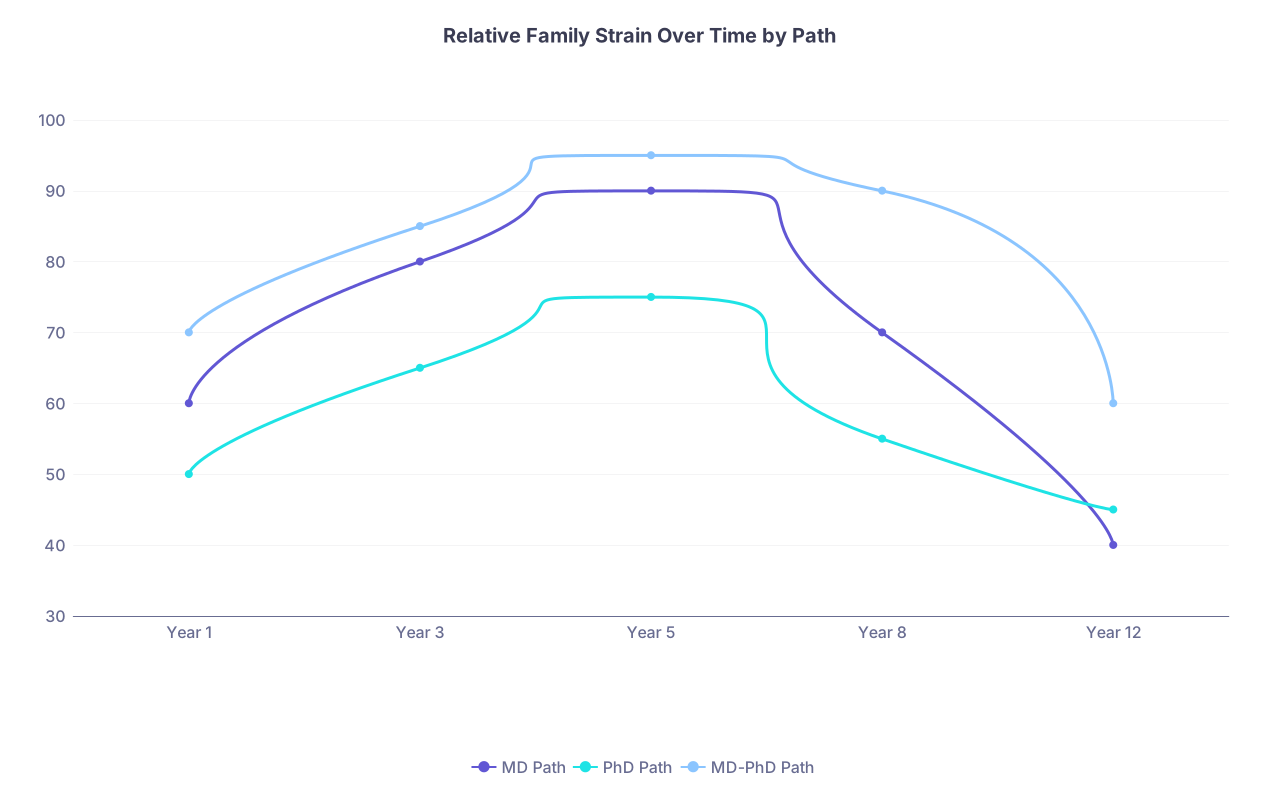
| Category | MD Path | PhD Path | MD-PhD Path |
|---|---|---|---|
| Year 1 | 60 | 50 | 70 |
| Year 3 | 80 | 65 | 85 |
| Year 5 | 90 | 75 | 95 |
| Year 8 | 70 | 55 | 90 |
| Year 12 | 40 | 45 | 60 |
(Scale is rough: 0 = minimal strain, 100 = peak chaos. Point is: MD and MD-PhD concentrate intense strain into specific years. PhD tends to spread moderate strain over a longer period.)
Step 9: Concrete next moves
If you’re still reading, you’re not casually curious. You’re genuinely on the fence.
Here’s what to do this month:
Talk to three people:
- A parent in med school or residency
- A parent doing or done with a PhD
- Your partner (or closest support person) in a no-BS, “What are we actually willing to live through?” conversation
Map your timeline
Take your current age, add the realistic training years for each path, and write down:- How old you’ll be
- How old your kids will be
- How much you’ll roughly be earning at that point
Run a basic budget
Look up:- Average med school tuition vs PhD stipend in the city you’d likely be in
- Childcare costs where you live
See which paths actually fit on paper.
Do a gut check on “patient vs problem”
Do you get more energy thinking about:- Sitting with a scared parent in a clinic room? (MD tilt)
- Designing an experiment or model to answer a question? (PhD tilt)
Don’t force yourself into the wrong universe and hope you grow to like it.

FAQ (exactly 5 questions)
1. Is it unrealistic to start an MD or PhD in my late 30s with kids?
Not automatically. Plenty of people do it. The key is being brutally honest about timeline and energy. Late 30s means you’ll be in intense stages of training while your kids are in school and early teens. For some families, that’s acceptable with strong support and clear expectations. For others, it leads to resentment. If your partner or main support is already stretched thin, I’d be more cautious.
2. Which is better for parenting: MD or PhD?
There’s no universal winner. PhD training typically has more schedule flexibility and less overnight chaos, but lower and longer-term uncertain income. MD has a rougher schedule during school and residency but better long-term financial security and benefits. If you prize flexible daily time and can tolerate modest income, PhD wins. If you prioritize long-term earning power and are willing to suffer in the short term, MD can make more sense.
3. Should I avoid MD-PhD entirely as a parent?
Not automatically, but the bar is very high. You should only choose MD-PhD if:
- You’re genuinely passionate about research (not just “it seems more impressive”)
- Your family has strong financial stability and support
- You accept that you’ll delay stable, higher income and complete training until well into your 40s
For most parents—especially older or single parents—MD-PhD is more burden than benefit.
4. Will admissions committees judge me for being a parent or older applicant?
Legally and ethically, they shouldn’t, and many programs actually appreciate the maturity and perspective older parents bring. But practically, some schools are more welcoming than others. Your job is to present your parenthood as a strength: evidence of resilience, time management, empathy. Also, quietly prioritize schools and programs in locations where you can realistically raise your kids, regardless of how “prestigious” they are.
5. What if I start one path (MD or PhD) and realize it doesn’t work for my family?
Then you treat it like triage: stabilize, reassess, adjust. People do leave MD programs, switch specialties, or step off the academic track after a PhD. It’s not ideal, but it’s survivable. What you shouldn’t do is grind your family into dust out of sunk-cost guilt. If you’re starting now, build in mental permission to pivot if reality turns out much harsher than the brochure version.
Open your calendar app and skip ahead 10 years. Write in the boxes: your age, each kid’s age, and your best guess of what you’d be doing under MD, PhD, MD-PhD, and “neither.” Look at those four futures side by side. One of them will feel less like fantasy and more like a life you and your family could actually live. Start drafting your plan around that one today.