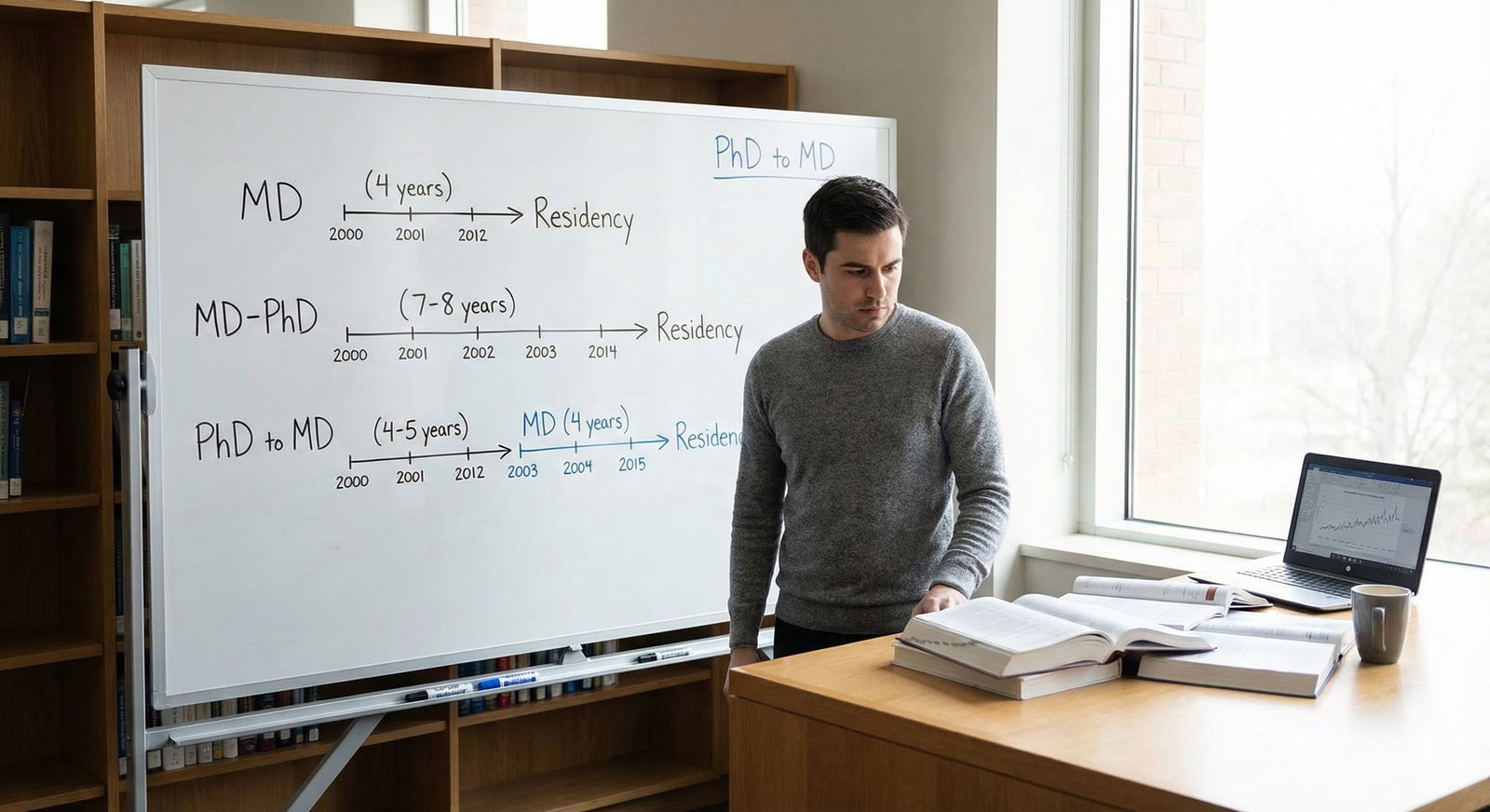
The fantasy that your MD and their PhD will magically “line up” is a lie. If you want this to work, you’re going to have to treat your relationship like a joint project with real constraints, tradeoffs, and deadlines.
You’re not just “in school at the same time.” You’re trying to sync two of the most chaotic, unpredictable training paths in higher education. If you wing it, you’ll end up with mismatched graduations, long-distance years you didn’t see coming, and delayed life plans. If you plan it, you can actually turn this into an advantage.
Let’s walk through how to coordinate an MD + PhD-partner timeline like adults who understand what’s coming—not like two people just “seeing how it goes.”
1. Get Real About Both Timelines (No, They’re Not the Same)
Before you make any promises about “finishing together” or “moving after training,” you both need a clear picture of the basic structures.
Typical MD timeline (US, standard 4-year program)
Years vary a bit by school, but roughly:
| Year | Main Focus |
|---|---|
| M1 | Pre-clinical, basic sciences |
| M2 | Pre-clinical + Step/Level exam |
| M3 | Core clinical clerkships |
| M4 | Sub-Is, electives, residency apps |
Then: 3–7+ years of residency, possibly followed by fellowship.
Typical PhD timeline (STEM-ish fields in the US)
This is where it gets messy. A “5-year PhD” is mostly a myth. More realistic ranges:
| Field Type | Common Range (Years) |
|---|---|
| Life sciences | 5–7 |
| Engineering | 5–6 |
| Social sciences | 5–7 |
| Humanities | 6–8 |
Rough phases for a PhD:
- Year 1–2: Coursework, preliminary exams
- Year 2–3: Qualifying exam, dissertation proposal
- Year 3–6+: Research, publications, dissertation writing, defense
And unlike an MD, a PhD doesn’t have a hard graduation date dictated by a Match. It’s “done when it’s done” — which can slip by 6–18 months frighteningly fast.
Here’s the first non-negotiable step: you two need a joint, brutally honest timeline on paper.
Not vibes. Not “I think I’ll be done in 5 years.”
On paper.
2. Build a Shared Master Timeline (Yes, Like a Project Plan)
You and your partner are essentially running a multi-year, two-person program with moving parts: exams, rotations, conferences, defenses, interviews, moves. Treat it that way.
Sit down with:
- Their current PhD year and program expectations
- Your med school start date and curriculum structure
- Rough desired life milestones (marriage, kids, buying a place, major moves)
Then map 7–10 years, not just 4. Because residency is going to hit like a truck if you pretend it does not exist.
Use this as a rough structure:
Year 0:
- You: Preparing to start MD
- Partner: What PhD year are they? Where exactly in their program (courses, quals, ABD, data collection, writing)?
Years 1–4:
- You: M1–M4
- Partner: Track yearly goals (pass quals, finish data collection, submit paper, defend)
Years 5–10:
- You: Residency range (3–7+ years depending on specialty)
- Partner: Potential postdoc, job hunt, or already working
Plot critical points for each of you:
For you (MD):
- Step/Level exams (or equivalent) and heavy study blocks
- Core clerkship year
- Residency application year
- Match Day
- Likely intern year (worst schedule)
For them (PhD):
- Coursework end
- Qualifying exam
- Proposal date estimate
- Data collection window
- Drafting the dissertation
- Target defense window
- Job or postdoc search cycle
Now look for obvious collision zones:
- Your Step 1 / Level 1 study window vs their qualifying exams
- Your M3 vs their heaviest research push
- Your residency interview season vs their job/postdoc interview season
- Your Match move vs their dissertation writing/final experiments
Those intersections are where stress will spike. You need a plan for those specific months, not just “we’ll support each other.”
Here’s what this often looks like if you’re starting MD while they’re mid-PhD:
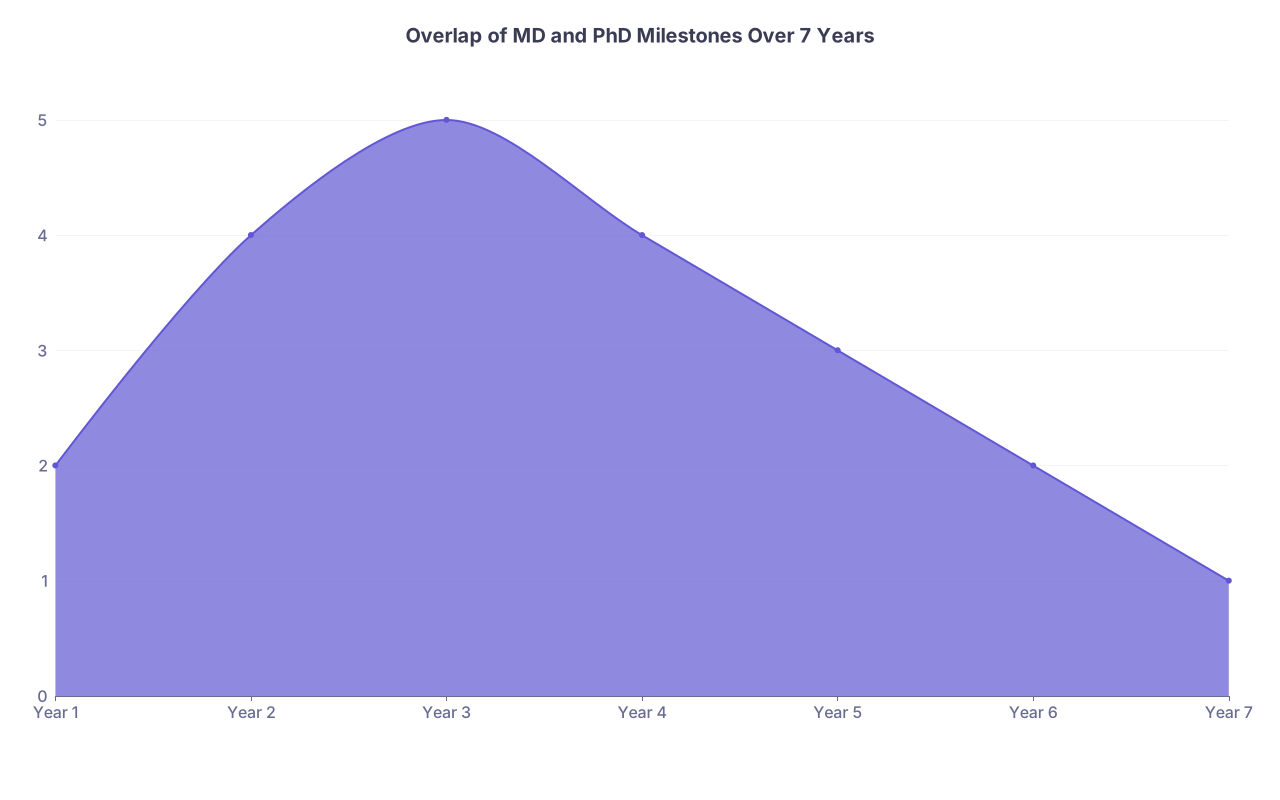
| Category | Value |
|---|---|
| Year 1 | 2 |
| Year 2 | 4 |
| Year 3 | 5 |
| Year 4 | 4 |
| Year 5 | 3 |
| Year 6 | 2 |
| Year 7 | 1 |
(The higher the value, the more overlapping “big stuff” is happening.)
3. Scenario Check: Where Is Your Partner in Their PhD Right Now?
Your strategy changes a lot depending on where they are when you start MD.
A. They’re starting PhD as you start MD
This is the longest grind. You’re probably together in one city for school, but your timelines almost definitely will not end together.
What to do:
- Accept that they’ll probably still be in PhD when you start residency.
- Build in the idea that you may do at least 1–2 years of long-distance.
- Encourage them to avoid extensive side commitments (extra TA-ing for money, unnecessary committees) in the mid-years so they can actually finish.
Key conversation:
“If my residency takes us to another city in 4 years, what’s your realistic best-case for being defend-ready?”
If their program average is 6.5 years, they’re not finishing in 4. Do not pretend they will because “I’ll work extra hard.”
B. They’re mid-PhD (ABD or close) as you start MD
This is actually one of the better setups.
They might be:
- Done with major coursework
- Past quals
- Deep in data analysis and writing
Here, you coordinate around:
- Their target defense window vs your M3 and M4
- Whether they can front-load writing while you’re still in pre-clinicals
- Whether it’s possible they finish and job-hunt before your Match
I’ve seen couples do this smartly:
Years 1–2 MD: you’re deep in classes, they hammer the dissertation.
Year 3: they defend and start postdoc/job in same city (if possible).
Year 4: you apply to residency, and now both of you are semi-mobile.
C. They’re finishing PhD / on the job market as you start MD
This can be surprisingly tough.
You’re locked for 4 years to your med school city (usually).
They’re suddenly flexible and employers may not be.
Tension points:
- Their best job offer may be in a completely different city.
- They may feel “stuck” trying to find something local and resenting it.
- You may feel guilty but immovable (because you are).
Strategy here:
- Be brutally honest: “I cannot relocate for 4 years. Are we okay with you doing a postdoc / job search restricted to this metro, or are we open to doing long-distance for a while?”
- Look seriously at remote/hybrid options in their field.
- Consider whether they can do a 1–2 year local position then re-enter the national market closer to your residency Match.
4. Decide If You’re Planning as “Same City” or “Same Time Zone”
You need to pick your primary constraint: are you optimizing for staying in the same city, or for syncing major transitions (e.g., both finishing within a year or two)?
You almost never get both.
If “same city” is the priority
Your PhD partner should:
- Strongly consider aligning dissertation writing to finish about 0–2 years before your MD graduation.
- Begin networking early with local institutions, companies, or labs.
- Be realistic: local academic jobs may be limited; industry may offer better options.
You should:
- If your school has affiliated residencies, factor that in. Staying for residency could dramatically reduce total moves and distance.
- Think carefully before applying to super-competitive, geographically tight specialties if couples match or same-city is a core goal.
If timeline alignment is the priority (graduating “together-ish”)
Your partner might:
- Accelerate experiments earlier (if they’re still in coursework phase, they likely cannot).
- Drop extra side projects that slow graduation but look nice on a CV.
- Negotiate with their PI about a feasible, bounded project that can graduate in X years.
You might:
- Be more flexible in residency geography.
- Consider specialties that have slightly broader geographic spread of programs if you want to couples match to the same area eventually.
Either way—write this down as an explicit statement:
“We are optimizing for _______ first, and accepting tradeoffs in _______.”
If you can’t fill those blanks together, you’re not aligned yet.
5. Money, Visas, and Logistics: The Boring Stuff That Breaks People
You cannot coordinate timelines if you ignore finances and, if applicable, immigration.
Income flow reality
Common pattern:
Years 1–2:
- You: No income, maybe loans.
- Them: Stipend (PhD), usually barely livable.
Years 3–4:
- You: Still no real income.
- Them: Same stipend, maybe extra from TA/RA work, maybe a bit more senior.
Post-Year 4:
- You: Resident paycheck (modest but real).
- Them: Either postdoc (similar or slightly higher than PhD), or real job.
What this means:
- Early on, they’re likely the only one with “income,” weak as it is. That can create a power imbalance if you’re not careful.
- You need a shared plan for debt (especially your medical loans).
- Big purchases (car, wedding, moving, kids) need to be timed around when either of you has real cash flow and/or loan disbursements.
Use a simple table when you plan:
| Stage | You (MD) | Partner (PhD) |
|---|---|---|
| MD M1–M4 | $0 (loans) | $25–40k stipend |
| Early Residency | $60–70k | $30–60k (postdoc or job) |
| Late Residency/Fellow | $65–80k | Varies widely |
You don’t need exact numbers. You do need to know when both of you are broke vs when at least one of you can float the other.
Visa issues (if either of you is international)
If one of you is on F-1, J-1, or similar, that trumps some of your other preferences.
You’ll have to think about:
- Can the PhD partner extend their stay if your MD/residency keeps you in the US longer?
- Will their OPT or J-1 timeline force them to move or change status right as you hit a critical MD or residency phase?
- Are there specific cities or institutions where both of you can realistically get visas / sponsorship?
Don’t do this casually. Sit with an international student advisor or immigration lawyer early. Not in the panic phase.
6. Handling the High-Stress Peaks Without Imploding
There will be months where both of you are underwater. Step/Level studying + their qual exam. Your residency apps + their job search. You can’t fully avoid overlap, but you can:
- Designate whose “crunch” takes priority when they coincide.
- Pre-plan what support actually looks like during those months.
For example:
You’re in dedicated Step 1 study.
They’re writing a grant.
You might agree:
- You don’t commit to major social obligations together that month.
- They handle 70–80% of chores and logistics.
- You promise not to pick fights about long-term plans during those weeks.
Reverse it for their defense month: you pick up more slack, you protect their writing time, you stop suggesting “just one more experiment” as if you’re their PI.
This sounds obvious. It is not in practice. People fight the most during predictable stress windows they never planned for.
7. Planning for the Residency + Post-PhD Phase (The Real Fork in the Road)
The actual crunch coordination is not MD-year-1 vs PhD-year-1. It’s your residency vs their post-PhD life.
Let’s break the main possibilities.
Option 1: They finish PhD before you apply to residency
Best case.
Then you two can:
- Decide together which geographic regions make sense for your residency apps and their job/postdoc search.
- Potentially coordinate a dual search (you applying via ERAS, them via job boards and PI networks) in 1–3 urban regions.
- Consider couples matching if they’re going into a residency-required field too (dual MDs) — though that’s another can of worms.
You’ll want to:
- Start these discussions 12–18 months before you submit your ERAS (or equivalent).
- Rank specialties and regions not only by competitiveness but also by where they have strong industry/academic ecosystems.
Option 2: They’re mid-to-late PhD when you hit Match
Trickier.
Common outcomes:
- You match somewhere else. They stay to finish PhD. You do 1–3 years long-distance.
- You try to rank heavily in regions with multiple PhD programs / campuses and they attempt a transfer (not always possible, sometimes career-damaging).
- They try to accelerate their finish and defend just before or during your intern year. Risky but sometimes doable.
If you go long-distance, make it structured:
- Plan visits around call schedules, not fantasy weekends.
- Budget travel money as a specific line item, not “we’ll figure it out.”
- Decide how many years you’re actually willing to do this before one of you flexes harder.
Option 3: They’re on the job/postdoc market when you match
Now you’re in dual-career hell like every two-physician or physician + scientist couple.
You approach this as:
- Identify top 2–3 metro areas with both strong residency options for you and realistic job options for them.
- You rank those regions higher on your list, if it doesn’t completely destroy your specialty goals.
- They apply aggressively in those same regions but also hold a backup plan: a slightly-less-ideal job in your city vs a dream job elsewhere.
You will both sacrifice something. That’s the reality. Name it openly.
8. Communication Rules That Keep This from Blowing Up
If you’ve read this far, you already care more than most couples in this situation. Good. Now protect that by setting a few rules.
I’ve seen the same three communication failures wreck MD–PhD-partner couples:
- Vague reassurance instead of real planning (“we’ll figure it out” instead of dates and scenarios).
- Weaponizing sacrifice (“I stayed in this city for you”).
- Avoiding the hard conversation about whose career gets priority when.
Do this instead:
Schedule 2–3 “state of the timeline” talks per year.
- Literally block time: 60–90 minutes, not at midnight, not post-call.
- Bring updated info: how their project is going, what you’re hearing about match prospects, advisor feedback, etc.
In those talks, answer specific questions:
- “If we had to move next year, where could you reasonably go?”
- “If your defense slipped by one year, what would that break?”
- “If I don’t match in X city, are we okay doing distance for Y years?”
Say the quiet part out loud:
- “I’m scared I’ll resent staying here for your PhD.”
- “I’m scared I’ll resent turning down a dream postdoc to follow your residency.”
Those are fixable when spoken early. They rot everything when hidden.
9. What To Do This Month If You’re About to Start MD and They’re in a PhD
Let me make this painfully practical for you.
In the next 30 days:
Sit down with your partner and a 7–10 year calendar.
Mark:- Your MD years
- Their current PhD year
- Estimated defense window
- Your residency years range
- Their likely postdoc/job search window
Ask them to get real estimates from their PI or program director.
Not “how long do people usually take?” but:- “Given my current project, what’s a realistic range for finishing?”
- “What milestones do you need from me in the next 12–18 months to stay on track?”
Talk with your med school academic advisor.
Ask:- “How flexible is the third-year schedule?”
- “Can I rank clinical sites or blocks if I need to be in a specific location during a partner’s defense/job search?”
Define your primary relationship priority—same city or timeline sync.
Write it down together. One sentence. Put it somewhere you both see.Pick the first two high-stress collision points and pre-plan them.
Example:- Collision 1: Your Step exam vs their quals.
- Collision 2: Your residency apps vs their thesis writing.
Decide:
- Whose schedule gets protected more in each case.
- Who handles more life tasks during those months.
Do not wait to “see how it goes.” That’s how people wake up in year 3 with silent resentment and no plan.
Open your calendar app (or a literal paper planner) today and block 90 minutes with your partner labeled: “MD + PhD Timeline Summit.” Bring your program handbooks, their grad handbook, and a willingness to be uncomfortably honest. That one meeting will do more for your future than another hour of passive worry.