
It’s late afternoon and you’re sitting in a “joint appointment” faculty meeting. On paper, everyone’s on equal footing: MDs, PhDs, MD-PhDs, all “collaborative,” all “interdisciplinary.” But you can feel it. The subtle hierarchy in who talks, whose opinion lands, who gets their way on hiring, space, and money. The official org chart says one thing; the actual power structure says something very different.
Let me tell you what really happens when MDs and PhDs are tied together through joint appointments in medical schools and academic health centers. Because this is one of those things nobody explains to trainees, yet it shapes your career more than any single exam score.
The Real Power Map Behind “Joint” Appointments
The public story is simple: joint appointments foster collaboration between basic science and clinical departments, break down silos, and help translate bench to bedside.
The real story is: joint appointments are political instruments. They move money, prestige, and leverage between departments. And the MD vs PhD gap sits right in the center.
Here’s the thing everyone in leadership knows but rarely says out loud: clinical departments bring in the bulk of revenue (billing, procedures, hospital contracts), while basic science departments bring in a lot of indirects (grant overhead) and scholarly prestige. Joint appointments are the plumbing that connects these two cash and prestige streams. And plumbing means control: who manages effort, who claims indirects, who “owns” you.
You as a trainee only see the title line under someone’s name: “Associate Professor of Medicine and Biochemistry.” What you do not see is how the Dean’s office, the Chair of Medicine, and the Chair of Biochemistry have fought over that FTE split.
Every joint appointment has three hidden numbers:
- Percent FTE in each department (on paper).
- Who controls your salary lines (not always same as FTE).
- Who controls your space and admin support.
You can survive a bad FTE split. You cannot survive if the wrong chair owns your salary or space.

MD vs PhD: Who Actually Wins in Joint Appointments?
Here’s the unvarnished reality in most US academic medical centers:
- MDs with joint appointments generally sit on top of the local power hierarchy.
- PhDs with joint appointments are often used as currency between departments.
- MD-PhDs are the swing votes and bargaining chips.
Not because MDs are smarter. Because they’re attached to revenue streams that deans and hospitals depend on. Clinical RVUs and hospital partnerships beat R01s in most dean’s offices when push comes to shove. Even when they won’t admit it.
So what does that mean on the ground?
For MDs with joint appointments
If you’re an MD in, say, Cardiology with a joint appointment in Physiology, your primary home is almost always the clinical department. Your chair of Cardiology:
- Controls your base salary.
- Controls your clinic and procedural assignments.
- Can kill your research “protected time” in one budget meeting.
The Physiology chair? They get to list your name on their website and maybe claim you as “collaborative faculty.” If you bring in grants, they will suddenly become very friendly and want a bigger FTE slice. But if there’s a fight, the dean nearly always sides with the clinical chair maintaining patient care capacity.
For PhDs with joint appointments
Now flip it. You’re a PhD neuroscientist with a primary appointment in a basic science department and a secondary appointment in Neurology.
You might think: “Great, I’m tied to a powerful clinical department, more resources, more collaboration.”
What actually happens at many places:
- You get trotted out whenever the clinical department needs “basic science” credibility for a grant, T32, or departmental review.
- You do a lot of teaching for clinicians-in-training (residents, fellows) that doesn’t fully “count” in your basic science department’s promotion matrix.
- When budgets get tight, the clinical chair reminds everyone, “They’re not clinical. Their salary is not our problem.”
You’re useful but not essential to the clinical side. That distinction shows up when there’s a space crunch or a salary shortfall.
For MD-PhDs
MD-PhDs with joint appointments live in a weird liminal space. Chairs love to recruit you because you look phenomenal in external reviews and grant applications. “Physician-scientist,” “bridge between bench and bedside,” the whole script.
Behind closed doors:
- Clinical chairs get irritated you “don’t generate enough RVUs.”
- Basic science chairs get irritated your clinical time makes your grant output variable.
- Each chair tries to get the benefits (prestige, grant overhead) while offloading the costs (salary, startup, protected time) to the other.
I’ve watched MD-PhDs get slowly squeezed as both sides say, “We support you 100%—but we just can’t pay for that 30% research time right now.” That 30% disappears one year at a time.
The Money Flows: Follow the Indirects, Follow the RVUs
If you really want to understand the politics, follow the money. Joint appointments exist to negotiate who gets what.
Let me decode the usual fights.
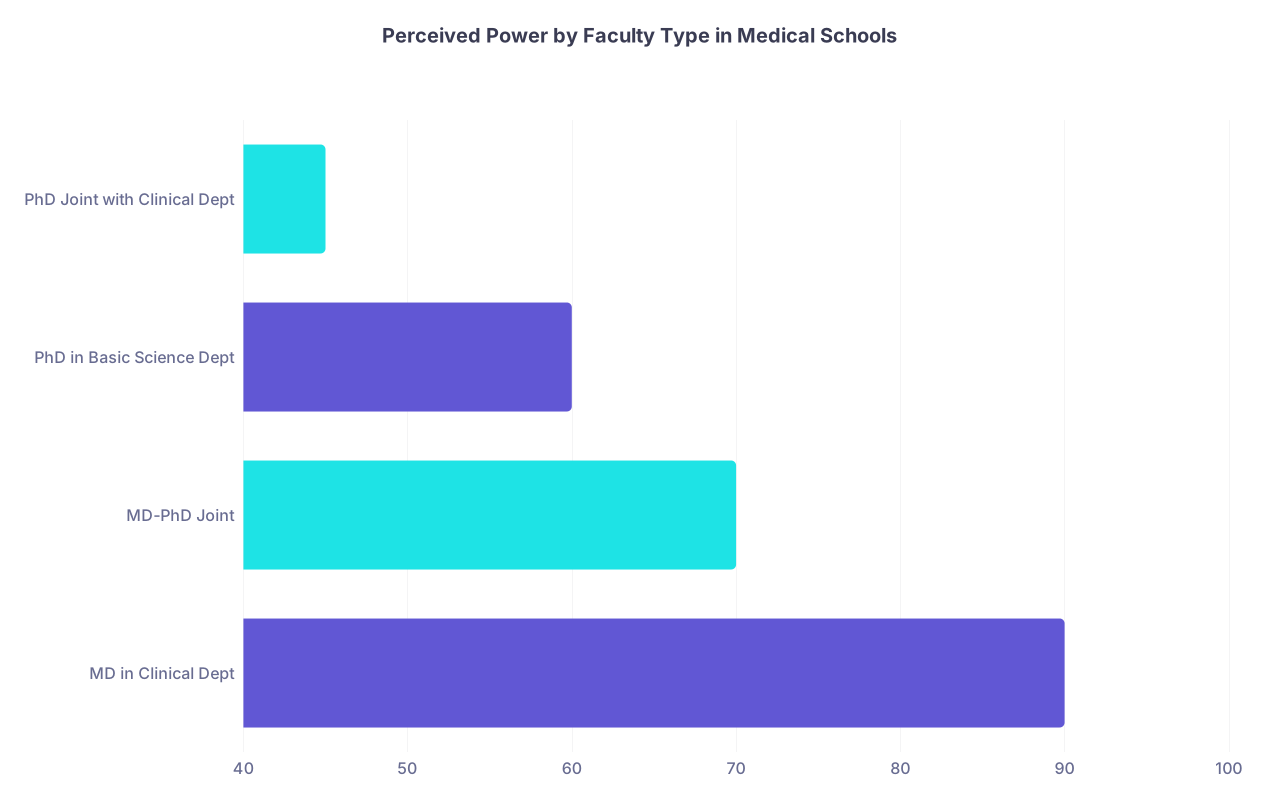
| Category | Value |
|---|---|
| MD in Clinical Dept | 90 |
| MD-PhD Joint | 70 |
| PhD in Basic Science Dept | 60 |
| PhD Joint with Clinical Dept | 45 |
These numbers aren’t from some published paper. They’re a good approximation of how committees actually behave. Perceived power, not official titles, drives decisions.
Indirect costs (overhead)
When you bring in a big R01 or U-series grant, NIH pays indirects. The medical school and hospital take their cut. The leftovers get split based on:
- Your primary department.
- Negotiated formulas between departments.
- How good your chair is at “protecting” their share.
If your primary appointment is in Medicine with a secondary in Immunology, and your grant is mostly basic science, expect Immunology to complain if they’re not getting enough overhead. That complaint turns into:
- “We should move more of your FTE into Immunology.”
- “Your lab should technically be assigned to Immunology.”
- “Future grants should list Immunology as the primary department.”
Those conversations sound “collaborative” until you realize you’re being relocated on paper and physically, and your clinical effort expectations somehow haven’t dropped.
Clinical RVUs
If you’re an MD (or MD-PhD) with a joint appointment, your RVU generation is bargaining power.
High RVU producers can push back when a clinical chair tries to cut their research time allocated to the joint basic science appointment. Low RVU producers with “too much” basic research time are vulnerable. I’ve literally heard a vice chair of clinical affairs say in a meeting:
“If he wants to be a scientist, he should be paid like a scientist. We’re not going to subsidize a lab with patient care revenue.”
Translation: move his salary burden to the basic science department or cut his protected time. “Joint appointment” or not.
Salary sources
Here’s where most trainees are totally in the dark. Your salary may be coming from:
- Clinical revenue (clinical department).
- Institutional funds (Dean’s office).
- Grant salary (basic or clinical department).
- Endowed chair or philanthropic funds.
Whoever pays the majority of your salary dictates your priorities, regardless of your fancy dual titles. Chairs privately count “how many lines” they’re covering for you. Once that number feels too big, the pressure campaign begins.
| Scenario | Who Really Controls You |
|---|---|
| MD, 0.7 FTE Medicine / 0.3 FTE Physiology | Medicine chair (via clinical salary) |
| PhD, 1.0 FTE Physiology, joint with Cardiology | Physiology chair (unless Cardiology funds salary) |
| MD-PhD, 0.5 FTE Neurology / 0.5 FTE Neuroscience | Whichever chair pays more salary + owns lab space |
| PhD, 0.6 FTE Cancer Biology / 0.4 FTE Medicine | Cancer Biology, unless major clinical salary support |
| MD, 0.5 FTE Pediatrics / 0.5 FTE Microbiology | Pediatrics unless protected time is externally funded |
How This Plays Out in Promotions, Space, and “Protected Time”
Joint appointments sound glamorous on paper. In practice, they complicate three things that decide your career: promotion, space, and time.
Promotion: two masters, one dossier
On paper, joint appointments give you “broader evaluation.” In reality, they expose you to misaligned expectations.
Typical scenario for an MD-PhD with joint appointment:
- Clinical department expects: clinical excellence, teaching residents, some scholarship, decent RVUs.
- Basic science department expects: consistent R01-level funding, first/last-author publications, thesis mentoring.
Promotion committee reads both letters: “This candidate is strong, but could be more productive in research,” and “This candidate is strong, but RVU generation is below departmental mean.” Congratulations: you’re a “but” candidate.
PhDs with joint clinical appointments get tagged as “service heavy.” You do a mountain of teaching and committee work for the clinical side, while your basic science metrics (grants, high-impact papers) lag. Your CV looks busy but not “high impact” enough on the science side, and not “mission critical” enough on the clinical side.
Space: labs, offices, and who can move you
Space is political capital. Especially wet lab space. The department that “owns” your space owns more of you than any title suggests.
I’ve watched this exact play multiple times:
- PhD has lab space designated under the basic science department.
- Clinical department wants to claim more of their FTE and overhead from grants.
- Basic science chair resists: “We’re not losing this lab to Medicine.”
- Dean mediates: “We’ll keep the space assigned to basic science, but list the PI as joint.”
Outcome: your badge says both departments. Your lab assignment shows you exactly who you must please if there’s a conflict.
If your space and your salary are in different departments, you are in a fragile position. One chair can say, “We can’t keep paying this salary for a lab in another department.” The other can say, “We can’t host a lab for someone whose primary commitment is elsewhere.” You become the problem to solve.
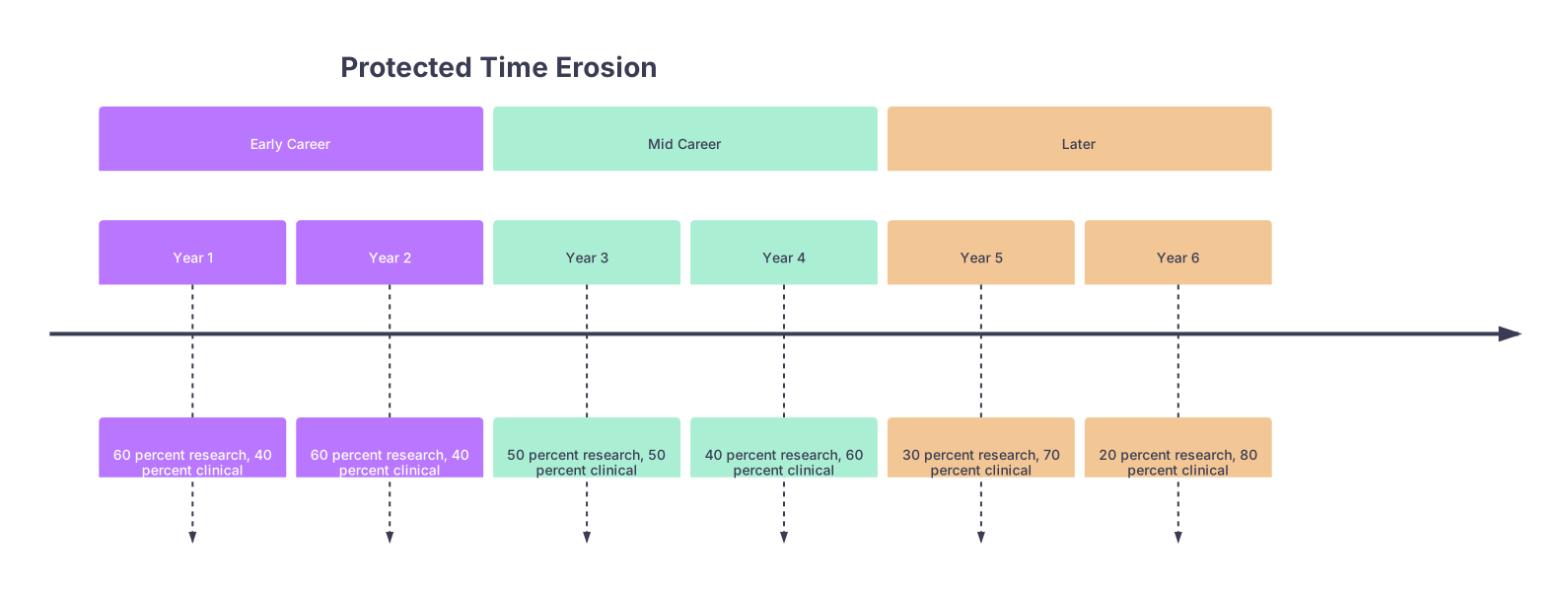
Protected time: the slow erosion
Protected time for research is the first thing joint-appointed MDs and MD-PhDs lose when clinical volumes surge.
The script is always the same:
Year 1–2: “You’re 60% research, 40% clinical. We’re committed to your development.”
Year 3–4: “We just need you to help cover clinics during this transition. It’s temporary.”
Year 5: “The budget is tight. Everyone is increasing clinical effort. We still value your research.”
Year 6: “We’d love to protect your time, but without external funding, we just can’t justify 50% research.”
Meanwhile the basic science side says, “We can’t evaluate you as a scientist at 20% effort.”
It doesn’t matter how joint your appointment is. When the hospital CEO calls the dean about clinical access, the dean leans on the clinical chairs. The clinical chairs lean on you.
| Period | Event |
|---|---|
| Early Career - Year 1 | 60 percent research, 40 percent clinical |
| Early Career - Year 2 | 60 percent research, 40 percent clinical |
| Mid Career - Year 3 | 50 percent research, 50 percent clinical |
| Mid Career - Year 4 | 40 percent research, 60 percent clinical |
| Later - Year 5 | 30 percent research, 70 percent clinical |
| Later - Year 6 | 20 percent research, 80 percent clinical |
MD vs PhD Culture Clashes in Joint Departments
Politics aren’t just about money. They’re about culture. MDs and PhDs are trained in different value systems, and joint appointments shove those systems together.
Time scale
PhDs think in grant cycles and multi-year projects. MDs live in daily clinic schedules, call rotations, and service weeks.
When you’re jointly appointed, the PhD side expects long, sustained, uninterrupted blocks of research time. The MD side expects flexibility to absorb clinical needs.
Guess who usually wins that tug-of-war.
What “productivity” means
For PhDs: grants, publications, trainees.
For MDs: RVUs, clinical outcomes, referral bases.
For MD-PhDs in joint roles, the bar quietly becomes “high” on both axes. I’ve seen vice chairs literally say, “We need you to be clinically solid and academically outstanding. That’s the job.” No adjustment. No recognition that they’re asking you to do 1.5 jobs under the banner of “integration.”
PhDs joint with clinical departments run into another issue: the clinical side doesn’t fully value certain basic science accomplishments (like deeply technical methods papers), and the basic side doesn’t fully value certain “clinical service” teaching activities. So your strongest work never lands with both.
Who gets listened to on committees
Walk into a joint committee on curriculum, promotion, or program leadership. Count how many pure PhDs vs MDs vs MD-PhDs are in the final decision-making group. Not the membership list. The actual core that meets with the dean.
If you’re a PhD with a joint appointment, you’re often labeled “supporting faculty.” You can give your input; the MD-heavy executive leadership decides the outcome.
Exception: when the topic is hardcore basic science or grant infrastructure, suddenly you’re central. But when decisions cross money/space/clinical access, MD leadership dominates. Every time.
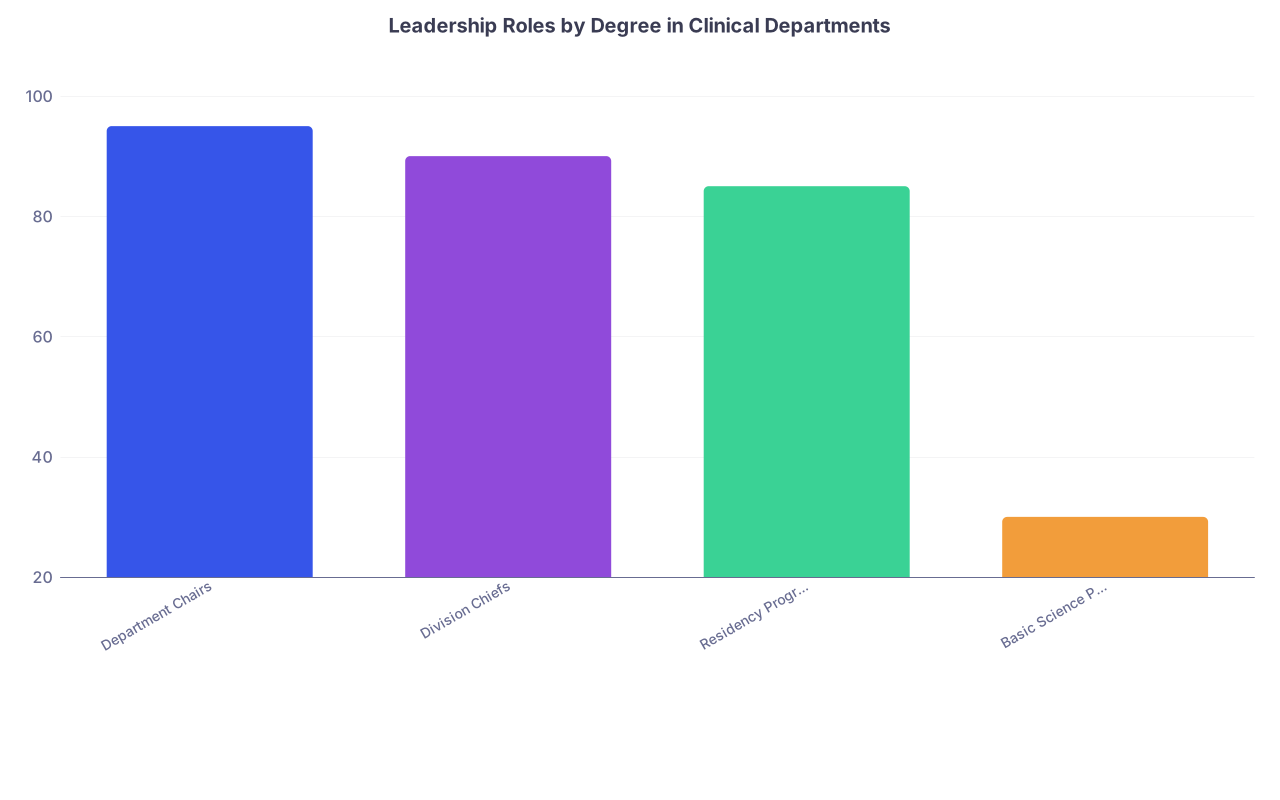
| Category | Value |
|---|---|
| Department Chairs | 95 |
| Division Chiefs | 90 |
| Residency Program Directors | 85 |
| Basic Science Program Directors | 30 |
Those are approximate percentages of roles held by MD/MD-PhDs vs pure PhDs in most medical schools. Again, not what the website sells. What actually happens.
How Trainees Get Caught in the Crossfire
Now let’s bring this back to you—MD student, PhD student, MD-PhD, resident, fellow, junior faculty. Because you’re not a neutral observer in this drama. You’re a resource.
For MD students and residents
You see joint-appointed faculty as “research-friendly clinicians” or “clinically-connected scientists.” Fair. But you miss the power dynamics that affect your opportunities.
What this means for you:
- If your mentor is MD/MD-PhD heavily clinical-FTE, their “protected time” for you can disappear overnight when the department ups clinical expectations.
- If your PhD mentor has a token joint appointment with a clinical department, they may not actually be able to protect a slot for you on a clinical fellowship, translational project, or T32, no matter how nice they are.
- Letters of recommendation from faculty in politically weak positions carry less weight than you think. Chairs and program directors know exactly who’s powerful internally.
For PhD students
If you’re housed in a basic science department but doing translational work in a clinical joint lab, ask a blunt question early: who owns the space and who owns my PI’s salary? That tells you whether your lab might be at risk in the next budget crisis or chair turnover.
Don’t be shocked when:
- Your committee pressures you for “more mechanistic” work while the clinical side is pushing for “more translational” output.
- Your PI is being pulled to teach or sit on clinical committees, slowing your project.
For MD-PhD trainees
You’re sold a story that the system is built for you. It’s not. It’s built for clinical revenue and then retrofitted to say nice things about science.
You need to ask hard questions before you commit to mentors and departments:
- Who controls their FTE and salary?
- Has their research time been stable over the last 5 years?
- Did they lose or gain space after their last grant cycle ended?
- Are they being groomed as leadership or being quietly sidelined?
This is the stuff that predicts whether you’ll actually have a functioning lab to inherit, not the number of awards on their wall.
How to Read Between the Lines When You’re Choosing Departments/Mentors
You can’t change the politics. But you can stop being blindsided by them.
Here’s how seasoned insiders actually evaluate joint appointments when deciding where to train or work:
Look at departmental chairs, division chiefs, program directors. What degrees do they hold? If nearly all are MD or MD-PhD, you’ve got a clinically dominant culture. PhDs with joint appointments are supportive but not central.
Scan faculty profiles. How many PhDs with joint clinical titles are full professors? How many MD-PhDs actually still run serious labs past mid-career? If the answer is “very few,” believe the pattern, not the brochure.
Ask specific questions during interviews, not vague ones:
- “How is FTE split and who controls salary for joint-appointed faculty?”
- “Has anyone here successfully maintained 50% or more research time long-term in a joint appointment?”
- “Who owns your lab space administratively?”
Pay attention to whose name is on shared grants and T32s. If the clinical department piggybacks on basic science infrastructure whenever it’s convenient, but the basic science folks don’t show up on clinical grants, that’s an imbalanced relationship.
Watch who gets quietly blamed. If you hear things like, “Well, Dr. X just wasn’t productive enough in research” about an MD-PhD who used to be a rising star, ask yourself what that really means. Often it’s code for: clinical demands quietly ate their research life and leadership didn’t protect them.
FAQ (5 Questions)
1. Is a joint appointment always a bad sign for an MD or PhD?
No. At some institutions, joint appointments are genuinely supportive structures—especially where the dean explicitly funds protected time and enforces FTE agreements. But you should never assume that. The key is whether protected time, space, and salary have actually been stable for people in those roles over 5–10 years. If you see a graveyard of failed MD-PhDs and sidelined PhDs with clinical joints, that’s your answer.
2. As a PhD, should I avoid joint appointments with clinical departments?
Not automatically, but you should treat them as political, not just scientific, decisions. A joint appointment can give you access to patients, specimens, and teaching that strengthen your CV. It can also saddle you with a ton of service that basic science promotion committees don’t value. If the clinical side is not putting real money (salary lines, startup, space) behind the joint, be cautious. Nice title, no power.
3. How can I tell if an MD-PhD mentor with a joint appointment is actually safe to bet my career on?
Look past the branding. Check: Do they still have R01-level funding? Are they still publishing as last author regularly? Ask directly whether their research FTE has changed in the last 5 years. Ask current trainees how often clinical duties disrupt lab time. If you’re seeing constant clinic encroachment and “I’ll get to that next week” for months, that’s a bad sign.
4. Do program directors and selection committees care about whether a letter writer is MD, PhD, or joint-appointed?
They care about influence and reputation, not just degree. An influential PhD who’s deeply embedded in a program’s core faculty can carry more weight than a peripheral MD with a joint title. But in many clinical-heavy environments, letters from high-status MDs (division chiefs, program directors, department leaders) land faster. Joint appointments only matter if they signal true centrality, not if they’re just decorative.
5. If I want a balanced MD-PhD career, should I aim for joint appointments or avoid them?
You probably can’t avoid them; the system loves labeling you as a “bridge.” The smarter move is to negotiate and choose your primary home wisely. You want one department clearly responsible for protecting your research time and space, with any joint appointment structured to support, not dilute, that mission. If both sides claim you and neither side truly funds you, you’ll get squeezed. Pick a strong home, then let the joint title serve your goals—not theirs.
Key points:
Joint appointments are political tools, not just collaboration badges. MDs, PhDs, and MD-PhDs don’t experience them equally—power tracks salary, space, and revenue, not titles. If you learn to read who really controls those three things, you’ll stop being surprised by how careers rise or stall in “joint” environments.