
You are finishing your second year of medical school. Your class group chat is buzzing because one of your classmates just posted their first PubMed link—third author on a cardiology case series. Meanwhile, your roommate in the MD/PhD program is already talking about “first-author mechanistic paper” and “impact factor targets.”
Same institution. Same age. Completely different publication trajectories.
That is what we are going to dissect: how MDs and PhDs actually build publication portfolios over time, what “authorship success” looks like for each, and how those patterns collide and sometimes clash in modern academic medicine.
MD vs PhD: Two Different Publication Economies
Let me be very clear from the start: MDs and PhDs do not live in the same publication economy.
PhDs are trained to produce knowledge as their primary currency. MDs are trained to apply knowledge to patient care, with research as a secondary (or tertiary) lane unless they deliberately carve out a different path.
This difference shows up immediately if you look at typical outputs over a 10–15 year arc.
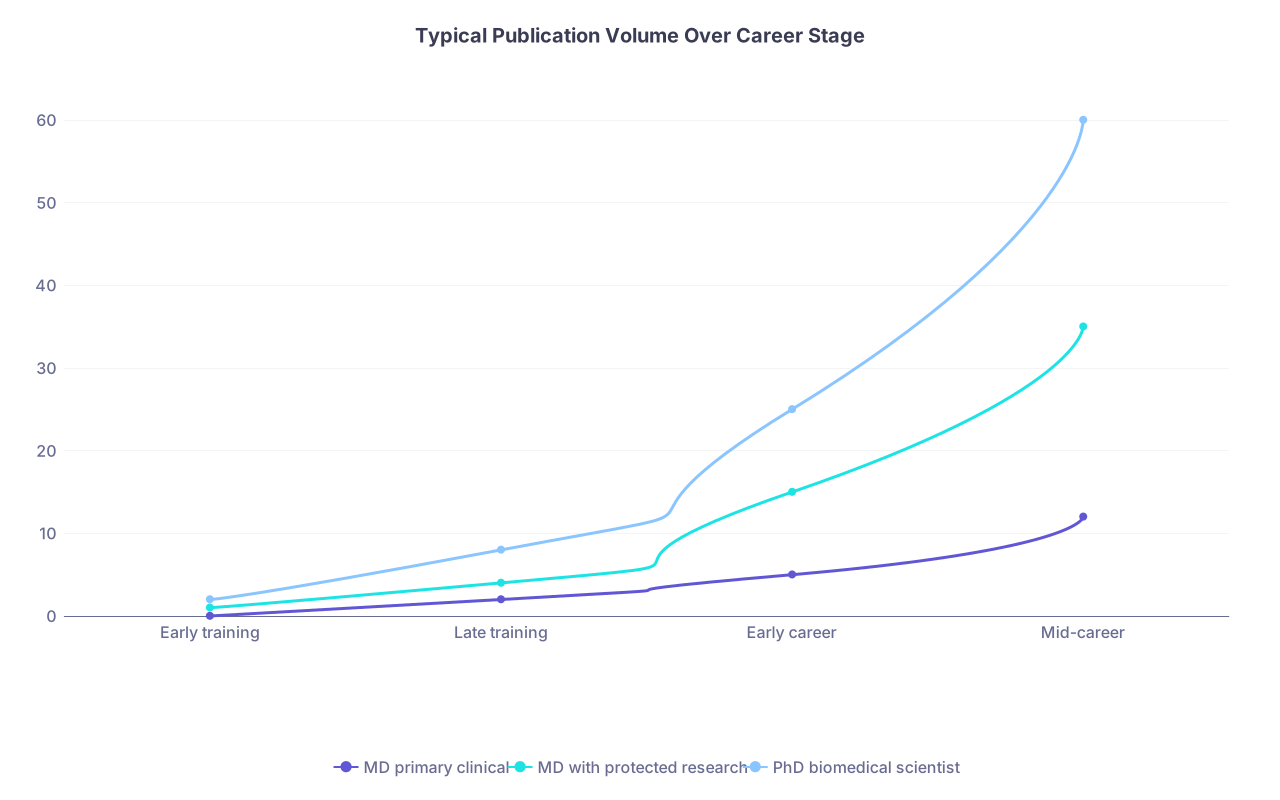
| Category | MD primary clinical | MD with protected research | PhD biomedical scientist |
|---|---|---|---|
| Early training | 0 | 1 | 2 |
| Late training | 2 | 4 | 8 |
| Early career | 5 | 15 | 25 |
| Mid-career | 12 | 35 | 60 |
Read those curves carefully:
- A typical MD who mostly cares about residency and then patient care might end up with low double-digit publications mid-career, often as middle or last author.
- The MD who deliberately chases protected time and grants can look quantitatively similar to a PhD by mid-career.
- The PhD is usually publishing consistently from late PhD through postdoc into faculty, often with a heavier concentration of first and senior (last) authorship.
You cannot compare raw publication counts between an intensivist doing 24 weeks of ICU service and a full-time basic science PI and think you are measuring the same thing. You are not.
Authorship Order: What It Actually Signals in Practice
People get this wrong constantly because they treat all author positions as vaguely similar “research experience.” That is lazy thinking. Authorship order is a code, and MDs and PhDs are trained to read it differently.

For MDs
Rough generalization, but accurate in most clinical departments:
First author:
Medical student, resident, or fellow who did most of the grunt work. Data collection, chart review, drafting, responding to comments. This is the “workhorse” position.Second author:
Often another trainee or collaborator who contributed substantially but not as heavily as first author. Sometimes the methods/statistics person.Middle author (3rd–penultimate):
Might range from serious collaborator to “you let us use your database” to “you saw these patients in clinic.” MD middle authorship quality varies wildly.Last author:
Attending/PI who conceived the project, secured resources, mentored the trainee, or runs the lab/clinical research unit. This is the senior mentor signal.
So for MDs, a residency program director glancing at a CV sees:
- 3–4 first-author clinical papers and a couple of case reports in med school → this person can start and carry projects to completion.
- 8 middle authorships with no clear leadership role → this person hung around projects, probably helpful, but may not drive research independently.
For PhDs
In PhD and postdoc world, the hierarchy is even more coded:
First author:
Primary driver. Conceived part of the project, designed experiments, performed the bulk of the work, wrote the draft. This is your central productivity index during training.Co–first author:
Sometimes genuine equal effort, sometimes political. Nonetheless, still counts heavily in a CV screen.Middle author:
Often a technical contributor, methods provider, or someone whose dataset or analysis was used. Could be very meaningful in collaborative projects, or almost trivial.Last author:
Grants, lab leadership, conceptual framework, overall direction. For faculty evaluation, last-author papers often matter more than being first author, especially after promotion to associate professor.
Here is how that difference looks if you put it in a simple comparison:
| Authorship Position | MD (Clinical Departments) | PhD (Basic/Translational Science) |
|---|---|---|
| First author | Trainee did most clinical/data work, main writer | Trainee led project, designed and executed |
| Middle author | Variable contribution, often collaborative | Methods, partial data, less central |
| Last author | Attending/PI, mentor, lab or project lead | PI, grant holder, lab head |
| Co–first author | Recognizes shared trainee effort | Highly valued, often counted as first |
You build a portfolio by accumulating the right types of authorship for your trajectory. That “right type” is absolutely different for MD and PhD training.
Early Stage: Medical Students vs PhD Students
You at M2 and your friend at year 2 of a biomedical PhD are not in the same training phase, even if your ages match.
Medical Students: Opportunistic and Time-Constrained
Med students have three problems:
No time. No methods depth. No continuity.
So the MD student publication pattern typically looks like:
- Case reports and case series (quick, low-barrier, ideal for first authorship)
- Retrospective chart reviews (if a resident or attending has a dataset ready)
- Simple QI projects, sometimes converted to papers or conference abstracts
- Maybe one or two more demanding clinical or basic science projects if they committed early
Common authorship portfolios at graduation for a student who "cared above average":
- 1–3 first-author case reports
- 1 first- or second-author retrospective study
- 2–5 middle-author contributions to other people’s projects or multicenter registries
And for the average US MD student applying to a decently competitive specialty:
- A mix of abstracts, posters, and publications, heavily weighted toward abstracts and posters.
Residency selection committees know exactly what that pattern means. Volume matters, but they are mostly looking for:
- Any proof you can finish what you start
- A signal that you understand IRB, data, and deadlines
- Evidence that you aimed for something slightly harder than “one poster on a random topic”
PhD Students: Deep, Slow, High-Stakes
PhD students in biomedical sciences live in a different universe.
Their expectations:
- Fewer total papers during training, but much deeper involvement
- Strong preference for first-author mechanistic or conceptual work in specialty-relevant journals
- Often 1–3 first-author papers needed for a “strong” graduation dossier, depending on field and lab
Typical PhD student patterns:
- Year 1–2: Learning methods, no publications beyond maybe a middle-author paper from joining a big project
- Year 3–5: One or two first-author papers, often in decent-impact journals, plus some middle-authorships on collaborative projects
- If in a powerhouse lab: Maybe one high-tier paper (Cell/Nature/Science–level) and several mid-level ones
For PhD students, authorship quality deeply outweighs raw count. A single first-author paper in a strong journal can outrank five middle-author appearances scattered across low-impact venues.
So by the time you, as an MD, are panicking about Step 2 scores and away rotations, your PhD counterparts are panicking about “do I have enough first-author work to land a good postdoc or K99-eligible track?”
These are not the same games.
Residency and Fellowship: Where MD Authorship Really Starts to Diverge
Now we enter the real split inside MD land itself:
Clinical MDs vs MDs on the academic/research-leaning track.
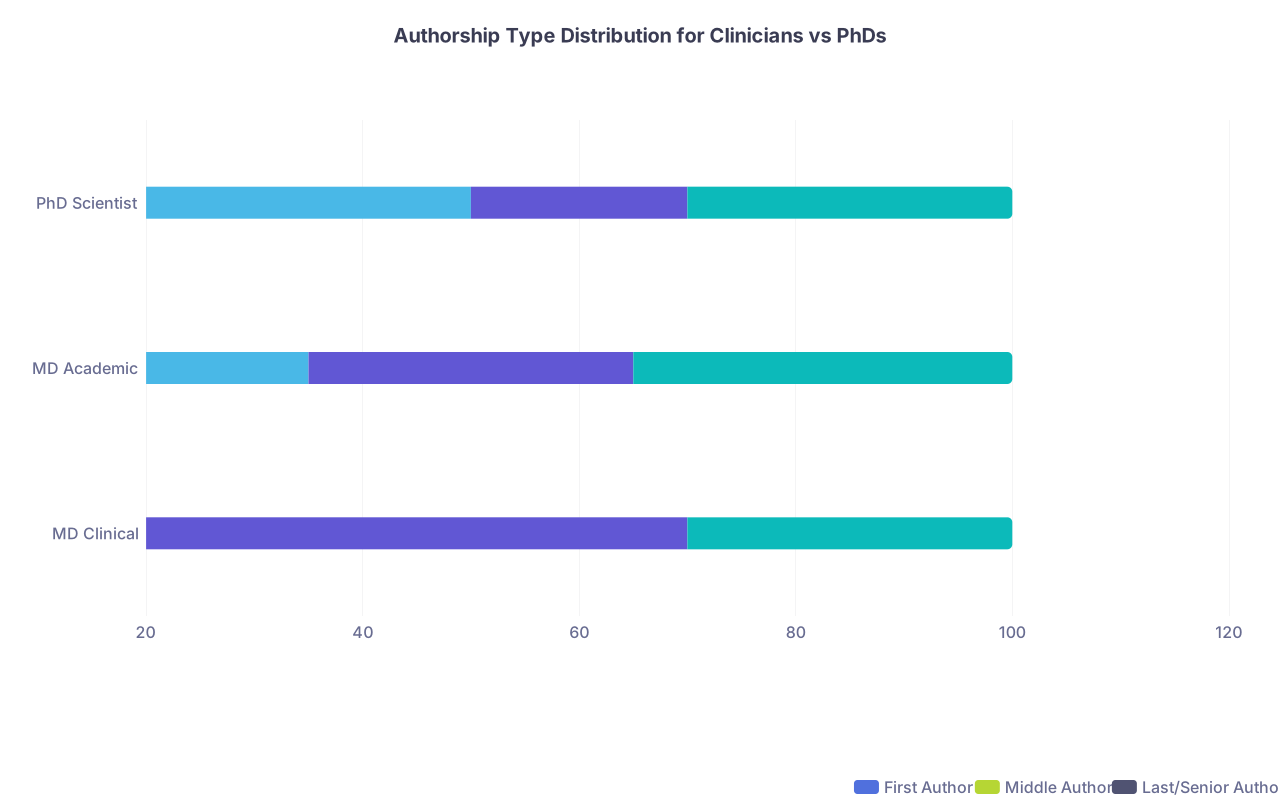
| Category | First Author | Middle Author | Last/Senior Author |
|---|---|---|---|
| MD Clinical | 20 | 50 | 30 |
| MD Academic | 35 | 30 | 35 |
| PhD Scientist | 50 | 20 | 30 |
(Percentages are rough relative distributions over a career, not absolute numbers.)
MD Residents: Volume, Not Perfection
Residents are drowning: call, notes, exam prep, life. Research often becomes “whatever I can realistically do.”
You see:
- Short retrospective clinical projects where they can be first or second author
- Case series and procedural outcome reports
- Middle-author on multicenter trials or registries led by attendings
- For highly motivated ones: 1–2 more rigorous, hypothesis-driven outcomes papers
The big shift: during residency, authorships start to represent your emerging niche. You are no longer just “med student #38 doing any project possible.” You are “the IM resident who does heart failure readmission work” or “the neurosurgery resident attached to the spine outcomes group.”
Residency selection committees previously just wanted to see that you could publish. Fellowship and first-job committees care very much about what you published in and whether there is a coherent story.
PhDs in Postdoc: First Author or Die (Career-Wise)
Postdocs are brutal because they are essentially “high-stakes first-author machines.”
Performance is evaluated based primarily on:
- Number and quality of first-author papers in solid journals
- Evidence of independent thinking (mechanistic insight, novel models, non-trivial methods)
- Early stabs at last authorship if they help supervise juniors or students
If a postdoc exits after 3–5 years with:
- 0 first-author papers → career in trouble for academia
- 1 good first-author and a few middle-author → maybe viable, depends on field and letter strength
- 2–3 first-author papers (one strong, one very strong) → competitive for K99/early-career awards and TT positions in many places
Meanwhile, a medicine resident could have 12 middle-author clinical papers and be considered “research productive” with almost no first-author work. That would be absurd in PhD circles but is common in clinical research ecosystems.
Faculty Years: How MDs and PhDs Build Senior Authorship
This is where portfolios fully diverge. Now you are not just part of someone else’s story. You are the one writing it.

MD Faculty Patterns
You can crudely divide MD faculty into three buckets:
Pure clinical (almost no time for research)
- Publications: sporadic, usually case reports, occasional co-authorships on projects from colleagues.
- Authorship profile: mostly middle and sometimes last author on smaller clinical series or QI work.
- Portfolio goal: acceptable academic footprint for promotion if the department is service-heavy and promotion bar is modest.
Clinician-educators who publish education or QI work
- Focus: med ed research, curriculum innovation, simulation, QI initiatives.
- Authorship pattern: first-author early (writing up their projects), then gradually moving to last-author as they mentor residents and students.
- Portfolio goal: enough first/last author work in education/QI journals to support promotion to associate professor and maybe leadership in education.
Physician-scientists / clinician-investigators with protected time
- This is where MDs can mirror PhD-style portfolios.
- Authorship pattern:
- Early assistant professor: still some first-author papers, especially when transitioning from fellowship projects.
- Progression to: predominant last-author on their own lab/clinical research line, with trainees and junior collaborators as first authors.
- Portfolio goal: R01-level funding, consistent last-author presence in field’s key journals, occasional co–first or co–last on big collaborations.
Key difference: MDs often mix types of papers:
- Clinical trials
- Outcomes and health services research
- Guidelines and consensus statements
- Review articles and book chapters
- QI and implementation projects
Many of these carry weight even if not first-author, especially guidelines/consensus positions, which can be career-defining.
PhD Faculty Patterns
PhD faculty are judged much more harshly on originality and authorship leadership.
Typical expectations for a thriving PhD PI:
- Continuous or near-continuous presence as last author on primary lab projects
- Trainees and postdocs as first authors, with PI steering direction, grants, and framing
- Occasional co-last or co-corresponding author on collaborations
- Review articles as either first or last author, reinforcing reputation as field leader
The PhD portfolio, when successful, has a very clean pattern:
- Training years: several first-author papers
- Early faculty: a mix of first- and last-author as they transition
- Mid- to late-career: predominantly last-author on a clear thematic program
In tenure decisions, senior-authored, original research in serious journals will be the currency that matters. Not random middle-author entries. Not case reports. That is the core difference.
Hybrid Trajectories: MD/PhD, Physician-Scientists, and “Research-Adjacent” Clinicians
Now the messy middle: MD/PhDs, MDs who act like PhDs, PhDs embedded in clinical departments.

| Step | Description |
|---|---|
| Step 1 | Student |
| Step 2 | Clinical Residency |
| Step 3 | Research Heavy Residency |
| Step 4 | Postdoc |
| Step 5 | Research Track Residency |
| Step 6 | Clinical Faculty |
| Step 7 | Clinician Investigator |
| Step 8 | PhD Faculty |
| Step 9 | Last Author Focus |
| Step 10 | Middle Author Focus |
| Step 11 | MD only |
| Step 12 | PhD only |
| Step 13 | MD PhD |
MD/PhD – The Bilinguals
MD/PhDs are supposed to be fluent in both clinical logic and PhD-style research rigor. Their portfolios, when done well, look like this over time:
- During PhD years: classic PhD pattern—1–3 first-author mechanistic papers
- During med school / early residency: some clinical or translational add-ons, maybe second- or middle-author
- In junior faculty: shift to last-author on translational projects, often bridging bench and bedside
Their credibility with both MD and PhD audiences hinges on maintaining a real line of work, not just scattered pieces. Programs will overlook fewer total papers if those few are clearly conceptual, hypothesis-driven, and sit in the right journals.
PhDs in Clinical Departments
The PhD sitting in a cardiology division or oncology department is under a different type of pressure than the MD faculty.
They are often:
- Evaluated almost entirely as research producers
- Expected to secure grants and run labs without the clinical service obligation
- Publishing with MDs as middle or last author, but expecting to remain last author on core mechanistic or methods papers
Authorship tension shows up here. I have seen this fight many times:
The PhD conceptualized and executed the molecular side; the MD brought the human samples and clinical context. Both want last-author credit. The compromise: co–last authorship, or last vs corresponding author splits depending on journal rules.
Clinicians on the Edge of Research
There is a sizable group of MDs who are not full-on physician-scientists but keep a foot in the research world:
- They help lead multicenter registries
- They contribute heavily to trial enrollment, becoming middle or co–senior authors
- They drive large, practice-informing observational studies
Their portfolios end up “wide but not deep”:
- Many co-authorships, comparatively fewer single-line first- or last-author threads
- Stronger in team science metrics (network centrality, guideline involvement) than in individual-PI narratives
This is not a failure. It is a different model of academic influence. Journals are increasingly rewarding large consortia work, and promotion committees are slowly learning how to value that properly.
Strategic Takeaways: How To Build the Right Portfolio for Your Path
You want practical direction, not philosophy. So let me spell it out by role.

If you are an MD student
You are not trying to look like a mini-PhD. That is the wrong game.
Aim for:
- A handful of genuinely first- or second-author clinical projects where you clearly did work
- Evidence of completion: submitted, accepted, PubMed indexed
- Some thematic coherence: 2–3 projects in the same rough area beats 7 scattered random case reports
Red flag pattern: 10 posters, 0 manuscripts. Programs see through that. Posters are fine, but completed publications show finish-line discipline.
If you are a PhD student
You live and die by first-author, hypothesis-driven work in legitimate journals.
Focus on:
- 1–3 serious first-author papers that tell a coherent story
- High-quality middle-authorships on big projects that show you are collaborative and technically useful
- Avoid scattering your efforts across dozens of side projects that never make it to solid journals
Red flag pattern: five middle-author papers and no first-author nearing graduation. I have seen committees essentially auto-flag these as “non-independent.”
If you are a resident/fellow (MD)
Two priorities:
- Projects you can finish before you leave
- Projects that build the first layer of your emerging subspecialty identity
Ideal pattern:
- One solid first-author project per 1–2 years of training
- Some co-authorships that connect you with your division’s research “power centers”
- At least one mentor who is consistently on your papers as last author and can write believable letters about your role
Do not chase “sexy ideas” that will still be in data collection when you are already three jobs down the road.
If you are aiming for academic faculty (MD or MD/PhD)
Your North Star is this:
“Can a reasonable outsider look at my last 5–7 years of publications and see a clear research storyline where I am the intellectual anchor?”
If the answer is no, you have a problem.
You should be moving into:
- Last-author dominance on a set of related topics
- Fewer random, off-theme middle-author appearances
- Collaboration roles that still align with your areas of expertise
For MDs, major clinical guidelines and consensus statements can act like super-papers. For PhDs, methods papers and conceptual reviews can carry outsized weight.
FAQs
1. Does raw publication count really matter less than authorship position?
Yes. For career advancement in serious academic settings, a smaller number of high-quality first- or last-author papers beats a long CV full of low-impact middle-author entries. Count still matters at the margins, but committees are not blind; they check positions, journals, and coherence of your work.
2. For an MD applying to a competitive residency, how many first-author papers are “enough”?
There is no magic number, but for highly competitive specialties (derm, plastics, ortho, ENT, rad onc) in the US, 2–3 solid first- or second-author clinical papers plus multiple abstracts/posters is a strong signal. More is fine, but volume without clear contribution or theme does not impress serious programs as much as applicants think.
3. How do co–first and co–last authorships get evaluated?
Most committees treat co–first as “close to first,” especially if clearly indicated in the manuscript. Co–last is more variable. In PhD-heavy environments, co–last is often respected if the collaboration was real and the individual’s role is supported by letters. In clinical MD settings, committees may not scrutinize the distinction as deeply but will see you as part of the senior leadership.
4. Are case reports and case series actually useful for a publication portfolio?
For MD students and residents: yes, as entry-level proof that you can identify something, write it up, and push it through peer review. For PhDs: mostly irrelevant unless tightly tied to a translational mechanistic story. Past early training, case reports should not be the center of an academic MD’s portfolio if they want serious research credibility.
5. How do systematic reviews and meta-analyses fit into MD vs PhD portfolios?
For MDs, especially trainees, systematic reviews and meta-analyses are excellent vehicles for first authorship and can be quite impressive if well executed and in good journals. For PhDs, they are secondary—useful for reputation building but not a substitute for original mechanistic or methodological research. Committees know which is which.
6. I am an MD who likes research but does not want a full laboratory career. What should I aim for?
Think “focused clinician-investigator” or “clinical trialist” rather than full bench scientist. Aim for:
- Consistent co-authorship and occasional first/last authorship on clinical trials or outcomes work in your niche.
- A recognizable theme across your papers (e.g., anticoagulation in AF, sepsis outcomes, spine fusion techniques).
- Enough last-author or corresponding-author presence that you are clearly more than just a patient-enroller.
Key points, briefly:
MD and PhD publication portfolios are built under completely different constraints and expectations; do not judge them by raw counts alone. Authorship order is a code that committees read quickly—first and last author are your real currency, especially for PhDs and research-heavy MDs. And if you want an academic future, your portfolio must tell a coherent story about you as a thinker, not just a body attached to other people’s projects.