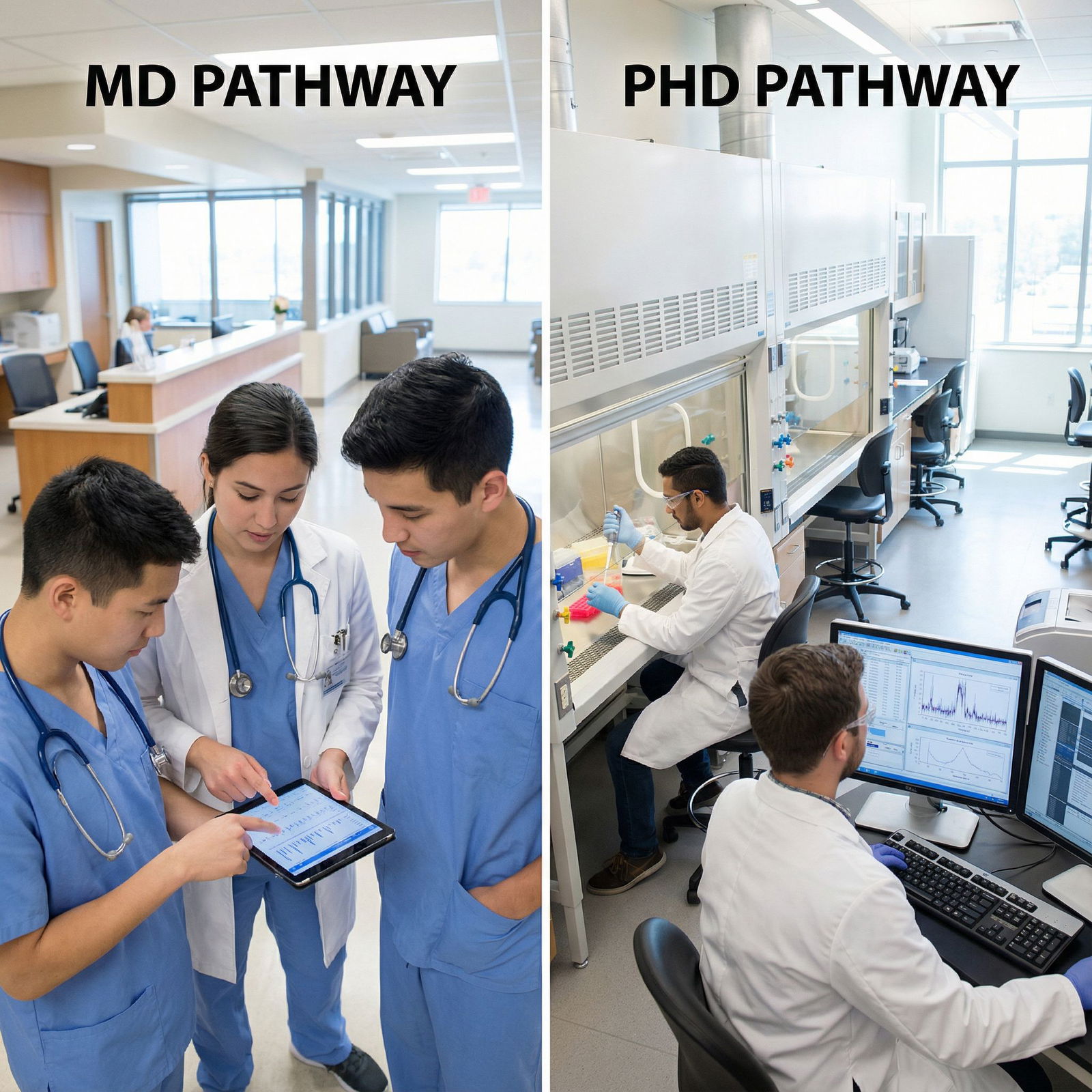
It is 10:30 p.m. You are a PGY-2 on a research track. Your mentor just emailed: “We should get an NIH K award in the pipeline this cycle. Start drafting a Specific Aims page.”
You stare at the screen. You can interpret a troponin delta at 3 a.m., manage DKA with your eyes half closed, but you have no idea how to structure a fundable grant. Meanwhile, the MD‑PhD in your lab is talking about “significance vs innovation sections” and “scoring criteria” like it is basic arithmetic.
This is the gap.
PhD training systematically builds grant-writing muscles over years. MD training, even in “research‑heavy” programs, usually does not. If you want to compete for K awards, R01s, foundations, or even internal pilot grants as an MD, you are bumping up against skills PhD trainees have been explicitly taught (and graded on) that you have largely been left to “pick up somehow.”
Let me break this down specifically.
1. How PhD Training Bakes Grant Writing Into the Culture
In most PhD programs, grant writing is not a side activity. It is part of the job description from very early on.
Typical sequence I have watched repeatedly:
- Year 1–2: Journal clubs focus not just on content, but on “how would you write this as an aims page?”
- Early candidacy: Students submit F31/F30s, T32 components, or institutional predoctoral fellowships, often as a requirement or strong expectation.
- Mid-to-late PhD: They help craft R01/R21/R03 sections with their PI—sometimes as “ghostwriters in training.”
The key: they see grant applications as a genre with rules, templates, and scoring logic. Not as mysterious black boxes.

| Step | Description |
|---|---|
| Step 1 | Undergrad |
| Step 2 | PhD Year 1 |
| Step 3 | Mock Proposals |
| Step 4 | F31 or Fellowship Draft |
| Step 5 | PI Grants - Section Writing |
| Step 6 | Postdoc - Co Investigator |
| Step 7 | Medical School |
| Step 8 | Residency |
| Step 9 | Occasional Abstracts |
| Step 10 | Early Faculty - Suddenly Needs K or R |
MD training, even at research‑intensive schools, usually looks very different:
- Preclinical years: Maybe a summer project. No one teaches you what an R01 looks like.
- Clinical years: You are rewarded for “productivity” = abstracts, posters, case reports. Almost never grants.
- Residency/Fellowship: You “help” your attending with a grant by sending them a spreadsheet or writing a paragraph of background. You do not see the whole assembled thing, the pink sheets, or the revision process.
So by the time an MD is a junior faculty member, they are being judged on a skill they were never systematically taught. That is not a fair game, but it is the game.
2. The Core Grant-Writing Competencies PhDs Actually Learn
Let us be concrete. What do PhD trainees actually internalize that MDs typically do not?
2.1 Understanding the Funding Ecosystem
PhD programs, especially in the biomedical sciences, walk students through who actually pays for research and what each mechanism is for.
Common concepts PhD students get drilled on:
- Mechanism matching: R01 vs R21 vs R03 vs foundation vs institutional pilot.
- Career stage logic: Predoctoral → postdoc → K99/R00 or K‑series → R01.
- Review culture: Study sections, percentiles vs priority scores, paylines, “programmatic relevance,” and what “out of scope” really means.
Many MDs can tell you “NIH gives grants” but cannot explain what study section their science would go to, how that drives the language they should use, or why their “great idea” is dead on arrival because the mechanism is wrong.
| Training Level | PhD Trainee Exposure | MD Trainee Exposure |
|---|---|---|
| Early Training | F31/F30, T32 docs | None or minimal |
| Mid Training | Draft R01 sections | Abstracts/posters |
| Late Training | Co-write fellowships | Maybe pilot grant |
2.2 Deconstructing the Specific Aims Page
PhD trainees get almost ritualistic exposure to Specific Aims. Many departments literally run “Aims page bootcamps.” Faculty bring funded and unfunded examples; students rip them apart.
They learn:
- Aims are not “Topics.” They are testable, discrete, interrelated units that stand up independently.
- The page has a formulaic rhetorical structure:
- Opening hook: the big problem in the field
- Gap in knowledge
- Central hypothesis
- Aims that test the hypothesis
- Impact statement
MDs, left alone, tend to write something else entirely:
- Aims that are purely descriptive (“Aim 1: Describe the prevalence…”).
- Aims that are service line expansion plans disguised as research.
- Aims that are just “steps” (“Aim 1: Build registry. Aim 2: Analyze registry.”).
PhD trainees learn to avoid these mistakes early because they get blunt feedback from PIs who live and die by paylines.
3. Selling Significance and Innovation (Not Just Telling a Clinical Story)
MDs are very good at telling clinically compelling stories. “I saw a patient with X, this is sad, we need Y.” That works for case reports. It does not win major grants.
Grant panels are not granting sympathy. They are scoring against structured criteria.
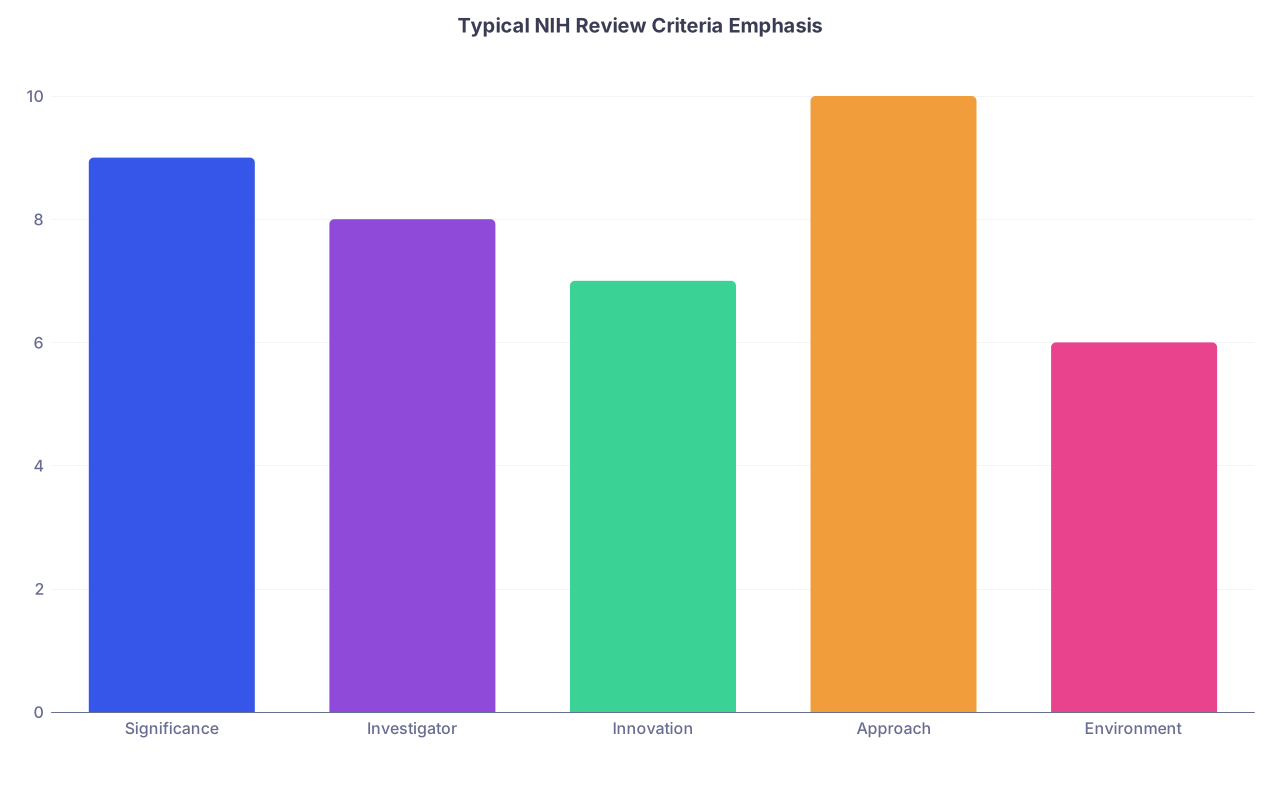
| Category | Value |
|---|---|
| Significance | 9 |
| Investigator | 8 |
| Innovation | 7 |
| Approach | 10 |
| Environment | 6 |
3.1 How PhDs Learn “Significance” as a Scoreable Thing
PhD mentors teach “significance” as:
- The specific, articulated gap in mechanistic or conceptual knowledge.
- The concrete downstream consequences for the field if that gap is filled.
- How this proposal is a realistic bridge between the gap and the consequence.
They practice concise formulations:
- “Although X is known, Y remains unknown because Z. This gap limits A and B. The proposed research will define Y by doing C and D, enabling E.”
MDs often confuse “significance” with:
- Disease prevalence.
- Morbidity and mortality stats.
- Vague statements like “This is a major public health problem.”
That is necessary but not sufficient. A grant reviewer wants to know: what do we actually not know, exactly, and exactly how will your project move that needle?
3.2 Innovation: Beyond Buzzwords
PhD trainees get punished for empty “innovative” language. They are told directly: “If everything you propose has been done before with the same tools, you are not innovative, no matter how many adjectives you use.”
They learn to frame innovation in three ways:
- Conceptual: New hypothesis or conceptual model.
- Methodologic: New technique, assay, analytic framework.
- Clinical/Translational: New way of applying known science to a care context.
MDs frequently oversell minor tweaks as innovation. Reviewers can smell that. PhD trainees, after a few rounds of pink sheets, stop doing it.
4. Designing a Fundable Approach, Not Just a Feasible Project
This is one of the big differentiators. MDs design what they can do. PhDs are pushed to design what will score.
4.1 Power, Feasibility, and Scope Calibration
PhD coursework and qualifying exams often include heavy design work:
- Designing experiments with proper controls and alternative readouts.
- Anticipating pitfalls and explicitly proposing alternatives.
- Calibrating project scope to a 3–5 year window and a realistic budget.
Many MD projects are wildly mis-scoped:
- An R21 that actually needs R01‑level resources.
- A K award project with four massive aims and 12 sub-aims.
- A small foundation grant with a multi-center trial buried in it.
PhD trainees hear, bluntly: “This is three grants, not one,” or “No one believes you can do a prospective 1,000‑patient trial with your current FTE; shrink it.”
4.2 Writing a Convincing Methods Section for Strangers
PhD trainees learn to treat reviewers as intelligent but skeptical people outside their sub‑niche. So methods sections are:
- Explicit enough to judge feasibility.
- Framed around validation, controls, and interpretability.
- Full of language that signals “we know the limits.”
MDs often write methods sections like IRB protocols: “We will collect X and run Y.” That does not tell a reviewer how robust the science will be or what will happen when something fails.
5. The Iterative Culture: Critique, Pink Sheets, and Revision
A big thing MDs do not see early: how ugly early drafts look, and how brutally they get fixed.
5.1 Internal Review Before External Review
In good PhD environments, there is an internal gauntlet:
- Lab meetings where aims pages get dissected line by line.
- Department‑level mock study sections.
- “Grant writing clubs” where people swap drafts and score each other as if they were the NIH.
So by the time a grant goes out the door, it has been hammered.
MDs frequently send first drafts to grants offices one week before the deadline. Then they act surprised when the score is in the 50s.

5.2 Reading Pink Sheets as Data, Not as Personal Attack
PhD trainees normalize the cycle:
- Submit.
- Get triaged or get a mediocre score.
- Read pink sheets (reviewer critiques).
- Fix, resubmit, or pivot.
They are taught to decode feedback:
- Which comments are “programmatic noise” vs real barriers.
- When to change the hypothesis vs when to clarify language.
- How to explicitly rebut comments without sounding defensive.
Many MDs see their first pink sheets in their 30s, as junior faculty. The learning curve is steep and very public.
6. Ownership, Role Clarity, and Authorship Culture
Another underappreciated piece: who actually “owns” the grant.
6.1 PhD Trainees as Primary Drafters
For fellowships and early K99/R00 work, PhD candidates and postdocs are often the real primary authors. Their PIs edit heavily, yes, but the student/postdoc is:
- Writing the first full drafts.
- Constructing figures.
- Corresponding with grants administrators.
- Explaining the project verbally at lab meetings over and over.
So by the time they are on the market for faculty jobs, many PhDs have:
- Written multiple full proposals.
- Seen what gets funded vs not.
- Internalized the pacing, tone, and formatting expectations.
MDs, even very bright ones, often have never written a full grant narrative themselves. They have contributed paragraphs. Very different level of muscle memory.
6.2 Authorship vs “Grant-ship”
In PhD culture, having “wrote the K99” or “crafted the Aims for the R01” is recognized internally, even if the PI is technically PI on paper. There is a subtext of grant‑writing credit that circulates at lab meetings and job talks.
In MD departments, authorship culture revolves around manuscripts, not grants. So trainees do not get deliberate, mentored practice on grant writing as a competency that affects their career.
7. Communication Style: The Grant Voice vs The Clinical Note Voice
MDs are trained to write quickly, concisely, and in a way optimized for clinical throughput. That style is almost the opposite of grant style.
7.1 The “Grant Voice”
PhD trainees learn to write in a way that:
- Leads reviewers by the hand. Every paragraph has an argument.
- Uses repetition strategically: the central hypothesis appears in multiple places, verbatim.
- Uses white space, headings, and signposting so nothing is missed on a fast skim.
They see dozens of examples from their mentors’ old submissions. Many PIs literally give their lab a “greatest hits” folder of funded Aims pages for different mechanisms.

MDs, on the other hand, often:
- Underuse signposting, headings, and explicit “here is what this means” transitions.
- Assume clinical relevance is obvious and does not need explicit justification.
- Pack too much information into dense paragraphs that are exhausting to read at 11 p.m. after six other grants.
Grant reviewers are tired humans. PhD trainees are taught to respect that.
8. Time Horizons and Strategic Planning
PhD and MD pathways encode very different notions of time.
8.1 PhD: Multi-Year Arc Planning
For a good PhD thesis, you need:
- A scientifically coherent story.
- A set of experiments that build on each other logically.
- A plausible arc from “naive” starting point to “new knowledge” endpoint.
That maps perfectly to how a 5‑year R01 is supposed to look.
So when a PhD trainee plans a grant, they often naturally think:
Year 1–2: Develop, validate, and pilot methods.
Year 2–3: Apply methods to core hypothesis.
Year 4–5: Extend, refine, and test boundary conditions.
MDs, who live in 12‑week rotation blocks and 1‑year residency cycles, tend to propose:
- Projects that are really 1‑year QI timelines, not 5‑year research plans.
- Or, the opposite: a 5‑year set of trials and implementation science compressed unrealistically into a 3‑year K award.
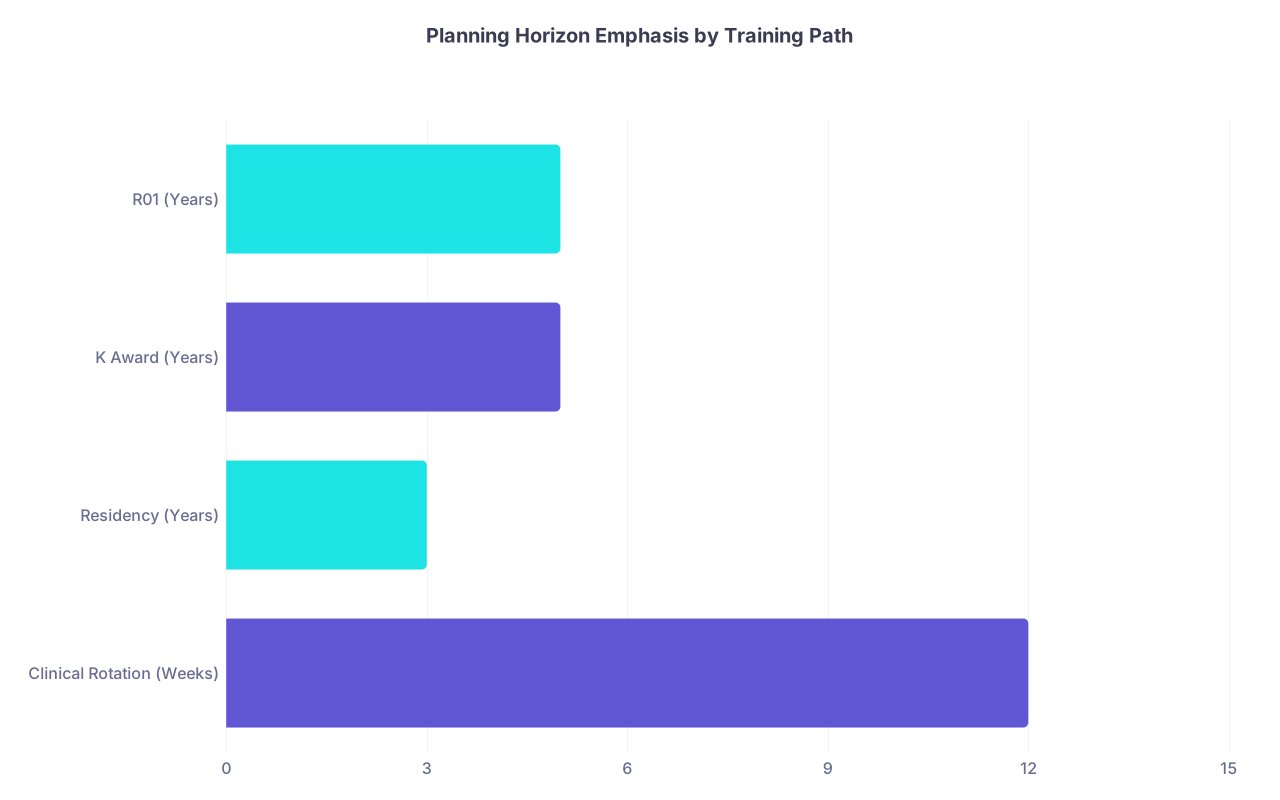
| Category | Value |
|---|---|
| Clinical Rotation (Weeks) | 12 |
| Residency (Years) | 3 |
| K Award (Years) | 5 |
| R01 (Years) | 5 |
PhD students are forced to think at the 3‑5 year scale almost from the day they write their proposal for candidacy.
9. The Administrative and Budget Side PhDs Get That MDs Ignore
Another quiet difference: comfort with the non‑scientific parts of grants.
9.1 Budgets, Justifications, and Modular vs Non-Modular
PhD trainees, especially senior ones, get pulled into:
- Drafting budgets for supplies, animals, sequencing, cores.
- Negotiating what to cut when institute caps hit.
- Writing budget justifications that show they understand cost structure.
MDs often ignore budgets completely, handing them off to a department admin. Reviewers can tell when the PI does not control their own resources conceptually.
9.2 Biosketches, Facilities, and Environment Sections
PhD programs often explicitly teach:
- How to write a biosketch that tells a coherent scientific story.
- How to phrase “Environment” to highlight strengths: cores, collaborations, institutional support.
MDs frequently treat these as afterthoughts:
- Generic environment language (“Large tertiary center with diverse patients”).
- Biosketch “Personal Statements” that read like CV summaries instead of arguments for why they are the perfect person to do this.
The difference is not subtle to a panel that reads 20–30 applications in a cycle.
10. If You Are an MD: What You Can Steal Directly from PhD Training
You cannot rewind and do a PhD, but you can steal the training patterns. This part is actionable.

10.1 Build Your Own “Mini-PhD” in Grant Writing
Borrow the structure:
Aims Page Bootcamp
- Collect 10 funded Specific Aims pages in your field (K, R, foundation).
- Read them aloud. Reverse‑engineer:
- How do they open?
- Where is the hypothesis?
- How are aims structured (2 vs 3, observational vs mechanistic, etc.)?
Internal Review Circle
- Form a small group (3–5 people: MDs + PhDs if possible).
- Every 2–4 weeks, one person brings an Aims page or Significance/Innovation draft.
- Others score it (1–9) and give comments like a study section.
Pink Sheet Literacy
- Ask a trusted mentor to show you de‑identified pink sheets from a funded and an unfunded application.
- Study the language:
- What are “fatal” comments vs “fixable”?
- How do they phrase concerns about feasibility, innovation, or investigator?
10.2 Work With People Who Live on Grants
If you are an MD planning a serious research career, find at least one mentor whose primary existence depends on peer‑reviewed grants. Not just someone “doing projects on the side.”
Tell them explicitly: “I want to learn to write grants, not just be on papers.” Then back that up:
- Volunteer to write the first draft of a section.
- Ask for line‑by‑line edits and be willing to revise.
- Sit in on their mock study section prep, if they do that.
You are trying to approximate, quickly, the years of iterative exposure PhD trainees get.
10.3 Study Sections Are Public. Use That.
NIH posts rosters and sometimes sample applications. Read them. Look up who reviews your area. This is standard practice in strong PhD labs. MDs underuse it badly.
11. What MDs Often Do Better – And How to Combine It
I am not romanticizing PhD training; it has plenty of flaws. MDs bring strengths PhDs often struggle with:
- Clinical intuition about what matters at the bedside and in systems.
- Access to patients, clinical data, and implementation environments.
- Narrative sense about illness, suffering, and urgency.
The magic happens when you combine:
- PhD‑style rigor in grant structuring and methodological framing with
- MD‑level clarity about clinical relevance, feasibility in practice, and impact on care.
The MDs who win in academic medicine are not “PhD‑level” writers or “clinical geniuses.” They are the ones who respect that grant writing is its own craft and decide to get good at it, deliberately, instead of hoping their name on someone else’s grant will carry them.
FAQs
1. I am a busy resident/fellow. Is it realistic to learn grant writing now, or should I wait until faculty?
Start now. You do not need to write an R01 during residency, but you can absolutely write:
- A one‑page Aims for a small foundation grant.
- An internal pilot proposal.
Those reps compound. Waiting until faculty means you are learning in public with your promotion clock already ticking.
2. Do I really need formal courses, or can I just learn from my mentor’s grants?
Formal courses help, but they are not essential. I have seen MDs become excellent grant writers by:
- Collecting and dissecting example applications.
- Getting ruthless internal feedback from experienced investigators.
A bad course is worse than self‑study with good exemplars. Prioritize access to strong, funded examples over PowerPoints about “how grants work.”
3. How many failed grants should I expect before getting funded?
For a serious research career, multiple failures are normal. Many strong investigators had 2–3 triaged or poorly scored grants before their first major success. What matters is whether each failure teaches you something concrete about:
- Scope.
- Mechanism fit.
- Clarity of hypothesis and approach.
4. Is it a disadvantage not to have a PhD if I want to be a physician‑scientist?
You are starting with less structured grant‑writing training, yes. But MD‑only investigators can and do run major funded programs. The key is whether you deliberately build:
- A PhD‑style approach to grant structure and critique.
- A clinical investigator’s eye for meaningful questions and workable designs.
Degree letters matter much less than demonstrated skill and a track record of fundable ideas.
Key points:
- PhD training systematically teaches grant writing as a core skill; MD training rarely does, creating a real but fixable gap.
- The differences are specific: understanding mechanisms and review culture, crafting Aims and Significance/Innovation, and iterating through critique and resubmission.
- MDs who consciously “steal” PhD training patterns—aims bootcamps, mock reviews, close mentorship with grant‑dependent investigators—can close this gap and compete effectively for serious funding.