
The fantasy that MD and PhD training are equivalent in “scientific rigor” is wrong. They are built for different jobs, and you can see it most clearly in how they treat statistics, methods, and rigor.
If you keep that in mind, a lot of confusion disappears. Let me break this down cleanly.
The Core Design: What Each Degree Is Actually Training You To Do
MD and PhD training diverge at the design level.
MD training is optimized to produce safe, reliable clinical decision-makers. Pattern recognition, guideline use, and risk–benefit judgment in messy human situations. The system cares more that you do not miss meningitis than whether you can derive a mixed model likelihood from first principles.
PhD training (in biomedical or quantitative fields) is optimized to produce people who can generate new knowledge. That means:
- Designing studies from scratch
- Understanding and building analytic pipelines
- Critically destroying weak methods (including their own)
Everything else is secondary.
Once you accept that, the differences in statistics, methods, and rigor stop being surprising and start being predictable.
| Aspect | MD Training Focus | PhD Training Focus |
|---|---|---|
| Core Output | Safe clinician | Independent researcher |
| Statistics Role | Tool for reading papers | Tool for creating new knowledge |
| Methods Emphasis | Evidence application | Evidence generation |
| Rigor Orientation | Clinical safety and standards | Internal validity and inference |
| Dominant Evaluation | Exams, OSCEs, clinical evals | Original research, dissertation |
Statistics: What You Actually Learn (and What You Don’t)
I will be blunt: typical MD training in statistics is shallow and often incoherent. It is good enough to pass boards and talk about “p-values” in journal club. It is not good enough to design a genuinely solid clinical study without help.
What Most MDs Actually Get in Stats
Across US and many international curricula, the MD path typically includes:
- 1 preclinical epidemiology/biostats course (sometimes blended into “public health”)
- Repeated light exposure in journal clubs and EBM sessions
- A small amount of statistics on licensing exams (USMLE, MCCQE, etc.)
What does that mean in practice?
You learn vocabulary and canned interpretations:
- p-value, confidence interval
- Sensitivity, specificity, likelihood ratios
- Relative risk vs odds ratio
- Kaplan–Meier curves, log-rank test
- “Intent-to-treat” vs “per protocol” in a hand-wavy way
What you usually do not learn in any serious way:
- Model specification (what belongs in the regression and why)
- Checking model assumptions (linearity, homoscedasticity, independence)
- Dealing with missing data beyond “complete case”
- Power and sample size calculations from scratch
- Multilevel/mixed-effects models
- Time-varying covariates or competing risks
- Causal inference frameworks (DAGs, potential outcomes)
You learn to recognize these words, not to wield them.
In MD training, statistics is a reading tool. Not a building tool.
What PhD Students Live and Breathe in Stats
Now flip to biomedical PhD training. The statistical expectations are not just higher; they are structurally different.
A typical path in a reasonably strong program:
- 2–4 serious graduate-level statistics/methods courses (not the “medical student” watered-down version)
- Continuous use of statistics in lab meetings, manuscript prep, and peer review
- Responsibility for implementing analyses in R, Python, Stata, or similar
You are expected not only to know what method is used, but why, how, and what breaks it.
So PhD-level exposure commonly includes:
- Generalized linear models
- Logistic, Poisson, negative binomial regression
- Survival analysis beyond just Kaplan–Meier (Cox models, parametric survival)
- Longitudinal and mixed-effects models
- Multiple testing correction (Bonferroni, FDR, etc.)
- Bayesian inference at least conceptually, often practically
- Power analysis and simulation studies
- Data cleaning pipelines and reproducible scripts
For quantitative PhDs (biostatistics, epidemiology, computational biology), this goes several levels deeper: likelihood theory, asymptotics, decision theory, high-dimensional modeling, etc.
That is why you see the split you see in real life:
- MD: “The adjusted odds ratio was 1.4 with a 95% CI of 1.1–1.8, so it is significant.”
- PhD: “Your model is mis-specified, you have informative censoring, and your multiple imputation assumes MAR that is not defensible.”
One is speaking EBM. The other is speaking methods.
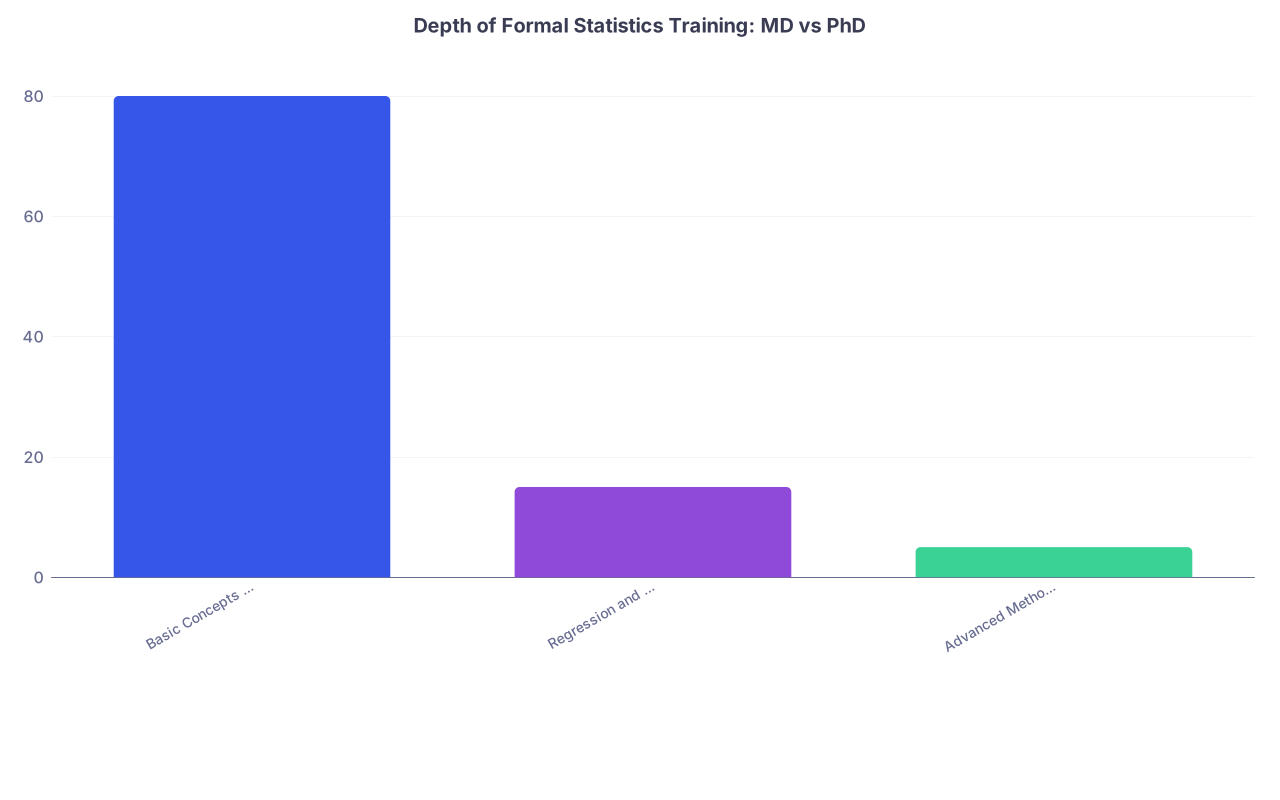
| Category | Value |
|---|---|
| Basic Concepts Only | 80 |
| Regression and Survival | 15 |
| Advanced Methods/Modeling | 5 |
(Interpret this as approximate proportions of MD graduates who are solid in each category. PhDs in quantitative fields invert that distribution.)
Methods: How Each Path Trains You to Think About Studies
Statistics is the syntax. Methods is the grammar. This is where the two degrees really diverge.
MD Training: Evidence Consumers and Guideline Anchors
The MD curriculum treats research as something other people do and clinicians must interpret. You are trained to:
- Classify study designs: RCT, cohort, case-control, cross-sectional, case series
- Recognize classic biases: selection, recall, confounding, observer bias
- Understand hierarchy of evidence: RCTs and meta-analyses at the top, expert opinion at the bottom
- Use evidence in patient care: apply risk calculators, memorize landmark trials
You will be quizzed on things like:
- “Which study design is best for a rare outcome?”
- “What kind of bias is introduced when only hospital patients are sampled?”
What is usually missing:
- Serious exposure to protocol writing
- Handling messy prospects: feasibility, recruitment, adherence, pragmatic vs explanatory design
- Detailed understanding of measurement error, misclassification, and how they distort estimates
- Hands-on experience with IRB submissions, pre-registration, or data/safety monitoring plans (unless you seek them out)
So MDs come out reasonably good at “Is this RCT high-level enough to change my practice?” but usually not great at “If I wanted to test X safely and convincingly, how do I actually build that study?”
PhD Training: Evidence Producers and Methodological Owners
PhD training lives and dies on original research. Methods are not a side note; they are the central spine.
A PhD student spends literally years:
- Defining a research question tightly enough that it is testable
- Mapping it to a design that can support a credible claim
- Refining the design to placate a skeptical committee and reviewers
- Implementing the protocol and handling every unglamorous problem that comes up
Concrete examples:
- You learn why a case-control study with hospital controls gives you insane odds ratios.
- You wrestle with cluster randomization in settings where individuals cannot be randomized.
- You deal with incomplete follow-up, competing risks, or contamination of control arms.
- You fight with data that violate assumptions and figure out when a model is lying to you.
You are not just naming bias types on exams. You are trying to rescue your own dissertation from them.
By the time you defend, you should be able to sit in a journal club and deconstruct a major RCT not just with “this is selection bias,” but with specific, mechanistic critique:
- Randomization unit was clinics but analysis ignored clustering
- Outcome was misclassified in 30% of controls based on external data
- Follow-up differed by arm because of differential withdrawal
That is a different level of methods literacy.
Rigor: How Each System Enforces Standards
Rigor is where people get sentimental and hand-wavey. So let us be explicit: rigor has different enforcement mechanisms in MD vs PhD paths.
MD: Clinical Rigor = Safety, Standards, Reproducible Practice
MD rigor is about doing the same safe thing reliably under pressure.
The system pushes you toward:
- Following practice guidelines and protocols (ACLS, sepsis bundles, anticoagulation rules)
- Applying population-level evidence pragmatically to each patient
- Minimizing error by checklists, order sets, and institutional pathways
You are evaluated by:
- Licensing exams that test applied knowledge
- OSCEs and clinical evaluations that test behavior and judgment
- Attending feedback on actual care decisions
So a “rigorous MD” is:
- The person who knows the mortality benefit from early antibiotics in septic shock, recognizes it at 3 a.m., and orders the right regimen in 10 minutes.
- The person who understands that one small underpowered RCT does not overthrow decade-long consensus and multi-trial meta-analyses.
What they are not required to do:
- Demonstrate reproducible code
- Publish analyses with data sharing plans
- Prove that their “n of 1” clinical anecdote is generalizable
The clinical world enforces rigor through outcomes and norms, not through statistical purity.
PhD: Scientific Rigor = Internal Validity, Transparency, Reproducibility
PhD rigor is about whether your claims about the world are:
- Logically supported by design
- Statistically justified
- Transparent and reproducible by others
The enforcement mechanisms here are brutal in a different way:
- Dissertation committees that will block graduation over flawed design
- Peer reviewers who barely skim your introduction but dissect your methods section
- Grant reviews that focus on feasibility, bias, and analytic plans
You are expected to:
- Pre-specify primary outcomes and main analyses (at least informally, increasingly formally)
- Justify your sample size and effect size assumptions
- Document and often share code and analytic decisions
- Describe handling of missing data, multiplicity, and sensitivity analyses
If you say “we adjusted for confounders,” someone will ask “which, why, and how did you choose them?”
So a rigorous PhD learns to distrust pretty results that do not survive sensitivity analysis. And to explain, line by line, what they did to their data.

How This Plays Out in Real Life: Scenarios You Actually See
Let me give you the kinds of situations where this MD vs PhD training difference stops being theoretical.
Scenario 1: Designing a Clinical Study
You are an attending internist with an MD only. You notice your diabetic inpatients often have medication reconciliation errors. You want to study an intervention.
Default MD approach (I have seen this conversation verbatim):
- “We will randomize patients to standard discharge versus a pharmacist-led review. Then compare the number of errors.”
- “We will just use a t-test or chi-square, whatever is appropriate.”
- “Sample size? We will see how many we can get in a year.”
The PhD sitting in the same meeting starts asking questions:
- “Randomize at patient level or provider level? Because behavior changes can contaminate groups.”
- “What is your primary outcome exactly? Proportion with at least one clinically significant error? How defined?”
- “How will you blind outcome assessors?”
- “Have you done a power calculation based on a plausible effect size and baseline error rate?”
- “What about post-discharge follow-up—do you care only about inpatient reconciliation or readmissions due to errors?”
It is not that the MD cannot understand these questions. It is that their training did not force them to habitually think this way. PhD training does.
Scenario 2: Reading a Landmark Trial
MD at journal club:
- Identifies that it is an RCT, likes the sample size, sees that the p-value is small, mentions external validity and cost.
- Concludes: “Practice changing” or “Not yet ready for prime time.”
PhD or methodologist at journal club:
- Points out that the primary outcome was switched between registry and publication.
- Notes that the subgroup analysis driving headlines was not pre-specified.
- Observes that missing outcome data were imputed using a method that assumes data missing at random, which seems unlikely given observed patterns.
- Asks why cluster randomization was used but analysis ignored clustering, artificially shrinking confidence intervals.
Again: different training objectives.
Scenario 3: Running a Clinical Research Career as an MD
Here is where people fool themselves. Many MDs think: “I will just learn enough stats on the side and be fine.”
Sometimes that works, especially if:
- You are in a highly supportive environment with strong PhD collaborators.
- You are honest about what you know and what you do not.
What actually happens too often:
- An MD PI “outsources” methods to a statistician at the 11th hour.
- The design is already locked; the sample is already collected.
- The statistician can only patch holes, not fix the hull.
Result:
- Underpowered, biased studies with complicated models but weak design.
- Shiny p-values, fragile inferences.
The MD is not stupid. They are undertrained for this specific job. A PhD in epidemiology or biostatistics is trained to anticipate these failures before you ever enroll patient #1.

| Step | Description |
|---|---|
| Step 1 | Clinical Question Arises |
| Step 2 | MD Path - Guideline Focus |
| Step 3 | PhD Path - Research Focus |
| Step 4 | Look up existing evidence |
| Step 5 | Apply to patient care |
| Step 6 | Formulate research question |
| Step 7 | Select study design |
| Step 8 | Develop protocol and analytic plan |
| Step 9 | Conduct study and refine methods |
Where MD Training Can Reach PhD-Level Rigor
To be fair, there are MDs whose methods training is absolutely at PhD level or higher. I have worked with them.
Common patterns:
- They did a research-heavy fellowship (e.g., cardiology with a T32 slot, oncology with a formal clinical research track).
- They completed a master’s in clinical research, epidemiology, or biostatistics during residency/fellowship.
- Or they have essentially self-taught to an obsessive degree, writing their own code, sitting in on graduate stats classes, reading method papers.
So the letters after your name are not destiny. But the default pipeline pushes MDs and PhDs in very different directions.
If you are an MD who wants to operate at that level, you almost always need:
- A formal second degree (MS, MPH with serious methods, MSc in epi, etc.)
- Or sustained close mentorship with methodologists who will not let you gloss over details.
Without that, you can absolutely be a good clinical researcher. But you will probably not be the methodological brains of the operation.
Comparative Snapshot: What Each Training Pipeline Actually Delivers
Here is the 30-second comparison you would give a serious student trying to choose MD vs PhD with “I like research” as the only input.
| Feature | Typical MD Path | Typical PhD Path |
|---|---|---|
| Stats Coursework | 1 basic biostats/epi course | 2–4 advanced stats/methods courses |
| Primary Role with Evidence | Apply in clinical care | Generate and critique in depth |
| Methods Practice | Journal club, small projects | Full protocol–to–publication cycle |
| Rigor Enforcement | Guidelines, clinical outcomes | Committees, peer review, replication |
| Code/Data Skills | Often minimal | Expected (R, Python, SAS, etc.) |
| Main Product | Competent clinician | Independent investigator |
Choosing Your Path (or Fixing the One You Already Picked)
If you are early in training and genuinely trying to decide:
- If you want to spend most of your life taking care of patients, making high-stakes decisions hour by hour, with research on the side → MD with some methods training is fine. Add an MS/MPH if you are serious about academic careers.
- If you want your primary output to be methods, models, or rigorous studies, and you do not care whether you are called “doctor” on the ward → a PhD (epi, biostats, health services research, etc.) is the correct instrument.
If you are already an MD and realize your methods foundation is thin:
- Stop pretending journal club is enough.
- Either commit to real training (formal coursework, degree, or sustained stats mentorship) or be honest that you will play a more clinical, content-expert role while others handle heavy methods.
That is not an insult. It is alignment.
If you are a PhD working with MDs:
- Do not expect them to know what you know. They were never trained to.
- Your job is not just to run their regressions. It is to protect the validity of the project, even when that means pushing back on design.
The Short Version: How MD and PhD Training Really Differ
Let me compress this.
MD training treats statistics and methods as tools for reading and applying evidence, not for building it from scratch. It prioritizes clinical rigor: safety, reproducible patient care, adherence to standards.
PhD training treats statistics and methods as the central craft. You are shaped into someone who can design, analyze, and defend original research with internal validity and transparency.
If you want to own methods-level decisions in clinical research, the default MD curriculum is not enough. You either need additional formal training or a PhD-level partner whose entire career has been built on exactly that.