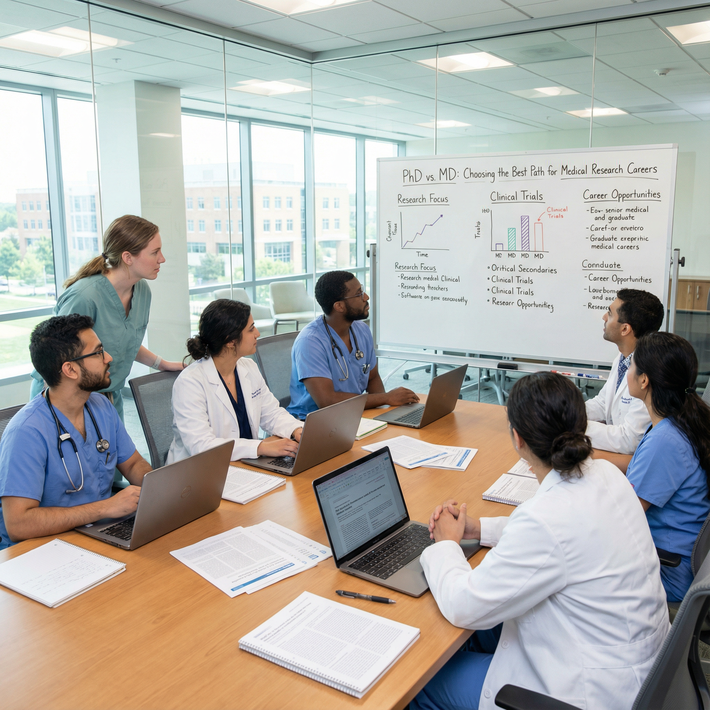
The fantasy that MDs, PhDs, and MD–PhDs all “do research” in similar ways is wrong. Their weekly lab lives are completely different ecosystems.
Let me break this down specifically: same building, same PI, same project even—and the MD student, the PhD student, and the MD–PhD student will have radically different time-in-lab patterns, constraints, and leverage. If you are choosing between these paths, you need to understand the lived weekly reality, not vague brochure language about “integration of research and clinical training.”
This is the stuff people only tell you after you have already signed the loan documents.
1. The Core Problem: Time, Identity, and Control
In academic medicine, “time in lab” is not just about hours. It is about:
- Who actually controls your schedule
- How predictable your days are
- Whether the lab is your primary identity—or a side gig competing with clinics or coursework
Here is the blunt version:
- PhD students: Lab is your full-time job. Your week orbits the bench and the data.
- MD students: Lab is elective, opportunistic, and usually subordinate to exams and clerkships.
- MD–PhD students: You live in three worlds—preclinical, lab, and clinic—and each one behaves like it owns you.
To make this real, I will walk through concrete weekly schedules for each, in different phases, and then compare side-by-side.
2. PhD Weekly Lab Life: This Is Your Home Base
Pure PhD students are the most straightforward to describe. The lab is not “protected time”—it is the time.
Typical PhD Phases
You can roughly split a biomedical PhD into three functional phases:
- Coursework / rotations (Year 1, sometimes early Year 2)
- Full-time lab + qualifying exam prep (mid-Year 1 to Year 3)
- Dissertation grind + writing and job hunt (Year 3–5+)
Weekly Schedule – Core Research Years (PhD)
Think of a reasonably serious, not-masochistic biomedical PhD student in years 2–4.
- Nominal expectation: 40–50 hours / week in lab and related work
- Reality at most solid programs: 50–60 hours with spikes before big experiments / deadlines
A realistic week:
Monday
08:30–09:00 – Emails, queue microscope / book equipment
09:00–12:00 – Bench work (cell culture, setting up westerns or PCRs)
12:00–12:30 – Quick lunch, sometimes at desk
12:30–15:00 – Data analysis, coding, stats, figure prep
15:00–16:00 – Lab meeting (you present every 4–8 weeks)
16:00–18:00 – More experiments or troubleshooting
Tuesday
09:00–12:30 – Bench heavy: surgeries, behavior runs, long protocols
12:30–13:00 – Lunch
13:00–17:30 – Continue experiment, start overnight incubations, data logging
17:30–18:30 – Journal club (every other week)
Wednesday
09:00–12:00 – Imaging (confocal, live-cell, whatever your lab uses)
12:00–13:00 – Department seminar (strongly “encouraged”)
13:00–17:00 – Data analysis, figure revision after PI comments
17:00–19:00 – Optional: come back if timepoints require it
Thursday
09:00–12:30 – Bench + sample processing
12:30–13:00 – Lunch
13:00–17:30 – Grants / fellowship applications or draft manuscript text
Friday
09:00–11:00 – Finish week’s experiments, freeze/store samples
11:00–12:00 – One-on-one with PI every 1–2 weeks
12:00–13:00 – Lunch
13:00–16:00 – Data cleanup, backup, ordering reagents
16:00–18:00 – You either leave or sit around “just finishing this figure”
Weekend:
- Many labs expect at least a few hours both days when animals, cultures, or timepoints demand it.
- A heavy experiment week: 3–8 weekend hours. A lighter week: none.
Notice the key features:
- You can choose early vs late, but you are there most weekdays, many weekends.
- When experiments require it, you build the rest of your life around those timepoints.
- The PI measures you by progress, not time-clock punches. But they absolutely notice when you vanish.
3. MD Student Time-in-Lab: Episodic, Negotiated, and Secondary
MD students are not trained primarily as researchers. Their weekly schedules are dominated by:
- Preclinical: lectures, small groups, anatomy, exams
- Clinical: wards, call, notes, pimping, evaluations
Research is something you wedge into the cracks, unless you intentionally carve a block out.
MD Phases Where Lab Time Actually Exists
For an MD-only path, true lab involvement tends to cluster in four windows:
- Preclinical summer between M1–M2 (classic 8–10 week block)
- Short research electives during clinical years
- Dedicated research year(s) (e.g., a funded scholarly year, HHMI, Doris Duke)
- Light, opportunistic involvement (chart review, remote data projects) during less intense rotations
Let’s walk through the main ones.
A. M1–M2 Summer Research Block (MD)
This is the cleanest time.
Most schools offer (or push) summer research between first and second year. You are effectively a short-term lab employee.
Typical expectation: 35–45 hours / week in lab for 8–10 weeks.
A realistic week:
Monday–Friday (similar pattern daily)
09:00–12:30 – Bench work, learning protocols, shadowing grad/postdoc
12:30–13:00 – Lunch
13:00–16:30 – More experiments or basic data analysis
16:30–17:30 – Reading background papers or meeting with mentor
Weekend: Usually off, unless your project has animals / timepoints. As the MD summer student you are rarely the one asked to come in on Sunday night to do perfusions. They hand you the lower-stakes work.
Key point: This block feels a bit like being a junior PhD student, but without long-term expectations. You are protected from courses and call. Once M2 starts, everything changes.
B. Preclinical Year (M1/M2) While Trying to Do Lab
Most MD students do not spend significant in-person lab hours during M1/M2 outside that summer.
If they do, it looks like this:
- 2–8 hours / week, highly variable
- Often data analysis, chart review, writing, or tagging along on small projects
- Nights or weekends, because daytime is lectures or self-study for exams
Example M2 week during exam-light period:
Thursday
17:00–19:00 – Go to lab after class, run simple assay or help with data entry
Saturday
10:00–13:00 – Analysis at home or in lab, simple R / Python / SPSS work
13:00–15:00 – Study for upcoming exam
This is not “time in lab” in the PhD sense. It is research exposure. You are not the engine of the project; you are an auxiliary.
C. Dedicated Research Year (MD)
More MD-only students are taking 1 research year (between M2–M3 or M3–M4), especially in competitive specialties. This is the time where their schedule finally resembles a PhD-style pattern.
Expectation: 40–55 hours / week
Reality: Maybe 50–60 if the student is highly ambitious and aiming for high-impact work.
Sample week for an MD taking a research year in a wet lab:
Monday
09:00–12:30 – Experiments
12:30–13:00 – Lunch
13:00–15:00 – Data analysis
15:00–16:30 – Lab meeting
16:30–18:30 – Literature review, project planning
Tuesday–Thursday
09:00–12:30 – Bench-heavy or recruitment/consent if clinical research
12:30–13:00 – Lunch
13:00–17:00 – Continue experiments, build database, code pipeline
17:00–18:00 – Write methods or results drafts
Friday
09:00–11:00 – Finish weekly runs
11:00–12:00 – Meeting with mentor
12:00–13:00 – Seminar
13:00–16:00 – Abstracts / posters / figure prep
Weekend:
- Some work before major deadlines; otherwise mostly off. Your PI knows you are “just” there for a year. They optimize you for discrete outputs (one paper, one abstract), not long multi-year projects.
4. MD–PhD Time-in-Lab: Split Identity, Serialized Phases
MD–PhD is where people get confused, because you technically do all three roles at different times. The key is to understand that your lab life is phase-dependent.
You live in three different operating modes:
- M1–M2: Mostly like MD-only preclinical, with some early research setups
- PhD years: Functionally a PhD student, but with identity baggage and eyes on return to clinic
- Clinical years (M3–M4): Almost identical to MD-only clinical life, with research as a “second shift” if you are ambitious or foolish
A. MD–PhD Preclinical Years (M1–M2)
You are often pushed to “find a lab early” and maybe start a project. Reality: your weekly research time is modest.
Typical pattern:
- Course-heavy weeks: 0–4 hr research
- Exam-light weeks: 4–10 hr research
- M1–M2 summer: 40–50 hr / week (often used as your formal lab “onboarding”)
Sample M2 week for MD–PhD who has chosen a lab:
Mon–Wed
08:00–16:00 – Class, small groups, self-study
16:30–18:30 – Go to lab 1–2 of these days to shadow / prep future project
Thursday
08:00–16:00 – Class / study
17:00–19:00 – Simple experiments or data work
Saturday
Half day – Reading papers, writing up background, maybe analysis from home
You are not driving a major project yet. You are building presence and trust so that during your PhD phase, the ramp-up is fast.
B. MD–PhD PhD Phase: You’re the Workhorse, But Different
Once you “bridge” into the PhD portion (usually after M2), your weekly life converges with the PhD student pattern: 50–60 hours typical, more near deadlines.
But there are some structural differences:
- You typically have a clearer end date (3–4 years expected), unlike some drifting PhDs.
- You may feel more pressure to produce work relevant to your future specialty.
- You sometimes juggle a trickle of MD obligations: longitudinal clinic, program meetings, Step exam timing.
Sample MD–PhD PhD-week (research-heavy, mid-PhD):
Monday
08:30–12:00 – Bench work
12:00–13:00 – Lunch
13:00–15:00 – Lab meeting
15:00–18:30 – Imaging + data analysis
Tuesday
09:00–12:30 – Animal work / surgeries / complex protocols
12:30–13:00 – Lunch
13:00–17:30 – Continue experiments, start time-course
Wednesday
09:00–11:00 – Analysis / coding / statistics
11:00–12:00 – Program MD–PhD seminar or career session
12:00–13:00 – Department seminar
13:00–17:00 – Experiments or manuscript writing
Thursday
09:00–12:30 – Bench work
12:30–13:00 – Lunch
13:00–17:00 – Fellowship apps, figure revisions, mentor meeting
Friday
09:00–11:00 – Finish weekly experiment sets
11:00–12:00 – Meeting with PI
12:00–13:00 – Lunch
13:00–16:00 – Data consolidation, backup, lab housekeeping
Weekend: similar to PhD patterns—on/off depending on experiment design.
So yes, during the PhD phase, an MD–PhD looks extremely similar to a straight PhD from the outside. The difference is mental: you know you are going back to the wards; you are often more ruthless about focusing on translatable or high-yield projects.
C. MD–PhD Clinical Years (M3–M4): Lab as Background Process
Once you re-enter clinical training, the lab becomes a secondary or tertiary priority. Time-in-lab drops hard.
Clinical rotations:
- Core clerkships (medicine, surgery, OB/GYN): 60–80 hr / week clinical
- Lighter rotations (psych, outpatient, some electives): 40–60 hr / week
Layer on any research, and you feel it immediately.
Typical MD–PhD clinical-year research patterns:
- Minimalist: Maintain email contact only, maybe help with revisions / responses to reviewers. Time ~1–3 hr / week.
- Moderate: 4–8 hr / week, often in evenings / weekends, mostly analysis and writing.
- Aggressive: 10–20 hr / week, often doing data-heavy or computational projects; in-person lab time limited by call schedules.
A realistic “aggressive” week on a moderately intense rotation:
Mon–Fri
06:00–17:30 – On the wards
18:00–19:00 – Dinner, collapse
19:00–21:00 – Two evenings / week: data analysis at home, Zoom with lab
Saturday
09:00–12:00 – Go into lab, help with key experiment or meet PI
Afternoon – Shelf studying
Sunday
Study, maybe 1–2 hr research emails / writing
This is the phase that breaks a lot of MD–PhD trainees if they are not careful about scope. You cannot keep a full experimental pipeline going while on busy surgical services. You can barely keep your laundry done.
5. Side-by-Side: Who Actually Spends Time in the Lab?
Let us put the major phases in one place.
| Path & Phase | Typical Lab / Research Hours per Week |
|---|---|
| PhD – Core research years | 50–60 (plus 0–8 weekend) |
| MD – M1/M2 in classes | 0–8 (mostly data/reading) |
| MD – M1–M2 summer | 35–45 |
| MD – Dedicated research yr | 40–55 |
| MD–PhD – M1/M2 | 4–10 (varies heavily) |
| MD–PhD – PhD years | 50–60 (similar to PhD) |
| MD–PhD – Clinical years | 1–10 (mostly analysis/writing) |
To visualize how dominance shifts by phase:
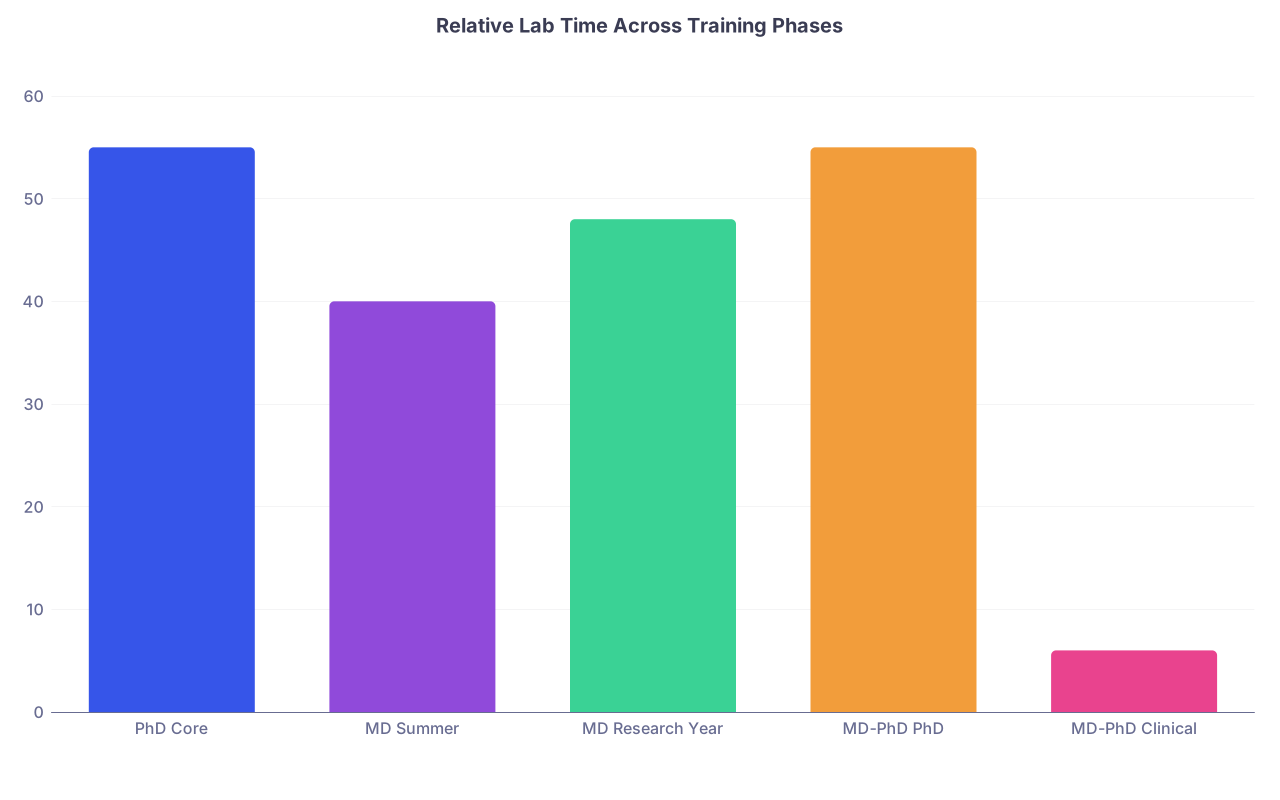
| Category | Value |
|---|---|
| PhD Core | 55 |
| MD Summer | 40 |
| MD Research Year | 48 |
| MD-PhD PhD | 55 |
| MD-PhD Clinical | 6 |
The peak “true lab life” is:
- Continuous, multi-year for PhD students and MD–PhDs during their PhD
- Short, burst-like for MD-only students (summer, 1 research year)
The trough is MD and MD–PhD clinical years, where in-person lab is minimal and the smartest people shift to analysis / retrospective work.
6. Concrete Weekly Schedules by Role and Specialty Interest
The nuance that often gets lost: your specialty interest also changes how you use lab time.
A PhD in a hardcore wet-lab basic science group will look very different from an MD student doing radiology AI research where half the work is coding at home.
Let’s take three archetypes and walk through their real weeks.
Scenario 1: PhD Student in a Mouse Neuroscience Lab
Years 3–4, heavy experiment phase.
Monday
08:30–09:00 – Check post-op mice, weights, recoveries
09:00–12:30 – Behavior assays
12:30–13:00 – Lunch
13:00–17:00 – Slice prep and electrophysiology recordings
17:00–19:00 – Data upload, initial QA, backup
Tuesday
09:00–12:00 – Surgery day (stereotactic injections)
12:00–13:00 – Lunch
13:00–17:00 – More surgeries, set up new cohorts
Evening – Brief animal checks, 30–45 minutes
Wednesday
09:00–12:00 – Immunostaining tissue
12:00–13:00 – Seminar
13:00–18:00 – Confocal imaging of stained sections
Thursday
10:00–12:00 – Data analysis, code behavioral quantifications
12:00–13:00 – Lunch
13:00–16:00 – PI meeting, design next round
16:00–19:00 – Start new behavior batch
Friday
09:00–12:00 – Finish imaging, animal checks
12:00–13:00 – Lunch
13:00–16:00 – Lab cleaning, orders, mouse colony planning
Weekend:
- At least one 1–2 hr trip both days to assess mice and handle any time-sensitive tasks.
This is the most classically “in-lab” life: much of the work cannot be done remotely, and the animals do not care about your social life.
Scenario 2: MD Student on Research Year in Translational Oncology
Bench + clinical data hybrid.
Monday
09:00–11:00 – Tumor sample processing in lab
11:00–12:00 – Tumor board, observe discussions
12:00–12:30 – Lunch
12:30–16:30 – RNA extraction / library prep
Tuesday
09:00–12:00 – Chart review: extract clinical variables into REDCap
12:00–13:00 – Lunch
13:00–17:00 – Meetings with biostatistician, build analysis plan
Wednesday
09:00–12:30 – Bench work continuation
12:30–13:00 – Lunch
13:00–14:00 – Department research conference
14:00–17:00 – R code for survival analysis
Thursday
09:00–11:00 – More data cleaning, revise variables based on mentor feedback
11:00–12:00 – Weekly one-on-one with PI
12:00–12:30 – Lunch
12:30–16:30 – Figures + draft Abstract for ASCO
Friday
09:00–12:00 – Finish wet work for the week
12:00–13:00 – Lunch
13:00–16:00 – Manuscript writing (Intro / Methods)
Weekend: Maybe 2–4 hours before abstract deadline, otherwise free.
Here, “lab” is split: some time at the bench, much time in front of a computer. Time is relatively predictable; you are shielded from call and clinics.
Scenario 3: MD–PhD in Final PhD Year, Ramping to Clinic
You are writing, finishing experiments, and starting to re-engage with the MD side.
Monday
09:00–12:00 – Final experiment replicate
12:00–13:00 – Lunch
13:00–16:00 – Dissertation writing (Results chapter)
Tuesday
09:00–12:00 – Data analysis + final figures for paper
12:00–13:00 – Lunch
13:00–15:00 – Meeting with PI to plan defense timing
15:00–17:00 – Online module for upcoming clerkships (your MD office requires these)
Wednesday
09:00–11:00 – Manuscript revisions after co-author feedback
11:00–12:00 – MD–PhD program meeting (re-integration planning)
12:00–13:00 – Lunch
13:00–16:00 – Practice talk for defense
Thursday
09:00–12:00 – Final bench tasks, protocol handoffs to junior student
12:00–13:00 – Lunch
13:00–17:00 – Literature catch-up for clinical skills, Step 2 planning
Friday
09:00–11:00 – Dissertation editing
11:00–12:00 – PI meeting re: future collaborations during residency
12:00–13:00 – Lunch
13:00–16:00 – Submit paper responses, finalize figures
Weekend: Variable. Some research, some Step prep.
Time-in-lab is tapering; time-in-writing and strategic planning is peaking. You are transitioning from “bench engine” to “PI collaborator in training.”
7. How Much Control Do You Actually Have Over Your Lab Time?
Hours are one thing. Control is another.
Here is the uncomfortable truth:
- PhD students: Moderate control over when they work, low control over how much they work.
- MD students (clinical years): Low control over both when and how much for clinical time; any lab time is what survives.
- MD–PhD: Whiplash. High control during PhD years, almost none during core clerkships.
Let me map it out quantitatively:
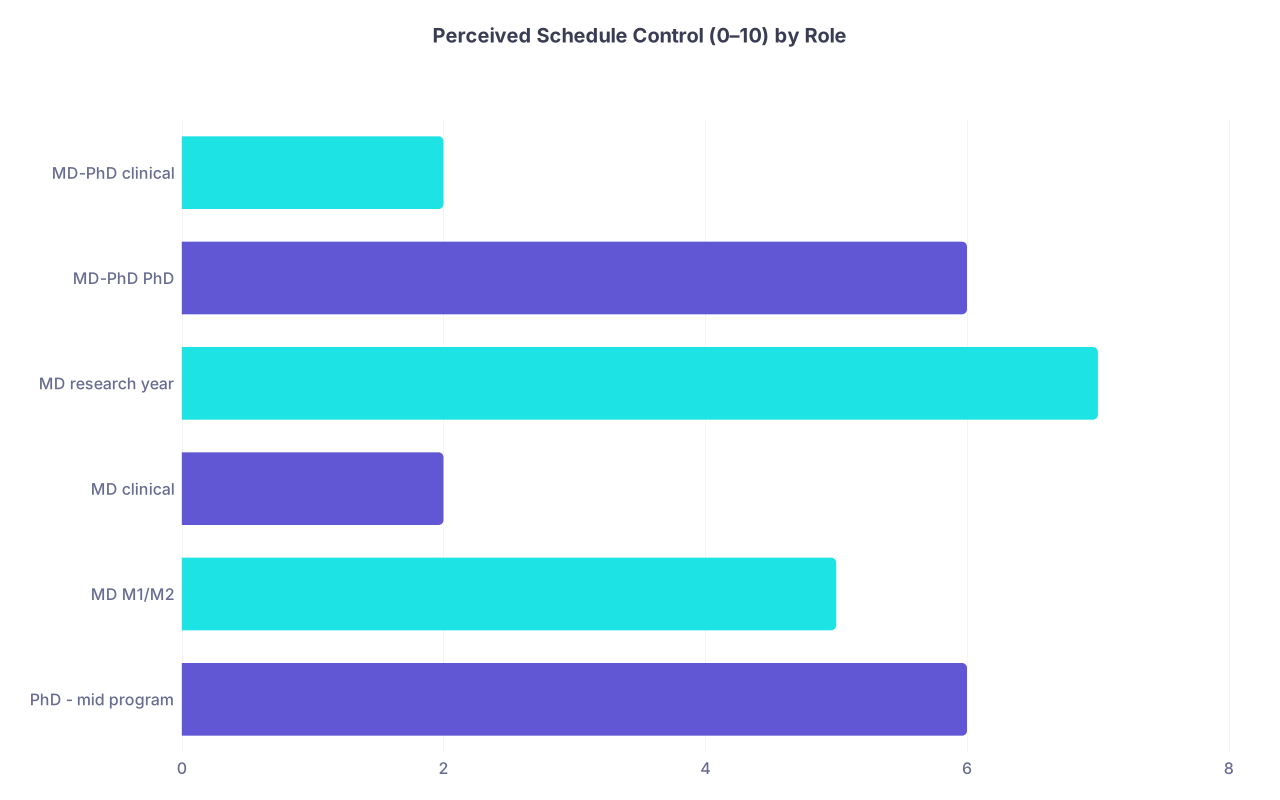
| Category | Value |
|---|---|
| PhD - mid program | 6 |
| MD M1/M2 | 5 |
| MD clinical | 2 |
| MD research year | 7 |
| MD-PhD PhD | 6 |
| MD-PhD clinical | 2 |
Interpretation:
- MD research year and PhD years have the most flexible lab schedules.
- Clinical years are rigid, and any lab work is packed around them, not integrated.
- Preclinical MD / MD–PhD have moderate freedom but are exam-driven—weeks swing between “no time” and “some time.”
This is why the question “How many hours in lab will I have?” is less useful than “Who owns my schedule in each phase?” For MDs and MD–PhDs, clinic always wins.
8. Choosing Your Path Based on Lab-Life Reality
If you are deciding between MD, PhD, and MD–PhD, use the time-in-lab reality as a filter—not the only one, but an honest one.
You probably fit one of these mental profiles:
“I want to live in the lab, drive long-term experiments, and I do not care about billing or clinic.”
- You are more of a PhD. MD training will be a long, expensive detour.
“I like research, but I care more about patient care and being on the wards.”
- MD with structured research experiences (summer, 1 research year, maybe a research track residency) is ideal.
- You will have meaningful research productivity if you are intentional, but the lab will never be your main habitat.
“I want to own translational research, run a lab, and also treat patients in a focused way.”
- That is true MD–PhD territory.
- Accept that your life will be phase-fragmented: heavy lab during PhD, heavy clinic later, with little ideal “50/50” during training.
The biggest misconception: MD–PhDs do not have more total lab hours than PhDs. They have them in a different pattern: compressed into several PhD years, then thinned out and mixed with clinics for the rest of their careers.
9. Final Practical Notes People Gloss Over
A few blunt points students in these tracks quietly talk about at 11 pm in the break room:
- Lab culture > official expectations. A “40-hour” lab with a workaholic PI still feels like 60.
- Animal and clinical recruitment timelines own you. If the OR calls that they have a case that fits your study, your nice color-coded calendar is irrelevant.
- Nights and weekends are research pressure valves. MD students, especially on clinical rotations, often do 100% of their research outside standard hours.
- Being “present” in the lab matters socially. For MDs and MD–PhDs, invisible weeks erode trust. You need to structure visibility, not just productivity.
- Data / computational projects are the only viable way to sustain research during intense clerkships or residency. Benches do not wait. Databases do.
If you want a life where your weekly schedule is mostly: wake up, go to lab, do experiments, come home—then do not fool yourself into thinking MD or MD–PhD are shortcuts. They are not. They are different jobs.
FAQ (Exactly 6 Questions)
1. As an MD-only student, can I realistically get strong publications without a full research year in lab?
Yes, but you will be swimming upstream. One or two solid first-author papers from fragmented time during M1–M4 are possible in highly efficient environments (e.g., retrospective database work, computational projects, or being plugged into a well-oiled clinical research operation). However, for competitive research-heavy specialties (derm, plastics, rad onc, neurosurgery), most serious applicants now take at least one dedicated research year. The gap is not just hours; it is the mental bandwidth to actually drive a project from question to publication.
2. Do MD–PhDs really spend as much time in lab as PhDs during the PhD phase?
Functionally, yes. During the core PhD years, MD–PhDs in serious labs are indistinguishable time-wise from PhD students: 50–60 hours / week is standard, with some peaks and valleys. The critical difference is trajectory and end date, not weekly hours. MD–PhDs usually have a more fixed time-window and are under pressure to finish in 3–4 years, which can make their day-to-day feel a bit more compressed and pointed.
3. Is a PhD actually “less busy” than an MD clinical year in terms of hours?
In raw hours, an aggressive PhD and a heavy inpatient rotation can look similar: 60–70 hours. The difference is how those hours feel. PhD time is usually more flexible, with fewer externally dictated start times and more control over when you read, analyze, or write. Inpatient wards have hard start times, call, nights, and evaluation pressure. Many people experience PhD years as less acutely stressful even when the total hours are comparable, because the time is more self-directed.
4. How much lab presence is “enough” for an MD–PhD during M3–M4 to keep a project alive?
If your project is mainly computational or retrospective, 4–8 hours per week of focused, protected time (usually nights/weekends) can maintain real momentum, especially if the PI or a postdoc runs interference on logistics. For wet-lab experimental work, honestly, less than 10–15 hours per week in-person is marginal. You can contribute, but you will not be the primary driver. Many MD–PhDs deliberately pivot towards analysis and writing projects during clerkships for this reason.
5. Will choosing a PhD instead of MD or MD–PhD limit my future ability to interact with patients or clinical problems?
You will not be a licensed clinician, so you will not be managing patients directly. But if your worry is “Will I be excluded from impactful, clinically relevant research?”—the answer is no. Many of the most influential translational labs are run by PhDs who collaborate tightly with MDs. What you lose is the ability to independently design and run clinical trials or have your own clinic; what you gain is more continuous time in lab and fewer structural constraints on your research agenda.
6. If I love both clinic and lab, is MD–PhD always the correct choice?
No. If you enjoy research but see your primary identity as a clinician, an MD with substantial research (summer + one research year + research-heavy residency) is often a better, shorter, and less fragmented route. MD–PhD makes sense if you are serious about leading a lab long term and want the MD primarily to inform and power your research program—not just to “keep clinic options open.” Look at where you want to spend your best weekly hours at age 40: if that is mostly in lab, MD–PhD or PhD; if mostly in clinic, MD with structured research is enough.
Key takeaways:
- PhD and MD–PhD (during their PhD years) live most of their professional week in the lab; MD students live there only in short, intense blocks.
- Clinic and call always win over lab—so MD and MD–PhD paths inevitably fragment and constrain in-person research time, especially during clinical years.
- Do not choose a dual degree hoping to “get more research exposure.” Choose it only if you actually want years of PhD-level lab life plus the cost and complexity of full clinical training.