
You are post-call, sitting in the residents’ lounge with a half‑cold coffee, staring at yet another “research opportunity” email: one PI wants help with a mouse model of cardiomyopathy, another is pitching a biomarker study in discharged heart failure patients, and your program director keeps saying, “Have you thought about a PhD?”
You are not just asking “what project should I pick.” You are asking the real question:
Bench vs translational vs clinical research – and MD vs PhD – which combination actually fits you, your brain, and the career you want, not the career people keep projecting onto you?
Let me break this down specifically.
1. First, define the three research types without the fluff
People throw around “bench,” “translational,” and “clinical” as if they are clean buckets. They are not. They are gradients. But for decision‑making, you need working definitions.
Bench (basic) research
Location: wet lab, core facilities, sometimes computational lab.
Core features:
- Works with molecules, cells, tissues, animal models, sometimes organoids
- Hypothesis usually about mechanisms: pathways, receptors, gene regulation, structure–function
- Time scale: very slow for “visible” outcomes; fast for data, slow for impact
- Typical outputs: mechanistic papers (JBC, Cell, Nature, etc.), methods, fundamental biology
Example:
- Studying how a specific RNA-binding protein changes after ischemia in mouse cardiomyocytes, and how that alters calcium handling.
If your “patients” are mice, cells, or datasets of sequences, you are in bench territory.
Translational research (“T1–T2 bridge” work)
Location: on the boundary – part bench, part animal, part early human work, or heavy biomarker/method work in patients.
Core features:
- Takes something mechanistic and moves it toward human application or vice versa
- Focuses on feasibility, proof of concept, biomarker validation, early-phase trials, or device development
- Time scale: medium. Longer than a chart review, shorter than discovering a new pathway
- Typical outputs: biomarker panels, phase I/II trials, diagnostic accuracy studies, early device/drug testing
Example:
- Taking that cardiomyocyte protein finding, measuring it in human plasma from STEMI patients, and running a small pilot trial to see whether modulating it changes LV function.
This is the “from bench to bedside” cliché zone. Except the good translational work is much harder and more technical than the cliché makes it sound.
Clinical research
Location: hospital floors, clinics, registries, databases, trial coordinating centers.
Core features:
- Studies humans directly: outcomes, therapies, diagnostics, behaviors, quality improvement
- Data sources: EHR, registries, prospective cohorts, clinical trials, pragmatic trials
- Time scale: can be surprisingly fast for retrospective work; long for large RCTs
- Typical outputs: outcome papers, guidelines-informing studies, comparative effectiveness, meta-analyses, QI trials
Example:
- Comparing readmission rates in heart failure patients randomized to a new multidisciplinary clinic model vs usual care.
If your main unit of analysis is the person (and their chart), this is clinical research.
2. How each aligns with MD vs PhD training
Now the real tension: which of these pairs naturally with an MD, which with a PhD, and where combined degrees shine.
What MD training actually gives you (and what it does not)
MD training strengths:
- Deep pattern recognition for disease presentations and course
- Intuition for clinically relevant questions (what actually matters at 3 a.m. on the wards)
- Access to patients, real-world settings, and clinical data
- Credibility with clinicians, guideline writers, hospital leadership
MD training weaknesses for research:
- Minimal formal training in experimental design beyond basic epidemiology and stats
- Very limited time for deep technical lab skill development
- Intermittent research time, prone to disruption by call, rotations, exams
Translate that: MDs are naturally positioned to ask high‑impact clinical questions and to run or lead clinically grounded translational and clinical research. They can do bench work, but they are usually at a tactical disadvantage against someone who spent 5–7 years full‑time immersed in that space.
What PhD training actually gives you
PhD training strengths:
- Serious depth in a narrow domain (e.g., ion channel biophysics, CRISPR design, Bayesian modeling)
- Years of experience in experimental design, troubleshooting, and technical mastery
- Culture of hypothesis refinement, iteration, and methodological rigor
- Time. Huge blocks of uninterrupted time that clinicians almost never get
PhD training weaknesses (for clinical impact):
- Less direct exposure to patient care realities
- Often weaker intuition about what will change a guideline vs what is “just interesting”
- Usually no independent ability to enroll, consent, and manage patients
PhDs dominate:
- Bench and methods-heavy translational research
- Complex modeling and biostatistics
- Tool/technology development
They can drive clinical and translational work, but they need serious clinical collaborators.
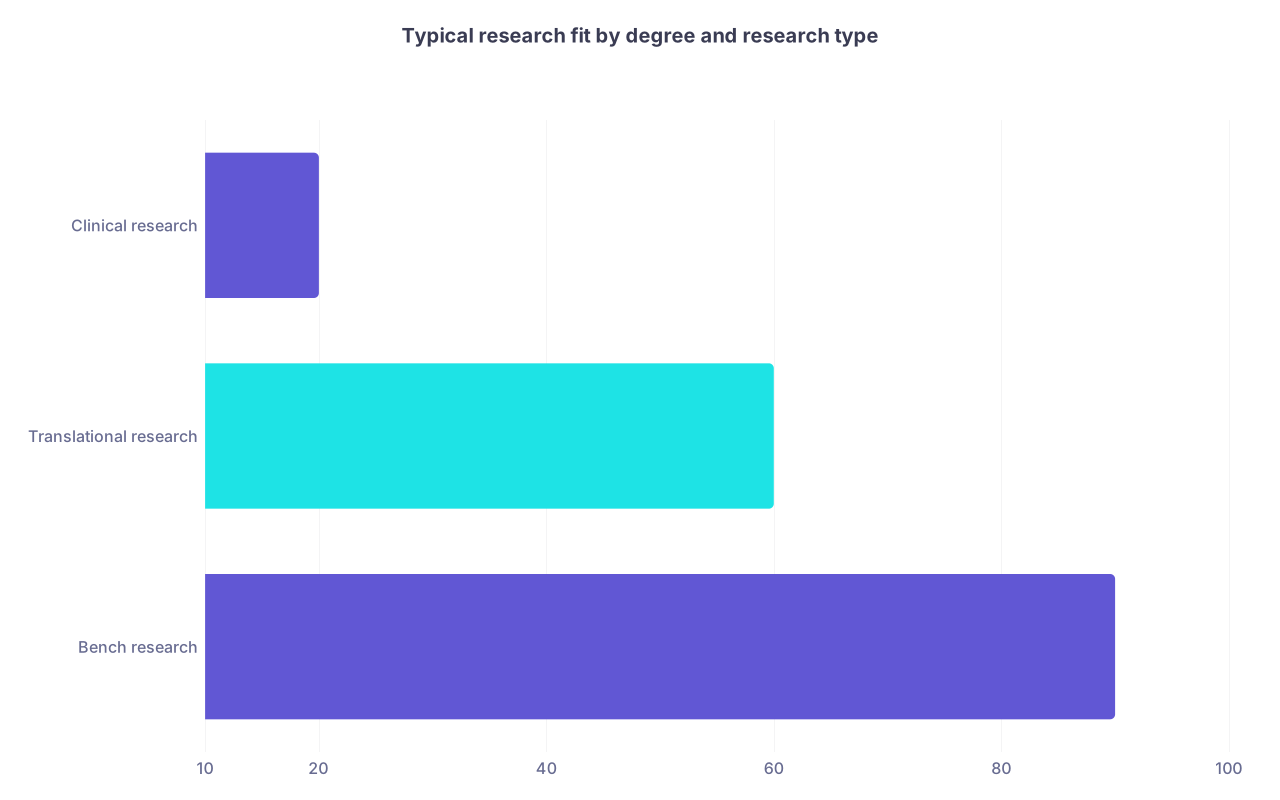
| Category | Value |
|---|---|
| Bench research | 90 |
| Translational research | 60 |
| Clinical research | 20 |
Interpretation: 90%+ of core bench PIs are PhD-trained; translational is mixed; clinical is MD-heavy. Yes, there are exceptions. No, they do not change the trend.
3. MD + Bench, MD + Translational, MD + Clinical: what actually fits
Let’s talk specifically as if you are MD or MD-leaning, since that is where most confusion sits.
MD + Clinical research: the natural pairing
This is the default best fit for most MDs who want research in their career.
What it looks like:
- Retrospective cohort studies from your institution’s EHR
- Prospective registries in your specialty (stroke, heart failure, ICU, oncology)
- Clinical trials: investigator-initiated RCTs, multicenter networks, pragmatic trials
- Outcomes research, health services research, quality improvement with rigorous design
Advantages:
- High alignment with your day job: your clinical work is literally your research substrate
- You sit at the decision point for practice change and can sense what matters
- Lower technical barrier: you can outsource advanced stats, but you control the question and design
- Easier to sustain through residency, fellowship, and early attending years
Disadvantages:
- Fierce competition; many MDs can do similar clinical work
- You must get serious about methods (epidemiology, statistics) or you will produce shallow, forgettable studies
- Funding still competitive; you do not get a free pass because you are “doing outcomes”
Who thrives here:
- People who enjoy guidelines, large datasets, talking odds ratios and NNTs
- Residents who naturally ask “did that actually improve anything?” after trying a new protocol
- Those comfortable working in teams with statisticians, informatics people, and coordinators
If you are MD only and you want research as a substantial part of your career, high-level clinical research is the most realistic and highest-yield primary lane.
MD + Translational research: high upside, high friction
This is where a lot of MD/DO residents get seduced: “bridge the bench and bedside.” The bumper sticker is easy; the career is not.
What it looks like:
- Early-phase clinical trials (phase I/II) of novel drugs/devices that came from bench discoveries
- Human biomarker validation based on mechanistic bench work
- Imaging methods translated from preclinical to clinical scanners
- Working in disease-specific centers (e.g., cancer centers) with strong basic and clinical arms
Advantages:
- Highly fundable if you can actually link mechanism + clinical need + feasible study
- Clinically impactful when done well: you move tools and therapies into human use
- MDs are essential at the human interface: consents, safety, outcome definitions
Disadvantages:
- Requires real understanding of both bench and clinical sides
- You are dependent on robust collaborators: core labs, animal facilities, regulatory teams
- Time intensive. Early-career MDs get crushed here without protected time or strong infrastructure
Who thrives here:
- MD/PhDs with genuine mechanistic chops and clinical training
- MDs in strong research environments who commit to heavy methods training and long-term projects
- People who can live in two cultures: lab meetings and tumor boards, both
Can a pure MD (no PhD) do serious translational work? Yes. But only with:
- Extra training (e.g., research fellowship, master’s, T32, KL2)
- Strong mentorship from basic scientists
- A realistic understanding that you will not personally be the one cloning constructs at 10 p.m.
If your institution lacks a serious basic science footprint, your “translational” project will often degenerate into “glorified clinical correlation with a blood test measured by some external lab.” That is not where you want to anchor a career.
MD + Bench research: niche, but possible
Now the controversial bit. MDs in pure bench roles.
Reality:
- There are MDs who run wet labs and do hardcore mechanistic work
- They are rare, usually at top academic centers, usually MD/PhDs or MDs with extensive postdoc-equivalent training
- They have major protected time (60–80% research) and strong grant support
For a straight MD without PhD:
- Competing head-to-head with people who have 5–7 years full-time bench training is uphill
- You will be slower on techniques, slower on troubleshooting, and more vulnerable to clinical time encroachment
- Funding agencies know this; study sections are not naïve
That said, if you:
- Absolutely love cells/animals/molecular biology more than patient contact
- Are willing to structure your clinical responsibilities to be minimal and carefully bounded
- Commit to an actual postdoc-style chunk of time (2–4 years) doing full-time lab work
Then an MD-led bench career is possible. I have seen a few succeed. But almost all of them behave, in practice, like PhDs who happen to have an MD license.
| Profile | Best Primary Research Type | Best Degree Path |
|---|---|---|
| Mechanism-obsessed, loves pipettes | Bench | PhD or MD/PhD |
| Bridge-builder, likes both lab and patients | Translational | MD/PhD or MD + extra |
| Clinic-focused, systems thinker | Clinical | MD (maybe MS/MPH) |
| Quant nerd, loves models and datasets | Clinical / Translational | MD + MS/PhD or PhD |
4. PhD + Bench, PhD + Translational, PhD + Clinical
Flip it now. You are on the PhD side, or considering it.
PhD + Bench: the canonical pathway
This is the cleanest mapping, and honestly, where most PhDs should start by default.
What it looks like:
- Running a lab focused on a disease mechanism or biological system
- Using cell culture, animal models, or computational biology as the core playground
- Collaborating with clinicians for sample access and clinical questions, but you own the mechanistic arm
Advantages:
- Your training maps almost 1:1 with job requirements
- You control methods, protocols, and intellectual direction
- Many funding agencies are set up to support this exact profile
Disadvantages:
- Translational / clinical relevance can be overstated or hand-wavy if you are not careful
- You may feel “distant” from patients and actual care
- Job market is competitive; you must produce at a high level
If your brain lights up at ligand–receptor interactions, patch clamp traces, or single-cell RNAseq clusters, this is where you should be.
PhD + Translational: highly valuable in the right ecosystem
PhDs in translational research do one of two things:
- They bring deep bench methods into structured translational programs (e.g., cancer centers, CTSA hubs).
- They anchor the “mechanism and assay” side of translational pipelines while MDs drive human studies.
What it looks like:
- Developing assays for biomarkers, then partnering with MDs to test them in patient cohorts
- Designing and optimizing drug candidates or delivery systems before early-phase trials
- Running core facilities that power translational projects (imaging, genomics, proteomics)
Advantages:
- Your work has a clearer path to the bedside
- Strong team-science funding opportunities (P50s, U grants, SPOREs, etc.)
- You can carve a niche as “the mechanistic spine” of a disease program
Disadvantages:
- You are more dependent on MD collaborators to close the loop clinically
- Career metrics sometimes get fuzzy: you contribute key pieces to many projects rather than owning one “hero paper” per year
- You must invest time to actually understand clinical context; otherwise you design pretty but useless assays
This path is superb for PhDs who enjoy application and team science, and who do not need personal ownership of every downstream clinical step.
PhD + Clinical research: rare but real
Can a PhD focus on clinical research? Yes, but the flavor is different.
Common scenarios:
- Biostatisticians and data scientists who co-lead clinical outcomes and prediction studies
- Health services / health policy PhDs who work with MDs on utilization, disparities, cost-effectiveness
- Psychologists or other non-MD PhDs who run clinical trials in their scope (e.g., psychotherapy RCTs)
What you lack:
- Independent license to treat and enroll patients (usually)
- Intuitive feel for day-to-day clinical priorities
What you gain:
- Methodological control: you become indispensable because you own the analytic core
- Portability: you can work across specialties and disease areas
If you are a quant‑heavy person who enjoys impacting medicine through data and design rather than direct care, this can work extremely well.
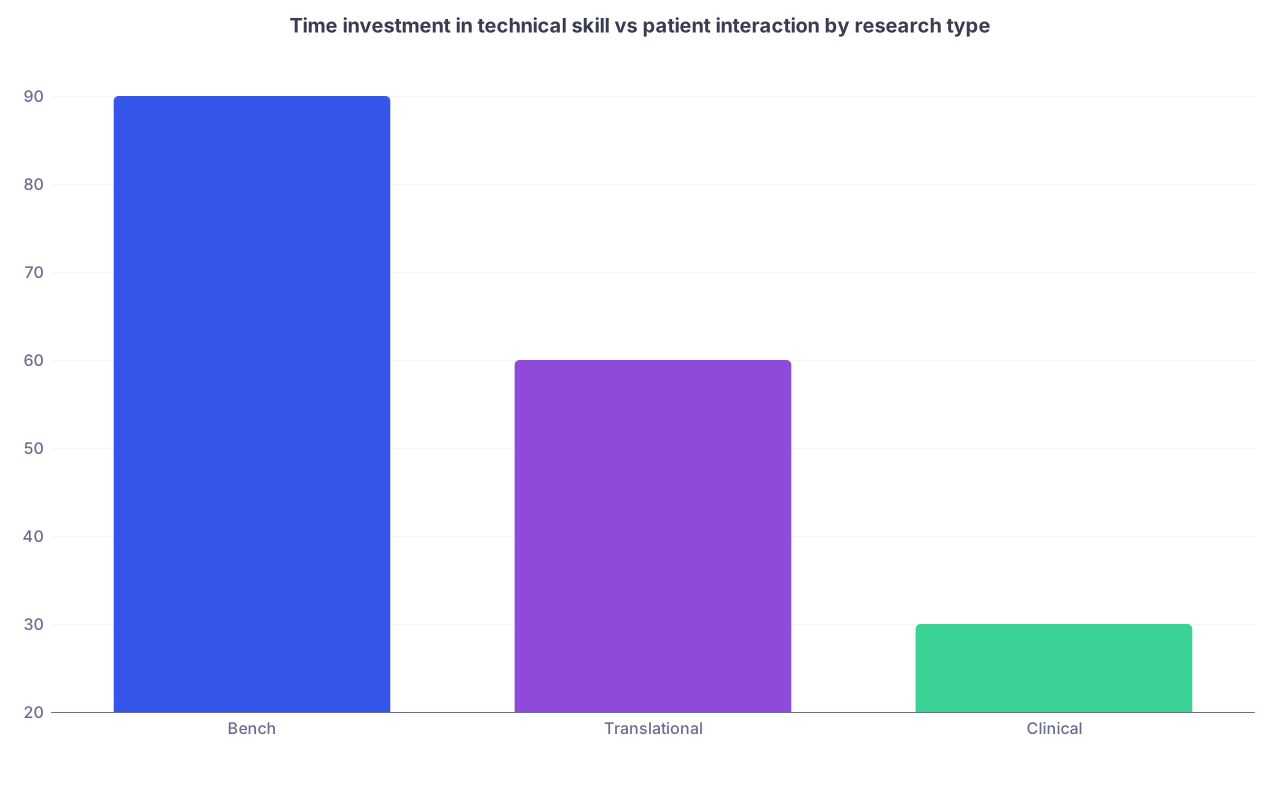
| Category | Value |
|---|---|
| Bench | 90 |
| Translational | 60 |
| Clinical | 30 |
Interpretation: bench research is technique-heavy and patient-light; clinical is the reverse; translational sits in between.
5. MD vs PhD vs MD/PhD: who should pick what combination?
Strip away prestige. Ask one ugly but honest question:
Where does your comparative advantage live?
If you are choosing between MD and PhD from the start
You should lean PhD if:
- Your core joy is explaining mechanisms, not fixing people in real time
- You do not feel a strong pull toward daily patient interaction
- The idea of spending 5+ years obsessing over one pathway or tool sounds exciting, not suffocating
You should lean MD if:
- You want to diagnose and treat disease as your main job
- Reading guidelines, thinking about trial data, and making bedside decisions sounds satisfying
- You are okay with research being one important piece, not the only piece, of your professional identity
You should seriously consider MD/PhD if:
- You genuinely like both complex biology and human disease
- You can tolerate a long training pipeline (8–10 years pre-residency)
- You see yourself spending at least 50% of your career time on research, not as a hobby
MD/PhD pairs best with:
- Bench + Translational work in an academic setting
- Running disease-oriented labs that do mouse work one day and tumor board the next
- Competing for K08, K23, R01, and equivalent investigator-driven grants
If you are already an MD in training and thinking “Do I need a PhD?”
Blunt answer:
- For most people pursuing clinical research: no, you do not need a PhD. A methodologically strong master’s (MS in Clinical Investigation, MPH, etc.) plus good mentorship is more than enough.
- For true bench-heavy careers where you want to be the PI of a molecular lab: a PhD or postdoc‑equivalent training is functionally necessary, whether or not it is degree‑granting.
- For translational careers where you want deep mechanistic credibility: MD/PhD or MD + extended bench training is strongly preferred.
What is overrated:
- Adding a PhD purely to look “academically serious” when your work will be predominantly outcomes research. You would be better served by:
- A focused methods master’s
- Time with a first-rate biostatistics group
- One or two high-quality, tightly designed studies with real clinical impact
6. How to choose your fit – concretely
Enough theory. You need an actual decision process.
Step 1: Track where you lose time when nobody is watching
Think back over the last 6 months of “free” time in medical school or residency:
- Did you end up reading about molecular pathways and methods papers?
- Or did you read trial design, RCTs, and guidelines?
- Or did you tinker with R/Python, cleaning datasets and building models?
Your default curiosities are not random. They point straight at bench, clinical, or methods-heavy translational work.
Step 2: Do a small, real project in each zone if possible
Do not join endless “meetings.” Join a project that forces you to touch the work.
Bench sample:
- One summer in a lab where you personally run experiments and analyze the data
- You should pipette, fail, troubleshoot, and attend actual lab meetings
Translational sample:
- A biomarker or imaging pilot linked to a patient cohort, where you see both the assay and the chart abstraction/data
Clinical sample:
- A retrospective cohort study or prospective QI project with pre/post outcome measures
You will know quickly:
- Whether you like the rhythm of bench work (slow experiments, deep focus, high failure tolerance)
- Whether designing and running protocols in humans excites or drains you
- Whether you like living inside statistical code and regression tables
Step 3: Listen to PIs’ actual lives, not their grant aims
Talk to:
- A bench-heavy PhD PI
- A translational MD/PhD
- A busy clinician–investigator running clinical trials
Ask them specific questions:
- “How many hours per week do you spend with patients vs grants vs data vs lab?”
- “When was the last time you personally touched a pipette / enrolled a patient / wrote code?”
- “If you could redesign your training path, would you still pick MD vs PhD vs MD/PhD for what you do now?”
The content of their answers will be useful. The tone of their answers will be even more useful.
Step 4: Be honest about your tolerance for delayed gratification
Bench and early translational work:
- Long cycles, many dead ends, occasional huge wins
- You might work 3 years on a project that never leaves the lab
Clinical research:
- Faster feedback, more incremental impact
- Higher chance of generating “something publishable” during residency and fellowship
- Lower chance of a single paper that revolutionizes basic biology (obviously)
If you need tangible, near-term results to stay engaged, a pure bench career will be punishing.

| Step | Description |
|---|---|
| Step 1 | Start - Interested in research |
| Step 2 | Consider MD PhD - Bench/Translational |
| Step 3 | MD with Clinical research focus |
| Step 4 | PhD - Bench or Translational |
| Step 5 | PhD in Epidemiology or Data Science |
| Step 6 | Want daily patient care? |
| Step 7 | Love mechanism or systems? |
| Step 8 | Prefer molecules or populations? |
7. Putting it together: best-fit combinations by goal
Here is the blunt mapping:
- “I want to discover new biological mechanisms with some disease relevance”
- Best fit: PhD or MD/PhD, primarily bench, some translational
- “I want to move lab discoveries into real patients and be at that interface”
- Best fit: MD/PhD or MD with dedicated research training, translational focus
- “I want to improve how we treat patients day to day: outcomes, guidelines, systems”
- Best fit: MD with strong clinical research training (MS/MPH optional), clinical focus
- “I want to drive analytic methods and models that others use in clinical research”
- Best fit: PhD in biostatistics, epidemiology, or data science, partnered with MDs
If you fight that mapping, you will spend your career compensating instead of compounding.
FAQ (4 questions)
1. I am an MD resident with zero bench experience but strong interest in mechanisms. Is it too late to go into bench or translational research?
Not necessarily, but you are behind on the technical curve. You would need:
- 1–3 years of serious, mostly full-time lab work (e.g., research fellowship, T32, postdoc-style period)
- A PI willing to treat you like a real trainee, not “the clinician who drops by once a week”
- A realistic plan for protecting time once you return to clinical duties
If you cannot commit that, aim for translational projects where you lead the human side and partner with a strong basic scientist who owns the bench.
2. I am a PhD in basic science and starting to feel boxed in. How can I move closer to clinical impact without an MD?
You do not need an MD to be translational. You need clinical collaborators and context. Join disease‑focused centers, pitch mechanistically informed biomarker or imaging projects to clinicians, and attend relevant tumor boards or case conferences. Learn just enough about the disease to choose meaningful endpoints. Your comparative advantage is making sure the mechanistic or assay side is rock solid.
3. Do MD/PhDs always have to do bench or translational research?
No. Many drift to pure clinical research or even primarily clinical work, sometimes by necessity, sometimes by preference. But it is wasteful to do an MD/PhD and then ignore the “PhD” skillset entirely. If you know from the start that you only want to do outcomes and health services research, an MD plus a methods-focused master’s is almost always more efficient.
4. How early do I need to “lock in” bench vs translational vs clinical as my primary research lane?
Later than people tell you, but earlier than you hope. By:
- End of med school: you should know whether you prefer lab, human studies, or data/methods
- End of residency: you should be aligned with a primary lane (bench, translational, or clinical) and building a track record consistent with it
- Fellowship: you should be executing a coherent research agenda, not jumping types every year
Changing lanes after that is possible but costly; you will essentially re‑enter as a junior in the new lane.
With those pieces on the table, you are not just reacting to whatever “research opportunity” wanders into your inbox. You can start steering. The next step is matching specific mentors and institutions to the path you have chosen—because the right (or wrong) environment will make or break everything you just decided. But that is a story for another day.