
Fear of Wasting Years: Is MD–PhD Worth the Training Length?
What if you commit to an MD–PhD, grind through 8–10+ brutal years of training, and then… realize you don’t even want that life?
That’s the nightmare scenario, right? Not just “this is hard” hard. But “I just burned my twenties and part of my thirties on the wrong path” hard.
If that’s the voice in your head, you’re not crazy and you’re not alone. The length of MD–PhD training freaks out almost everyone who actually understands what they’re signing up for.
Let’s be honest: people love to say, “If you love research and medicine, it’s worth it!”
Cool. But you’re here because you’re thinking:
- What if I change my mind?
- What if I never get a good faculty job?
- What if I end up just seeing patients like any MD, but with 8 extra years and less money?
- What if I’m 35 and still “in training” while my friends own houses and have kids?
So let’s actually answer the question: is MD–PhD worth the training length, for you, not for some idealized unicorn physician–scientist in a brochure.
How Long Are We Really Talking About?
Let’s put the nightmare in numbers first, because hand‑waving “it’s long” just makes the anxiety worse.
| Pathway | School + Training Length | Age Finished (Start at 22) |
|---|---|---|
| MD only | 4 yrs med school + 3 yr residency | ~29 |
| MD only (long residency/fellowship) | 4 + 6–8 | 32–34 |
| MD–PhD (avg) | 8 yrs school + 3 yr residency | ~33 |
| MD–PhD (with fellowship) | 8 + 6–8 | 36–38 |
| PhD only | 5–6 yrs + 2–3 yr postdoc | 29–31 |
And that’s if everything goes relatively smoothly. PhD drags? Add a year or two. Decide on a competitive specialty with longer residency/fellowship? Add more.
So yeah, you might be mid‑30s before you have what feels like a “real” attending-level job.
The math is scary. Especially when you imagine your college friend in tech hitting $200k at 27 while you’re still logging patient notes as a resident.
But here’s the part people often miss: the time cost is real—but so is the time illusion.
Because no matter what you do in your 20s and early 30s… you’re still going to be that age. The real question isn’t “Will I be 35 and still training?” It’s: “When I’m 35, what do I want my skills and options to look like?”
That doesn’t magically make it fine. But it reframes it a bit. You’re not choosing whether to age. You’re choosing what you’re becoming while you age.
The Worst-Case MD–PhD Fears (And How Real They Actually Are)
Let’s drag the ugly thoughts out into the light.
Fear #1: “What if I end up just being a clinician anyway?”
This is probably the most common MD–PhD horror story you hear in whispers:
“He did an MD–PhD at a top place and now he’s just a community internist.”
“She never got protected time, now she’s just seeing patients 5 days a week.”
The thing is, that’s not a myth. It happens. I’ve seen:
- People who thought they loved research… until they were three years into a miserable, failing project.
- Folks who landed in departments that promised “75% research time” and delivered “you’re covering three clinics and we’ll talk about research later.”
- People burnt so thoroughly by the PhD years that they never want to see a pipette again.
So yes, worst case: you can absolutely end up functionally being “just an MD” after adding 4–6+ extra years of training you barely use.
Here’s the hard truth:
If the idea of that scenario makes you want to scream, that’s actually a good sign. It means you do care about research enough that losing it would feel like an amputation, not a relief.
But if you secretly think, “Honestly… I wouldn’t mind if I ‘just did clinical’ in the end,” that’s a giant red flag for committing to an MD–PhD.
Because the default gravity of the system pulls you toward clinical work. You have to fight to protect research. Loving the idea of being “Dr. Scientist” is not enough. You need to love the process of research enough to fight for it when everyone else is tugging you toward more RVUs and clinic templates.
Fear #2: “What if I’m too old when I’m finally done?”
Translation: “Will I be 36, exhausted, behind on life milestones, and resentful?”
I’ve heard variations of this:
- “I don’t want to be a 35-year-old ‘student.’”
- “What if I can’t have kids when I want?”
- “What if dating / marriage is a mess because I’m always in training?”
These are not shallow worries. They’re real life.
And yes, MD–PhD stretches everything:
- You’re more likely to be moving at 30+.
- You might be trying to have kids during residency or postdoc.
- You’ll be financially behind your non-med friends and even behind many MD-only peers.
But here’s the subtle piece: MD‑only paths don’t magically fix this either. Many MDs doing competitive specialties + fellowship also don’t feel “done” until 32–35. A cardiologist or GI doc is not exactly “done” at 29.
The main difference with MD–PhD isn’t just age. It’s identity and momentum:
- 8 years in one place doing school + PhD can feel like “stuck.”
- You watch undergrads become attendings while you’re still rewriting your aim 2.
- The PhD years often feel socially disconnected from the rest of your class.
So yes. You might be older. And you might feel behind. Often.
The only way I’ve seen people not crumble under this is when they’re very clear on this thought:
“I’m trading time and income now for a future where I get to do the kind of work I actually care about.”
If you don’t really believe that trade is worth it, the age thing will slowly eat you alive.
Fear #3: “What if the MD–PhD doesn’t actually help my career that much?”
This one’s complicated.
There’s this fantasy version of MD–PhD:
- You get “automatic” faculty jobs.
- You magically get grants.
- Everyone respects you.
- You smoothly do 70% research, 30% clinic at a top academic center forever.
Reality? More like:
- You still have to compete hard for residencies and fellowships.
- You can absolutely strike out on faculty positions.
- Grants are brutal, with rejection as the norm.
- Some specialties don’t care that much that you have a PhD.
But does the MD–PhD help? For certain tracks, yes, it absolutely does:
- If you want to be a basic/translational scientist with a lab and NIH grants.
- If you want to run clinical trials and lead research programs.
- If you want to live in that physician–scientist lane with protected time.
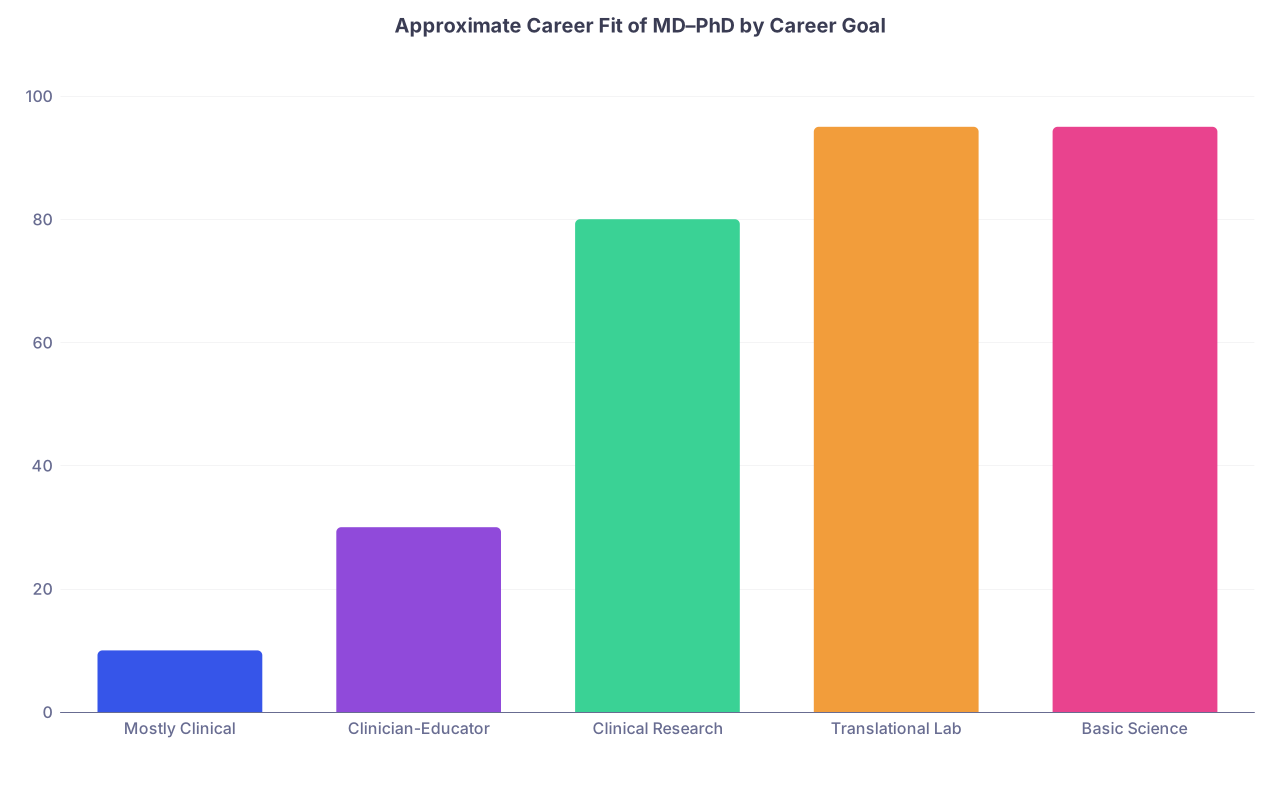
| Category | Value |
|---|---|
| Mostly Clinical | 10 |
| Clinician-Educator | 30 |
| Clinical Research | 80 |
| Translational Lab | 95 |
| Basic Science | 95 |
If your dream job is: “I want to see patients 4 days a week, teach, and maybe do some quality improvement or small projects,” you do not need an MD–PhD. The training length is almost certainly not worth it.
If your dream is: “I want to run a lab, write grants, and have clinical work that informs my research,” that’s exactly what MD–PhD is built for.
So the scary question you have to answer is:
Are you actually willing to live the research life or do you just like the idea of being “dual-degreed and impressive”?
Funding vs Time: The Trap Nobody Really Explains
One thing that messes with everyone’s brain: MD–PhD is usually “free.” Stipend + tuition coverage. MD-only can mean $200k+ in debt.
So your brain does this:
“Free MD–PhD vs $250,000 MD? Obviously take the free one. I’m being smart with money.”
But that’s a half-truth.
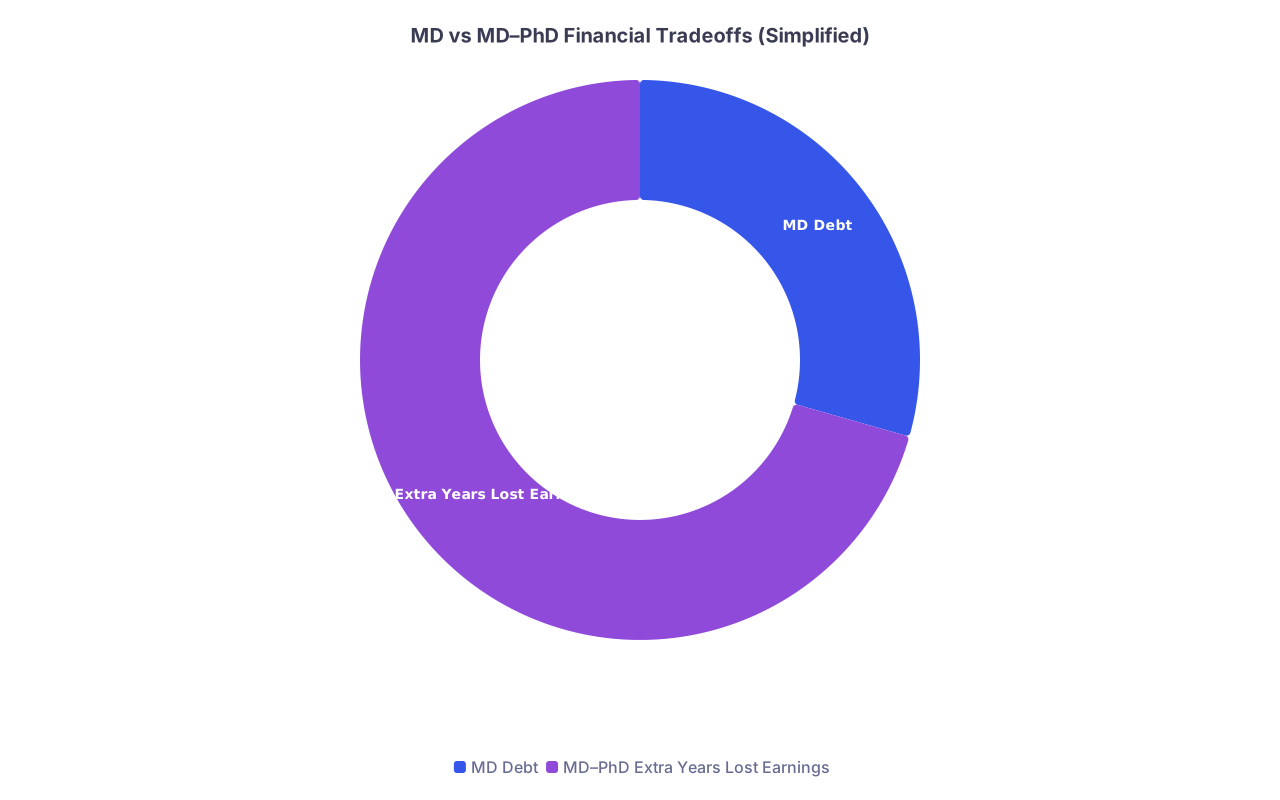
| Category | Value |
|---|---|
| MD Debt | 250 |
| MD–PhD Extra Years Lost Earnings | 600 |
Because those extra 4–5 years? That’s 4–5 years of attending-level income you’re not earning. Extremely rough math: even assuming $200–250k/year potential attending salary, you’re foregoing $800k–$1.25M in gross income.
No, it’s not that simple. You’re not going to be an attending at 26. But the point stands: you’re paying with time and delayed income instead of tuition checks.
So the real equation is closer to this:
“Is having an MD–PhD career I love worth trading:
- Several extra years,
- Earlier financial independence,
- And a simpler, shorter path?”
Sometimes the answer is yes. Sometimes it’s absolutely not.
The worst mistake is choosing MD–PhD just to avoid debt, when you don’t genuinely want the career it sets you up for. That’s like getting a free ticket to a city you don’t want to live in.
Who Actually Regrets MD–PhD (And Who Doesn’t)
Let me be blunt: I’ve seen people deeply regret choosing MD–PhD.
Patterns in the regret crowd:
- They liked research in undergrad, but hadn’t done anything truly independent or long-term.
- They chose MD–PhD mainly for “prestige” or “funding.”
- They imagined a faculty job as a guaranteed outcome instead of a competitive long game.
- They discovered during the PhD that they hate the uncertainty, repetition, and constant failure of research.
They hit PGY-2 or PGY-3 and think: “I could have been here four years ago.”
On the flip side, the ones who rarely regret it:
- Did at least 1–2 full years of legit research before applying (not just a summer project).
- Enjoyed the process of research: troubleshooting experiments, analyzing data, writing.
- Can see themselves working on the same kind of question for years without boredom.
- Care more about impact and discovery than about getting to a certain salary quickly.
They still complain about the length. They still get tired. They still question their life choices some nights. But when they imagine a life where they never get to seriously do research, that feels worse than all of it.
MD vs MD–PhD vs PhD: What Are You Actually Optimizing For?
You’re not choosing a degree. You’re choosing a life you’re signing up to live.
Here’s the blunt version:
- If you mainly want to treat patients, influence healthcare, make good money, and maybe dabble in smaller projects → MD.
- If you want to fully live in research, couldn’t care less about writing notes in an EMR, and don’t need the MD authority in clinical settings → PhD.
- If you want to live in that awkward, demanding middle: serious research + real patient care, and you don’t mind your life being more complicated and slower to stabilize → MD–PhD.

If reading that last bullet makes you think: “Yes, that’s literally me, I want both and I’m willing to pay for it in time,” then the length might be worth it.
If you felt a twinge of nausea instead, listen to that.
How to Pressure-Test Whether MD–PhD Is Worth It For You
This is where you stop reading generic advice and actually test yourself a bit.
Ask yourself, no sugarcoating:
Have you done at least 1+ year of real research with your own project?
Not just washing dishes, not just shadowing. Your own data. Your own figures. If the answer’s no, you’re gambling.Can you name specific research questions you’d want to spend 5+ years on?
If all you’ve got is “cancer” or “neuroscience is cool,” that’s not enough.Does the idea of writing grants and papers for the rest of your life sound meaningful or just exhausting?
Because that’s the job.If you didn’t get to do serious research as an attending, would you feel relieved or devastated?
Your gut answer here is huge.Are you okay with being “behind” your peers on every normal life milestone for a while?
Not theoretically. Actually okay.
If your honest answers skew toward “no,” “not really,” or “I don’t know,” it doesn’t mean you can’t ever do MD–PhD. But it does mean: you probably should not make this decision on vibes alone.
At minimum, you should take 1–2 gap years doing full‑time research before you commit. That’s not wasting time. That’s paying for clarity so you don’t waste even more time in the wrong training.
FAQs – Anxious Edition
1. What if I start an MD–PhD and realize during the PhD I hate research?
Then you’re living the nightmare scenario people whisper about. But it’s not an automatic life-ruiner. A lot of programs allow you to exit with just the MD if you truly want out, though it’s messy and emotionally rough. You’ll feel guilty. You’ll feel like you “failed.” But you’d still be an MD-in-training, which is not exactly a tragic outcome. It just means you took a long, painful detour. That’s why you absolutely should test your love for research before you’re already enrolled.
2. Does doing an MD–PhD guarantee me an academic job with lots of research time?
No. No one is guaranteed a cushy physician–scientist role, not even from the most prestigious MSTP. What it does give you is a powerful signal that you’re serious about research, training that makes you more competitive, and funding experience that’s harder to get as MD-only. But you still have to hustle, publish, get good mentorship, land a good residency/fellowship, and then convince a department you’re worth hiring and protecting. If you’re looking for a guarantee, MD–PhD won’t give it.
3. Can I just do MD now and “add research later” without the PhD?
Yes. Many people do this. You can do research in med school, during residency, and as faculty. You can pursue research fellowships, master’s degrees, or even a PhD later if you really want it. The catch is that it’s harder to carve out substantial protected research time as MD-only, and you may always feel like you’re trying to “prove” your research seriousness. But it’s 100% possible to have a research-heavy career without the dual-degree, especially in clinical or outcomes research.
4. Is the MD–PhD length worth it financially in the long run?
Purely financially? Usually no, if your alternative is a solid MD career with a good specialty. You might come out okay or even very well, but you probably won’t “beat” someone who finished earlier and started earning attending pay sooner. The value of MD–PhD is not primarily financial—it’s in the kind of work you get to do. If your top priority is maximizing lifetime income with minimum delay, MD–PhD is not the way.
5. What if I’m interested in a super competitive specialty—does MD–PhD help?
It can help at the margins, especially for research-heavy specialties like dermatology, radiation oncology, certain surgical subspecialties, or academic neurology/oncology. Strong research credentials (PhD, publications) absolutely help you stand out. But they don’t compensate for weak Step scores, poor clinical performance, or bad letters. Also: doing an MD–PhD just to “boost” your shot at a competitive specialty is a terrible idea if you don’t truly want a research-based career.
6. I’m terrified of wasting years—how do I make peace with whatever I choose?
You don’t get perfect peace. You get a choice and then you get tradeoffs. What actually helps is making your decision on purpose instead of by inertia or fear. That means: get real research experience, talk to actual MD–PhDs at different stages (PhD, residency, junior faculty), talk to MD-only academic physicians, and write down what a “good life” looks like for you at 40. If you can convincingly see MD–PhD as the best path to that life, the training length becomes a cost you’re consciously paying, not a fog you’re stumbling into.
Open a blank page right now and write two things: “If I never did serious research again, would I feel relieved or crushed?” and “At 40, my ideal week of work looks like…”. Answer those honestly, without trying to impress anyone. That’s your starting point.