The myth that only “superhuman robots” should do MD–PhD is flat‑out wrong.
But the fear that MD–PhD will burn you out? That’s very real. And honestly, it’s smart you’re worried about it instead of blindly signing up for an 8+ year life commitment because you “like research.”
Let me be blunt: loving lab work isn’t enough by itself to make MD–PhD a good idea. But fearing burnout also doesn’t automatically mean you’re too fragile or “not cut out” for it.
You’re just seeing the cost clearly. Which a lot of people don’t until they’re already stuck.
Let’s untangle this.
What You’re Really Asking (Underneath “Is MD–PhD Too Much?”)
You’re not just asking, “Is MD–PhD hard?” You already know it is.
You’re asking stuff like:
- What if I start an MD–PhD and halfway through the PhD I can’t stand it anymore?
- What if everyone else in the program is insanely productive and I’m the weak link?
- What if I lose all my clinical skills while I’m in the lab and never feel like a real doctor?
- What if I’m already tired as a premed — so how the hell am I supposed to survive 8–10 more years?
- What if I waste the “prime” of my 20s/early 30s and come out miserable?
Those are not overreactions. I’ve heard versions of those exact sentences from MD–PhD students at places like UCSF, Washington University, Pitt, you name it.
So let’s not sugarcoat.
How MD–PhD Actually Feels Day to Day (Not the Brochure Version)
The brochure shows people smiling at microscopes and then examining patients with a mentor beaming proudly in the background.
Reality is…a little different.
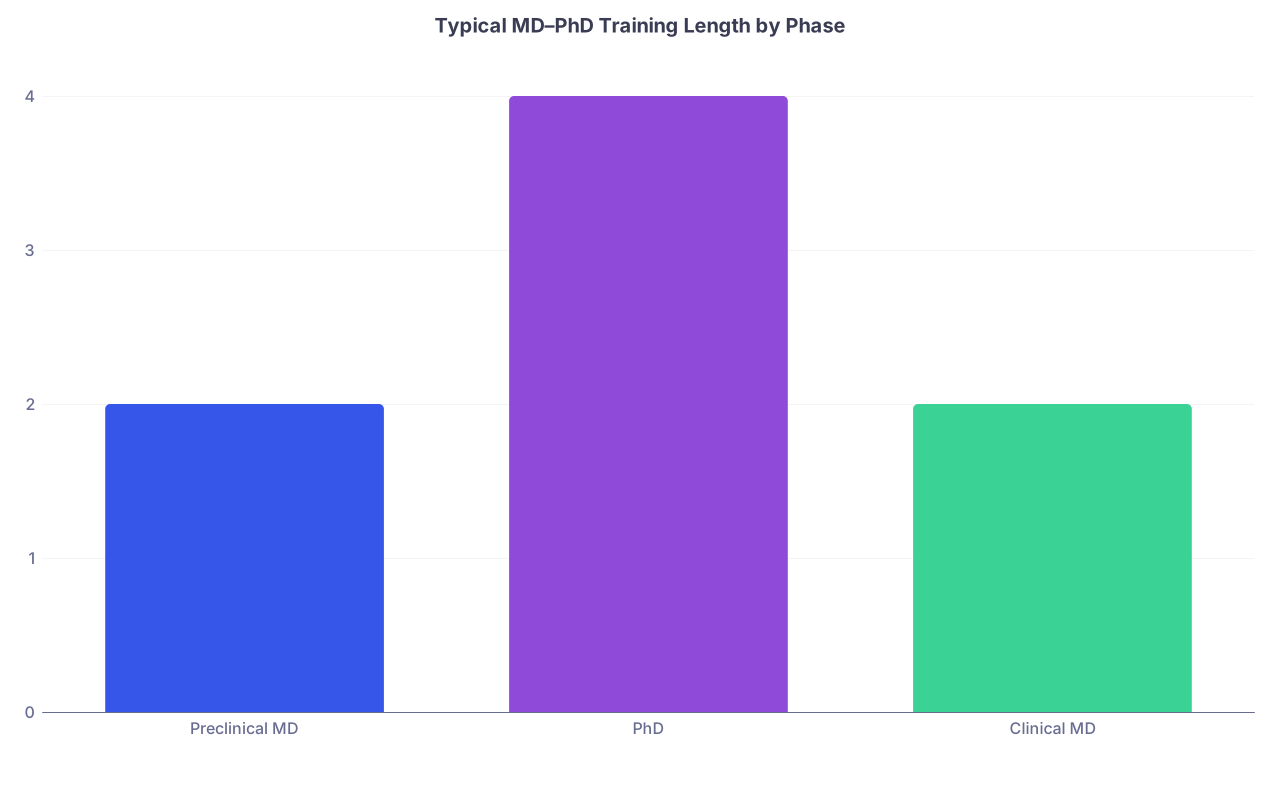
| Category | Value |
|---|---|
| Preclinical MD | 2 |
| PhD | 4 |
| Clinical MD | 2 |
For most MD–PhD programs, you’re signing up for about 8 years:
- 2 years: preclinical med school (anatomy, biochem, exams nonstop)
- 3–5 years: PhD (lab, research, papers, failed experiments)
- 2 years: clinical rotations (wards, call, notes, pagers, patients)
Does everyone finish in exactly 8? No. I’ve seen people at 9. Even 10. Because experiments don’t care about your timeline. Neither do thesis committees.
The med school part
Preclinical MD is not “intro level.” It’s drinking from a firehose while trying not to drown. Most MD–PhD students can handle the academics fine. The burnout there is more like:
- Constant performance pressure
- Feeling guilty if you’re not studying
- Comparing yourself to that one person who “never studies” and still crushes exams
- No space to think deeply, which research‑oriented brains desperately want
You probably will be OK academically. But you might feel like you’re suppressing the part of you that loves slow, careful experimentation.
The PhD part
Then suddenly, you’re tossed into the opposite world: ambiguous goals, long timelines, and nobody cares about tiny grades — they care about “productivity.”
This is where a lot of the burnout risk lives.
Lab life looks like:
- 6+ hour experiments that fail because of one stupid contaminated reagent
- Working nights or weekends because “the cells are ready”
- Watching your friends in the MD class graduate while you’re still optimizing a Western blot
- Papers rejected. Grants not funded. Reviewer 2 acting like your work personally offended them
But also: it’s where you might be happiest intellectually.
You know that feeling you get when an experiment works and the data actually mean something? MD–PhD students live for that. The problem is the massive emotional valleys between the peaks.

The Core Question: Do You Love Lab Work Enough To Survive Its Worst Days?
People romanticize “I love lab work.” But the version in your head might be:
- Cool discoveries
- Presenting posters
- Smart colleagues
- Flexible hours
Reality includes:
- Doing the same protocol for the 14th time because it “almost worked”
- Your PI saying, “We need more data before we can publish”
- Watching a younger grad student graduate before you because their project took off
- Wondering if you’re actually bad at science or just unlucky
So let’s be real: you shouldn’t do an MD–PhD unless you can answer yes to both of these:
- You enjoy the process of figuring things out, even when it’s slow, frustrating, and uncertain.
- You’re OK tying your identity, at least in part, to being a scientist, not “just” a future clinician.
If what you actually like is: “I enjoy structured lab classes, getting A’s in research methods, and doing a summer project where someone already set up the system for me,” that’s not the same as loving real research.
That doesn’t make you weak. That makes you sane.
Burnout Risk: MD vs MD–PhD (It’s Not As Simple As “MD–PhD Is Worse”)
Here’s the annoying truth: you can absolutely burn out on either path.
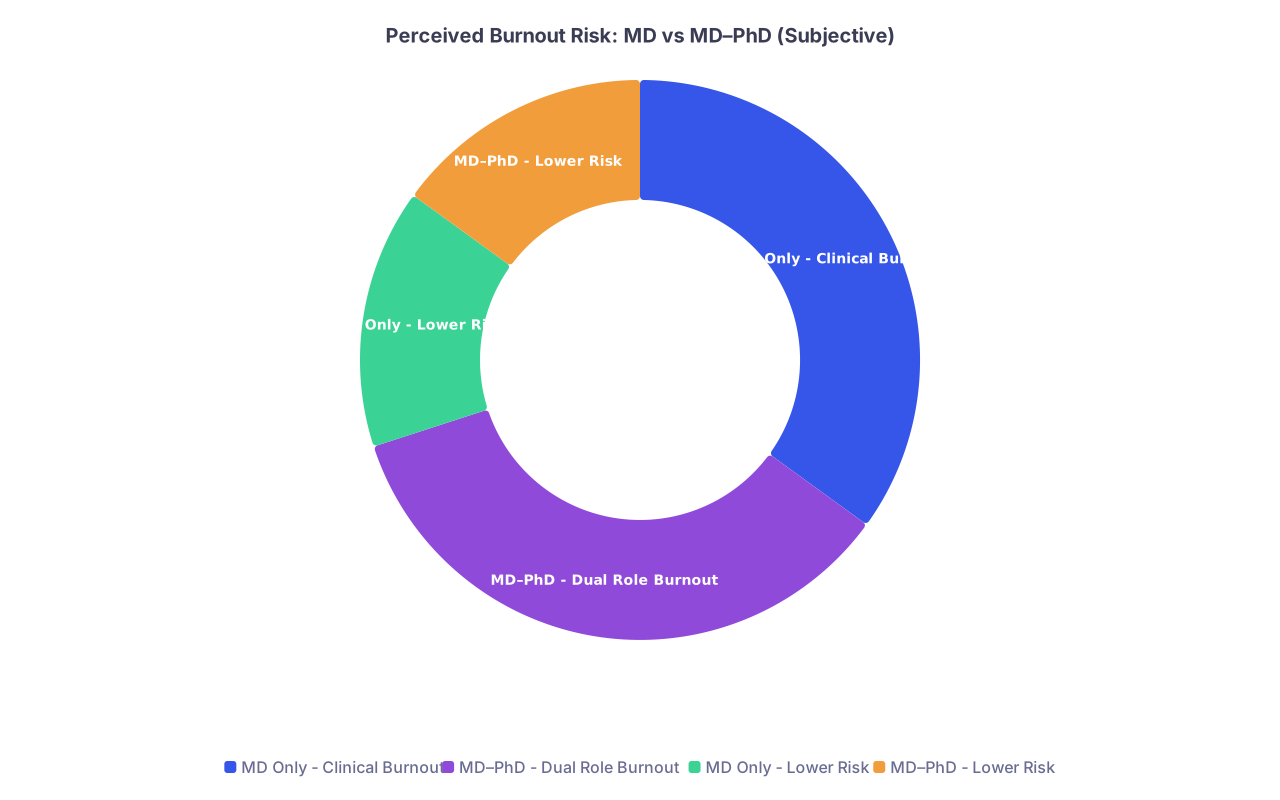
| Category | Value |
|---|---|
| MD Only - Clinical Burnout | 35 |
| MD–PhD - Dual Role Burnout | 35 |
| MD Only - Lower Risk | 15 |
| MD–PhD - Lower Risk | 15 |
MD‑only burnout often looks like:
- Endless clinic days
- RVU pressure, billing, admin nonsense
- Charting at home at 10 pm
- Feeling like a “cog” with no time to think
MD–PhD burnout is different:
- Feeling like you’re never “enough” in either world
- Losing your clinical confidence during the PhD years
- Feeling pressure to constantly produce: grants, papers, talks
- Identity whiplash: am I a doctor? a scientist? neither? both?
So no, MD–PhD isn’t automatically more “burnout‑y.” But it’s a longer, more complex path, and the types of strain are different.
If you’re already exhausted by academic life now, ask yourself: is it because you hate the grind? Or because you’re bored and want more depth and ownership? Those two burnouts are not the same.
A Brutally Honest Sanity Check: Should You Even Consider MD–PhD?
Let’s put some structure to the chaos in your head.
| Question | If you lean MD–PhD | If you lean MD only |
|---|---|---|
| Need to do high-level research? | Strong yes | Mild/uncertain |
| Tolerance for long training | High-ish | Low/moderate |
| Enjoy ambiguity, trial and error | Yes | Not really |
| Crave patient contact early/often | Less urgent | Very strong |
| Fear of long-term debt | High concern | Manageable |
If you’re reading that and thinking, “Oh God, I’m split down the middle,” that’s normal.
But if your answers are:
“I mostly want to take good care of patients, maybe do some clinical research, and I’m already dreading more school”
→ MD only is probably wiser.“I feel dead inside when I’m not thinking deeply about mechanisms, I fantasize about hypotheses, and I’m weirdly OK with a long, twisty road if it means I get to lead science”
→ MD–PhD is more on the table.
Debt, Money, and the Fear of Being Trapped
You know this, but let’s say it out loud: one big perk of MD–PhD (especially MSTP) is funding.
Most MSTP programs:
- Pay your med school tuition
- Give you a stipend during both MD and PhD years
That sounds amazing when you’re staring down $250k+ of potential med school debt.
But here’s the catch: if you’re doing MD–PhD just to avoid debt, and not because you’re all‑in on research, you’re setting yourself up to be trapped in a long program you resent.
Financial reality matters. But “I’m afraid of loans” is not a good enough reason to spend 8–10 years in training for a job that is explicitly research‑heavy.
Worst-Case Scenarios You’re Afraid Of (And How They Actually Play Out)
Let’s walk through some of the nightmare stories you’re probably playing in your head at 2 am.
1. “What if I quit the PhD halfway?”
It happens. More than programs like to admit.
Is it ideal? No.
Does it ruin your life? Also no.
People who leave MD–PhD often:
- Transition into MD‑only
- Lose funding, sometimes owe tuition for the MD years going forward
- Feel guilt and shame for a while
- Eventually…are fine. They become doctors. Nobody in clinic cares that they once started a PhD.
But you can avoid that misery by not starting MD–PhD unless your research interest is serious.
2. “What if I come back to clinical years and I’m awful with patients?”
Every MD–PhD I’ve talked to has worried about this. The first few months back are rough. Skills are rusty. Physical exam feels alien. You’re older than your classmates.
But people do catch up. Quickly. The human brain is annoyingly adaptable.

| Step | Description |
|---|---|
| Step 1 | Preclinical MD 1-2 |
| Step 2 | PhD 3-7 |
| Step 3 | Clinical MD 3-4 |
| Step 4 | MD Only Path |
| Step 5 | Doubt about research |
What actually hurts more is the identity crash:
- Your MD‑only classmates are already co‑residents, maybe attendings, while you’re a student again
- You feel like you’ve “lost years”
That’s a psychological thing, not an actual competence thing.
3. “What if I end up doing neither serious research nor serious clinical work well?”
This is one of the deepest MD–PhD fears: being “mediocre at both, great at nothing.”
Reality check: some MD–PhDs absolutely do end up mostly clinical with a little academic window dressing. Some do mostly research and barely see patients. Some find a true 50/50.
The people who end up frustrated are usually the ones who:
- Chose MD–PhD for prestige or funding, not for actual love of research
- Never really found a niche in which they feel competent and valued
If you’re already someone who obsesses about doing things well and hates feeling half‑baked, you’re actually less likely to let yourself drift like that.
Alternatives If You Love Lab Work But Hate the Idea of 8+ Years
You are not stuck between “MD–PhD or nothing.”
There are other ways to blend medicine and research with less structural commitment:
- MD only + strong research during med school
- MD only + research year (between M3/M4 or after graduation)
- MD only + research fellowship during residency
- MD only + Master’s (MPH, MS, etc.)
- Or: straight PhD, if what you really want is science and medicine is more of a side curiosity

If your heart lights up at patient contact and lab is “cool but optional,” an MD with serious research time is more than enough.
If your heart lights up most at experimental questions and patients feel a bit secondary, then honestly, a PhD or MD–PhD might be better than MD alone.
How To Test Yourself Before You Commit
You don’t have to guess blindly about burnout. You can stress‑test your interest and resilience now.
Here’s what I’d do if I were you, starting this week:
Get back into a real lab if you’re not in one now. Not a class. Not a 2‑hour/week thing. A real lab with real responsibility. See how you feel after 3–4 months, when the novelty wears off.
Notice what type of exhaustion you feel.
- Mentally tired but satisfied after a long day chasing an experiment?
- Or mentally fried and resentful, wishing you were with people instead of cells/mice/computers?
Talk to at least three MD–PhD students. Ask them:
- “Tell me about your worst week in this program.”
- “If you could go back, would you still do MD–PhD?”
- “How many people in your program have left or burned out?”
Be honest about your life priorities.
If the thought of being in training until your early 30s makes you want to scream, don’t ignore that. You don’t magically become a different person in med school. The dread you feel now will still be there later.
A Hard Truth: You Will Never Find a Path With Zero Burnout Risk
If you’re wired like most anxious, overthinking premeds (hi, I see you), you’re probably searching for the option where you:
- Don’t regret the decision
- Don’t burn out
- Don’t fail
- Don’t disappoint anyone
- Don’t close any doors
That option does not exist.
MD has burnout risk. MD–PhD has burnout risk. PhD has burnout risk. Even not going into medicine has burnout risk.
So the better question is:
On which path are you most willing to suffer?
Because you will suffer. The key is choosing the flavor of suffering that comes with rewards you actually care about.
If the idea of doing deep, long‑term research makes the pain feel “worth it,” MD–PhD is still absolutely on the table, even if you’re scared.
If the idea of yet more school, more uncertainty, more “your experiment failed,” makes you feel like you’re suffocating? Then please don’t sign yourself up for 8–10 years of that because you once had a fun summer in a lab.
So…Is MD–PhD Too Much for You?
Here’s my honest stance:
MD–PhD is “too much” for you if:
- You’re mainly doing it to avoid debt or to seem impressive
- You like lab but don’t need it as a core part of your career identity
- You already feel maxed out by school and hate ambiguity
- Your main dream is to be an excellent clinician with a happy, stable life
MD–PhD is not too much for you even if you’re scared if:
- You feel empty when you’re not wrestling with scientific questions
- You can tolerate long, frustrating projects as long as the work is meaningful
- You’re OK being a little “off-cycle” in life milestones (later residency, later attending)
- You’d honestly regret not giving yourself a shot at a serious research career
You don’t have to be fearless to do MD–PhD.
You just have to want the scientist part of your future badly enough that the fear doesn’t win.
FAQ (Exactly 4 Questions)
1. What if I start MD–PhD and realize I only want to do clinical work?
Then you pivot. People leave MD–PhD tracks and become MD‑only all the time. It can come with financial/logistical headaches, but it’s not the end of the world. Programs hate to advertise it, but they’d much rather you be a happy, functioning physician than a miserable, half‑engaged MD–PhD student stuck in their lab. The risk is real, but it’s survivable.
2. Will MD–PhD make residency applications easier or harder?
Easier for certain research‑heavy specialties and academic programs, especially if you have strong publications. Harder in the sense that you’re older, maybe more selective, and sometimes torn between research time and clinical training. But program directors love MD–PhD applicants who actually used their training well. If you’re productive and have a clear story, it’s a plus. If you coasted through the PhD, it’s more complicated.
3. Can I still do serious research with an MD only?
Yes. 100% yes. You’ll have to be more intentional about carving out protected time, maybe doing a research year or research fellowship, and finding mentors who actually support physician‑scientists. It’s harder to be a basic science PI with only an MD, but it’s not impossible, and clinical/translational work is very doable. MD–PhD is a structured pipeline, not the only doorway.
4. I’m already feeling burned out as a premed. Is that a sign I shouldn’t do MD–PhD?
It’s a sign you need to figure out why you’re burned out. If it’s from pointless hoop‑jumping, shallow coursework, and busywork that feels meaningless, you might actually do better in an environment where you own your project (like a PhD). If it’s from the whole idea of endless training, delayed adulthood, and high‑stakes pressure, then yes, MD–PhD might amplify that, not fix it. Your current burnout isn’t a verdict, but it is data you shouldn’t ignore.
Open a blank page right now and write two short paragraphs: one describing your life in 10 years as an MD–PhD physician‑scientist, one as an MD‑only clinician who sometimes does research. Read them both. Which one scares you in a way that feels exciting, and which one just feels heavy? Start listening to that answer.