
What happens if you’re two years into a PhD, everyone thinks you’re on this brilliant research track… and you can’t stop thinking about rounding, clinic notes, and auscultating an actual human chest?
Because that’s the fear, right?
That you’ll commit to a PhD, lose your place in the “MD line,” and then wake up one day realizing: I want patients, not pipettes… and now I’ve ruined everything.
Let me say this clearly: you are not the first person to panic about this, and you’re not trapped. But the paths out are messy, emotional, and sometimes expensive. Let’s walk through it honestly.
First: Are You Actually Missing Patient Care… Or Missing the Idea of It?
This is the part no one wants to admit out loud.
A lot of people in PhDs say, “I miss patient care,” but when you dig deeper, they actually miss:
- Structure (set rotations vs. endless unstructured research time)
- Clear progress markers (shelf exam → Step → clerkships vs. “your experiment failed again, try a new protocol”)
- External validation (grades, evals, attendings saying “good job” vs. weeks with no feedback)
- Community (team on rounds vs. solo in the lab at 11 pm with a half-broken centrifuge)
And yeah, some truly miss direct human care: being in the room, making decisions, touching lives in this very tangible, immediate way. But it’s easy to conflate that with just… hating your current environment.
Ask yourself some ugly, uncomfortable questions:
When I picture “patient care,” do I picture:
- Real medicine: 3 am consults, EMR frustrations, difficult families, no time to pee
- Or the highlight reel: grateful patients, interesting cases, “Doctor, you saved my life”?
When I’m miserable in the lab, is my brain saying:
- “I deeply miss clinical reasoning and bedside interactions”
- Or “I just want out of this project/PI/school and medicine looks like an escape hatch”?
If I imagine a good PhD environment (supportive PI, interesting project, good lab culture)… do I still feel like I’d rather be in clinic than at the bench?
If even in the best-case PhD scenario you still crave patients, that’s important. That’s not just burnout. That’s direction.
If what you miss is structure, clarity, and human interaction in any form… you might be idealizing patient care as a fix for larger dissatisfaction.
You don’t have to perfectly answer this today. But you do have to stop pretending you “just need to push through” without interrogating what you’re actually feeling.
Are You “Wasting Time” If You Switch Paths?
I know this is the one that keeps you up.
“If I leave this PhD, I wasted 2–3 years.”
“If I stay and then still go to med school, I’ll be 35+ when I’m done.”
“If I don’t finish, everyone will think I failed.”
Let’s be brutal about the numbers for a minute.
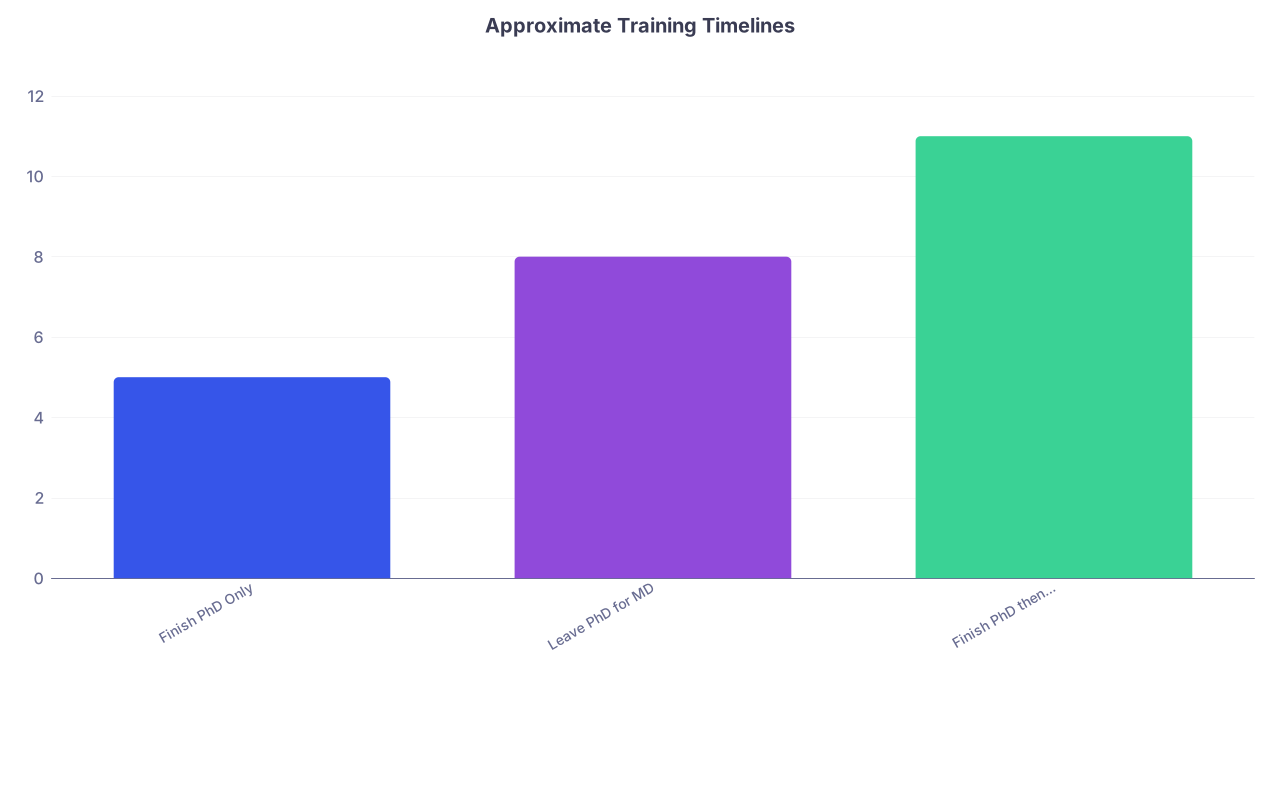
| Category | Value |
|---|---|
| Finish PhD Only | 5 |
| Leave PhD for MD | 8 |
| Finish PhD then MD | 11 |
Roughly, you’re comparing:
- 5-ish years: PhD only → postdoc → academic/industry research
- 8-ish years: leave now → finish prereqs/apply → med school → start residency
- 11-ish years: finish PhD first → then med school → then residency
The anxiety voice says: “11 years? That’s insane. I’ll be ancient. I’ll be an intern with gray hairs.”
Reality: every program has “non-traditional” students who started at 28, 32, 36, 40+. They still match. They still practice. Their patients do not care what year they took organic chemistry.
Here’s what is a waste: staying in a track you already know you don’t want, only to avoid looking like you changed your mind.
You don’t get a medal for suffering in the wrong career.
You also don’t get your time back. But that time isn’t garbage. You gain:
- Research skills most MDs never truly get
- Comfort reading primary literature and designing studies
- Credibility for future academic/physician–scientist roles
- Maturity, perspective, and frankly, some grit
Is there a cost? Yes. Lost income, added loans, more years of training. You’d be stupid not to factor that in.
But “wasted time” is a really bad decision metric. If your future self as a 45-year-old attending (or 45-year-old PI deeply missing clinical work) looked back, would they say: “Glad I stayed in the wrong field to avoid being 1–3 years older when I changed”?
Exactly.
What Actually Happens If You Leave a PhD For Medicine?
Let’s talk mechanics. Because the unknown is what makes the anxiety scream loudest.
There are a few realistic patterns I’ve seen (and yes, I’ve watched real people do every one of these):
| Path | Main Move | Typical Risk |
|---|---|---|
| Leave Early | Quit PhD, apply to MD/DO | Highest emotional/social |
| Finish Then MD | Complete PhD, then apply | Longest timeline |
| MD/PhD Transfer | Switch to combined track | Limited availability |
| Bridge Roles | PA/NP or clinical research | Indirect route |
| Shadow/Ease In | Stay in PhD, explore clinically | Lowest immediate risk |
1. Leave the PhD and Apply to MD/DO
You:
- Meet with your PI and committee
- Negotiate a masters exit (if possible)
- Finish this year or next, walk with a masters, then refocus on pre-reqs/MCAT/apps
Risk: people will have opinions. Some will say you’re making a mistake, or that you’re “wasting your talent.” Your PI might be supportive… or very much not.
Reality check: lots of med schools accept applicants who pivot from PhD programs. They care about:
- Can you articulate why you want patient care and not just “I hate my lab”?
- Do your letters (including PI if possible) support your work ethic and judgment?
- Have you done any recent clinical exposure to show you know what you’re getting into?
2. Finish the PhD, Then Apply to Medical School
You tough it out. You finish the thesis, defend, get the Dr. in front of your name… and then you start over as MS1.
This makes sense if:
- You’re more mid- to late-stage (ABD, papers in progress)
- You can tolerate another 2–3 years without resenting every waking hour
- You actually see value in using this PhD later (physician–scientist, academic medicine, etc.)
The emotional trap here: saying “I’ll just finish first” as a way of avoiding the hard conversation with yourself… then realizing you’re still not happy after finishing.
3. MD/PhD or Internal Transfer (If You’re Already in a Dual Path)
If you’re in an MSTP or similar program and you’re in PhD years missing the wards desperately, you might be able to:
- Shorten the PhD
- Adjust your project to something clinically adjacent
- In rare cases, convert to MD-only (this varies by institution and can get politically messy)
You are absolutely not the first MD/PhD trainee to cry in the bathroom because you miss patients. Programs know this pattern.
4. Alternative Clinical Routes (PA, NP, PharmD, etc.)
Someone will suggest this to you eventually: “If you like science and want patient care, why not PA?”
Sometimes this makes sense:
- Shorter training
- Still get clinical work
- Less debt (often) than MD in the US
But be honest with yourself: would you constantly feel like you compromised? Some people truly love the PA/NP role. Others choose it because they’re scared to go all in on med school and end up resenting it.
Don’t pick a path just because it’s shorter. Pick it because you actually want that role, that scope, that responsibility.
How Do Med Schools View “I Left a PhD”?
Short version: they don’t automatically hate it. But they will interrogate it.
What admission committees worry about:
- Are you someone who bails when things get hard?
- Are you chasing prestige/letters rather than a clear sense of purpose?
- Are you running from a bad experience instead of running toward something you truly understand?
What reassures them:
- A coherent story: “I started this because I loved X, but through doing real research, I realized I want to be closer to patient care, and here’s concrete evidence.”
- Ownership: “Here’s what wasn’t working, here’s what I did about it, here’s what I learned.” Not pure victim narrative.
- Evidence you can commit: recent long-term involvement in something (volunteering, work, research, whatever) where you didn’t flake.
Honestly, if anything, many committees like applicants who’ve done deep research work and then chose medicine deliberately. It looks mature. But only if your application doesn’t read like an impulsive escape attempt.
Reduce the Panic Before You Blow Everything Up
Before you email your PI a resignation manifesto or register for the MCAT at 2 am, stabilize the situation.
1. Get Real Clinical Exposure Now
Not TikTok “day in the life of an internist” videos. Actual shadowing / volunteering / scribing / MA work (if feasible with your visa/status/etc.).
At minimum, schedule some shadowing in:
- Inpatient wards
- Outpatient clinic
- Maybe an ED shift or two if you can swing it
You need to see the unfiltered version. The paperwork. The rushed visits. The patients who don’t get better. If you still feel pulled toward it after that, pay attention.
2. Talk to Real Humans Who’ve Done This
Not Reddit doom spirals. Not just your classmates who are equally lost.
You want at least:
- One person who left a PhD and went to med school
- One person who finished a PhD and then did med school
- One person who stayed in research and is happy with that choice
Ask them what they regret. Ask what surprised them. Ask what they wish they’d admitted to themselves earlier.
3. Have the Hard Conversation With Your PI (Strategically)
This one is delicate. You don’t walk in saying, “I’m out.” You start with:
“I’ve been thinking seriously about long-term clinical work and medicine. I want to do right by this lab and this project, but I also need to explore this honestly. Can we talk about options—shorter PhD, masters exit, timeline?”
Yes, it’s terrifying. Yes, they might be disappointed. You are not responsible for managing an adult’s emotional reaction to your life path.
How To Know You’re Not Just Burnt Out
Some reality checks that you’re in “wrong path” territory, not just “having a bad month”:
- You’ve had different PIs/rotations/environments and the entire premise of full-time research feels draining, not just this specific lab
- Even on your “good” lab days, if someone offered you a full clinical day instead, you’d switch in a heartbeat
- You feel more energized by 3 hours of shadowing/clinical volunteering than by a whole week of experiments
- When you try to imagine yourself 10 years from now as a PI running a lab, it fills you with dread, not excitement
If those resonate strongly, your gut’s already telling you the answer. You’re just fighting it because of sunk cost and fear of judgment.
Quick Reality Snapshot: Money, Lifestyle, Burnout
Let’s kill a few fantasies on both sides.
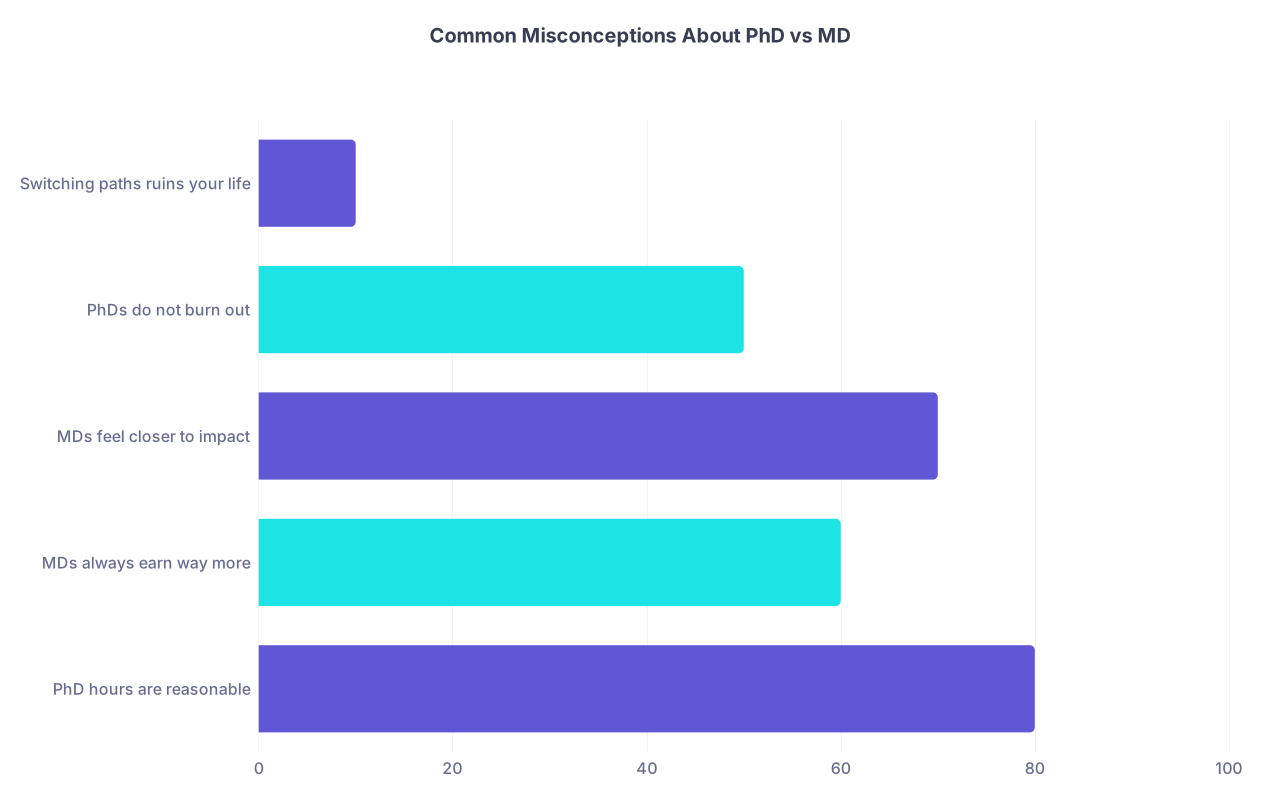
| Category | Value |
|---|---|
| PhD hours are reasonable | 80 |
| MDs always earn way more | 60 |
| MDs feel closer to impact | 70 |
| PhDs do not burn out | 50 |
| Switching paths ruins your life | 10 |
Those values roughly reflect how often I hear these myths believed, not truth.
- PhD hours can be brutal. There’s no call schedule, but there’s also no real boundary.
- MDs don’t always “earn so much more” once you factor loans, specialty choice, and location.
- Plenty of MDs feel like cogs in a system, not miracle workers.
- PhD burnout is very, very real (isolation, uncertainty, endless failure cycles).
- Switching paths late? Not ideal. But absolutely not life-ruining.
Either path can be meaningful. Either path can be miserable. The real question is: where do you want your suffering and your joy to come from?
If You’re Reading This in Tears at 1 am…
Let me normalize a few things:
- It’s okay if you’ve already invested years in this and only now are realizing it might not be your long-term home. That doesn’t mean you were stupid before. It means you’ve grown.
- It’s okay if you don’t have a clean narrative yet. The story can form over the next 6–12 months while you explore.
- It’s okay if your family, PI, or friends don’t get it right away. Your job is not to live a life that makes them less anxious.
Here’s what you don’t have to do today:
Decide your entire future.
Here’s what you can do today:
Take one non-dramatic step that moves you from spiraling to exploring.
FAQ (Exactly 5 Questions)
1. Will leaving my PhD make med schools think I’m a quitter?
Not automatically. They’ll judge you on why you left and what you did next. If you leave thoughtfully, take responsibility, gain clinical experience, and show a pattern of commitment afterward, it can actually make your story stronger. If you ghost your PI, trash everyone in your essays, and show no long-term follow-through in anything else, yeah, that’ll look bad. You control which version they see.
2. Should I finish my PhD before applying to medical school?
If you’re close to the finish line (writing phase, key experiments done), it’s often worth finishing—if it won’t crush your mental health. If you’re early-stage, miserable, and see no future in research, dragging yourself for 3–4 more years just to “not waste time” is its own kind of waste. A good rule: if you can’t imagine yourself even remotely happy as a PI or career researcher, finishing purely for the letters after your name may not be worth it.
3. Is it realistic to do MD/PhD if I already feel unsure about full-time research?
Bluntly: no. MD/PhD is a research-heavy path. You don’t sign up for that because you “kinda like research” or think it’ll make you more competitive. You sign up because you genuinely want research to be a major, permanent chunk of your career. If you’re already questioning your happiness in a PhD, bolting an MD onto it won’t fix that. It’ll just give you more obligations and less time.
4. How do I talk to my PI about maybe leaving without blowing up the relationship?
Go in prepared and calm. Frame it as long-term career alignment, not “this lab sucks.” Use language like: “I’ve been reflecting on my long-term goals and I keep coming back to wanting more direct clinical work. I want to honor the work I’ve done here and not leave you hanging. Can we discuss options—like a masters completion or clear timeline—while I explore this seriously?” Expect disappointment. That’s okay. Your goal is to be honest, respectful, and to give reasonable notice, not to make them happy.
5. What if I make the switch and then regret leaving research later?
You can still do research as an MD. Tons of clinicians are involved in clinical trials, health services research, outcomes studies, quality improvement, etc. Will it look different from being a full-time basic science PI? Yes. But if what you miss is curiosity, designing studies, and impact on knowledge—not pipetting for 10 hours a day—you can absolutely scratch that itch as a physician. The reverse (going from pure PhD to full, independent clinical practice) is far harder without the whole MD/DO path.
Open a blank document right now and write three sentences:
- What parts of patient care do I actually miss?
- What parts of research do I genuinely like (if any)?
- If I keep doing what I’m doing for 10 more years, what scares me the most?
Don’t overthink. Just write. That’s your starting point.