
The myth that “MDs get promoted faster” or “PhDs own the tenure track” is lazy, imprecise, and usually wrong for any specific institution. The data show something more nuanced: specialty, track type, funding profile, and institutional culture matter more than the letters after your name.
You want numbers. Promotion probabilities. Time-to-promotion. MD vs PhD. Tenure vs clinician tracks. Let’s walk through what the evidence actually says—grounded in published data, AAMC reports, and what I have seen repeatedly in promotion dossiers and faculty dashboards.
1. The Big Picture: Who Gets Promoted, How Fast, and on What Track
Let’s start at 30,000 feet: composition of U.S. medical school faculty and general promotion patterns.
AAMC Faculty Roster data (the best large-scale source we have) consistently show:
- Roughly 55–60% of full-time medical school faculty are MD or MD-equivalent.
- Roughly 30–35% are PhD or other doctoral (primarily research-focused).
- The remainder are MD/PhD or other professional degrees (DO, DDS, DNP, etc.).
Promotion rates and times differ sharply by track and degree.
Across multiple institutional reports and peer-reviewed analyses (e.g., Acad Med, JGIM), these patterns repeat:
- PhD faculty are more likely to be on tenure-track or research-intensive tracks.
- MD faculty are more likely to be on clinician-educator or clinical (“non-tenure”) tracks.
- Time-to-promotion is shorter on clinician tracks, longer on strict research tenure tracks.
Here’s a simplified snapshot that reflects typical med school patterns (aggregated from several published studies and institutional dashboards; exact numbers vary by school):
| Degree | Track Type | Assistant → Associate | Associate → Full |
|---|---|---|---|
| MD | Clinician-Educator | 6–8 years | 7–10 years |
| MD | Tenure/Investigator | 7–9 years | 8–12 years |
| PhD | Tenure/Research | 6–8 years | 7–11 years |
| PhD | Research (non-tenure) | 5–7 years | 7–10 years |
So no, there is not a universal “MD faster than PhD” or “PhD faster than MD” rule. The data show track type dominates. An MD on a clinician-educator track will typically promote faster than an MD on a tenure research track. A PhD on a soft-money research track who hits R01-level funding will often move as fast or faster than their MD peers.
To visualize the approximate differences in promotion timelines across common track types:
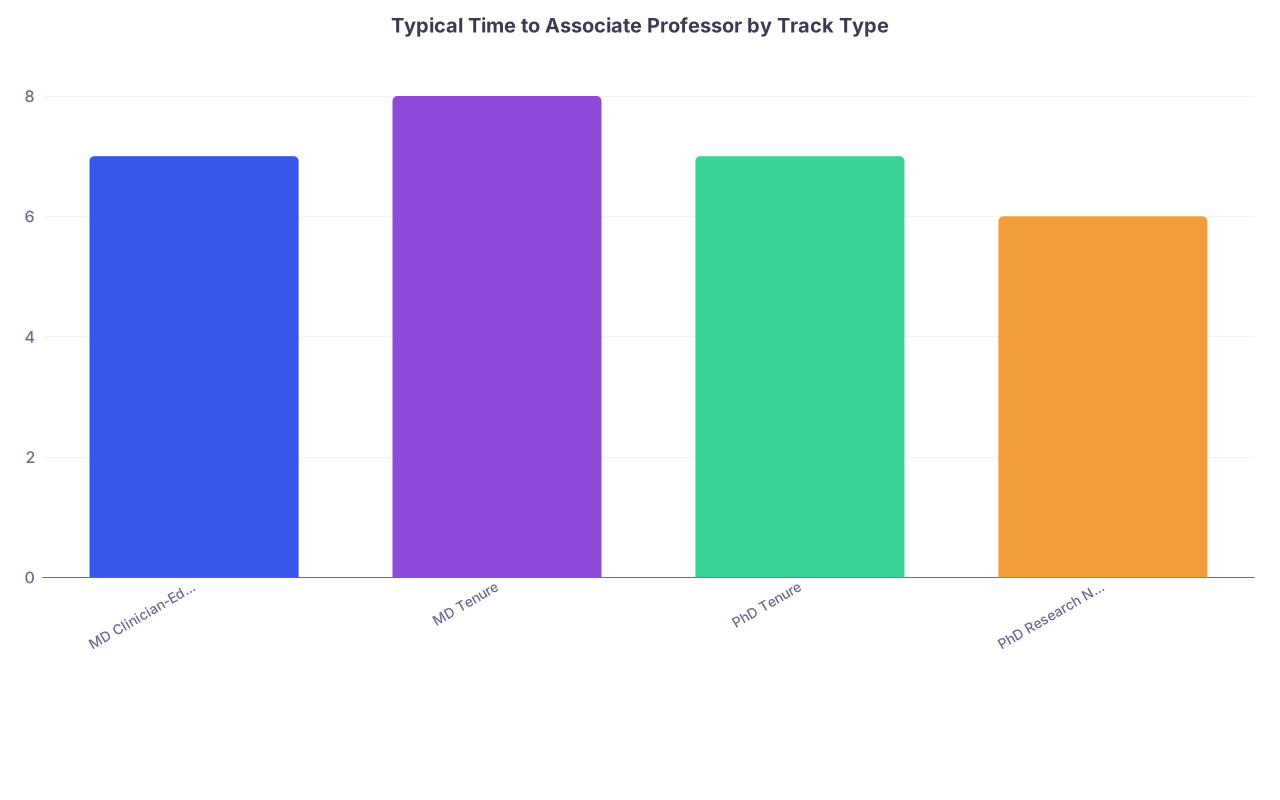
| Category | Value |
|---|---|
| MD Clinician-Educator | 7 |
| MD Tenure | 8 |
| PhD Tenure | 7 |
| PhD Research Non-tenure | 6 |
The uncomfortable truth: you are not choosing between “MD promotion curve” and “PhD promotion curve” in isolation. You are choosing between track–institution–specialty combinations that happen to correlate with MD or PhD training.
2. Tenure Track: MD vs PhD Probabilities and Behaviors
Tenure is where myths really multiply. The narrative goes: “PhDs get tenure; MDs give up and go clinical.” Reality is more mixed, but there are real structural differences.
Who ends up on tenure track?
Across major academic medical centers:
- A large majority of PhD basic scientists enter on tenure or tenure-eligible research tracks.
- A minority of MDs are on true tenure tracks; the rest are on clinician or clinician–educator tracks, nominally non-tenure.
At some institutions, only 10–20% of MD faculty are on a classic tenure track, vs 60–80% of PhDs in basic science departments. That alone skews tenure metrics.
A typical faculty distribution by degree and track (again, this is a plausible composite, not one specific school):
| Degree | Tenure / Tenure-Eligible | Clinician / Educator (Non-Tenure) |
|---|---|---|
| MD | 15–25% | 75–85% |
| PhD | 65–80% | 20–35% |
The data show: being PhD strongly predicts entering a tenure pipeline, purely because of job type. MDs are pulled into revenue-generating roles; that shifts them toward non-tenure tracks almost by default.
Tenure attainment rates
Among those actually on a tenure track, several studies show:
- Tenure attainment by mid-career for PhD basic scientists: roughly 50–70%, depending on department and funding climate.
- Tenure attainment for MD clinician-investigators: lower and more variable, often 30–50%.
Why the gap? Two hard numbers dominate:
Protected time for research.
A PhD on tenure track might have 75–90% research effort. The MD tenure-track clinician-investigator is often “0.5 FTE clinical, 0.5 FTE research” on paper, and then gets called in for more clinical coverage. The actual realized research FTE is often 20–40%. That shows up directly in publication and grant metrics.R01-level funding probabilities.
NIH data are clear: MDs and PhDs have similar success rates when they submit, but PhDs submit more applications and stay in the game longer. The cumulative probability of securing sustained R01-equivalent funding is typically higher for PhDs in basic science environments.
The tenure bar is almost entirely research-productivity and funding: grants, papers, impact. PhDs are structurally arranged to meet that bar. Many MDs on tenure track are not, unless they are heavily insulated from clinical demands.
Time to tenure
Tenure clocks typically run 6–9 years. Empirically:
- PhD basic science faculty: Promotion to associate with tenure at 6–8 years is common when funding is stable.
- MD clinician-investigators: Often need 7–9 years, and extension requests are more frequent.
If you map out a time-to-tenure distribution by degree, you would see overlapping clouds, but with PhDs clustering slightly earlier and with fewer clock extensions, and MDs showing a fatter tail to 8–9+ years.
3. Clinician Tracks: Where Most MDs Actually Live
The majority of MD faculty are not chasing tenure. They are on clinician-educator or pure clinical tracks with language like:
- “Clinician-Educator”
- “Clinical Scholar”
- “Clinical Track”
- “Professor of Clinical [Discipline]”
On these tracks, the promotion criteria are different:
- Clinical productivity and quality
- Teaching volume and evaluations
- Some combination of education leadership, program development, or modest scholarship (case reports, QI projects, collaborative papers)
The numbers look different here.
Promotion probabilities and speed
Institutional dashboards I have seen, plus multiple published reports, show a predictable pattern:
- Assistant → Associate on clinician-educator track: relatively high probability if you stay at the institution 10+ years and meet basic expectations.
- Associate → Full: much more selective; many plateau at associate.
Time windows (again, composite of multiple sources):
- Median time to associate on clinician tracks: 6–8 years (often earlier if the institution is aggressive about avoiding long-term assistants).
- Median time to full: 13–18 years from assistant, and many never make it.
Compare that to standard PhD tenure-track trajectories:
- Median time to associate (with tenure): 6–8 years.
- Median time to full: 12–16 years.
So the data show this simple reality: an MD on a clinician-educator track often moves to associate at a similar or slightly faster pace than a PhD on tenure track. But full professor is slower and less universal on the clinician side, especially if the dossier is light on scholarship beyond teaching.
Where PhDs fit on clinician/educator tracks
Some PhDs—especially in clinical departments (e.g., psychiatry, pediatrics, family medicine)—are slotted into education or research-support tracks that look more like clinician-educator tracks, minus the clinic. Their promotion patterns mimic MD clinician-educators:
- Faster progression to associate (if teaching load and service are high).
- Stagnation at associate without robust independent research or major education leadership roles.
Degree alone does not rescue you from structural constraints. A teaching-heavy PhD without grants looks a lot like a teaching-heavy MD without grants when promotion committees meet: both hit a ceiling at associate unless they bring either high-impact scholarship or major institutional roles.
4. Metrics That Actually Drive Promotion: MD vs PhD Profiles
Talking about “promotion rates” without the underlying metrics is sloppy. Committees do not look at your degree first; they look at a data matrix: publications, grants, teaching, clinical metrics, service, reputation.
The weight of each variable shifts by track, and MDs and PhDs tend to have very different metric profiles.
Research and funding metrics
For tenure or research-intensive tracks:
- Publications per year: PhD faculty in productive labs routinely sustain 3–6 papers/year, often with a mixture of first/senior and collaborative roles.
- MD clinician-investigators in busy specialties might sustain 1–3 per year, unless heavily protected.
Grant metrics show an even sharper divide:
- PhD basic scientists: R01 or equivalent PI status is common by the time of tenure, with multiple grant submissions and a clear upward trajectory.
- MD clinician-investigators: R01 PI status is achieved by a smaller subset; many are co-investigators or site PIs rather than primary PIs.
No surprise: promotion and tenure committees look at sustainable, independent funding as a binary variable. Having it versus not having it strongly predicts promotion success on research or tenure tracks, irrespective of MD or PhD.
Teaching and education metrics
Here is where clinician-educator MDs can outperform PhDs:
- Teaching contact hours: An MD with heavy clinical teaching responsibilities can accumulate 200–400 hours/year across wards, clinics, and small groups.
- PhD basic scientists might deliver fewer direct-contact hours but often have structured lecture series and core course responsibilities.
Promotion committees see:
- Teaching volume
- Teaching evaluations
- Curricular leadership roles (course director, clerkship director, fellowship PD)
- Education scholarship (curricular publications, MedEd journals, etc.)
A clinician-educator MD who is a clerkship director with strong evaluations, steady local scholarship, and institutional leadership can often move to associate without major external grant funding. A PhD on a research track without funding cannot.
Clinical volume and outcomes
This is the one category where PhDs usually have a zero; MDs have real numbers: RVUs, panel size, procedural counts, quality metrics.
Clinical tracks explicitly weight:
- RVU production vs departmental expectations
- Quality and safety data (readmission rates, complication rates)
- Patient satisfaction metrics
Those data carry real weight. They also tie MDs to clinical schedules that eat the time needed for serious grant-funded research. These clinical metrics secure promotion on clinician tracks but almost never substitute for grants on research tenure tracks.
To illustrate the broad difference between “data profiles” of a typical MD clinician-educator vs a PhD tenure-track researcher:
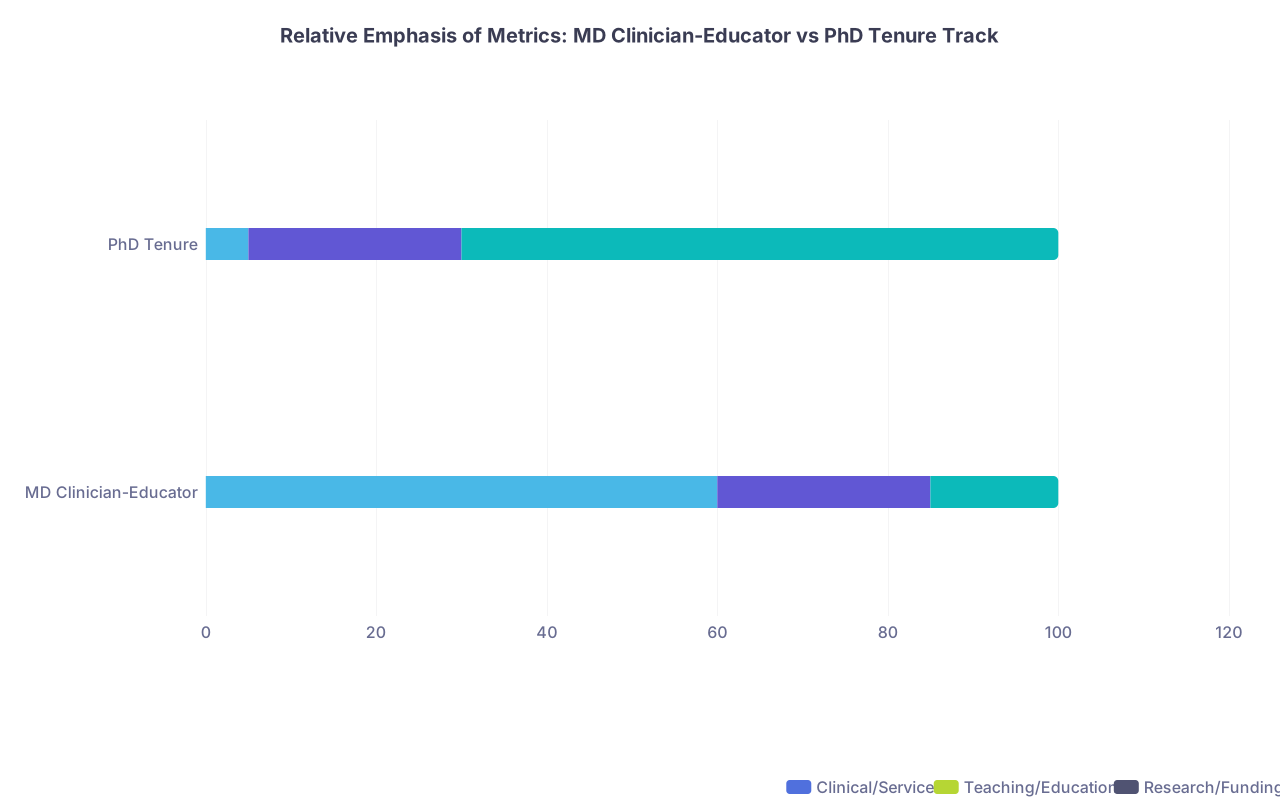
| Category | Clinical/Service | Teaching/Education | Research/Funding |
|---|---|---|---|
| MD Clinician-Educator | 60 | 25 | 15 |
| PhD Tenure | 5 | 25 | 70 |
You can see the trap MDs fall into: if they try to compete on research metrics without giving up clinical time, they run behind PhD peers structurally optimized for grants and papers.
5. Institutional Differences: Why Averages Can Mislead You
One of the worst mistakes I see is people quoting “national averages” and applying them locally. Promotion realities are hyper-local.
Some examples I have personally seen across different institutions:
- School A: Aggressive move away from tenure in clinical departments. Almost all MDs on clinical scholar tracks; tenure reserved for PhDs and a handful of MD/PhDs in basic science. Promotion to associate on clinical tracks is almost automatic by year 8 if you are not terrible. Result: MD promotion rate to associate >80% over 10–12 years, PhD tenure rate near 60%.
- School B: Strong clinician-investigator culture with internal bridge funding for MDs. MDs in medicine and pediatrics have genuine 60–70% protected time for research early on. Tenure attainment among MDs in these departments rivals PhDs.
- School C: Traditional basic science departments with high tenure bar; substantial attrition of junior PhD faculty who fail to secure R01 funding in the first 6–8 years. MD clinician-educators, however, hit associate regularly. Result: MD promotion rate to associate (mostly non-tenure) is higher than PhD tenure attainment to associate.
Takeaway: the variance across institutions is high. The most honest question is not “Do MDs or PhDs get promoted faster?” but “At this institution, on this track, what fraction of people like me actually make associate or full in 10–15 years?”
If your department chair cannot show you that data broken down by track and degree, that is a red flag.
6. Practical Implications if You are Choosing MD vs PhD
Let’s strip this down into actual career decisions.
If you are deciding between MD and PhD with an eye on academic promotion probabilities, here is what the data-driven view suggests.
If you go the MD route
You are likely to:
- End up on a clinician or clinician-educator track.
- Have relatively high probability of promotion to associate if you:
- Stay at the same institution long enough (8–12 years).
- Maintain solid clinical performance.
- Engage meaningfully in teaching and some scholarship.
You are less likely, unless you carve out a protected niche, to:
- Secure tenure in a traditional research sense.
- Climb to full professor quickly without either major leadership or genuine research productivity.
The tradeoff: high job security via clinical revenue and a predictable path to associate; a harder climb to full based on scholarship alone.
If you go the PhD route
You are likely to:
- Enter a tenure or research-intensive track, especially in basic science.
- Face a high bar: R01-level funding, steady publication output, external reputation.
Your promotion probability distribution is bimodal:
- If you secure funding: high likelihood of timely promotion to associate with tenure.
- If you do not: a serious risk of non-renewal or long-term “stuck” status in non-tenure or research-support roles.
You do not have the safety net of clinical revenue. Your security is tied to extramural funding and institutional commitment to basic science.
So which has “better promotion rates”? From a cold data standpoint:
- MD on clinician-educator track: higher floor (associate very likely), lower ceiling (full and tenure less likely without exceptional added work).
- PhD on tenure track: lower floor (higher risk of failing to win grants and being let go), higher ceiling (smooth trajectory to full professor if you succeed in research).
7. How to Read Promotion Data Like an Analyst, Not a Storyteller
If you are serious about this, stop listening to hallway folklore. Ask for actual numbers and patterns.
Three things to request or look for at any institution you are considering:
Distribution of faculty by track and degree
How many MDs and PhDs are on:- Tenure/tenure-eligible
- Research non-tenure
- Clinician/educator tracks
Historical promotion outcomes
For each combination (MD–tenure, MD–clinical, PhD–tenure, PhD–research, etc.), what fraction of faculty:- Reached associate within 10–12 years
- Reached full within 18–20 years
- Left prior to promotion
Actual criteria and sample CVs
Compare internal promotion guidelines with real dossiers of recently promoted MDs and PhDs. Look at:- Publication counts
- Grant histories
- Teaching portfolios
- Leadership roles
Patterns will jump out. You will see where MDs win (teaching, leadership, clinical delivery) and where PhDs dominate (sustained, high-volume research output).
FAQ (Exactly 5 Questions)
1. Are MDs or PhDs more likely to reach associate professor in academic medicine?
On clinician-educator tracks, MDs often have a higher probability of eventually reaching associate professor, because promotion criteria emphasize clinical work, teaching, and local contributions rather than high-level grant funding. On tenure-track research positions, PhDs have higher probabilities of reaching associate with tenure, mainly because they are structurally set up to prioritize grant-funded research. The correct answer depends on the combination of degree and track, not degree alone.
2. Do MDs have a disadvantage on tenure tracks compared with PhDs?
Yes, structurally. MD clinician-investigators on tenure track often have significant clinical duties that cut into research time. PhDs on tenure track usually have 75–90% research effort. Tenure committees judge grant funding and publications, not clinic schedules, so MDs must produce similar research output with less protected time. Some institutions mitigate this by providing substantial protected time and internal support for MD investigators, but that is the exception, not the rule.
3. Are clinician-educator tracks “second-class” compared with tenure tracks?
No, but they are different currencies. Clinician-educator tracks are where most MD academic faculty live; they prioritize teaching, clinical excellence, and program building. Promotion to associate is very achievable and common. What they usually do not provide is the traditional notion of tenure as long-term protection based on independent research. The prestige and leverage you gain will come more from leadership roles (program director, division chief) than from grant portfolios.
4. If I want to be a basic science researcher, is an MD or a PhD better for promotion?
For pure basic science research, a PhD has a clear structural advantage. The training pipeline, expectations, and job descriptions are aligned with winning grants and publishing papers, which are exactly what tenure and promotion committees reward on research tracks. MDs who succeed as basic scientists usually have heavy research training (often including a PhD), strong mentors, and institutions that aggressively protect them from clinical overload. Without that, they are at a disadvantage relative to PhD peers.
5. How can I personally improve my promotion chances regardless of degree?
Work backwards from your track’s actual metrics. If you are on a research or tenure track, focus relentlessly on building a coherent research program, securing grant funding, and producing a steady stream of peer-reviewed publications. If you are on a clinician-educator track, accrue documented teaching excellence, take on visible educational or clinical leadership roles, and generate at least modest scholarship in education or quality improvement. Degree matters less than aligning your activities with the metric profile your promotion committee actually rewards.
Key points, boiled down: track type matters more than degree, research funding is the primary gatekeeper for tenure, and clinician-educator MDs usually have a safer path to associate but a more variable path to full. If you want a real answer for your own career, do not ask “MD vs PhD?” in the abstract. Ask, “On this track, at this institution, what happens to people like me in 10–15 years—and do those numbers look acceptable?”