
The mythology that “MD–PhDs match anywhere they want” is wrong. The data show a clear pattern: MD–PhD applicants are advantaged in some specialties, merely average in others, and occasionally boxed out.
Let’s walk through what the recent numbers actually say.
1. Big-Picture: How MD–PhDs Perform in the Match
The National Resident Matching Program (NRMP) and the AAMC have made this easier to analyze over the last decade. When you strip out the anecdotes and look at the percentages, three things jump out:
MD–PhDs:
- Apply to fewer specialties on average.
- Match at slightly higher overall rates than MD-only U.S. seniors.
- Cluster heavily in a few research-oriented fields.
Their edge is not constant:
- Strong in internal medicine, neurology, pathology, radiation oncology.
- Modest in general surgery, OB-GYN.
- Narrow to nonexistent in the most competitive, procedure-heavy fields like dermatology, plastic surgery, and some surgical subspecialties.
The differentiator is not the PhD by itself:
- It is the combination of Step/COMLEX performance, research productivity, institutional reputation, and fit with “physician–scientist” departments.
- The PhD is a multiplier for a strong application, not a rescue line for a weak one.
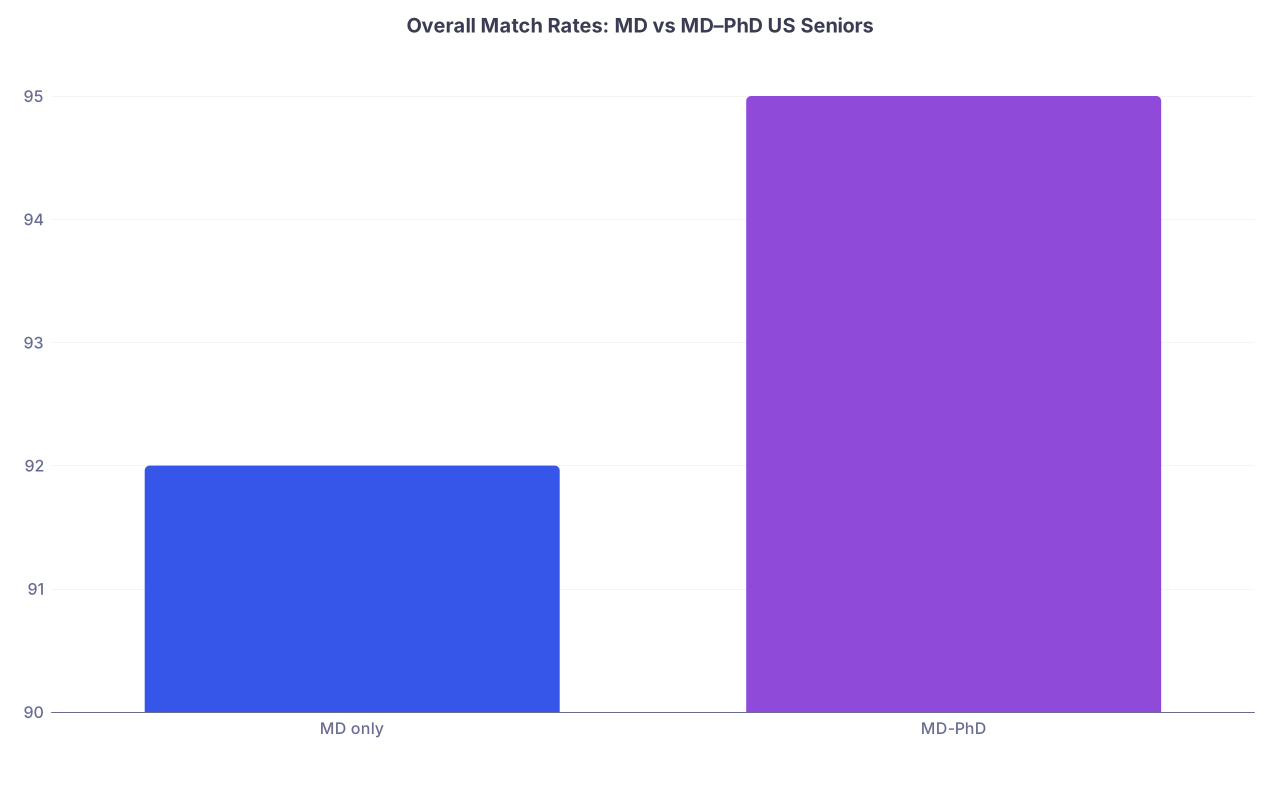
To ground this, consider approximate overall match rates for recent cycles (U.S. MD seniors across all specialties):
| Category | Value |
|---|---|
| MD only | 92 |
| MD-PhD | 95 |
Across all specialties, MD–PhD applicants usually sit a few percentage points above MD-only peers in match rate. But that 3-point advantage does not apply evenly in every specialty.
2. Where MD–PhDs Cluster: Specialty Distribution
The AAMC and NRMP data show MD–PhDs are not randomly spread. They concentrate in specialties with:
- Strong research funding pipelines (NIH-heavy).
- Established physician–scientist tracks.
- Longer training with clear academic paths.
Typical high-yield destinations for MD–PhDs (in proportion to their graduating class size):
- Internal Medicine (including research tracks and PSTPs).
- Neurology.
- Pathology.
- Radiation Oncology.
- Pediatrics (especially academic-focused programs).
- Medical subspecialties (via IM first: heme/onc, cardiology, pulmonary/critical care, rheumatology, etc.).
By contrast, MD–PhDs are underrepresented in:
- Emergency Medicine.
- Family Medicine.
- Physical Medicine & Rehabilitation.
- Obvious procedure-heavy lifestyle fields like Dermatology, Ophthalmology, Orthopaedic Surgery, Plastic Surgery (there are MD–PhDs in each, but far fewer than you might assume given applicant interest).
The pattern is not “what MD–PhDs like.” It is where:
- Departments value research enough to protect time.
- There are structured tracks that turn bench or translational work into an actual career, not just “that thing you did before.”
3. Specialty-by-Specialty Outcomes: Where the PhD Helps (and Where It Does Not)
Here is where the signal is. I will walk through the major specialties and what the data and real-world experience show.
Internal Medicine (and Medicine Subspecialties)
Internal Medicine (IM) is the default landing zone for many MD–PhDs.
Data trends:
- Overall IM match rates for U.S. MD seniors are extremely high (often 96–99%).
- MD–PhD applicants in IM match at or near 100% in many years, especially when targeting research-heavy academic programs.
- Physician–scientist training programs (PSTPs) are heavily populated by MD–PhDs.
The PhD is genuinely additive here. Departments with big NIH portfolios want people who can produce R01-level work. If you pair a PhD with:
- Step 2 CK above specialty average.
- Strong medicine clerkship comments.
- Multiple first-author or co-first-author papers.
…you end up very competitive not only for a match but for top-tier programs with guaranteed research time and mentoring structure.
The subtle data point: MD–PhDs are overrepresented in the “upper quartile” IM programs (large university hospitals, heavy research funding) and underrepresented in pure community IM.
Neurology
Neurology is another classic MD–PhD destination.
Key patterns:
- Match rates for U.S. MD seniors in neurology are typically high (mid-90%+).
- MD–PhD applicants often match at close to 100%, with strong placement into academic neurology departments.
- Programs frequently highlight MD–PhDs in their resident bios; they are explicitly recruiting for translational neuroscience and neuroimmunology.
The neuroscience PhD pairs very cleanly here. If your dissertation involved animal models of neurodegeneration or fMRI cognition work, you are speaking the same language as faculty running R01s. Interviewers know exactly what to do with you.
Pathology
Pathology may be the most quantitatively “PhD-friendly” clinical field.
Trends:
- Overall pathology match rates for U.S. MD seniors are high, often above 95%.
- MD–PhDs match very reliably, frequently at research-intensive academic centers.
- Some pathology departments essentially view an MD–PhD as the ideal incoming resident profile for future academic leadership.
The caveat: the field has faced job market concerns and shifting residency fill rates. The PhD will not fix macroeconomic trends. But if you want a lab-based investigative career, pathology still offers a very rational path from a data standpoint: high match security, strong alignment with bench research, and predictable academic trajectories.
Radiation Oncology
Radiation oncology used to be brutally competitive; recent cycles have been more volatile, with unfilled positions and concerns about job saturation. For MD–PhDs, though, the field remains very receptive.
Data patterns:
- Match rates for U.S. MD seniors in rad onc have fluctuated but MD–PhDs remain overrepresented relative to their class size.
- A sizable fraction of rad onc residents at top programs hold PhDs or equivalent research training.
- Departments often emphasize translational oncology, radiation biology, and clinical trials, all highly PhD-compatible.
However, the risk side of the equation is real. The job market is less rosy than 10–15 years ago. If you are thinking quantitatively: the probability of matching is good; the long-term probability of a stable academic or hybrid job is field-dependent and region-sensitive.
Pediatrics
Pediatrics is generally less competitive overall, but that hides nuance.
Data:
- Overall peds match rates for U.S. MD seniors are very high (often 97–99%).
- MD–PhD applicants match very well, especially into academic children’s hospitals.
- Where the PhD really bites is later: in pediatric subspecialties. Heme/onc, immunology, NICU, GI, etc., all have robust research ecosystems.
Departments looking to grow pediatric research (immunotherapies, gene therapy, developmental biology) tend to see MD–PhDs as long-term faculty investments. Your match odds are high; the ceiling is also high if you execute on research during residency and fellowship.
General Surgery
General surgery is where the story gets more complicated.
Raw competitiveness:
- General surgery match rates for U.S. MD seniors sit lower than IM/peds, often in the low 90s.
- There is a long tail of unmatched US seniors each year.
For MD–PhDs:
- The PhD helps more at the top than in the middle. Top-20 academic surgery programs do value high-impact research, especially in oncology, outcomes, or basic science.
- But surgical programs still prioritize operative skills, grit, and clinical performance. A PhD does not compensate for mediocre Step 2 scores or poor surgery clerkship comments.
- Data from program rosters show MD–PhDs are present in academic general surgery, but rare in pure community programs.
Net effect: the PhD is a modest plus factor in academic general surgery, but it does not turn a marginal applicant into a strong one. Seen it many times: 3+ high-quality papers, but Step 2 in the low 220s and mediocre letters; the MD–PhD does not rescue that file.
Dermatology, Plastic Surgery, Orthopaedic Surgery, ENT, Ophthalmology
These are the “fantasy” targets that many MD–PhD students quietly consider. The data are blunt.
- Match rates for U.S. MD seniors in these fields are much lower than IM/peds, often in the 70–85% band, with substantial variability year-to-year.
- In many of these programs, MD–PhDs appear, but they are far from dominant. Your PhD may give you an advantage only if:
- You have top-decile Step 2 scores.
- You have several first-author papers in that exact specialty.
- You trained at a well-known institution with faculty that program directors know personally.
Otherwise, the PhD is often seen as “interesting but not decisive.” The core filter is test scores, letters, and demonstrated commitment to the field. A PhD in biochemistry without any derm publications does not push you over a 260-scoring MD-only applicant with three derm papers.
Data-driven bottom line: In these hyper-competitive specialties, the MD–PhD tag correlates with strong matches only when it rides alongside stellar traditional metrics. It is not a separate lane.
Psychiatry, Emergency Medicine, Family Medicine, PM&R
For these largely less-competitive or mid-competitive fields:
- Match rates for U.S. MD seniors are generally high (often >93–95%).
- MD–PhDs are a minority but usually match very well when they apply, particularly into academic psychiatry.
- In EM/FM/PM&R, the PhD often matters less for selection, more for career shaping (research roles, academic tracks, QI leadership).
If you are an MD–PhD entering one of these fields, you will probably match. The harder question is: can you actually use your research training meaningfully afterward? That depends on choosing programs with protected time and mentors who care.
4. Specialty Competitiveness vs MD–PhD Match Advantage
Let me summarize the relationship in a structured way. The exact percentages vary by year, but the relative pattern has been stable.
| Specialty Group | Overall US MD Senior Match Rate (approx) | MD–PhD Relative Advantage | Typical MD–PhD Fit |
|---|---|---|---|
| Highly Competitive (Derm, Plastics, ENT, Ortho, Ophtho) | 70–85% | Small to none | Only with top scores + specialty research |
| Mid-Competitive (Gen Surg, Anesthesia, OB-GYN, EM) | 85–93% | Modest, mostly academic | Select academic programs, not universal |
| Less Competitive but Academic-Heavy (IM, Neuro, Path, Rad Onc, Peds) | 95–99% | Strong | Many programs prefer MD–PhDs |
In other words:
- Where a field already has a strong research culture, MD–PhDs gain a clear structural advantage.
- Where procedure volume and service needs dominate, the PhD signals less value unless tightly aligned with the specialty.
5. Research Productivity: The Real Signal Behind the Degree
Programs do not match “PhDs.” They match evidence.
The data from NRMP Program Director Surveys and many published analyses show consistent drivers:
- Step 2 CK score.
- Clerkship grades (especially in the specialty).
- Letters of recommendation.
- Class ranking / AOA.
- Meaningful research output.
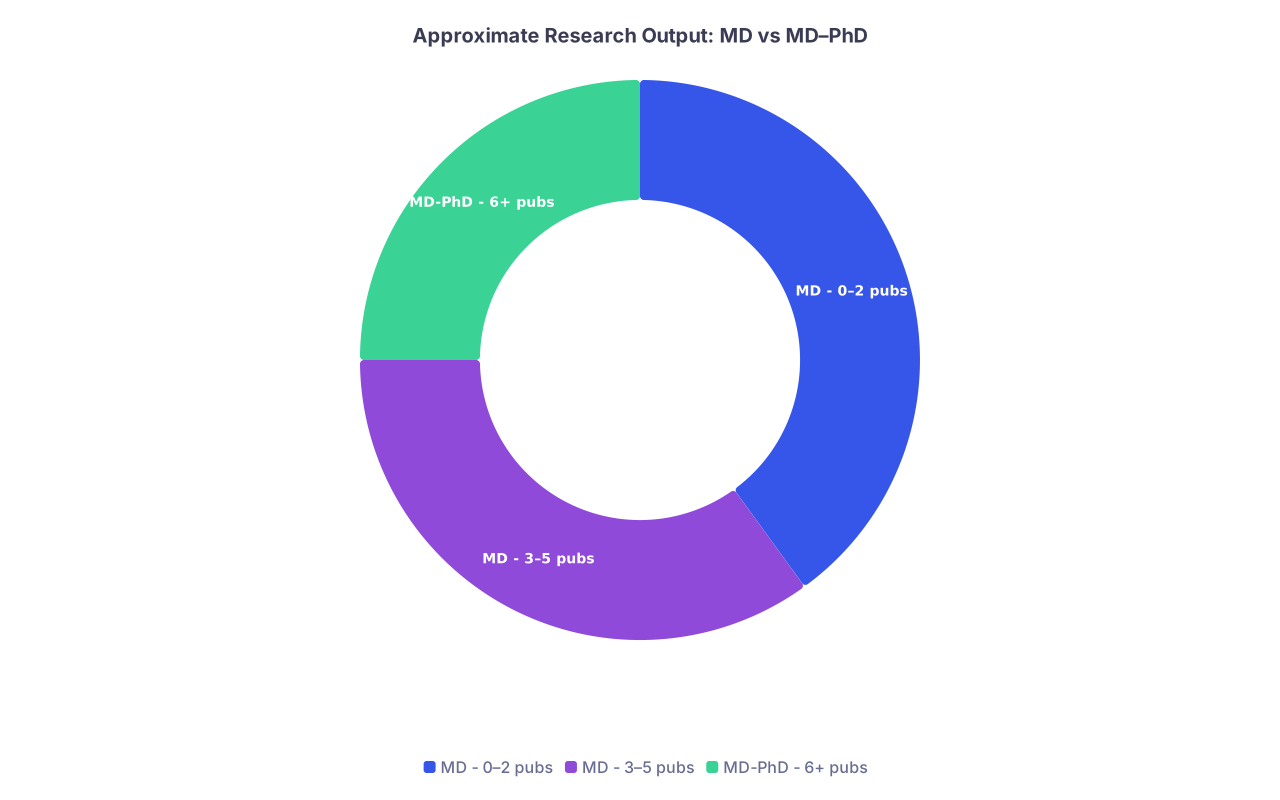
The last one is where MD–PhDs usually separate. The median MD graduate might have 1–3 publications; MD–PhDs often report 6–10, with multiple first-author works.
| Category | Value |
|---|---|
| MD - 0–2 pubs | 40 |
| MD - 3–5 pubs | 35 |
| MD-PhD - 6+ pubs | 25 |
Not exact numbers, but directionally correct: MD–PhDs cluster in the “high output” tail.
Two important caveats:
Specialty relevance matters.
Five immunology papers help a lot more in heme/onc or rheumatology than in orthopaedics, unless your work is directly related.Quality trumps quantity at the top tier.
A single high-impact, first-author basic science paper in Nature Medicine or JCI can outweigh six middle-author case reports in a low-impact journal.
I have seen program directors skim a CV, skip straight to the publications section, then look only at first-author entries, journal names, and PubMed IDs. That is the level at which a PhD pays off.
6. Trends Over the Last Decade: Has the MD–PhD Edge Changed?
You are not applying in 2005. The environment has shifted.
Several trends in the data:
Step 1 pass/fail
Once Step 1 went pass/fail, the weight shifted toward:- Step 2 CK.
- Clerkship performance.
- Research portfolio. Net effect: MD–PhDs with strong Step 2 scores likely gained relative ground in research-heavy specialties.
Growth of “physician–scientist tracks”
More IM, neurology, and pediatrics programs now list:- “Physician scientist track”
- “Research pathway”
- “ABIM research pathway” These are explicitly designed to attract MD–PhDs and similar applicants.
Competitive subspecialties tightening
In derm, plastics, ortho, ENT, etc., the bar keeps creeping. Many programs now expect:- Double-digit publications.
- Specialty-specific research.
- Strong away rotations.
MD–PhDs who meet those bars match very well. Those who do not end up with the same risk as any other applicant.
Geographic clustering
MD–PhD matches cluster at research-heavy institutions:- UCSF, Penn, Hopkins, WashU, Columbia, Stanford, MGH/Brigham, etc. This is not random. Departments with deep NIH funding streams and MSTPs tend to be the ones most invested in hiring future physician–scientists. The match outcomes reflect that.
7. Strategic Implications for Current MD–PhD Trainees
Let me be blunt. The smartest MD–PhD applicants treat match outcomes as an optimization problem, not a wish list.
If you want to maximize match probability and future research impact:
Fields with the best MD–PhD “ROI” historically:
- Internal Medicine → subspecialty (heme/onc, cards, pulm/crit, rheum).
- Neurology → subspecialty (neuroimmunology, movement, epilepsy, stroke, neuro-onc).
- Pathology.
- Radiation Oncology (with cautious attention to job market).
- Pediatrics → subspecialty (heme/onc, immunology, NICU, etc.).
Fields where the PhD is a smaller marginal advantage:
- General Surgery, OB-GYN, Anesthesia, EM, PM&R.
- You can absolutely match; you just are competing more directly on usual metrics.
Fields where you must have elite traditional metrics to leverage the PhD:
- Dermatology, Plastics, Ortho, Ophtho, ENT.
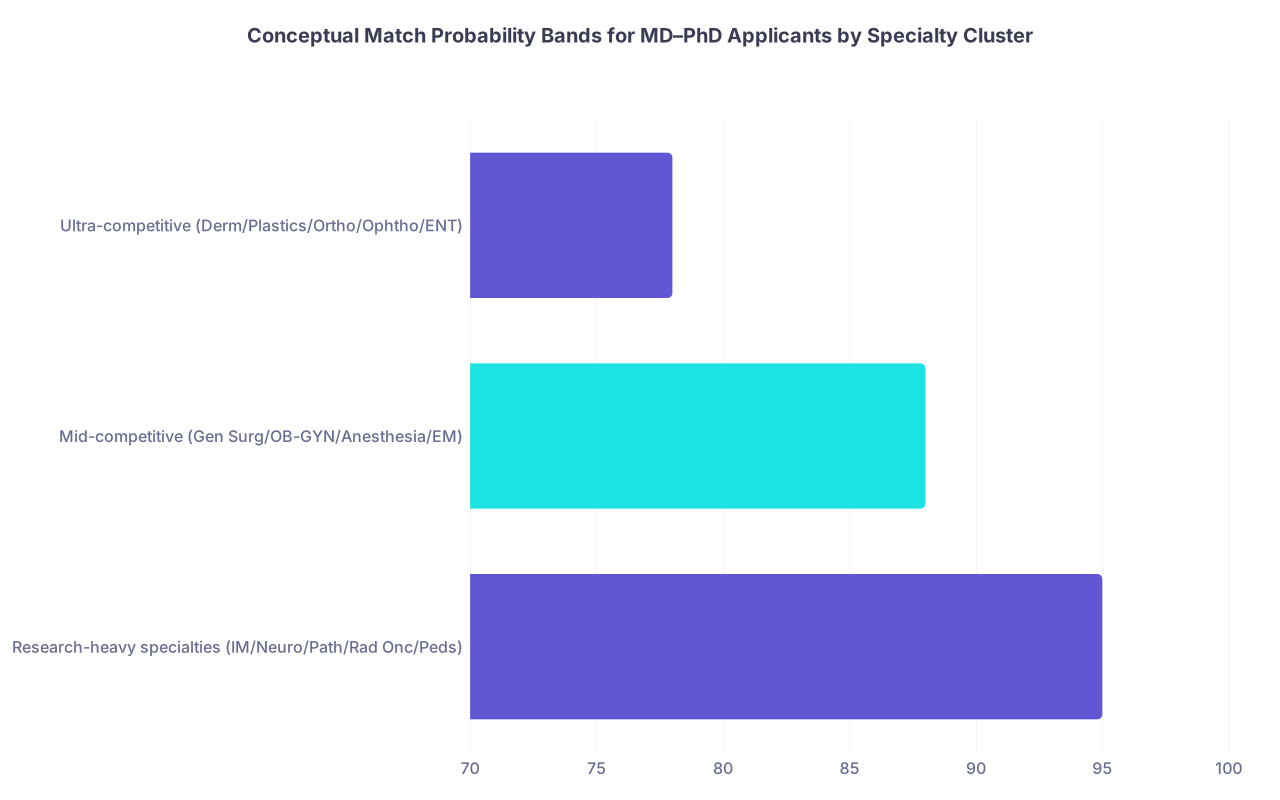
From a decision-making standpoint, you should think in probabilities, not absolutes.
| Category | Value |
|---|---|
| Research-heavy specialties (IM/Neuro/Path/Rad Onc/Peds) | 95 |
| Mid-competitive (Gen Surg/OB-GYN/Anesthesia/EM) | 88 |
| Ultra-competitive (Derm/Plastics/Ortho/Ophtho/ENT) | 78 |
These are conceptual, not exact. But the ranking is accurate: research-heavy fields give you the highest probability of converting your MD–PhD into both a match and a long-term research career.
And yes, sometimes the smart move is to adjust your target based on the numbers rather than forcing a poor probability play.
8. Quick Case Examples (Actual Patterns I Have Seen)
MD–PhD in immunology, Step 2 CK 255, 7 publications (3 first-author), all in T-cell biology. Applied IM with interest in rheumatology. Matched into a top-5 academic IM program, then into rheum fellowship with a KL2 award. Classic high-probability route.
MD–PhD in neuroscience, Step 2 CK 240, 4 publications (1 first-author), applied neurology. Matched into a mid-tier but research-active neuro program with explicit research track. Reasonably secure and aligned with training.
MD–PhD in molecular biology, Step 2 CK 262, 9 publications including 2 first-author in good oncology journals, did a derm research year. Applied dermatology. Matched at a high-prestige derm program. Here, the PhD was meaningful, but without the strong Step 2, specialty-specific output, and targeted networking, it would have been a coin flip.
MD–PhD in biochemistry, Step 2 CK 228, 3 middle-author publications. Applied plastic surgery. Went unmatched, then re-applied to general surgery and ultimately matched into a community program. PhD did not offset weaker numbers.
Patterns repeat. The statistics are not theoretical; they are visible in outcomes.
FAQ (4 Questions)
1. Does having an MD–PhD guarantee a better match than MD-only applicants?
No. The aggregated data show slightly higher overall match rates for MD–PhDs, but that advantage vanishes in the most competitive specialties if your Step 2, clerkship performance, and specialty-specific research are not at or above the field’s norms. In research-heavy specialties, though, the MD–PhD often provides a real edge.
2. Which specialties give MD–PhD applicants the strongest advantage?
The data and program structures point to internal medicine (especially via physician–scientist tracks), neurology, pathology, radiation oncology, and academic pediatrics as the most MD–PhD-friendly. These fields have a strong culture of research, formalized research pathways, and departments that explicitly seek physician–scientists.
3. How many publications do MD–PhD applicants typically have when they match?
There is no magic number, but MD–PhDs frequently report higher research output than MD-only peers—often in the 5–10 publication range, with multiple first-author papers. Program directors focus less on raw count and more on first-author work, journal quality, and relevance to the specialty you are applying to.
4. If I am an MD–PhD and want a very competitive surgical or lifestyle specialty, is it a bad idea?
It is not inherently a bad idea, but it is statistically risky unless you also have top-tier Step 2 CK scores, excellent clinical evaluations, and substantial specialty-specific research. The PhD by itself does not compensate for weak traditional metrics in fields like dermatology, plastic surgery, orthopaedics, ophthalmology, or ENT. If you pursue these, treat it as a high-variance strategy and plan contingencies.