
The idea that you should do an MD–PhD to “help your residency application” is wrong—and dangerously expensive.
If you’re even half-considering a dual degree primarily as a residency booster, you’re walking straight toward one of the biggest traps in medical education.
Let me be blunt: a PhD is not a +1 line on your ERAS CV. It is 4–6+ years of your life, your twenties or early thirties, poured into a very specific way of thinking and working. You do not get those years back. You will not magically be “set” for derm, ortho, plastics, or neurosurgery just because you added three letters to your name.
You might think you’re being strategic. In reality, you might be overcommitting to the wrong life.
Below, I’ll walk you through the classic mistakes people make when they choose MD–PhD for the wrong reason—and how to avoid them.
1. The Core Mistake: Treating MD–PhD as a Residency Cheat Code
The most common bad rationale I hear is some version of this:
- “I heard MD–PhD students match better.”
- “A PhD will make my application stand out.”
- “I’m not sure what specialty I want—MD–PhD keeps doors open.”
- “I like research… I guess? And it will probably help for competitive fields.”
That’s not strategy. That’s fear plus hearsay.
Here’s reality: Residency directors do not treat a PhD as a golden ticket. They care about whether you can:
- Take great care of patients
- Function on a team, under pressure
- Show sustained commitment to their field
- Produce and communicate scholarly work (yes, research—but not necessarily a PhD)
They do not hand out derm or plastics seats as a “thank you” for surviving qualifying exams.
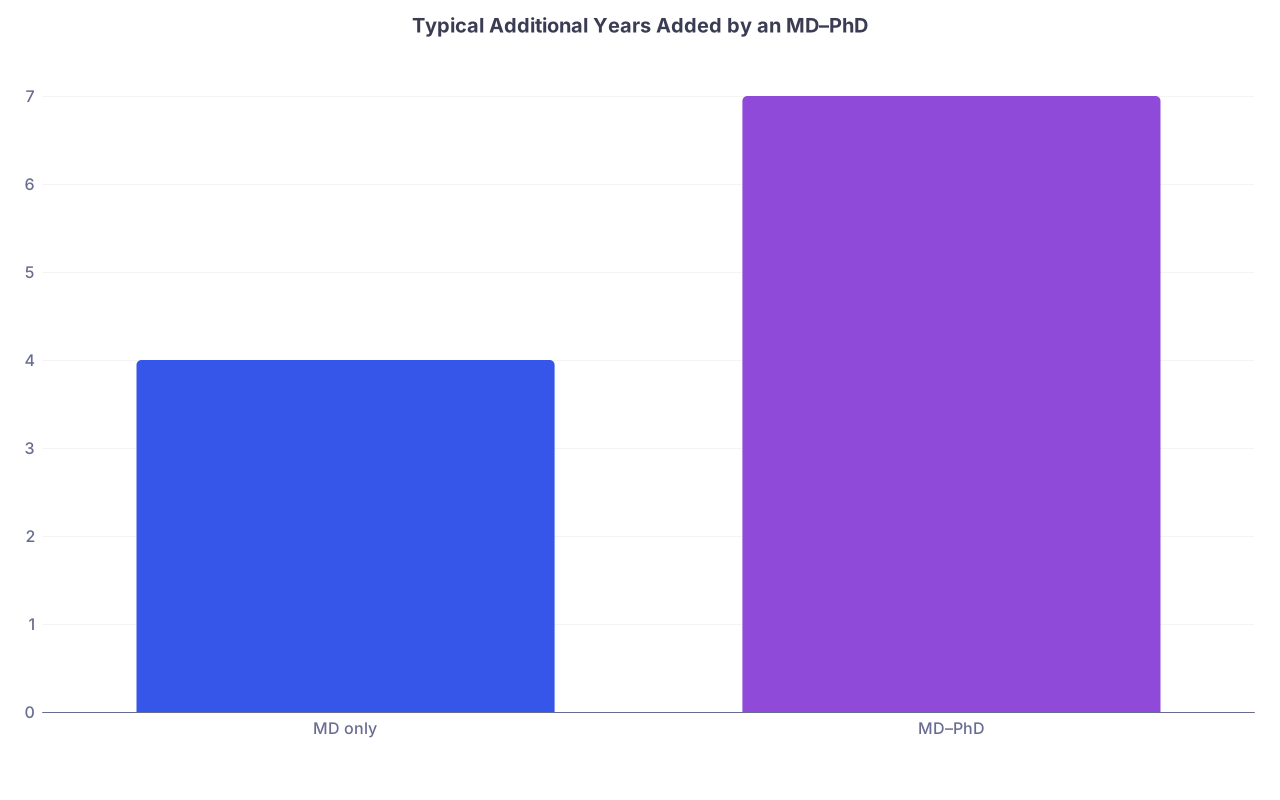
| Category | Value |
|---|---|
| MD only | 4 |
| MD–PhD | 7 |
For most MD–PhD programs in the U.S., you are adding 3–4 extra years minimum. Often more.
Trading 3–6 years of your life for a “maybe” improvement in your odds at a competitive specialty is a terrible deal if you aren’t deeply committed to a research career.
The real question you should be asking is not “Will this help my application?” but “Do I want to be a physician–scientist badly enough to pay this price?”
If the honest answer is “I’m not sure,” you should not be doing an MD–PhD. Full stop.
2. Misunderstanding What MD–PhD Actually Trains You For
The second big mistake: thinking MD–PhD is just “more school” or “advanced research skills.”
No. It’s a professional identity.
MD–PhD training is designed for people who plan to spend a significant chunk of their career doing:
- Hypothesis-driven research
- Grant writing
- Running a lab or research group
- Mentoring students and trainees in research settings
- Publishing regularly and being evaluated on that output
If you envision yourself in 10–15 years as mostly a clinician seeing patients 5 days a week, doing minimal research, then MD–PhD is massive overkill. It’s like getting a PhD in mechanical engineering to replace your car’s brake pads.

| Step | Description |
|---|---|
| Step 1 | MD only |
| Step 2 | Primarily clinical care |
| Step 3 | Clinician educator |
| Step 4 | Clinician with some research |
| Step 5 | MD PhD |
| Step 6 | Physician scientist |
| Step 7 | Lab based researcher |
Most MD–PhD graduates are expected—explicitly or implicitly—to pursue careers where research is a central component, not a “nice to have.”
If you’re already thinking, “Well, maybe I’ll just use the PhD to get in, then I’ll pivot to pure clinical practice,” you’re already telling me you’re not the target audience for this path.
That’s like signing up for a surgical fellowship because “It might help me get into primary care.”
3. Overestimating How Much a PhD Impresses Residency Programs
Here’s a quieter truth: plenty of MD–PhD students get humbled in the residency match.
Yes, some do very well. Especially when their PhD and research output align cleanly with their target specialty, and they’re strong clinically.
But I’ve personally watched:
- An MD–PhD with a weak Step 2 score and mediocre letters struggle to get interviews in a competitive field.
- A PhD in a remote basic science area not translate into “wow” for a clinically focused program.
- Committees barely comment on the PhD in interviews, but dig deeply into clinical evaluations and fit.
Why? Because residency programs are hiring doctors, not junior faculty.
If your clinical performance, board scores, and specialty-specific experiences are only average, a PhD may not rescue you. Programs worry much more about how you’ll function on night float than how well you pipette.

Where a PhD can help—and where it absolutely does not
Helpful when:
- You’re applying to research-heavy programs that specifically want physician–scientists.
- Your publications and thesis topic align with the specialty.
- You can speak fluently about how you’ll integrate research into your career.
Not a magic boost when:
- Your clinical grades are weak.
- Your board scores are at or below a specialty’s usual cutoffs.
- Your letters are lukewarm.
- You have no clear specialty-related experiences.
The common mistake is assuming:
“I have a PhD → therefore my application is strong.”
Wrong framing.
The right framing is:
“I have a solid residency application → and my PhD is a meaningful bonus for certain programs.”
4. Ignoring the Massive Time, Energy, and Identity Cost
People love to talk about “free tuition” and “stipends” in MD–PhD programs.
They conveniently skip:
- The lost earning years
- The delayed independence
- The psychological toll of yet another long training phase
Let’s quantify the time cost.
| Path | Years to MD/MD–PhD | Residency (avg) | Total Pre-Attending |
|---|---|---|---|
| MD only | 4 | 3–7 | 7–11 |
| MD–PhD | 7–8 (often 8+) | 3–7 | 10–15+ |
That extra 3–5+ years is not “just more school.” It’s:
- Years your non-MD–PhD classmates are: in residency, earning an attending salary sooner, building families, paying down loans, or simply not living on a grad student stipend.
- Years of being in limbo between identites: not quite a physician, not quite a career scientist yet.
And no, the “free MD tuition” does not necessarily come out ahead financially when you factor in opportunity cost—especially if you end up doing mostly clinical work.
If you love research, those years are an investment.
If you’re “meh” on research and just want to be a strong residency candidate, those years are a self-imposed penalty.
5. Confusing “Liking Research” With “Wanting a Research Career”
Huge pitfall here.
There’s a big difference between:
- Enjoying a summer project
- Getting a thrill from seeing your name on a poster
- Loving exactly 10 weeks of bench work before you’re bored
versus:
- Being willing to grind through failed experiments for months
- Rewriting grants eight times after rejection
- Spending years inside a single, narrow scientific question
MD–PhD is for the second category.
If your “research experience” so far is:
- One gap year in a lab, mostly doing data entry or simple tasks
- A summer program where your mentor designed and analyzed everything
- A few posters where you barely understood the methods section
then you do not yet know whether you actually like research enough for a PhD.
You know you like the idea of research.
I’ve seen students jump into MD–PhD because they got dopamine from an abstract acceptance email… and then crash hard when they realized the real work is 90% tedium, 10% excitement.
A safer test before you commit
Before you even say the words “MD–PhD” out loud to an advisor, you should:
- Spend at least 1–2 years in research with meaningful ownership: designing parts of a project, analyzing data yourself, troubleshooting when things fail.
- Ask your PI and labmates bluntly what their day-to-day looks like and what they hate about the job.
- Notice how you feel after months in the lab: energized or drained?
If you’re already sick of pipetting, coding, or writing after 6 months, what do you think 4+ PhD years will feel like?
6. Believing There’s No Other Way to Be “Competitive”
This is the part that really pushes me to write pieces like this: the false belief that MD–PhD is the only route to a strong academic or competitive residency application.
It’s not even close.
For residency applications, the usual differentiators are:
- Strong clinical performance (honors in key rotations)
- Solid board scores (or equivalent standardized metrics where they exist)
- Strong specialty-specific letters
- Demonstrated commitment to the field (sub-I’s, electives, interest group leadership)
- Scholarship relevant to the specialty (which does not require a PhD)
You can absolutely become a serious clinician–researcher with:
- An MD only
- A research-heavy year (e.g., dedicated research year during med school)
- A strong portfolio of publications and presentations
- Then later, additional research training (e.g., fellowships, T32, MSc, MPH, or even a PhD later if you truly want it)
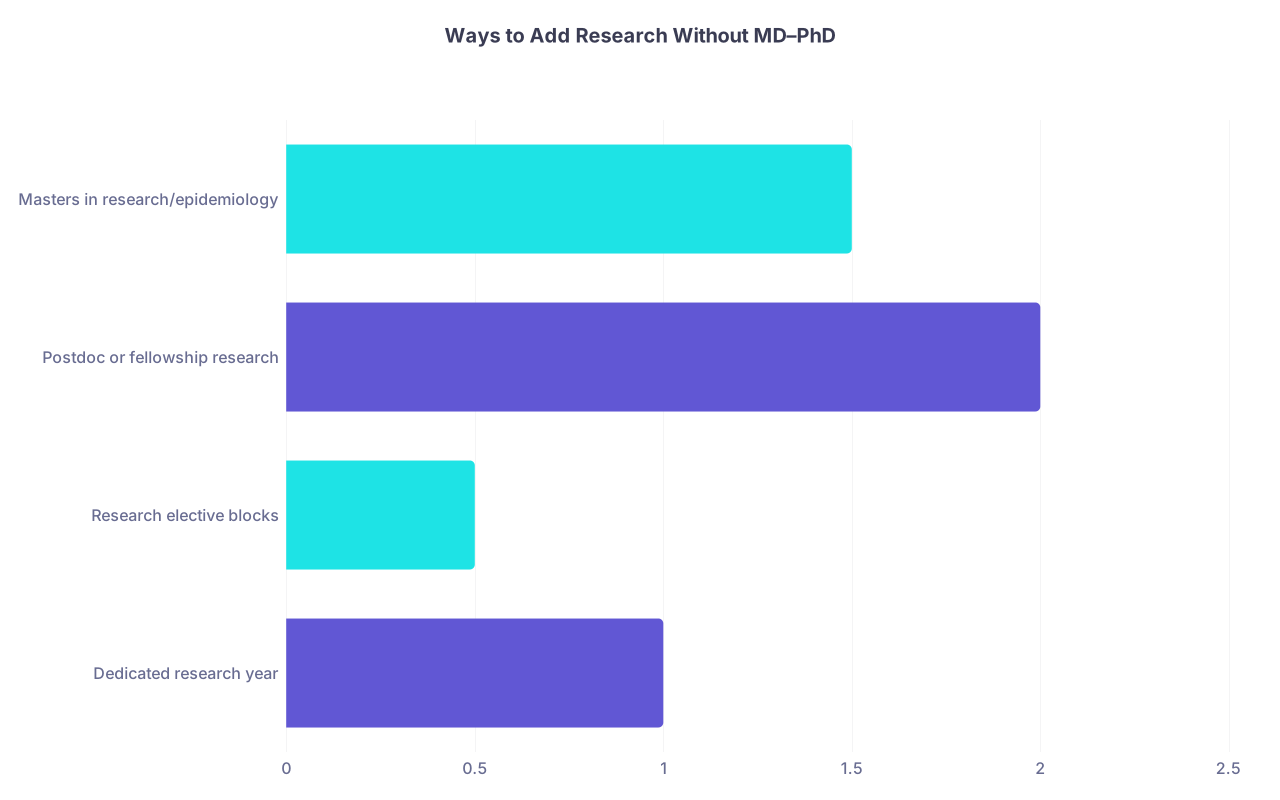
| Category | Value |
|---|---|
| Dedicated research year | 1 |
| Research elective blocks | 0.5 |
| Postdoc or fellowship research | 2 |
| Masters in research/epidemiology | 1.5 |
Notice something? All of these can be layered onto a standard MD path, once you’re more confident about your goals.
Choosing MD–PhD up front locks you into the longest, least flexible version of “I like research.”
If what you actually want is “I like research and I want my file to be strong for competitive residencies,” then an MD with targeted research exposure is almost always a smarter, lower-risk move.
7. Red Flags You’re Considering MD–PhD for the Wrong Reasons
Here are some warning lights I pay attention to when advising students:
- You can’t name a specific type of research you want to do long term. Just “something with cancer” or “neuro stuff.”
- You’re mainly motivated by avoiding debt, not by the work itself.
- You’re hoping MD–PhD will make up for a weak GPA or MCAT.
- Your research experiences so far have been shallow, short, or mostly passive.
- When you imagine your future, you picture clinic, OR, or wards… and the research is vague or tacked on.
If two or more of those describe you, you’re probably using MD–PhD as a psychological safety blanket rather than an intentional career move.
Another red flag: you catch yourself saying things like:
- “If I hate the PhD part, I’ll just grind through.”
- “Even if I don’t do research later, the PhD will still help somehow.”
- “Everyone says research is important. Might as well go all the way.”
This is sunk-cost thinking before you’ve even sunk the cost.
8. How to Sanely Decide Between MD and MD–PhD
Let’s get practical. You want a test that doesn’t rely on hype or fear.
Use this simple check:

| Step | Description |
|---|---|
| Step 1 | Do you want research as core of career? |
| Step 2 | Have 1-2 years of real research? |
| Step 3 | Consider MD PhD seriously |
| Step 4 | Do more research before deciding |
| Step 5 | MD only with research opportunities |
| Step 6 | Yes |
| Step 7 | No or not sure |
Ask yourself, and actually write down the answers:
- In 15 years, what does a perfect workweek look like for you?
- How many days are you in clinic, OR, wards?
- How many days are you in the lab, analyzing data, writing papers, writing grants?
- Would you still choose MD–PhD if it did not give you any advantage in the residency match, but simply trained you well for research?
- Would you still choose MD–PhD if your eventual salary was the same as a pure clinician in your field?
If your answers are:
- Mostly patient care, occasional research → MD only, beef up research if needed.
- “No” to the second or third question → you’re probably chasing the wrong prize.
And one more brutal test:
Talk to 3 MD–PhD students or grads and ask each:
- “What’s the worst part of doing an MD–PhD that nobody tells applicants?”
If their answers scare you more than they excite you, listen to that.
9. If You’ve Already Started Down the MD–PhD Path
Some of you reading this are already in an MD–PhD program and quietly thinking, “Uh oh. That’s me.”
Do not panic. But also, don’t gaslight yourself.
You still have choices:
- Many programs have off-ramps: you can complete the MD only if you truly realize research is not for you. It’s not a failure; it’s course correction.
- You can shape your PhD work to be more clinically relevant or aligned with a specialty you genuinely like, making the degree more valuable to you.
- You can actively seek mentors who’ve balanced heavy clinical work with research and ask how they did it—and whether they’d do MD–PhD again.
But the worst move is to just “tough it out” for years in a field you dislike because you’re afraid of looking like you quit.
Surviving is not the same as making a good decision.
FAQ (Exactly 3 Questions)
1. Does having an MD–PhD significantly increase your chances of matching into competitive specialties like dermatology or plastic surgery?
Not by itself. Programs care far more about clinical performance, board scores (or their equivalents), letters, and specialty-specific commitment. A PhD can help at institutions that value research heavily, especially if your work is aligned with the specialty and you have strong publications. But an MD–PhD will not reliably overcome mediocre clinical grades or weak board performance, and there are plenty of MD-only applicants who outperform MD–PhDs in the match because their overall profile is stronger.
2. If I’m interested in academia and research but not sure about a full research career, should I still consider MD–PhD?
Probably not yet. MD–PhD is best for those who are fairly certain they want research to be a central, non-negotiable part of their career. If you’re interested but unsure, a safer and more flexible path is MD only with robust research experiences: a dedicated research year, strong mentorship, and possible additional training later (fellowship, T32, Masters). You can still become a successful academic physician this way, and you avoid locking yourself into 3–6 extra PhD years before you truly know what you want.
3. I genuinely enjoy research and have multiple years of serious experience. How do I know if MD–PhD is right for me versus MD with later research training?
Look at your imagined long-term time allocation. If, in your ideal future, you’d be satisfied spending 40–70% of your professional life on research—writing grants, running a lab or research group, mentoring trainees, and publishing regularly—then MD–PhD is worth serious consideration. If you see research more as a 10–25% “adjunct” to a primarily clinical career, MD with targeted research training is usually more appropriate. Also test yourself with a hard question: “If MD–PhD did not help my residency odds at all, would I still want it purely for the research training?” If the answer is anything but a clear yes, press pause.
Open a blank page right now and write—in one paragraph—what you want your ideal workweek to look like 15 years from today. Then ask yourself: does that paragraph truly require a PhD, or are you reaching for MD–PhD mainly because you’re scared your MD application won’t be “enough”?