The “free MD–PhD” pitch is a lie by omission. You’re not getting a free medical degree. You’re trading 8–10 of your most productive years for a modest stipend, delayed earnings, and a career path that quietly assumes you’ll accept lower lifetime income in exchange for “prestige” and “impact.”
Let’s strip the marketing language and look at what’s actually happening.
What “Free” MD–PhD Funding Really Is
Here’s the usual sales pitch you’ve heard from advisors and program directors:
- “You don’t pay med school tuition.”
- “You get a stipend every year.”
- “You’ll graduate debt-free.”
- “You can always fall back on a clinical career.”
All of that is technically true. And still deeply misleading.
You are not getting something for nothing. You are being paid—below market rate—to do specific work (research) that benefits the institution:
- You generate data that leads to papers.
- Those papers help PIs get and maintain grants.
- Those grants bring indirect costs/overhead to the institution (often 50–70% on top of direct costs).
- You contribute to the “NIH-funded, physician-scientist” branding that schools use to climb rankings and attract more money.
An MD–PhD is a funded job plus a very long training pipeline, not free education.
And when you call it “free,” you hide the cost that matters most: opportunity cost.
The Hard Numbers: What You Give Up vs What You Get
Let’s plug this into something resembling reality instead of brochure fantasy.
Time: The First Hidden Cost
Typical MD–PhD duration in the US:
- MD only: 4 years
- MD–PhD: 7–9 years is common, 8 is a decent median
So you’re giving up ~4 extra years as a student/trainee before residency. Sometimes more.
Those are years where an MD-only peer:
- Finishes residency
- Starts attending life
- Starts paying down loans
- Starts compounding investments
You’re…still in lab, making $35–45k and fighting with a temperamental Western blot.
Money: The Second Hidden Cost
Let’s be concrete and conservative:
- MD–PhD stipend: ~$30k–$45k/year (varies by city and program; some are a bit higher)
- Med school tuition/fees: $50k–$70k/year sticker price (private) before scholarships, discounts, service commitments, etc.
- Average US med student debt: ~$200k+*
*Plenty graduate with less, especially with scholarships, military HPSP, PSLF-eligible jobs, or family help. The “everyone has $350k in debt” scare story is exaggerated.
Now compare career timing:
Scenario A – MD-only
- Graduate: 4 years
- Residency: 3–7 years depending on specialty
- Start as attending: say age 30–32 in many fields
- First attending salary: easily $220k+ in primary care, $300k+ in many specialties, $500k+ in some procedurals
Scenario B – MD–PhD
- Graduate: 8 years
- Residency: same 3–7 years
- Start as attending: now age 34–36
- Extra years before attending: let’s call it +4 years
Those 4 years aren’t just “delayed income.” They’re missing high-earning years.
Take something bland and middle-of-the-road:
- Attending income: $250k/year (again, conservative; many are higher)
- MD–PhD stipend in those “extra” 4 years: $40k/year
That’s a difference of $210k/year.
Over 4 years: $210k × 4 = $840k in gross income you did not earn.
That’s before compounding. If you’d invested even a fraction of that as an attending starting earlier, the gap widens dramatically over a career.
So what did you “save”?
Roughly $200k–$300k in tuition and maybe $50kish in living expenses (via stipends) that an MD-only might have covered with loans or other mechanisms.
You “saved” ~$250k and forfeited something north of $800k in early-career income plus compound growth.
“Free” is doing a lot of work in that sentence.
Data Side-by-Side
| Factor | MD Only (Typical) | MD–PhD (Typical) |
|---|---|---|
| Years in school | 4 | 7–9 |
| Tuition paid | \$200k–\$300k | \$0 (covered) |
| Stipend during school | Usually \$0 | \$30k–\$45k/year |
| Start of attending income | Age ~30–32 | Age ~34–36 |
| Early income gap (4 yrs) | — | ≈\$800k+ lost potential |
Is this exact for every person? No. But directionally, the economic math is not subtle. MD–PhD is a financial loss on average, unless:
- You were going to get absolutely hammered by tuition with zero chance of scholarship/loan forgiveness, and
- You end up in a relatively low-paying specialty and never get much attending income anyway, or
- You would have never completed an MD without the PhD funding (which is rare)
Most of you reading this are not in those edge cases.
“But I Won’t Have Debt” – The Half-Truth
Here’s the line I hear all the time in advising offices:
“I want an MD–PhD so I can graduate debt-free.”
Translation: “I’m scared of debt and nobody has explained how physician income, repayment options, and loan forgiveness actually work.”
Debt is a tool. Not a moral stain.
Plenty of MD-only grads with $200k in loans end up with:
- Income-driven repayment
- Public Service Loan Forgiveness (PSLF) after 10 years in academic/non-profit hospitals
- Or just paying them off outright within 5–10 years with attending income
Meanwhile, many MD–PhDs who “avoided debt”:
- Are still doing postdocs or low-paying early-faculty jobs at 38
- Are applying for K awards and living on $80k while their MD-only friends cleared their loans years ago and are filling 401(k)s
So yes, MD–PhD often means less principal debt. But “no debt” is not the same thing as “better off financially.”
Not even close.
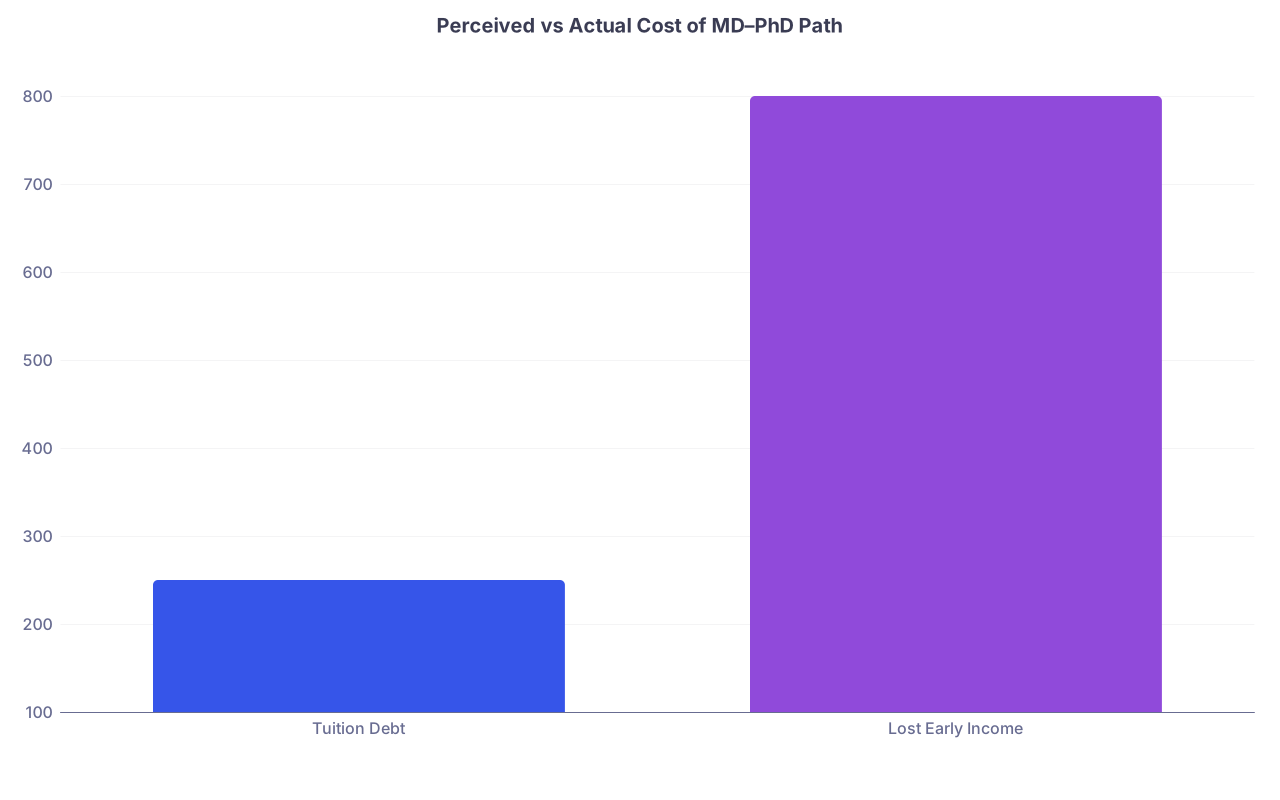
| Category | Value |
|---|---|
| Tuition Debt | 250 |
| Lost Early Income | 800 |
That chart is the basic mismatch: you stare obsessively at the bar called “tuition debt” and ignore the much bigger bar called “lost early income.”
What the Stipend Really Buys—from Their Perspective
MD–PhD programs aren’t charity. They’re strategically funded pipelines.
Your stipend and tuition coverage usually come from some mix of:
- NIH Medical Scientist Training Program (MSTP) funds
- PI grants (you’re cheap, skilled labor)
- Department funds and institutional support
Why are they willing to “pay” that?
Because MD–PhD students:
- Boost the school’s NIH funding portfolio and rankings
- Produce translatable, clinically flavored research that makes grant applications more persuasive
- Fill long-term pipeline needs for physician-scientists who keep the academic machine running
Your time is monetized in ways you never see:
- Each R01 or U grant brings in indirect costs overhead (often 50–70%) that keeps the lights on.
- Your name on publications under big-name PIs is part of their currency for promotion and future funding.
- Your success as a future faculty member is marketed as proof: “Our MSTP produces leaders.”
So when people throw “they’re paying you to go to school!” at you, flip it around:
No. You’re working for them while going to school. The stipend is not free money. It’s discounted salary for a job with controlled outputs and absolutely no job security at the end.
The Career Trap: Physician-Scientist Isn’t Just “MD Plus”
Another myth: “MD–PhD gives you more options.”
On paper? True. You have:
- MD-only clinical paths.
- PhD-only research paths.
- Hybrid physician-scientist roles.
In practice, the path of least resistance is pretty narrow:
- You’re socially and professionally channeled into academic medicine.
- You’re expected to pursue grant-funded research.
- Your training, mentors, and network all bias you toward that one identity: physician-scientist.
The problem: that career path is structurally fragile.
- RO1 funding rates: often ~20% or worse depending on institute and cycle.
- Tenure-track positions? Shrinking and hyper-competitive.
- Clinical productivity demands keep increasing, eating into research time.
Plenty of MD–PhDs end up doing:
- 80–100% clinical work
- Minimal research beyond quality improvement or small clinical projects
- A career that looks indistinguishable from an MD-only academic clinician
At that point, the PhD was a passion project. Or a very long, very expensive detour.
Who Actually Gets a Good Deal from MD–PhD Training?
Here’s the uncomfortable truth: for a narrow slice of people, MD–PhD is genuinely worth it.
Those people usually share some traits:
They already love research before applying
I don’t mean “did a summer project.” I mean:- 2+ years of sustained research (often full-time)
- Multiple posters, maybe a first- or co-author paper
- They think in experiments, not just in grades
They can see themselves happy with substantial research time long-term
Not “I’d like to do some research.” That’s MD-plus.
Real MD–PhD fit looks like:- 50–80% research in your ideal job
- Writing grants doesn’t horrify you
- You like thinking in hypotheses, models, and methods, not just guidelines
They accept the economic hit
Not in a romantic, hand-wavy way. In a spreadsheet way.
They’ve run the numbers and decided: “Yes, I’m okay trading income and time for this.”
For those people, the PhD is not “free med school.”
It’s: “I get paid (poorly, but paid) to become a serious scientist while also getting my MD.”
That’s a different frame. Honest and accurate.
The Alternative That Nobody Markets
Here’s what most premeds never hear from advisors because it doesn’t sound as shiny:
You can absolutely:
- Go MD-only.
- Do a research-heavy residency/fellowship.
- Join a research-oriented department.
- Build a research career with 20–40% of your time protected, especially in academic centers.
- Get a master’s or even PhD later if your career truly demands it, sometimes funded by your institution.
There are MD-only physicians with:
- More publications than some MD–PhDs
- Big roles in clinical trials, implementation science, outcomes research
- Leadership roles in industry, FDA, policy, biotech — all without a formal PhD
And they didn’t give up 4–5 early-career years for the privilege.

| Step | Description |
|---|---|
| Step 1 | Premed |
| Step 2 | MD Only |
| Step 3 | MD-PhD |
| Step 4 | Residency |
| Step 5 | Residency |
| Step 6 | Academic Clinician |
| Step 7 | Community Clinician |
| Step 8 | Research Track |
| Step 9 | Physician Scientist Track |
| Step 10 | Mostly Clinical Practice |
Notice those last two boxes: a nontrivial number of MD–PhDs end up in “Mostly Clinical Practice” anyway. At that point, the PhD was high-cost enrichment.
The Psychological Hook: Prestige and Fear
A lot of people do MD–PhD for reasons they won’t say out loud:
- “It sounds more impressive.”
- “I don’t want to be ‘just’ a doctor.”
- “Free med school sounds safer than big loans.”
- “Everyone in my lab says MD–PhD is the smart move.”
This is where I’m blunt: prestige is an expensive hobby.
You can absolutely end up 36, finally out of training, with:
- No loans…
- But no savings
- No house
- 2–3 fewer years of attending-level skills
- And a research career that’s not nearly as protected or supported as you were promised
Meanwhile your former undergrad lab mate who “settled” for MD-only is 3–5 years into attending life, has kids, a 401(k), and does 20% research through their department.
Who made the wiser move? You tell me.
So When Is “Free MD–PhD” Actually a Lie?
Every time someone:
- Treats stipends as a gift rather than low-rate compensation for labor.
- Ignores the million-dollar-scale opportunity cost of delayed earnings and compounding.
- Sells “no debt” as synonymous with “financially smart.”
- Pretends MD-only paths can’t lead to research-heavy or impactful careers.
- Uses fear of loans or prestige FOMO to push MD–PhD on people who are lukewarm about research.
MD–PhD is not a scam. But calling it free is.
Three Things You Should Actually Do
Run your own numbers. On paper.
Compare:- MD-only with realistic debt + realistic specialty income
- MD–PhD with realistic duration + likely career path income
Use conservative assumptions. Look at total lifetime earnings, not just debt at graduation.
Test your research appetite hard before committing.
I mean:- 1–2 post-bac years in a lab
- Taking real responsibility for a project
- Writing or co-writing something publishable
If you’re not hungry for more after that, you almost certainly don’t need a PhD.
Stop telling yourself it’s free.
It’s not.
It’s a trade: time, income, and career flexibility for a shot at a research-centric physician identity.
If you still want it after seeing the costs clearly? Good. Then you’re doing MD–PhD for the right reason: because you want the life at the other end, not because someone dangled “free tuition” in front of you.
Key takeaways:
- MD–PhD funding is not free; it’s underpaid labor plus a massive opportunity cost in lost early-career income.
- “No debt” does not mean “better off” when you factor in delayed attending years and compounding.
- MD-only paths can absolutely support meaningful research careers; MD–PhD should be reserved for people who truly want long-term, high-intensity research—not those just trying to dodge loans.