
The prestige attached to MD–PhD programs is wildly out of proportion to what the outcomes actually show.
Let me be direct: a huge chunk of premeds chase MD–PhD programs for the wrong reasons—status, the illusion of being “more competitive,” or the vague idea that it will make them some kind of physician–scientist superhero. The reality is much less glamorous and a lot more nuanced. And in some cases, it is simply the wrong move.
The Myth: MD–PhD as the Ultimate Flex
Walk into any high-achieving premed circle and you’ll hear the same scripts.
“I’m thinking MD–PhD at Harvard, Hopkins, maybe MSTP at UCSF.”
“MD alone feels like ‘settling.’ I want to do real science.”
There’s a quiet hierarchy that people rarely say out loud: MD–PhD > MD > DO > everyone else. And MD–PhD sits at the altar like some golden ticket—NIH-funded, tuition-free, stipend, automatic path to academia, guaranteed R01 funding, whatever fantasy is in circulation that semester.
Most of that is myth.
Are MD–PhD programs valuable? Yes—for a very specific kind of person with a very specific kind of career in mind. Are they automatically better, more prestigious, or the “smart choice” if you’re interested in research? No. The data do not support that narrative.
Let’s walk through what actually happens to MD–PhD graduates and why the worship of these programs is, frankly, overrated.
What MD–PhD Training Really Buys You
First, some basic realities.
Most NIH-funded MSTP programs are 7–9 years long. Four-ish years of med school. Three to five years of PhD. Then residency. Then maybe fellowship. Then, if you still have the energy and sanity left, you try to build a research career.
| Pathway | Med School | PhD Years | Residency+ | Total to Attending |
|---|---|---|---|---|
| MD only | 4 | 0 | 3–7 | 7–11 years |
| MD–PhD | 4 | 3–5 | 3–7 | 10–16 years |
| PhD only | 0 | 4–6 | 0 | 4–6 years |
The supposed “trade” is:
- You give: 3–5 extra years of your life, major opportunity cost, and a narrower early-career focus.
- You get: free (or heavily subsidized) tuition, a stipend, strong research training, and better odds—not guarantees—of landing as a physician–scientist.
So does that trade pay off?
Outcome #1: Career Paths Are Less “Research-Heavy” Than the Brochures Suggest
The classic promise: MD–PhD → 80% research, 20% clinic, tenure-track, R01-funded, big lab.
The reality: Most MD–PhDs do not end up as majority-research, R01-funded investigators.
The Association of American Medical Colleges (AAMC) and NIH tracking data have been remarkably consistent over time:
- A majority of MD–PhD graduates do enter academic medicine or research-related careers, yes.
- But only a minority maintain very high research time (e.g., >50%–75%) long-term.
- A non-trivial fraction end up in roles that look very similar to MD-only careers: mostly clinical, some teaching, maybe small-scale research or QI.
There’s a well-known NIH report from the Physician-Scientist Workforce Working Group that spells this out: the pipeline leaks. A lot. You lose people during PhD. Then more during residency. Then during early faculty years when grant pressure hits.
So the marketing image of “you’ll run a lab and change the world” is aspirational. It is not a guaranteed endpoint. For many MD–PhDs, their eventual job could have been reached—with a shorter path—via MD-only plus serious research during residency/fellowship.
Outcome #2: The “Free Tuition” Story Is Financially Overhyped
Yes, MSTP-style programs usually cover tuition and pay you a stipend. That is attractive. For students from lower-income backgrounds, the financial relief is very real and can be life-changing.
But let’s stop pretending it’s free money.
You are paying with time, and time is expensive.
Say you add 4 extra years for the PhD. That’s 4 years you are not earning attending-level salary. Even if you go into a relatively modest-paying academic specialty and make, say, $230–300k/year, that’s easily $1 million of delayed earnings, plus lost compounding, retirement contributions, etc.
Your stipend during those four years? Maybe $30–40k a year before tax.
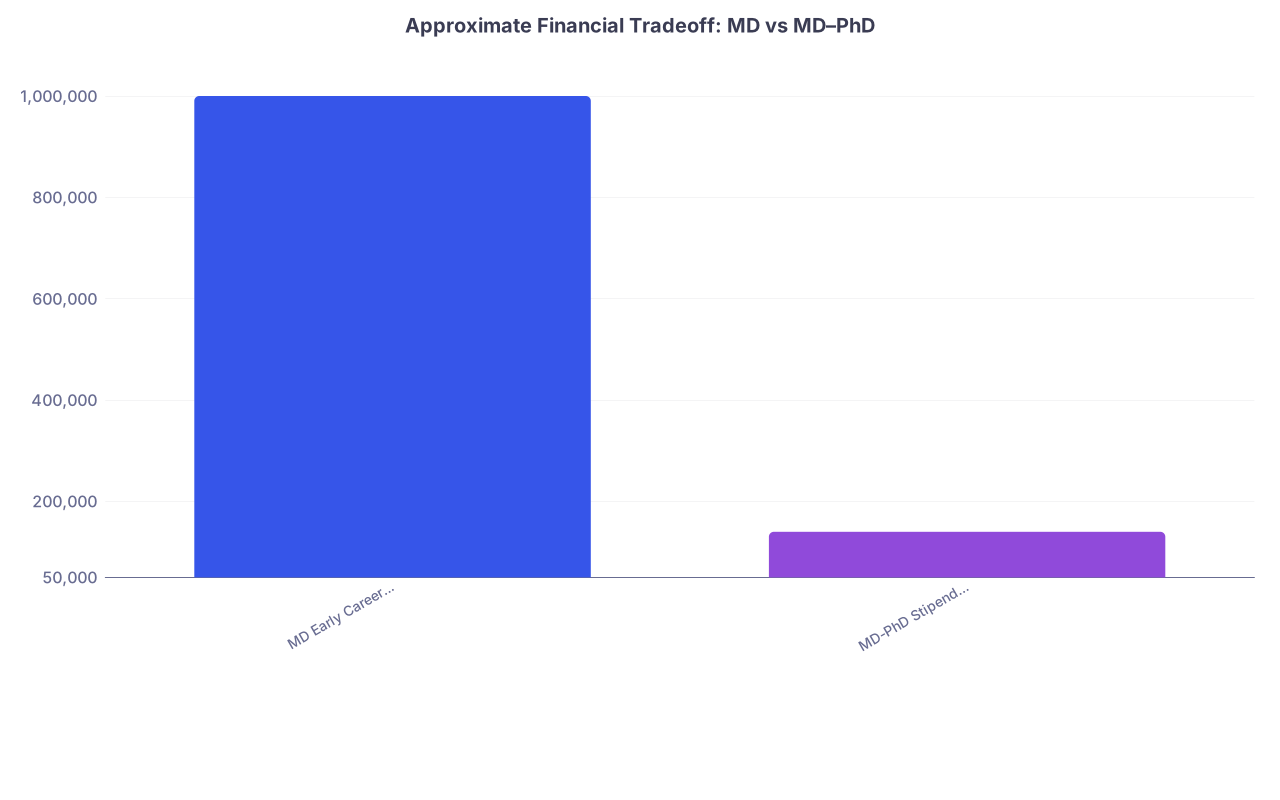
| Category | Value |
|---|---|
| MD Early Career Earnings (first 4 years as attending) | 1000000 |
| MD-PhD Stipend (4 extra PhD years) | 140000 |
The math is not subtle.
If your primary driver for considering MD–PhD is “free med school,” you’re misreading the equation. The financial “win” only really makes sense if you are committed to a career where the dual degree is enabling you to do something you couldn’t realistically do otherwise—and you care about that more than maximizing lifetime earnings.
If what you want is to minimize debt and then go be a clinician, MD–PhD is a brutally inefficient path.
Outcome #3: You Do Not Need a PhD to Do Serious Clinical or Translational Research
This is where the prestige myth really bites.
The unspoken message a lot of premeds absorb is: if you really love research, you must do MD–PhD. MD-only is for people who “just” want to be clinicians.
That’s wrong.
Look at the faculty rosters of major academic medical centers. You’ll find:
- MD-only physicians as PIs on major clinical trials.
- Surgeons running large multicenter studies.
- Internists leading implementation science projects.
- Hospitalists doing outcomes research and publishing in NEJM and JAMA.
They often get there via:
- MD → research-heavy residency/fellowship → mentored K awards → R funding.
- MD → master’s degree (MPH, MS in clinical investigation, epidemiology, biostats).
- MD → protected research time negotiated into an academic appointment.
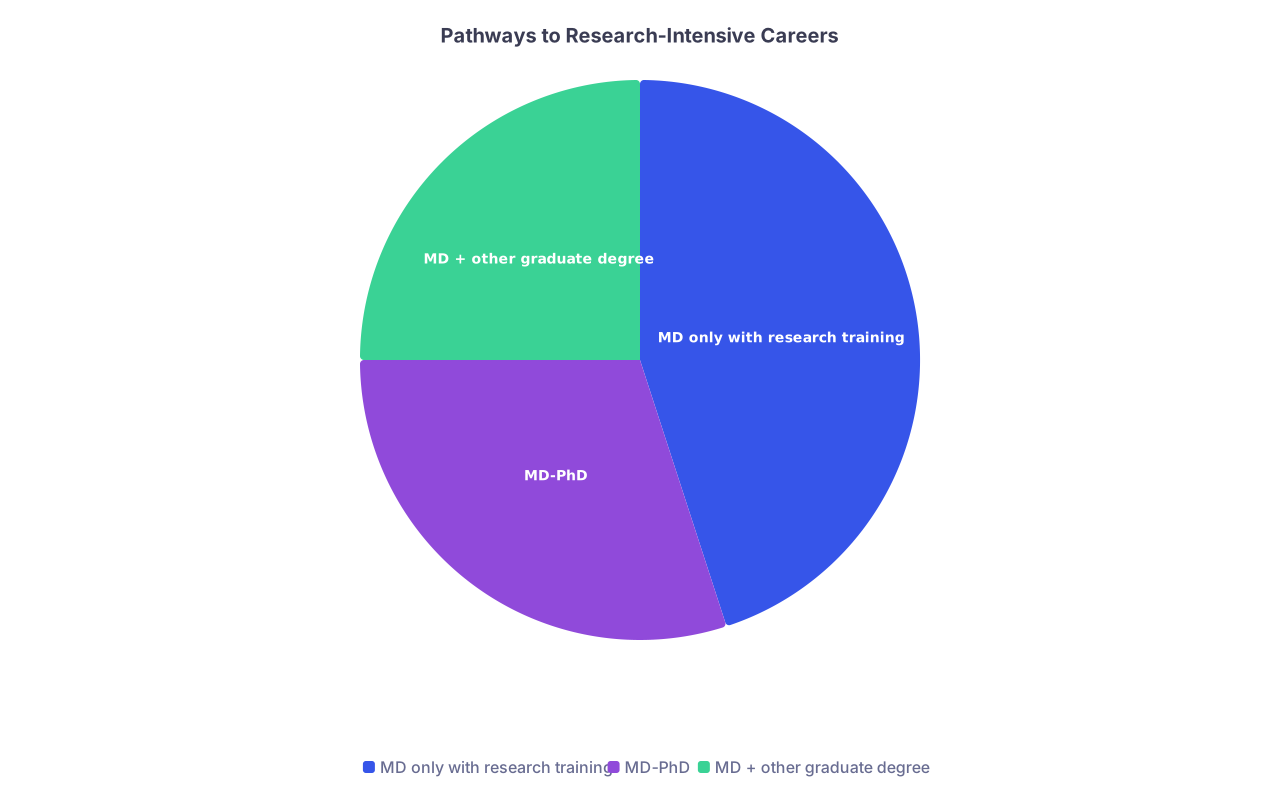
| Category | Value |
|---|---|
| MD only with research training | 45 |
| MD-PhD | 30 |
| MD + other graduate degree | 25 |
Those numbers aren’t from a single clean study; they’re a reasonable synthesis of AAMC/NIH workforce reports and institutional data. The point is simple: MD–PhD is one path into the physician–scientist world. Not the only one. Not automatically the best one.
If your primary research interests are clinical, epidemiologic, outcomes-based, or implementation-focused, a biostatistics-heavy master’s degree during or after residency may be more directly relevant than five extra years in a wet lab.
Outcome #4: Many MD–PhDs Drift Away from Research
I’ve watched a depressingly familiar pattern repeat:
- Student enters MD–PhD wide-eyed, convinced they’ll be 80% research.
- During PhD: they see the grind—failed experiments, endless revisions, a PI living from R01 to R01.
- During clerkships: they discover they actually enjoy clinical work more than pipetting at 9 pm.
- During residency: they realize research time is squeezed by service needs, and the pressure to be productive is relentless.
- By early attending years: they’re 80–90% clinical, maybe on a small project or two.
This is not failure. People are allowed to change. But the prestige narrative never warns you that this is common.
The NIH data echo this: a substantial portion of MD–PhDs end up in primarily clinical roles. Functionally indistinguishable from MD-only colleagues. Same job. Same day-to-day. Plus an extra 3–5 years of training behind them.
So if you’re even moderately unsure whether you actually want a large chunk of your life to be grant-writing and hypothesis-testing, the MD–PhD route is an expensive way to find out.
Outcome #5: Specialty Choice Often Trumps Degree Type
Here’s another quiet truth that breaks the “MD–PhD = superior” illusion.
Your eventual specialty will often have more impact on your research opportunities and career life than whether you have a PhD.
A general internal medicine physician at a major academic center with 40% protected research time and a good mentor will have far better research output than a private-practice dermatologist with an MD–PhD who is in clinic 10 hours a day.
The degree does not generate protected time. Your job contract does.
Some specialties are simply better positioned to support research careers: oncology, rheumatology, ID, academic pediatrics, etc. Others, especially heavy-procedure or private-practice-dominated fields, are much harder to build a sustained research portfolio in regardless of letters after your name.
So obsessing over MD vs MD–PhD while ignoring how different specialties structure time, money, and academic expectations is missing the main driver.
Outcome #6: Attrition and Burnout Are Real
Programs love to advertise match lists and alumni success stories. They are less eager to talk about who left.
MD–PhD attrition is not astronomical, but it’s not trivial either. People drop out during:
- The preclinical years (deciding to stick with MD only)
- The PhD phase (leaving the dual program, sometimes with just the PhD trajectory)
- Or they finish but emerge clearly exhausted and detached from research.
Long training means more chances for life to happen: partners, kids, illness, burnout, financial pressure. That “I’m willing to commit a decade plus” energy at 21 feels very different at 32 when your classmates are already attendings with stable salaries.
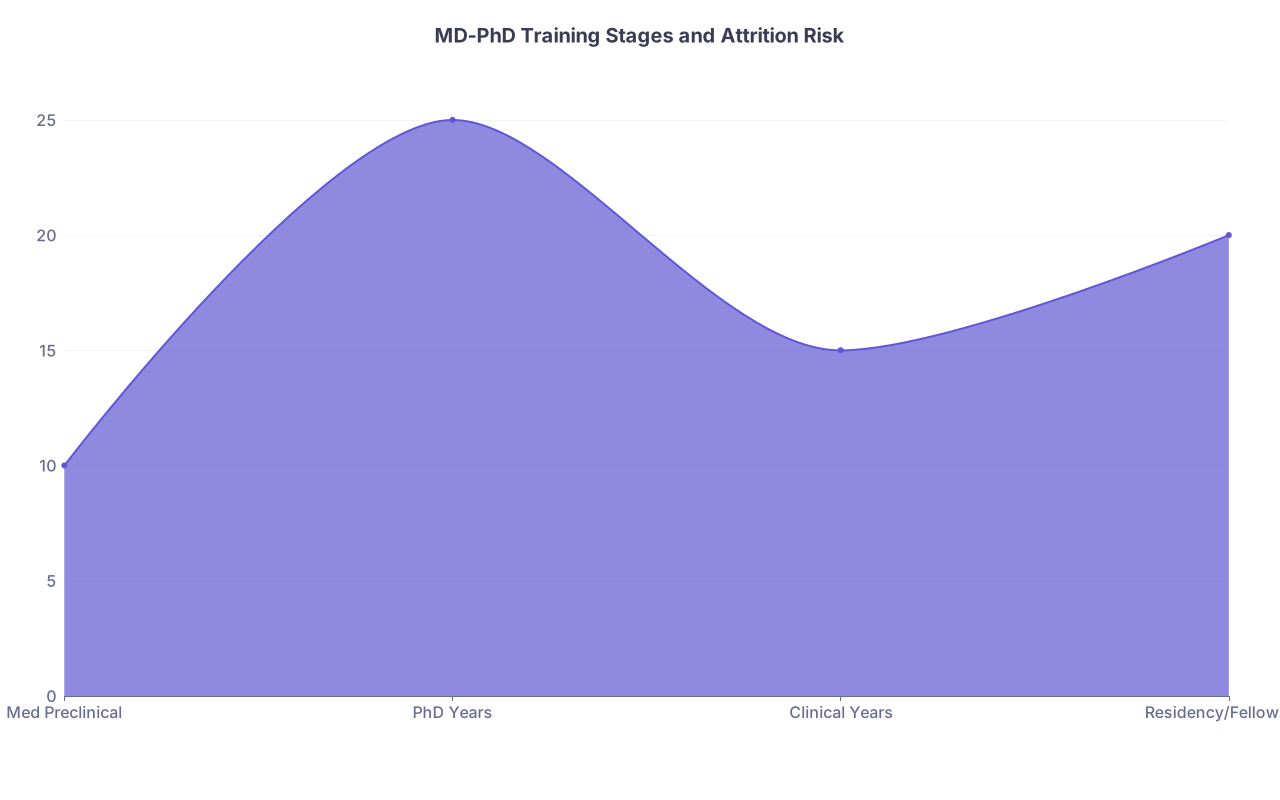
| Category | Value |
|---|---|
| Med Preclinical | 10 |
| PhD Years | 25 |
| Clinical Years | 15 |
| Residency/Fellowship | 20 |
Those “risk” percentages aren’t formal values; they’re a visual way of representing where the friction points tend to cluster. The point is: the longer and more complicated the route, the more failure modes it has.
Who Actually Benefits from MD–PhD Training?
Now, the part everyone skims for. Who should consider MD–PhD?
The people who genuinely win from these programs usually have several things in common:
They enjoy the process of science itself. Not just the idea of “doing research,” but the day-to-day of experiments, coding, data cleaning, troubleshooting, and thinking about mechanisms or methods. If you’ve spent two years in a lab and still want more, that’s a signal.
They can name the kind of science they want to do. Not “I want to cure cancer” vague. More like, “I’m interested in tumor immunology and how T-cell exhaustion shapes checkpoint inhibitor response.” Or “I want to work on neural circuit mapping with optogenetics.” Precision matters.
They understand the tradeoffs. They’re not starry-eyed about prestige or free tuition. They’ve talked to actual MD–PhDs 10–15 years out, not just program directors.
They want to lead labs, shape translational pipelines, build tools, or sit at the bench and the bedside. They don’t just want “research exposure.” They want to make research the backbone of their career.
If that’s you, MD–PhD can be fantastic. For the right person, the dual training really does provide a unique skill set and network. Many brilliant physician–scientists took this route and would do it again.
But that’s not most of the applicants who are lured in by the halo effect.
Better Questions to Ask Yourself
Instead of “Is MD–PhD more prestigious?”, try:
- Do I actually like the day-to-day reality of research, or do I only like results and recognition?
- Am I okay being in training into my mid-30s (or beyond)?
- Is my research interest more basic/translational (strong case for MD–PhD) or clinical/outcomes/population-based (stronger case for MD + focused research training)?
- If I ended up 80–90% clinical, would I feel the MD–PhD years were still worth it?
- Have I talked to at least three MD–PhDs at different stages—PhD phase, early faculty, mid-career—and heard the unvarnished version?
If you cannot confidently say yes to most of these, you are likely being seduced more by prestige than by fit.
Quick Reality Checks vs the Hype
To put the “overrated prestige” idea in sharp relief:
| Claim | Reality |
|---|---|
| Guarantees a research-heavy career | Increases odds, does not guarantee |
| Financially superior due to free MD | Large opportunity cost from delayed earnings |
| Required for serious research | Many MD-only physicians have major grants |
| Always valued more than MD clinically | Clinically, patients and most colleagues do not care |
| Best option if you 'like research' | Best only if you want research as a central career pillar |