
The belief that “a PhD makes residency matching easier” is lazy thinking—and the data does not back it in the way people assume.
It does not magically guarantee interviews. It does not rescue a weak MD record. And in several specialties, it functionally only helps if your PhD is tightly aligned with the program’s research priorities and stacked on top of already strong stats.
Let’s go through what the numbers actually say, not what the guy two years ahead of you on the wards claims.
What People Think a PhD Does vs What It Actually Does
The myth goes like this: admissions committees see “MD/PhD” (or MD with a separate PhD) and auto-upgrade your application. Harder rotations? Forgiven. Mediocre Step scores? Compensated. Research-heavy programs? Instant golden ticket.
Reality is messier.
Program directors, when you read their surveys instead of their marketing blurbs, consistently rank:
- USMLE/COMLEX scores
- Clinical performance (clerkship grades, MSPE)
- Letters of recommendation
- Perceived “fit”
as higher than “graduate degree” for interview and rank decisions.
PhD is a bonus category. Not a core one.
Here’s what the PhD actually does for you in residency matching:
- It increases your odds at a subset of research-heavy programs and tracks.
- It gives you more credibility when your research output is substantial and relevant.
- It may slightly buffer you if your score is solid-but-not-stellar and you’re going for academic programs in your lane.
And here’s what it does not do:
- It does not reliably rescue low Step 1/2 scores.
- It does not compensate for weak clerkship performance.
- It does not fix generic or lukewarm letters.
The MD part still drives the bus.
What The Data Actually Shows (Not The Hallway Myths)
Let’s anchor this in NRMP and specialty-specific data trends. Exact numbers move year to year, but the patterns are stable.
Across competitive, research-driven specialties (think dermatology, radiation oncology, plastic surgery, neurosurgery), the proportion of matched applicants with PhDs is higher than in family medicine or pediatrics. But that doesn’t mean “PhD → automatic match.” It usually means:
Highly motivated, research‑oriented people choose those fields, do a PhD, publish a ton, and also tend to have very strong scores and letters.
Correlation, not magic.
To make this a bit more concrete, here’s a stylized comparison based on the trend you see across NRMP Charting Outcomes–type data. These are pattern‑illustrative, not exact numbers for any given year:
| Profile Type | Match Rate Trend | Typical Board Score Band | Research Output Trend |
|---|---|---|---|
| MD only, strong stats | High | High | Some pubs/abstracts |
| MD only, average stats | Moderate/Low | Mid | Limited research |
| MD + PhD, strong stats | Very high | High | Multiple pubs, first-author |
| MD + PhD, average stats | Moderate | Mid | Strong pub list |
| MD + PhD, weak stats | Low | Below avg | Even with research, still low |
Notice the key point: the PhD mainly amplifies strong MD applications. It adds less—and sometimes almost nothing—when the underlying clinical and exam performance is weak.
Let’s visualize how programs actually weigh things.
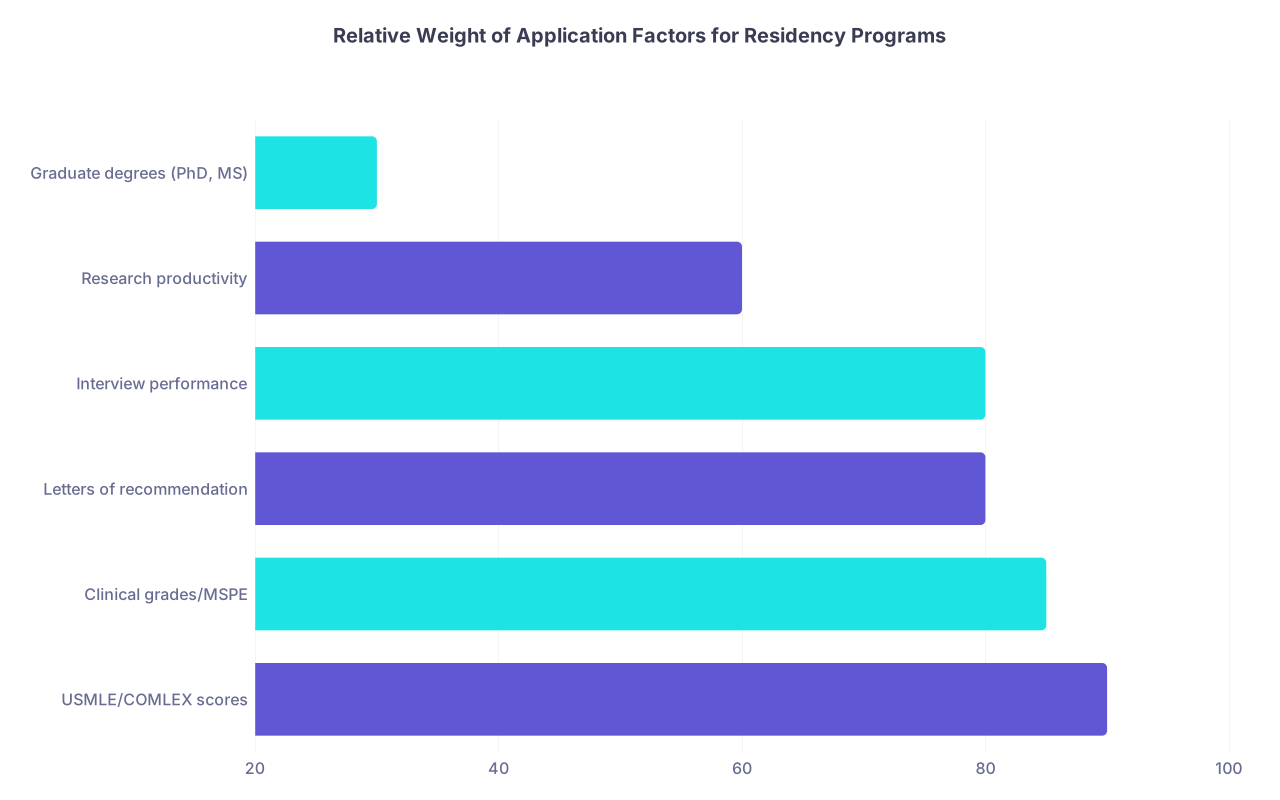
| Category | Value |
|---|---|
| USMLE/COMLEX scores | 90 |
| Clinical grades/MSPE | 85 |
| Letters of recommendation | 80 |
| Interview performance | 80 |
| Research productivity | 60 |
| Graduate degrees (PhD, MS) | 30 |
Programs care much more about how you perform as a future clinician than which letters sit after your name.
Where a PhD Truly Helps (And Where It Barely Registers)
Broad strokes: a PhD is a high-yield asset in three situations and mostly decoration elsewhere.
1. Research-Intensive Tracks and Elite Academic Programs
If you’re targeting:
- Physician–scientist tracks (PSTs)
- Top‑tier academic programs with explicit research missions
- NIH-funded departments that brag about their R01 count on slide 1 of the interview day
then a PhD can matter a lot.
Not because of the diploma. Because of what the diploma usually implies: you can generate hypotheses, design experiments, push projects to publication, and grind through years of failure without collapsing. Programs that care about their grant pipeline and K‑award rates notice that.
This is especially true when:
- Your PhD field directly maps to the specialty (e.g., immunology → rheumatology/derm; biomedical engineering → neurosurgery/rads; cancer biology → heme/onc, rad onc).
- Your publications include first‑author basic or translational papers in reasonable or strong journals.
- You can clearly articulate a research trajectory that plugs directly into their existing labs.
In that group, the comparison is not “MD vs MD/PhD.” It’s more like: “Clerkship‑strong MD with 3 posters vs MD/PhD with 6 first‑author papers and an R21 co‑authorship.” Unsurprisingly, the latter looks better to programs trying to feed the academic pipeline.
2. Hyper‑Competitive, Research-Obsessed Fields
Derm, plastics, rad onc, ENT, neurosurgery—these fields have a track record of heavily valuing research. Unsurprisingly, a PhD appears more often in matched applicant bios.
But here’s the key: those same applicants usually also have Step 1/2 well above specialty means, glowing letters from big‑name faculty, and home‑institution support. If you strip those away and leave only “has a PhD,” the advantage craters.
I’ve seen the scenario too many times:
- Applicant: MD/PhD, 2–3 first‑author papers, but Step score 1+ SD below the mean for that specialty and average clerkship comments.
- Result: Interview list is thin, especially at the top‑tier places they were “supposed” to get. Matched? Sometimes yes, but often only after widening their net or going to a less research‑intense program than they imagined.
Meanwhile, an MD‑only student with 260+ and a couple of good projects? They’re matching fine at elite programs without a doctorate in sight.
3. Weak Extracurriculars, Strong Research—But Not Disastrous Stats
There’s a more subtle case where the PhD helps: the student whose MD side is solid but not flashy—middle‑of‑the-class clinically, mid‑to‑high Step scores, nothing special in leadership—but whose research track is objectively excellent.
For those people, the PhD and research productivity often pull them into consideration at programs that might otherwise overlook them. Not because PDs feel bad ignoring a PhD, but because:
Publications and clear academic direction signal that you’ll contribute to the department’s academic output even if you’re not the star clerk.
Again: this is less about the degree and more about the body of work it represents.
Where a PhD Does Almost Nothing (or Hurts)
Let me be blunt: there are situations where the PhD is nearly irrelevant and a few where it can actively backfire.
Community and Purely Clinical Programs
Most community-based programs, and even some academic ones that are clinically heavy, are not waking up at night worrying about their next R01.
Their priorities:
- Will this resident be safe and reliable on call?
- Are they going to show up, do the work, and not melt down?
- Do they have any red flags?
A PhD doesn’t answer those questions. I’ve watched interviewers skim right past the thesis title, jump straight to Step scores and clinical comments, and never once ask about the dissertation.
For internal medicine at a regional community program, your PhD in molecular biophysics might matter less than your sub‑I evaluation saying you were “calm and effective on busy nights.”
PhD With Minimal Output or No Clear Relevance
Harsh truth: a weak PhD is almost as unimpressive as weak MD performance.
If your CV reads:
- 6 years “PhD”
- 0 publications
- A vague dissertation topic few people understand
- No sustained mentorship relationships
programs may quietly downgrade you. Why? Because you took a ton of extra time and do not have much to show for it. They worry you’re slow, disorganized, or unable to finish long projects.
Same issue when the field is utterly disconnected and you cannot weave a coherent story:
- Candidate with a PhD in medieval studies applying to orthopedic surgery isn’t doomed. But if they can’t explain what skills translate—rigorous analysis, long‑form projects, handling uncertainty—it feels like two separate lives, not a deliberate trajectory.
The “Are You Actually Going to Clinically Work?” Concern
Some PDs are candid: they’re suspicious that MD/PhDs are flight risks for the lab. They’ve been burned by residents vanishing into basic science and leaving clinical services under‑staffed.
I’ve sat in rank-list meetings where people said:
- “I’m not convinced this person really wants to be in the clinic full‑time.”
- “We’re primarily a clinical program. This person screams R01 lab, not service coverage.”
If you apply to a program like that and oversell your desire to be in the lab 80% of the time, your PhD is not a plus. It’s a mismatch flag.
The Real Bottleneck: Time, Debt, and Opportunity Cost
Set aside match odds for a minute. The bigger mistake is assuming a PhD is “the smart way” to secure a residency spot.
You’re usually talking:
- +3–5 extra years of training
- Significant lost attending income
- More years before you can pay down loans or have a normal adult life
That’s fine if you genuinely want a research career. It’s absurd if you’re only doing the PhD because you’re scared your MD application will be too weak.
If your primary goal is to maximize match chances, the data-driven moves are boring:
- Do very well on Step 2.
- Crush your core clerkships and sub‑internships.
- Build a couple of legitimate research or QI projects with solid mentors.
- Get strong letters from people programs know and respect.
A PhD is a specialization choice, not a repair tool.
Let me sketch it as process, because this is where people go wrong:

| Step | Description |
|---|---|
| Step 1 | Want better match odds |
| Step 2 | Consider PhD or MSTP |
| Step 3 | Skip PhD |
| Step 4 | Pursue PhD with aligned research |
| Step 5 | Focus on strong MD record and research |
| Step 6 | Maximize scores, clinical grades, letters |
| Step 7 | Main career goal |
| Step 8 | Ready for 3 to 5 more years |
If you land in box D and still talk yourself into a PhD “for the match,” you’re probably rationalizing.
How Programs Actually Read a PhD on Your CV
Here’s the mental checklist I’ve seen in real committee rooms when a PhD pops up:
- Does this signal they can produce meaningful research here?
- Is their research relevant to our department’s strengths?
- Do their clinical evaluations reassure us they can function like everyone else?
- Are they so research‑heavy they’ll be unhappy with our program’s clinical demands?
- Are their scores and letters consistent with their self‑image? Or is there a mismatch?
If you have:
- Strong PhD and strong MD: you look like a future academic leader. Big plus.
- Strong PhD, average MD: you look like a decent but narrower fit for research‑friendly places. Neutral to mild plus.
- Strong PhD, weak MD: you look like a potential lab star and clinical headache. High risk.
- Weak PhD, weak or average MD: you look like someone who spends a long time doing things without excelling. Big minus.
That’s the honest calculus.
So, Does a PhD Make Residency Matching Easier?
Only in specific lanes, and only when built on top of an already strong MD foundation.
It makes matching to:
- Research‑heavy, academic tracks
- Programs aligned with your scientific niche
somewhat easier if your scores, clinical work, and letters are already competitive.
It does almost nothing for:
- Generic community programs
- Applicants with poor exams and weak clinical narratives
And it can hurt when:
- The PhD is low‑yield or irrelevant
- You overshoot into programs mismatched with your true priorities
If you want to be a physician–scientist, fantastic. A PhD or MD/PhD can be exactly the right move. But if your main question is, “Will this make matching easier?” you’re asking the wrong question.
The smarter one is: “Do I want to spend several more prime years doing real research badly enough that I’d do it even if it did nothing for my match?”
If the answer is no, you already have your answer.