
Is NIH Funding Easier for PhDs Than MDs? What Study Sections Actually Show
Why is your PhD colleague with no clinic time pulling in R01s while the MD in the next office is drowning in EPIC messages and getting pink sheets instead of paylines? Is NIH funding genuinely “stacked” in favor of PhDs?
Short answer: yes, structurally it’s easier for PhDs. But not for the cartoon reason most people think. The bias is less “evil reviewers hate clinicians” and more “the entire NIH ecosystem is optimized for full‑time lab scientists who look a lot like PhDs.”
Let’s go through what the data — and the mechanics of study sections — actually show.
The Big Picture: Who Gets Funded?
First, some numbers to kill the “it’s all random” argument.
Multiple NIH and AAMC analyses over the last decade show the same pattern:
- PhD-only PIs dominate R01 grants.
- MD-only PIs are underrepresented relative to their presence in academic medicine.
- MD/PhD PIs sit in the middle and often perform more like PhDs than MDs in funding metrics.
NIH doesn’t routinely publish super-clean “MD vs PhD” tables in every report, but when institutions or specialty societies disaggregate their own data by degree, the pattern repeats: PhDs are more likely to be continuous NIH-funded investigators, and they get there earlier.
Here’s the structural snapshot that matters far more than individual anecdotes about “that one superstar MD-PI”:
| Profile Type | MD Only | MD/PhD | PhD Only |
|---|---|---|---|
| Primary Role | Clinical + Research | Research + Some Clinical | Research |
| Time in Clinic | High | Low–Moderate | None |
| Typical % Effort on Grants | 10–40% | 40–80% | 75–100% |
| Training Emphasis | Patient care | Mixed | Research |
| Share of R01 PIs (many institutions) | Lower than headcount | Moderate | Higher than headcount |
You do not need a biostatistician to see why the PhDs usually win the NIH game: they’re playing it full-time.
The myth is that this is just “hard work” or “merit.” The reality is baked-in structural advantage.
What Study Sections Actually Reward (Hint: It’s Not Heroic Clinical Work)
Let’s talk about how your grant actually dies or survives: study section.
NIH reviewers score on five core criteria: Significance, Investigator, Innovation, Approach, and Environment.
On paper, there’s nothing that says “PhDs get extra points.” But look at how those criteria function in practice.
1. Investigator
This is where MDs often get quietly punished.
Reviewers don’t see “saves lives in ICU” and add a bonus. They see:
- Number of first/last-author papers
- Continuity of research focus
- Evidence the PI can run a lab and deliver what they propose
A PhD who’s spent 10 straight years publishing in one mechanistic niche looks like a safer bet than an MD who:
- Switched topics a few times chasing what fit their clinic schedule
- Has publication gaps during residency/fellowship
- Spreads effort across QI, clinical trials, and some basic work
The MD may be smarter, more clinically insightful, more relevant to disease. NIH scoring doesn’t care. It rewards sustained, uninterrupted research output. That’s PhD-shaped.
2. Approach
Approach is where grants live and die.
This means:
- Detailed methodology
- Preliminary data tightly aligned with the proposal
- Clean mechanistic logic or a clearly powered clinical design
Who has the time and lab continuity to build “bulletproof” preliminary data and perfect methods sections?
The full-time PhD PI with a steady lab, techs, and postdocs. Not the MD who’s stitching together experiments between ward weeks and clinic blocks.
I’ve watched MD investigators walk into study section with genuinely important, clinically grounded questions — and get hammered on “lack of mechanistic depth” or “insufficient preliminary data.” Meanwhile, a PhD’s grant on some microscopic signaling nuance gets praised for “rigor and feasibility.”
Study sections reward the grants that look like they’re already half-done. You only get that if you’re running a stable lab machine. MDs are often trying to build the machine and run it while simultaneously staffing the ward.
3. Environment
Environment is supposed to be about institutional support.
Again, who usually gets the best startup packages, fully protected time, and guaranteed lab space?
Not the average clinician-hired-to-generate-RVUs. It’s the PhD recruited as “research faculty” to help the department’s Blue Ridge rankings.
MDs do get environment points from big-name hospitals, but if you’re a clinically heavy MD in a mid-tier department with tepid research infrastructure, your “Environment” score quietly loses ground versus a PhD in a lab-centric department.
The Time Trap: Why MDs Start Two Steps Behind
Let’s stop pretending MD and PhD training pipelines are equivalent for research.
Typical trajectories:
- PhD: 5–6 years grad school → 3–5 years postdoc → 10+ years of pure research training before first faculty job
- MD: 4 years medical school → 3–7 years residency/fellowship with fragmented or token research time → then try to start a research career while on service schedules
An MD might realistically start real research momentum in their early to mid-30s. A PhD might have been running independent projects since their mid-20s.
NIH doesn’t add a handicap score for “lost years to being in the OR at 2 a.m.”
Now tack on this:
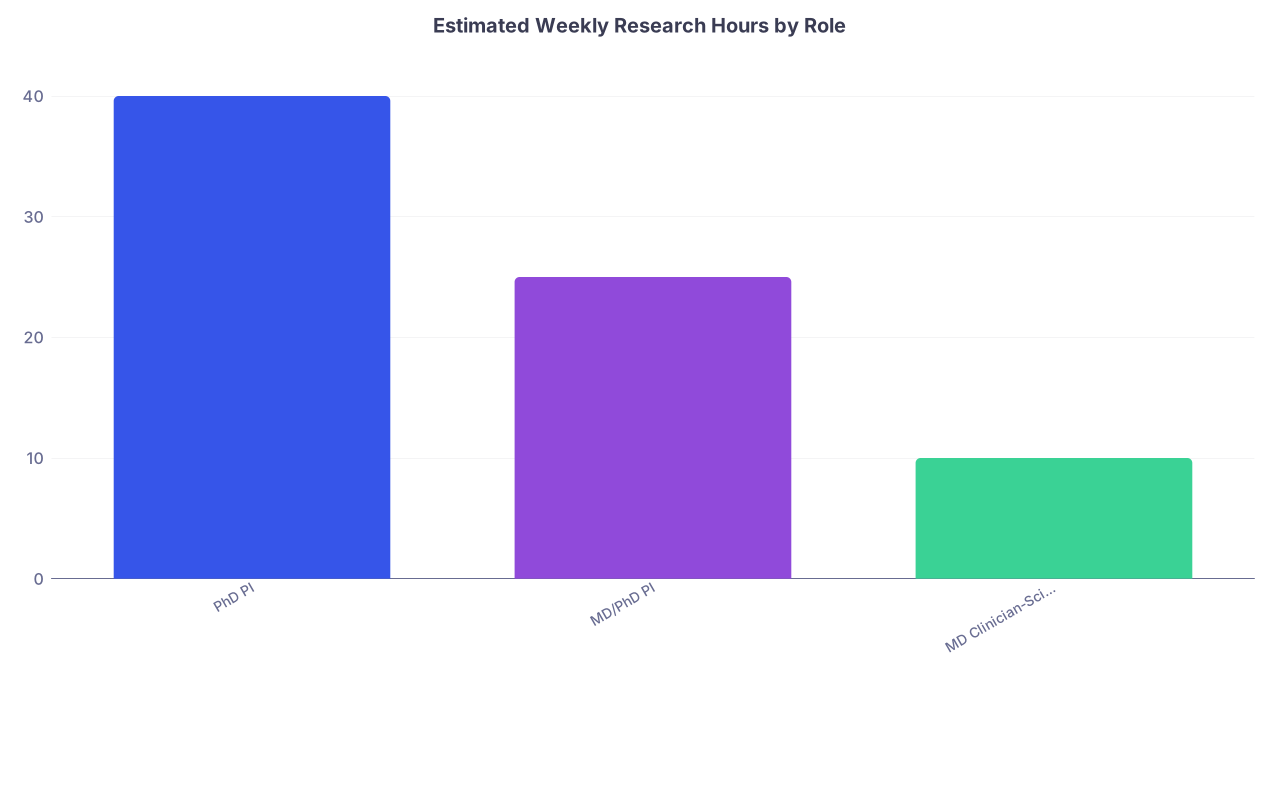
| Category | Value |
|---|---|
| PhD PI | 40 |
| MD/PhD PI | 25 |
| MD Clinician-Scientist | 10 |
Tell me again how this is a fair contest.
The usual response is, “Well, MDs can just negotiate protected time.” Sure. Sometimes. But even when departments promise 50% protected time, real life looks like:
- Constant clinical creep (“just one more half-day of clinic”)
- Being the go-to person for all “clinical expertise” on others’ projects
- Administrative/service load for “representation” on committees
The PhD doesn’t get a page to run down to the ED mid-lab meeting. The MD does.
Study Sections: Who’s in the Room Matters
Another myth: “Reviewers don’t care about your degree.”
They do. Not consciously most of the time, but structurally.
Look at the composition of many basic and translational study sections: overwhelmingly PhD and PhD-style scientists. Clinical trial study sections are more MD-heavy, but most NIH money still flows through mechanisms where mechanistic depth beats clinical insight.
When you send a mechanistic proposal from a clinically loaded MD to a room full of full-time lab scientists, you are asking them to compare:
- Your lab, which might look thin on continuous R01-level output
- Their mental model of a “real lab,” which is usually their own or their peers’ PhD labs
There’s also a credibility issue that no one likes to admit:
- MDs are sometimes seen as “tourists” in the lab world
- PhDs are the “professionals”
So if the methods are slightly underbaked or the preliminary data is thin, reviewers subconsciously think:
- For a PhD: “They have a track record. They’ll work it out.”
- For an MD: “This looks underpowered. I’m not sure they can execute.”
You can hear this in study section comments if you listen closely.
But Don’t MDs Get Priority on ‘Clinically Relevant’ Stuff?
Not really in the way people think.
Clinically heavy MDs often pivot to:
- K23s and patient-oriented awards
- Pragmatic clinical trials
- Health services research
Those spaces can be more MD-friendly, but they’re also increasingly crowded with PhDs in biostats, epidemiology, implementation science, etc., who again are doing this full-time.
The “clinically relevant” card helps most when:
- The MD has serious research training (read: looks like a PhD on paper), and
- The question is clearly better informed by being in the clinic.
If you’re an MD who tries to “wing” research on the side with no rigorous training, NIH is not going to give you a pass because you wear a white coat. This is where many MDs fool themselves. Clinical wisdom alone doesn’t translate into fundable grants.
So do MDs have a lane? Yes, but it’s narrow: MDs who commit hard to research training, fight tooth and nail for protected time, and focus on areas where clinical traction matters — they can absolutely compete. But they’re functionally choosing a non-standard MD career to play on nearly equal terms.
The Quiet Structural Biases No One Likes to Talk About
There are a few built-in biases that tilt the field towards PhDs even when no one is actively discriminating:
Continuity of Mentorship
PhDs are mentored by people whose entire success is NIH funding. MDs are often mentored by people whose success is RVUs, surgical volumes, or leadership roles. That shows up in grant quality.Departmental Incentives
Many departments say they value research but pay raises and promotions track clinical revenue, not impact scores. For PhDs, the only way to survive is to get grants. So their environment and incentives are perfectly aligned with NIH.Promotion Clocks
MD faculty can often climb ranks with moderate publications and strong clinical performance. PhDs without grants and papers get fired. Guess which group is more desperate (and therefore more optimized) for funding success.Lab Infrastructure
The PhD lab is the institutional default. Many MD “labs” are a couple of benches in someone else’s space, a shared tech, and a rotating troupe of med students who disappear after a summer.
None of these show up on a score sheet as “discrimination.” All of them affect scores.
How MDs Actually Win When They Do
So if the deck is stacked, why do some MDs still win big NIH funding?
They stop pretending they can do “full” clinical work and “real” research simultaneously at the same level.
Patterns I’ve seen in consistently funded MD PIs:
- They negotiated aggressive protected time early (often 70–80% research), sometimes taking a hit on salary or prestige initially.
- They found PhD-level mentorship and collaborators and let them stress-test methods and preliminary data mercilessly.
- They built a focused research identity, not scattershot “interesting clinical projects.” One domain. One core question. Many grants.
- They treated research like a second residency: long hours, methodical training, humility about what they didn’t know.
In other words, when MDs play the NIH game successfully, they behave — structurally — a lot like PhDs.
If You’re an MD or MD Trainee Eyeing NIH Funding
Here’s the unvarnished version:
NIH funding is not “fair” between MDs and PhDs if you define fair as “normalized to total workload.” PhDs are structurally advantaged because NIH rewards exactly what PhDs are trained and paid to do full-time.
You can’t fix this with hustle alone while doing 60% clinic. You either restructure your job toward serious research time or accept that NIH will be a long shot.
You must get brutally honest feedback from people who live in study sections. Not your division chief who hasn’t submitted a grant in 15 years. Not the “research-friendly” attending who mostly runs QI projects. You need:
- Someone with current R01-level funding
- Preferably someone who actually sits on NIH review panels
- And ideally, a PhD collaborator who will tear your methods apart before reviewers do
To make this concrete, here’s the basic flow of the NIH game you’re trying to enter:

| Step | Description |
|---|---|
| Step 1 | Clinical MD |
| Step 2 | Focus on non-NIH careers |
| Step 3 | Obtain serious research training |
| Step 4 | Secure protected time and environment |
| Step 5 | Generate focused preliminary data |
| Step 6 | Submit K or pilot grants |
| Step 7 | Build publication record in one niche |
| Step 8 | Submit first R01 or equivalent |
| Step 9 | Revise, resubmit, iterate |
| Step 10 | Continuous funding or pivot |
| Step 11 | Commit to research track |
Most frustrated MDs I talk to are stuck somewhere between A and E but are submitting at H anyway and then wondering why reviewers are unconvinced.
So, Is NIH Funding Easier for PhDs Than MDs?
Yes. For structural, not conspiratorial, reasons.
Here’s the bottom line stripped of diplomacy:
NIH study sections are optimized for people who look like PhDs: long, continuous research training, concentrated time in the lab, method-heavy proposals with deep preliminary data.
Most MDs are trying to do research from a fundamentally disadvantaged position: fragmented time, late start, weaker infrastructure, and institutional incentives that prioritize clinical productivity.
The MDs who succeed in NIH funding are the ones who stop playing by the default MD rules and instead reshape their careers to align with the way NIH actually scores grants — not how they wish it worked.
If you want NIH money as an MD, you either move your life toward the PhD model of work or you carve out a very focused, protected lane that lets you play by the same rules. Anything less is just wishful thinking dressed up as “trying really hard.”