
Only 18–20% of MD‑PhDs end up spending the majority of their time on research—despite training pathways that are supposedly “for future physician‑scientists.”
That statistic alone should make you suspicious of the usual narratives about PhDs and clinical careers. Either the PhD is “useless” for most clinicians… or the way people talk about it is wildly disconnected from how careers actually play out.
Let’s sort out which.
You’ve probably heard both extremes:
- “If you want to do any serious research, you need a PhD.”
- “A PhD is a complete waste for clinicians. Just do research with your MD.”
Both are wrong in predictable ways. The truth is narrower, more data‑driven, and a little uncomfortable: a PhD is extremely valuable for a very specific minority of clinicians and mostly unnecessary (but not totally useless) for the rest.
The Three Career Lanes Clinicians Actually End Up In
Before arguing about whether a PhD is “useless,” you have to be honest about what lane you’re actually headed toward. Most physicians eventually fall into one of three dominant patterns:
- Primarily clinical – 80–100% clinical, maybe some QI projects or occasional papers. This is the majority of practicing physicians.
- Clinical + some scholarship – 50–80% clinical, plus teaching, QI, and low‑to‑moderate research output (retrospective studies, clinical trials enrollment, occasional first/last‑author work).
- Clinician‑scientist – 50% or less clinical, substantial time on grant‑funded research, lab or big‑data group, sustained publication trajectory.
Most medical students think they’re aiming for lane 3. The data says otherwise.
The AAMC and NIH numbers are consistent: only a small fraction of MDs—single digits percentage‑wise—end up with substantial protected research time and long‑term grant funding. And even among MD‑PhDs, a lot drift toward heavy‑clinical jobs because of lifestyle, money, or institutional pressure.
So the question isn’t “Is a PhD useless for clinicians?” in the abstract. It’s:
- Is a PhD useful for the average lane‑1 clinician? No, mostly not.
- Is it useful for lane‑2? Sometimes, but often overkill.
- Is it useful and often decisive for lane‑3? Yes. That’s where the ROI lives.
Let’s put structure on that.
| Career Lane | Clinical Time | Research Time | PhD Value |
|---|---|---|---|
| Primarily Clinical | 80–100% | 0–10% | Very low |
| Clinical + Scholarship | 50–80% | 10–30% | Low to moderate |
| Clinician‑Scientist | 20–50% | 40–80% | High to essential |
What the Career Data Actually Shows About MD vs MD‑PhD
Let’s kill the vague hand‑waving and look at actual patterns from NIH and AAMC data.
Across multiple reports, MD‑PhDs:
- Are disproportionately represented among NIH R01 and career development (K‑series) grantees relative to their tiny fraction of all physicians.
- Hold a higher share of department chair and major research leadership roles (especially in internal medicine, pediatrics, neurology, pathology).
- Spend a significantly lower proportion of their time seeing patients and a higher proportion on research and administration.
But that doesn’t mean “MD‑PhD = success” or “MD only = no research.” The distributions overlap.
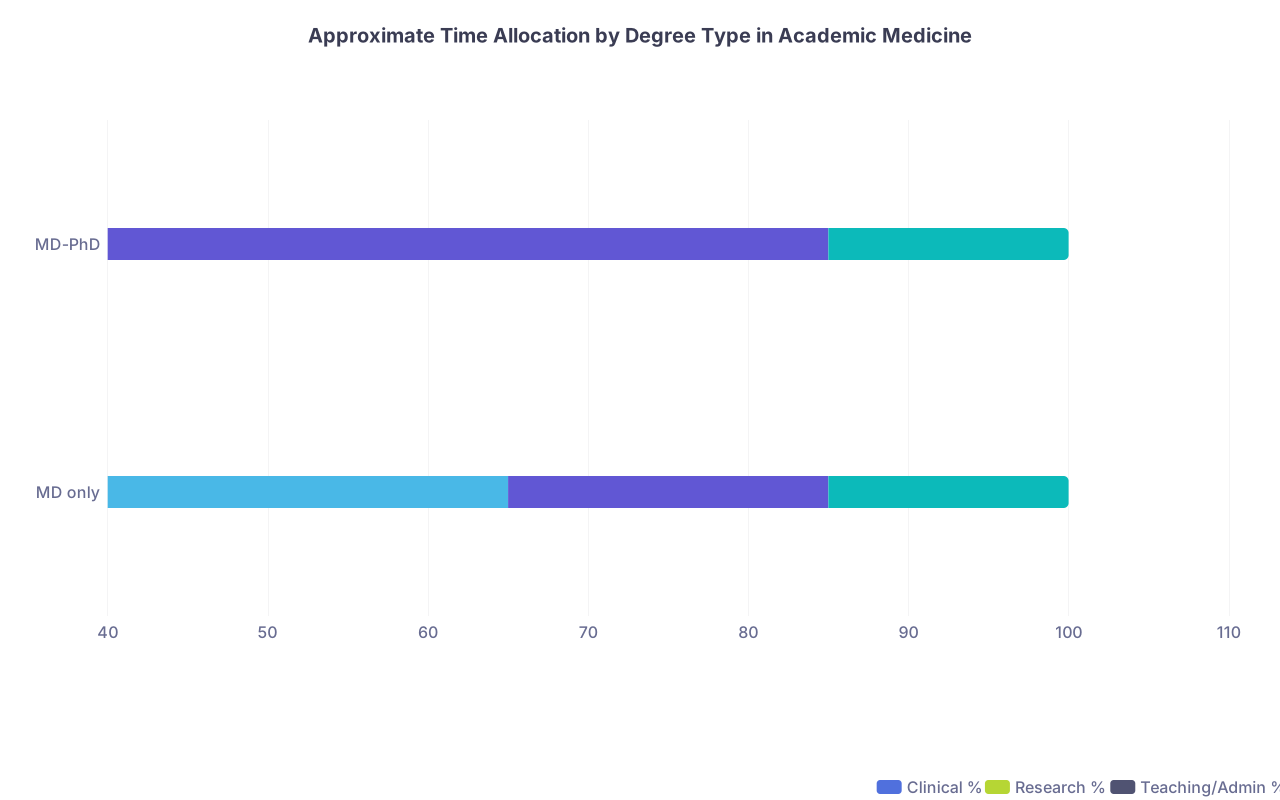
| Category | Clinical % | Research % | Teaching/Admin % |
|---|---|---|---|
| MD only | 65 | 20 | 15 |
| MD-PhD | 40 | 45 | 15 |
Interpret this for what it is: on average, MD‑PhDs do more research, less clinical work. Not a shock. The key detail most students miss is this:
MD‑PhDs are not uniformly “superstars.” They’re skewed into institutions and specialties where research is structurally supported, and many still fail to secure sustained NIH funding.
So the PhD is neither magical nor meaningless. It’s an amplifier in environments that already value research. In a community hospitalist job? It’s mostly a decorative line on your CV.
The Most Persistent Myths About PhDs for Clinicians
Myth 1: “If you want to do research, you need a PhD.”
Bluntly: false.
I’ve watched cardiologists, oncologists, and intensivists with zero PhD run multi‑center trials, sit on guideline committees, and pull in seven‑figure grants. What they had wasn’t an extra degree. It was:
- Protected time written into their job contract
- Mentorship from established investigators
- Institutional backing for infrastructure (coordinators, statisticians, IRB muscle)
- A track record of focused work in a niche
A PhD can accelerate how quickly you become genuinely independent. It does not replace those structural pieces. Without them, your PhD turns into a “fun fact” on your bio while you grind through 24 clinic patients a day.
Where a PhD does move the needle is in basic, translational, and certain data‑heavy fields where experimental design, methods, and grant‑writing skills are central currency. If you’re trying to run a wet lab and compete with full‑time PhDs for R01s, having that training isn’t optional. It’s survival.
Myth 2: “A PhD is useless unless you’re full‑time research.”
Also wrong.
For lane‑2 “clinical plus serious scholarship” people, the PhD isn’t useless; it’s just often overpriced in time and opportunity cost.
Think about these scenarios:
- An academic neurologist with 60–70% clinical time but a PhD in neuroimaging who becomes the go‑to methods expert and co‑PI on multiple grants.
- A pediatric intensivist with a PhD in epidemiology running high‑impact observational studies, leading QI collaboratives, and getting K‑level funding while still in the ICU regularly.
- A radiation oncologist using a PhD in physics or machine learning to design new planning algorithms or predictive models.
They are not doing 80% research. They’re hybrid. Their PhD still matters a lot, because methods expertise and credibility become force multipliers in collaborative work.
The point isn’t “only pure lab rats benefit.” It’s that you have to be in a context that actually uses what the PhD gives you. Which is not true for a huge swath of bread‑and‑butter clinical jobs.
Myth 3: “An MD alone can completely substitute for a PhD, if you’re motivated enough.”
Partially true, but over‑sold.
In clinical research (trials, retrospective cohorts, outcomes), yes—strong mentorship and targeted training (e.g., a research‑heavy fellowship + master’s in clinical investigation/epi/biostats) can absolutely replace a PhD. Many of the most cited clinical investigators have MD+MS or MD+MPH, not PhDs.
But if you’re trying to:
- Run a basic science lab with competitive NIH funding
- Be taken seriously as a methods innovator in biostatistics/ML/genomics
- Compete for certain high‑prestige translational awards where deep mechanistic work is central
Then “I did some projects in residency” is not equivalent to five years of immersion in a discipline, qualifying exams, and producing a rigorous dissertation.
You can brute‑force your way into those spaces as an MD. People have done it. But pretending the training is interchangeable is naïve. Reviewers don’t forget degrees when they’re scanning Biosketches.
The Money and Time Problem Everyone Hand‑Waves Away
The most conveniently ignored question: what does the PhD actually cost you as a clinician?
Let’s put some brutal numbers to it.
Say you take 4–5 extra years for a PhD (MD‑PhD, or stepping out for a stand‑alone PhD). That’s 4–5 years you’re not earning attending‑level income. Pick conservative numbers:
- Clinical attending salary: $250k–$400k+ per year (many specialties more)
- Resident/Fellow/PhD stipend: $60k–$75k at best
The opportunity cost isn’t just salary. It’s compound growth of investments, retirement savings, and debt repayment. You’re easily looking at a seven‑figure delta over a career.
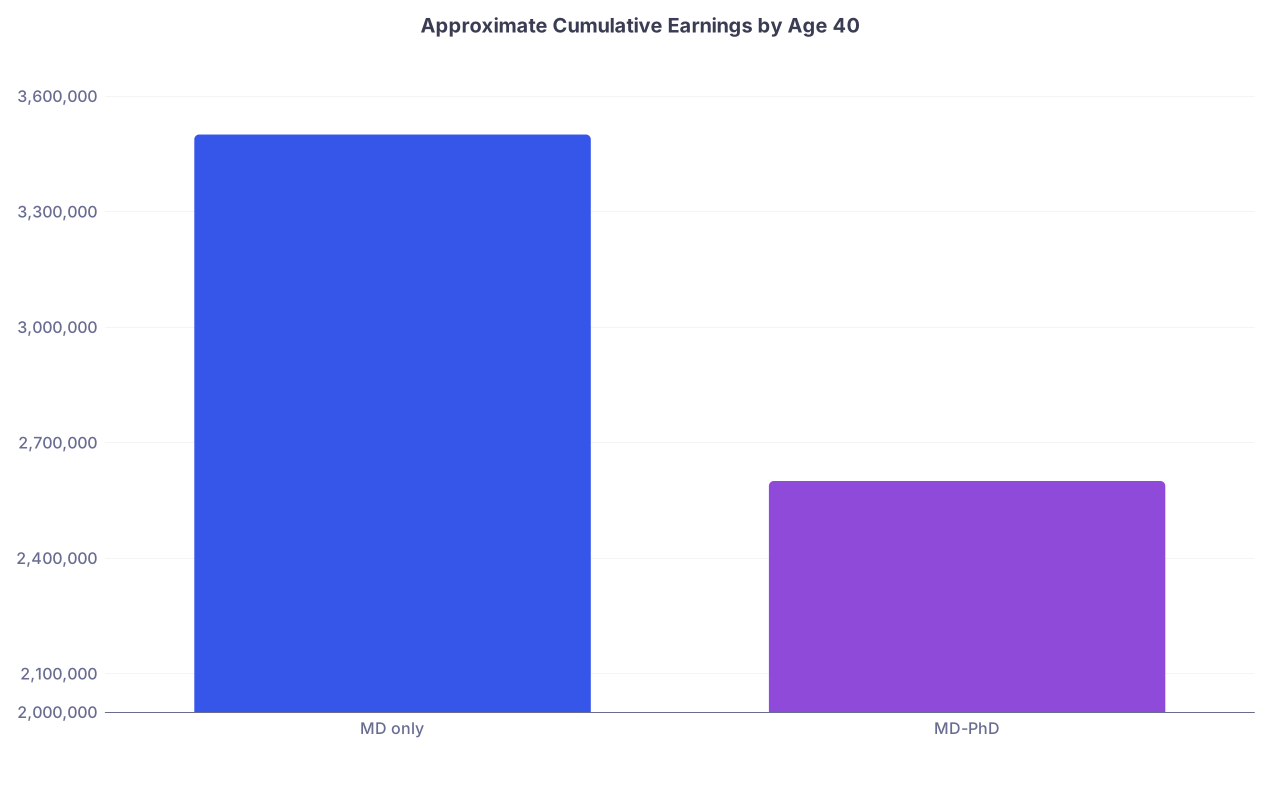
| Category | Value |
|---|---|
| MD only | 3500000 |
| MD-PhD | 2600000 |
That’s not “nothing.” You’re trading a very real financial gap for:
- Increased odds of research‑heavy, grant‑funded careers
- Better positioning for certain academic roles
- More leverage in methods‑centered niches
If your actual future looks like “hospitalist in a large community system seeing 18–20 patients a day,” this trade is just bad math. The PhD doesn’t improve your day‑to‑day work, pay, or job security there. It might help you get a committee title. It won’t fundamentally change your life.
On the other hand, if your realistic path is “tenure‑track immunologist at a major academic center with 50% protected research time,” those 4–5 years are tuition for a different type of career, not just a credential.
MD+Master’s vs MD‑PhD: The Quiet Alternative That Actually Fits Most People
Here’s the thing many med students don’t realize because the MD‑PhD narrative sucks all the oxygen out of the room: for a lot of clinically‑inclined people who still want to publish and lead projects, a targeted master’s is a better move than a PhD.
Think: MPH, MS in Clinical Investigation, MSc in Epidemiology, Biostats, Health Services Research, even Biomedical Informatics.
These programs:
- Usually add 1–2 years, not 4–6.
- Are tightly focused on skills you will actually use in clinical research.
- Pair well with fellowships (oncology, cards, pulm/crit, EM, etc.).
- Are legible and respected on grants and at academic centers.
| Path | Extra Years | Best For | Main Tradeoff |
|---|---|---|---|
| MD-PhD | 4–6 | Basic/translational scientists | Huge time, strong prep |
| MD+Master’s | 1–2 | Clinical researchers / trialists | Less deep, more agile |
| MD only | 0 | Primarily clinical, light research | Fastest earning |
A lot of lane‑2 clinicians—those wanting meaningful, ongoing scholarship without giving up a heavy clinical footprint—are far better served by the master’s route.
They learn design, stats, grant basics, and get plugged into research networks. Without burning a half‑decade.
So when someone says “PhDs are useless for clinicians,” what they’re usually bumping into is this: they watched people do 5+ extra years when a 1‑year epi degree plus a research‑heavy fellowship would’ve given them 90% of what they actually use.
Where a PhD Is Actually a Rational, High‑ROI Move
Let me stop being coy and draw the line.
A PhD for a clinician is not useless if:
- You want to spend at least 40–50% of your professional life on research.
- You’re aiming for basic or mechanistic translational science, not just “Does Drug A beat Drug B.”
- You like methods. Not just “interesting questions,” but actual methods: experimental design, coding, bench techniques, statistics, or model building.
- You want to compete for independent national grants as PI, not only be the “clinician collaborator.”
- You realistically see yourself at an academic medical center where labs, cores, and PhD‑heavy departments are central to your identity.
That’s the zone where the PhD is not vanity. It’s training that shapes how you think, who you work with, and what problems you’re actually capable of attacking.

If that’s genuinely not you, forcing yourself into a PhD program because you “like research” is like enrolling in culinary school because you enjoy eating. Wrong level of commitment.
Where a PhD Is Basically a Very Expensive Hobby
Now the impolite side.
If your likely path looks like:
- Full‑time community practice in EM, FM, anesthesia, hospitalist work, or general surgery
- A heavy RVU‑driven academic job where “research” means squeezing in retrospective chart reviews on nights and weekends
- Administrative or leadership aspirations that are more operational (CMO, service line lead) than research‑focused
Then a PhD isn’t just “not necessary.” It’s actively misaligned.
You’ll get almost no structural support to use your training. Your schedule won’t allow deep, uninterrupted work. Your promotion and pay will be tied to clinical volume, not methods expertise.
In those settings, you’re much better off with:
- A lean methods toolkit (short courses, workshops, focused mentorship)
- A clear, small niche of interest (e.g., sepsis quality, ED throughput, periop outcomes)
- Strategic collaboration with full‑time researchers who actually have the bandwidth
Many of the community‑oriented clinicians I’ve seen with PhDs end up frustrated. Overqualified for the work they’re allowed to do. Under‑resourced to use the skills they paid for in time and lost earnings.
The degree isn’t “useless” in some cosmic sense—they think more critically, read papers better, can lead QI smarter—but it is economically and structurally mismatched with their reality.
How to Decide: A Simple Stress Test
Instead of obsessing about titles, run your intent through a rough stress test:

| Step | Description |
|---|---|
| Step 1 | Do you want 40 percent or more research long term |
| Step 2 | Skip PhD, consider masters |
| Step 3 | Are you drawn to basic or methods heavy work |
| Step 4 | MD plus masters or research fellowship |
| Step 5 | Consider MD PhD or dedicated PhD |
| Step 6 | Reality check with 3 senior clinician scientists |
The two real pivot questions are:
- How much of your actual week do you want to spend on research, not in theory but when you’re 10 years out and tired?
- Do you want to be the methods/experimental design expert, or the clinical mind partnering with such experts?
If your honest answers are “less than half” and “more clinical mind,” you probably don’t need a PhD. Master’s, yes. Strong mentorship, yes. But not a full PhD.
If your answers are “at least half” and “I want to own the methods,” then a PhD stops being some romantic add‑on and starts being a fairly logical investment.
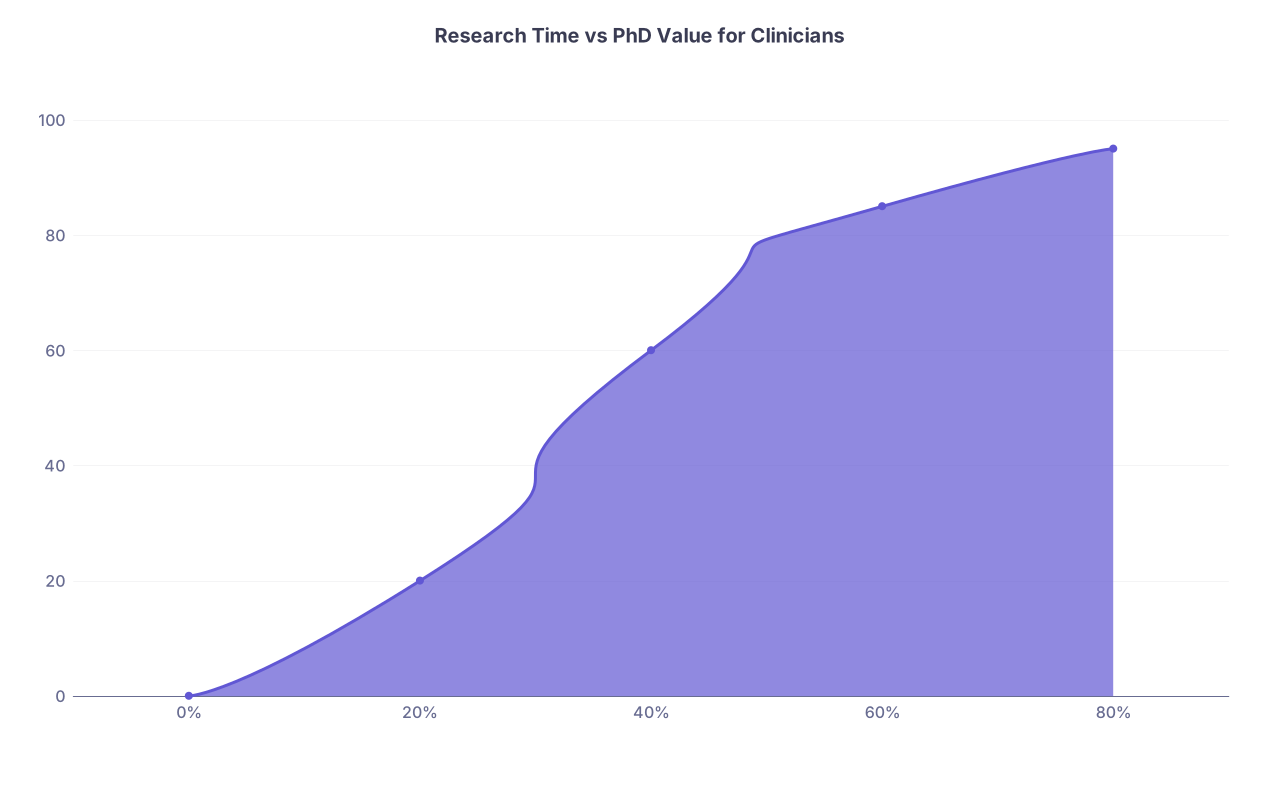
| Category | Value |
|---|---|
| 0% | 0 |
| 20% | 20 |
| 40% | 60 |
| 60% | 85 |
| 80% | 95 |
(Here, think of the y‑axis as “relative value of a PhD.” Once you’re above ~40% research time, the curve steepens fast.)
The Bottom Line: Useless for Most, Indispensable for a Few
Calling a PhD “useless” for clinicians is lazy. So is implying everybody serious about research should get one.
Here’s the uncomfortable, data‑consistent reality:
- For most physicians in primarily clinical roles, a PhD offers negligible practical benefit relative to its cost in time and lost earnings.
- For hybrid clinician‑scholars, focused master’s degrees and research‑dense fellowships are usually a smarter, more efficient bet.
- For a small but critical minority—the genuine clinician‑scientists in basic and mechanistic fields—a PhD isn’t optional fluff. It’s part of the minimum viable toolkit to survive and lead in that ecosystem.
So the right question was never “Is a PhD useless for clinicians?” It’s “Is a PhD useless for the clinician you’re actually going to become, not the fantasy version you describe on your med school application?”
Years from now, you won’t be thinking about whether you picked the “prestigious” path. You’ll be living the daily reality of it—clinic schedules, grant deadlines, lab meetings, or none of the above. Make the call based on the life you want to wake up to, not the letters you want after your name.