
The belief that an MD–PhD “locks in” an academic job is fantasy. A comforting one. But still fantasy.
Let me be blunt: an MD–PhD dramatically improves your odds of pursuing a research or academic career. It does not guarantee you a faculty position, a lab, or protected time. And the gap between the myth and the data is getting wider every year.
You want reality? Here it is.
The Core Myth: “If I Do an MD–PhD, I’ll Automatically End Up in Academia”
I hear some version of this from premeds and early med students all the time:
- “MD–PhD is the pipeline to academic medicine.”
- “MSTP grads all end up with R01s and labs.”
- “If I want to be a professor, I have to do an MD–PhD.”
All oversimplified. Some just flat wrong.
What actually happens is more nuanced:
- Many MD–PhDs do not end up as tenure-track physician–scientists.
- A nontrivial fraction move into primarily clinical roles, industry, or non-research academic positions (clinician-educator, admin, etc.).
- Plenty of pure MDs end up as professors, division chiefs, deans, and NIH-funded investigators.
So the real question is not “Does an MD–PhD guarantee an academic job?” The real question is: “What does the data say an MD–PhD really buys you?”
Let’s look at numbers instead of anecdotes.
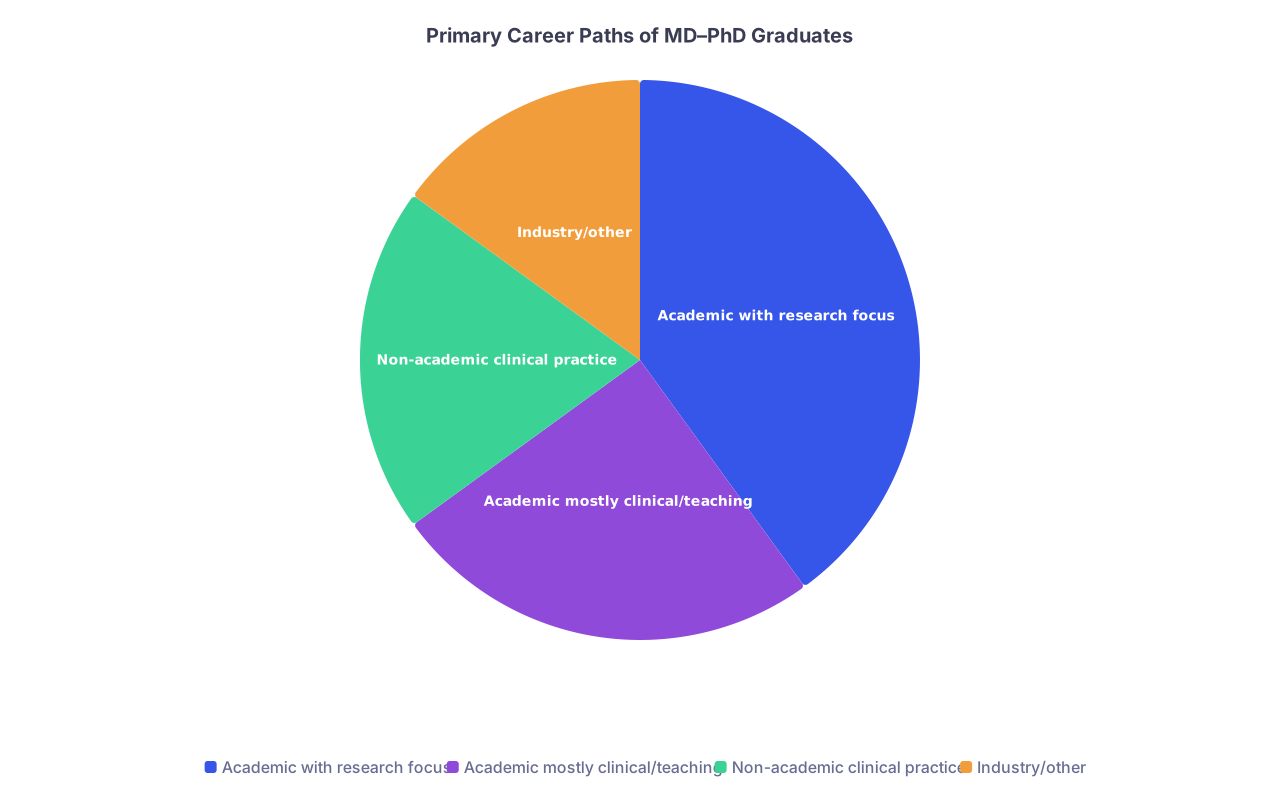
| Category | Value |
|---|---|
| Academic with research focus | 40 |
| Academic mostly clinical/teaching | 25 |
| Non-academic clinical practice | 20 |
| Industry/other | 15 |
These are approximate pooled figures from NIH MSTP outcome reports, AAMC data, and multiple institutional follow-ups. Exact percentages vary by school and graduation cohort, but the pattern is stable:
- Only a minority end up in the classic “grant-funded lab + clinic one day/week” model.
- A sizable chunk are in academic medicine but not as heavy researchers.
- A significant number leave academia entirely.
So no, the MD–PhD is not a golden ticket. It’s more like a very expensive, very long lottery ticket with better-than-average odds—but still uncertain.
What the Longitudinal Data Actually Shows
The best large-scale data we have come from MSTP (NIH-funded MD–PhD) program outcomes and AAMC follow-up surveys.
When you look 10–15+ years post-matriculation, patterns emerge:
- Roughly two-thirds to three-quarters of MD–PhD graduates are in some form of academic medicine or research role.
- But only about 40–50% are doing substantial, independent research as a major part of their job (think lab PI, substantial grant portfolio, or clear research time).
- MD–PhDs do have higher rates of NIH funding and faculty appointments than MD-only peers. That part of the brochure is real.
- Yet the proportion who actually land and sustain R01-level funding is dramatically smaller than the “everyone will run their own lab” story students are often sold.
There’s a second piece of reality people conveniently ignore: leakage over time. Many MD–PhDs start with ambitious research plans and slowly shift toward clinical work. Reasons are predictable:
- Poor funding climate and grant fatigue
- Institutional pressure to generate RVUs (relative value units)
- Burnout from trying to juggle clinic, teaching, and research
- Life factors: kids, partner’s career, geography, debt (for non-funded programs), or simply changing interests
So the raw pipeline is leaky. Not because MD–PhDs are uncommitted, but because the system is structurally hostile to protected research careers.
Guarantee? No. Advantage? Yes, but context matters.
Academic Jobs: Far More Competitive Than the Brochures Suggest
The phrase “academic job” itself is slippery. It ranges from:
- Tenure-track physician–scientist with significant protected research time
- Clinician-educator with mostly clinical work and some teaching
- Soft-money research faculty constantly chasing grant dollars
- Hospital-employed “academic” clinician who teaches a bit but is 90–95% clinical
When premeds say they want an “academic job,” they usually mean the first category: run a lab, write grants, see patients a bit, mentor trainees.
Here’s the hard part: those specific jobs are scarce.
The number of MD–PhD graduates has grown steadily. The number of tenure-track, research-heavy positions has not kept pace. NIH paylines are still brutal. Departments increasingly want people who can bill clinically, because that’s what keeps the lights on.
You get a situation where:
- Many MD–PhDs finish fellowship and find:
- Research-heavy jobs in their ideal city and specialty simply do not exist.
- Positions advertised as “50% research” quietly become “10–20% research” once RVU pressure hits.
- Others string together years of K awards, soft-money positions, and temporary roles before either landing something stable or bailing out to clinical practice or industry.
So yes, an MD–PhD gives you a leg up in competing for these jobs. But it doesn’t change the structural reality: the number of people trained for this career far exceeds the number of stable, well-supported positions.
That’s not a personal failure. That’s the math.
MD–PhD vs MD Alone: Who Actually Ends Up in Academia?
Let’s kill another lazy myth: “You can’t be a serious academic with just an MD.”
Nonsense. Some of the most influential figures in academic medicine are MD-only.
The better framing is: an MD–PhD changes the probabilities and the type of roles you’re competitive for, not whether academia is possible.
Rough ballpark from looking at AAMC data and multiple school outcome reports:
| Pathway | Any Academic Appointment | Substantial Research Role |
|---|---|---|
| MD only | ~20–30% | ~5–10% |
| MD–PhD | ~60–75% | ~40–50% |
| MSTP-funded MD–PhD | ~70–80% | ~50–60% |
These are broad, rounded ranges, but they capture the gist:
- MD–PhD dramatically increases your chance of doing real research as a major career component.
- MD-only can still get you into academia, especially as a clinician-educator or admin, and sometimes even serious research if you hustle hard in residency/fellowship.
But again: none of these rows says 100%.
So if you are telling yourself, “If I do the dual degree, I’ve secured an academic job,” you’re lying to yourself. What you’ve actually done is raise the ceiling and the odds, at the cost of many extra years of training.
The Parts of the MD–PhD Value Proposition That Are Real
I’m not anti–MD–PhD. I’m anti-myth.
There are genuinely strong arguments for the dual degree — if they match your actual goals.
Things MD–PhD really does for you:
Structured research training
You get serious, rigorous research experience, usually with 3–5 years of focused PhD work. You learn how to design studies, analyze data, write papers, think like a scientist. This is not the same as “a couple of summers of research in med school.”Funding and reduced debt (for MSTP and many institutional programs)
U.S. MSTP programs cover tuition and pay a stipend. That’s not trivial. Graduating with minimal debt gives you more flexibility to choose lower-paying research roles instead of chasing the highest-paying private practice job.Credibility and signaling
Hiring committees and NIH study sections know what MD–PhD typically means: sustained research exposure, publications, familiarity with the culture of science. You look like someone who understands both worlds. That matters.Network and mentorship
Strong MD–PhD programs plug you into a network of physician–scientists, labs, and mentors. It’s easier to get into good residencies, good postdocs or fellowships, and early-career awards when you’ve been in that ecosystem.
So if your authentic goal is: “I want to spend a major chunk of my career generating new knowledge, not just consuming it,” an MD–PhD can be a powerful path.
But power and guarantee are not the same thing.
The Stuff Nobody Puts in the Brochures
Here’s the side of the story that gets downplayed on interview day.
1. Time cost and opportunity cost
You’re usually looking at 7–9 years for MD–PhD vs 4 for MD alone (not counting residency/fellowship). That’s:
- Extra years of training during prime income-earning and life-building time
- Delayed attending-level salary
- More moves, more transitions, more chances to burn out
If you end up in a mostly clinical job anyway, that extra half-decade can feel like a bad trade.
2. The two-masters problem
As an MD–PhD, you’re constantly pulled between two worlds:
- The clinical side wants RVUs, full clinics, call coverage.
- The research side wants publications, grants, meetings, and lab management.
Both sides assume they’re your first priority. You’re asked to be two full-time people in one body. Something gives. For many, it’s the research.
3. Research is still brutal, even with the degree
The PhD does not magically smooth over:
- Grant rejection rates
- Reviewer randomness
- Politics in departments
- Soft-money positions where your salary depends on constantly renewing funding
You’ll have more tools. You won’t have fewer obstacles.
4. Your interests will change
Plenty of MD–PhDs discover in residency that they love clinical work more than they expected. Or that the day-to-day reality of running a lab (budgets, personnel issues, endless grant writing) is less appealing than they thought from the student vantage point.
And that’s okay. But it means the “guarantee” premise collapses even on the level of personal preference. You might simply stop wanting what you think you want now.
Where MD–PhD Does Strongly Align With Academic Jobs
Let me flip sides for a moment. There are scenarios where MD–PhD makes excellent sense and does correlate strongly with academic careers.
You’re a very good candidate for the dual degree if:
- You have substantial prior research experience (years, not months) and you enjoyed the process, not just the results.
- You can point to concrete output: papers, posters, serious contributions, not just “I helped pipette.”
- You’ve seen clinical medicine up close and still feel pulled toward discovery-level work, not just patient-facing practice.
- When you picture your ideal workweek, research time is a core part of it, not just an occasional hobby.
In that setting, the MD–PhD is not a guarantee, but it is a rational, data-supported bet.
Without that background? You’re often signing up for an expensive experiment in self-discovery that may or may not match your reality.
The Better Question: What Kind of “Academic” Do You Actually Want to Be?
People lump “academic” into one bucket. That’s lazy thinking.
There are at least four very different archetypes:
The classic physician–scientist PI
Runs a lab. Writes grants. Has 50–80% protected research time. Sees patients one or two half-days a week. This is the stereotypical MD–PhD endpoint. Rare. Competitive. Feasible with either MD–PhD or MD + heavy research, but odds are much better with MD–PhD.The clinician–educator
Mostly clinical. Teaches residents and med students. May do some QI projects, curriculum work, or small studies. MD alone is plenty for this path. MD–PhD helps only marginally and may even be overkill.The hybrid with modest research
Splits time between clinic and smaller-scale research projects or collaborations, maybe 20–30% research. Could come from either pathway. MD–PhD helps, but you don’t need it.The administrator/leader
Program director, chair, dean, CMO. Leadership and political skills matter more than degrees. MD–PhD is optional flair, not a prerequisite.
If what you truly want is #2 or #4, an MD–PhD is often unnecessary pain. If you are obsessed with #1, the dual degree significantly improves your odds—but you still have to execute at a high level and survive a rough ecosystem.
So, Does an MD–PhD Guarantee an Academic Job?
No. Not even close.
What it does:
- Substantially increases the probability you land in academia, especially research-intensive roles.
- Gives you tools, networks, and credibility that make an academic career more plausible.
- Shifts the distribution of your likely outcomes, but leaves plenty of room for you to end up non-academic, non-research, or industry.
What it does not do:
- Ensure a tenure-track position
- Protect you from bad funding climates, toxic departments, or institutional RVU demands
- Lock in your future preferences or career satisfaction
If you go into an MD–PhD expecting a guarantee, you’re setting yourself up for disappointment. If you go in seeing it as a high-commitment, high-variance bet on a particular kind of career, you’re finally speaking the truth.