
Myth: Only PhDs Can Lead Major Labs—How MDs Run Research Empires
Who do you think is more likely to be running a 40‑person lab with multiple R01s and a pipeline of phase I trials—an MD or a PhD?
If your gut answer is “obviously a PhD,” you’re already buying into a myth that does not match what’s actually happening at top academic centers.
Let me be blunt: the idea that MDs “can’t” or “don’t” lead big, serious labs is outdated. It was shaky 20 years ago. It’s just wrong now.
Do many PhDs run phenomenal labs? Of course. But the belief that major research empires are reserved for PhDs—and that MDs are, at best, side‑project clinical dabblers—is fiction. And it quietly pushes medical students and residents away from research tracks they’re absolutely capable of owning.
Let’s dismantle this.
What the Data Actually Shows: MDs Are All Over the Big Grants
You’ll hear versions of this in med school hallways all the time:
“If you want to be a real PI, you need a PhD. MDs just do ‘clinical research’.”
Reality check: MDs are heavily represented among PIs on major NIH grants, especially in clinical and translational work. At many academic medical centers, the people running the most visible labs are MDs or MD/PhDs, not pure PhDs.
Look at a few concrete patterns.
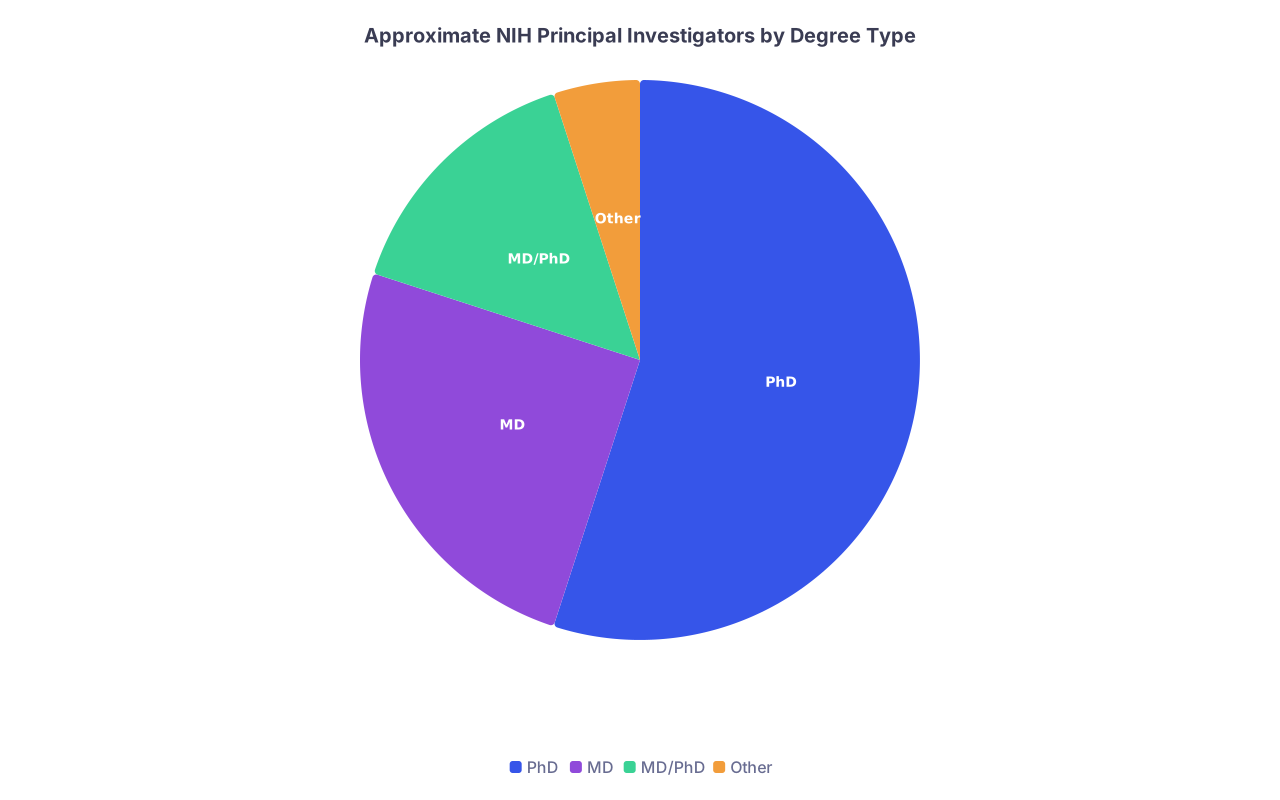
| Category | Value |
|---|---|
| PhD | 55 |
| MD | 25 |
| MD/PhD | 15 |
| Other | 5 |
Numbers like these vary by institute and year, but the key point is simple: a huge fraction of serious NIH‑funded PIs are MDs or MD/PhDs. Not a tiny fringe group. Not token clinicians tagged on to make trials look legitimate. They are running the show.
Walk through the leadership of major cancer centers, cardiology institutes, and neuroscience programs:
- Phase I oncology trial units at NCI‑designated centers? Frequently led by MDs.
- Big‑name translational immunology programs? MDs and MD/PhDs everywhere.
- Multi‑center interventional cardiology trials that actually change guidelines? Almost always MD‑led.
Are there bench‑heavy, mechanistic, mouse‑model‑obsessed labs led by PhDs? Absolutely. But if we’re talking about “major labs” in an academic medical center—large teams, high grant volume, sustained output, major clinical impact—MDs (with or without PhDs) are a huge portion of that universe.
If you only look in basic science departments that barely touch the hospital, you’ll undercount MDs and then pretend that’s the whole story. That’s lazy. The real action—where labs meet patients—is exactly where MDs dominate.
Why the Myth Persists: A Very Narrow Idea of What a “Real Lab” Is
Where does this “only PhDs run real labs” narrative come from? A few bad assumptions.
1. Confusing “wet bench only” with “real science”
If your mental image of a “serious lab” is a basement floor with mice, Western blots, and no daylight, then sure, you’ll see more PhDs. That’s their historical turf. But modern biomedical research is nothing like that siloed caricature.
Major labs now often blend:
- Wet bench experiments
- Bioinformatics and big‑data analysis
- Biomarker discovery
- Clinical trial design and execution
- Health systems or outcomes research
PhDs tend to dominate in the pure mechanistic end of that spectrum. MDs dominate where biology touches patients. The “real” part is not the pipette. It’s the rigor, scale, and impact.
2. Ignoring that hospitals are where the money and patients are
You know who controls access to patients, specimens, EMR data, and the clinical trial machinery? MDs. Departments of medicine, surgery, pediatrics, etc. The big hospital systems.
Funding flows there. Not just NIH R01s. Industry trials. Philanthropy. Institutional program grants. Philanthropists don’t usually donate $50M to “Basic Science Department X.” They name cancer centers and cardiovascular institutes. Those are typically MD‑heavy at the top.
3. Survivor bias from undergrad and early grad exposure
Most premeds and college students only see labs in basic science departments. Those are mostly PhD‑led labs. So they internalize: “real PI = PhD”. They never see the MDs running giant translational research groups inside the hospital because they’re not allowed near those projects yet.
By the time people finally rotate through those clinical departments as residents or fellows, the myth is already baked in.
What MD‑Led “Research Empires” Actually Look Like
Let’s stop speaking in abstractions. What does a major MD‑run lab or program look like in real life?
Picture this: an MD in hematologic oncology at a major center. They’re not alone at a bench pipetting.
They’re:
- PI or co‑PI on multiple R01s and a U‑series or P‑series program grant
- Running 2–4 phase I/II clinical trials at any time
- Directing a lab with 15–30 people: PhD postdocs, MD fellows, research nurses, coordinators, data managers, biostatisticians
- Publishing in NEJM, JCO, Cancer Discovery
- Sitting on guideline committees and DSMBs
- Meeting one day with pharma to design an adaptive trial, and the next day with the IRB about a novel cell therapy protocol
That’s a research empire. It’s not one PI at a bench. It’s a hybrid machine connecting molecular findings, computational models, trial design, and actual patient care.
And a lot of those are led by MDs.

| Step | Description |
|---|---|
| Step 1 | MD PI |
| Step 2 | Associate PI PhD |
| Step 3 | Clinical Trials Core |
| Step 4 | Wet Lab Team |
| Step 5 | Data Science Group |
| Step 6 | Research Nurses |
| Step 7 | Coordinators |
| Step 8 | Postdocs |
| Step 9 | Technicians |
| Step 10 | Bioinformaticians |
| Step 11 | Biostatisticians |
Notice something important: the MD PI is not doing everything alone. Neither is the PhD. The scale comes from leadership and integration, not personally running every western blot or writing every line of R code.
MD vs PhD: Who’s Actually Better Positioned to Lead Big Labs?
Here’s the part people avoid saying out loud because it upsets the neat hierarchy many PhDs cling to: in large, translational labs embedded in hospitals, MDs often have structural advantages.
Do PhDs have deeper formal training in experimental design and basic mechanisms? Yes. Do they often have more hands‑on time at the bench during training? Also yes.
But when the lab gets big and clinical, those advantages are not the only variables that matter.
Here’s how MDs stack up objectively.
| Dimension | MD (clinician or MD/PhD) | PhD |
|---|---|---|
| Access to patients | Direct, built into role | Indirect, via collaborators |
| Control of trials | Can be PI on interventional trials | Often co-PI or methods lead |
| Clinical credibility | High with IRB, hospital, patients | Must partner with MDs |
| Basic methods depth | Variable, often less hands-on | Typically deeper |
| Funding streams | NIH + industry + clinical revenue | Primarily grants |
If you’re building a big translational research empire, the limiting factor is rarely “Can this person run a perfect patch‑clamp protocol?” The bottleneck is:
- Can they marshal resources?
- Can they align clinical and lab teams?
- Can they get trials approved and funded?
- Can they attract patients and collaborators?
For those levers, an MD (especially an MD with good scientific training) is often more potent than a pure PhD.
Let me be clear before someone has a meltdown: there are PhD‑led labs that are absolutely colossal and genuinely world‑class. This is not a “PhDs bad, MDs good” argument. It’s a “stop pretending MDs can’t be primary lab leaders” argument.
The Real Tradeoffs: Training, Time, and Pain
So if MDs clearly can and do lead major labs, why doesn’t everyone do it? Because it’s hard, and you pay for it with time and sanity.
The limiting resources are:
- Training time
- Protected research time
- Mentorship and environment
1. Training pathways that actually work
If you’re an MD who wants to run a large lab, the successful archetypes typically follow one of a few routes:
- MD/PhD → research‑heavy residency → research fellowship → K‑award → R01s
- MD only → heavy research in med school → research track residency (e.g., ABIM research pathways) → postdoc‑style fellowship → K‑series
- Clinician who pivots later → 2–4 years of protected research during fellowship, often with an additional advanced degree (MS, MPH, sometimes PhD but not always)
The common denominator: serious research training and real protected time. Not “I did a summer project and wrote a chart review.”
If your schedule is 90% clinical, forget about running a research empire. You’ll be a consultant on other people’s projects at best. That’s not an MD problem; that’s a time problem.
2. MDs who half‑commit and then declare it impossible
I’ve watched this pattern repeat:
- Resident does a year of “research” that’s 80% case reports and database fishing.
- Takes a faculty job with “protected” time that erodes to 0.3 FTE in 18 months.
- Writes a couple of modest grants, gets turned down.
- Declares the game rigged: “Only PhDs can get big grants.”
Meanwhile, the MD/PhD down the hall spent 3 years doing legit postdoc work, took a pay hit, and deliberately chose a division chief who actually defends protected time like it matters. That MD/PhD now runs a 20‑person lab.
It’s not magic. It’s alignment of training, incentives, and mentors.
Concrete Examples: MDs Running What Everyone Thinks “Belongs” to PhDs
You don’t need a list of names to understand the pattern, but let’s talk specialties and structures where MDs are routinely the top dogs in big research operations.
- Oncology – Phase I units, CAR‑T and cellular therapy programs, translational immuno‑oncology labs. Often MD or MD/PhD directors with PhD co‑directors.
- Cardiology – Interventional labs, structural heart programs, outcomes research centers that shape guidelines. Heavy MD leadership.
- Neurology and neurosurgery – Epilepsy centers, stroke programs, neuro‑oncology groups integrating imaging, biomarkers, and trials. MDs often at the top.
- Infectious disease – HIV, TB, emerging pathogens, vaccine trials. MD‑driven networks with huge grant portfolios.
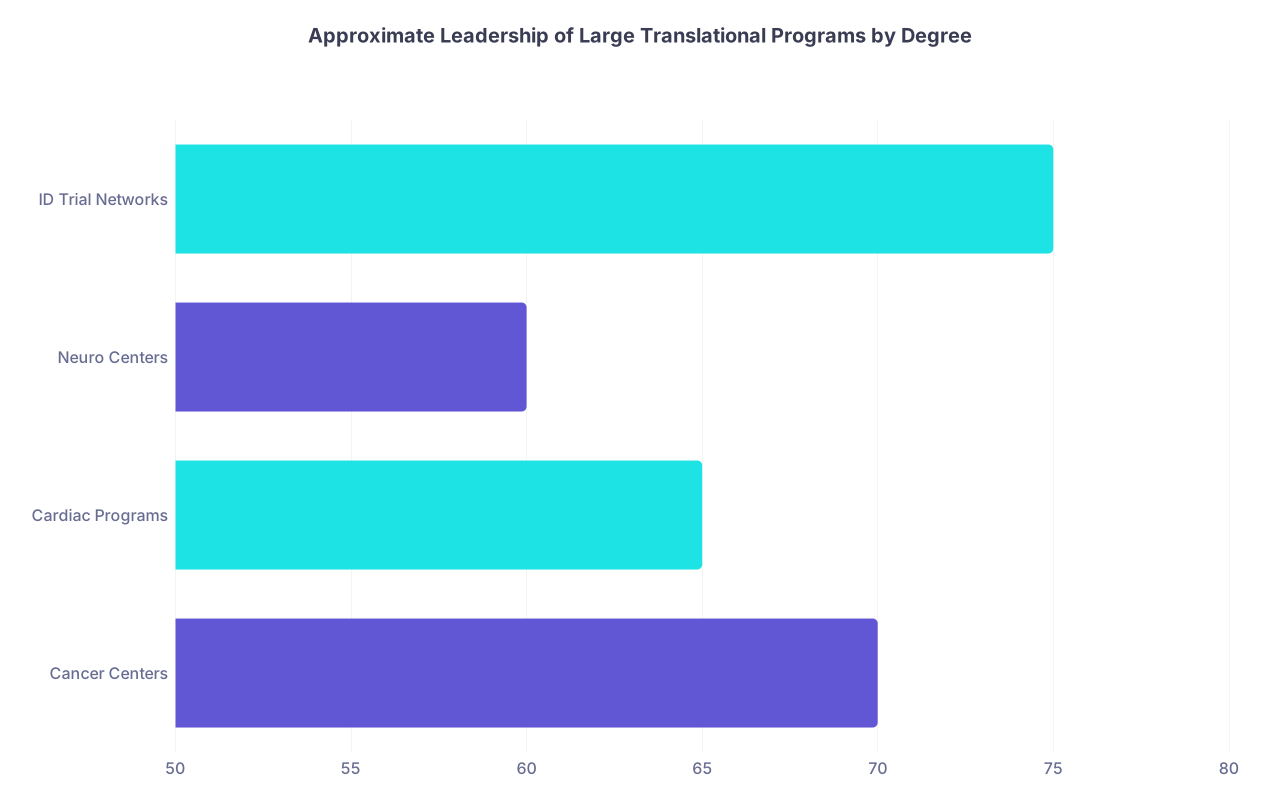
| Category | Value |
|---|---|
| Cancer Centers | 70 |
| Cardiac Programs | 65 |
| Neuro Centers | 60 |
| ID Trial Networks | 75 |
Values here are rough representations of a consistent reality at major academic systems: a majority of those program directors and PIs are MDs or MD/PhDs, not only PhDs.
If your personal sample is “the one PhD‑only lab I saw as an undergrad,” that’s not evidence. That’s anecdote.
What It Actually Takes for an MD Student or Resident to Get There
If you’re in med school or residency and you want to run a big lab someday, you don’t need to buy into the inferiority myth. You do need to be strategic and a little ruthless.
A few non‑fluffy, actually relevant moves:
Choose mentors by track record, not title.
Do they have multi‑year funding? Do they protect their mentees’ time? Have former trainees become PIs? If not, walk.Commit to real methods training.
Whether it’s genomics, imaging, trial design, or biostatistics, you need to be more than a tourist. MDs who lead serious labs usually have a couple of techniques or domains they truly own, not just supervise.Fight for protected time like your career depends on it—because it does.
If your “50% research” job quietly becomes 20%, you will not build a lab. I’ve seen people sleepwalk into that trap, then wonder why the grants never land.Integrate clinic and lab early.
The MD advantage is at the clinic–bench interface. Lean into that. Let your research questions be pulled from the patients in front of you. That’s how you build something a PhD cannot easily replace.

| Step | Description |
|---|---|
| Step 1 | Med Student |
| Step 2 | Serious Research Blocks |
| Step 3 | Residency Research Track |
| Step 4 | Research Heavy Fellowship |
| Step 5 | K Award |
| Step 6 | First R01 |
| Step 7 | Expanded Lab and Trials |
Notice there’s no box there that says “Must get PhD or you are doomed.” The additional PhD can help with depth, yes. It’s not a mystical permission slip to run a lab.
When You Should Consider a PhD as an MD
Here’s where I’ll be precise and a bit unpopular: some MDs absolutely should consider adding a PhD or equivalent deep scientific training. But not for the reason people think (“MDs aren’t real scientists”).
Consider it if:
- You’re obsessed with deeply mechanistic work in a very narrow domain (e.g., structural biology, ion channel biophysics, theoretical neuroscience)
- You want to compete directly in a field that is structurally dominated by PhD‑heavy basic science departments, not clinical departments
- You genuinely enjoy long, detailed, methodologically intense projects more than clinical work
If that’s you, MD/PhD or an MD + later PhD can be a rational move. It’s just not the required price of admission to run a big, impactful lab embedded in a hospital.
The Bottom Line Myths vs Reality
Let’s strip this down.
Myths:
- Only PhDs can be “real PIs” with big labs
- MDs are inherently worse scientists
- MDs are limited to “soft” clinical or outcomes research
- Running a major lab is incompatible with seeing patients
Reality:
- MDs and MD/PhDs lead a huge number of large, well‑funded labs—especially in translational and clinical research.
- The main determinants are training, time, mentorship, and environment, not the presence or absence of three extra letters after your name.
- MDs have structural advantages at the clinic–research interface that PhDs simply don’t, especially for trials, patient access, and program leadership.
You do not need a PhD to run a major lab.
You do need a plan, a spine about your protected time, and the patience to build real scientific skills instead of dabbling.
If you’re an MD or future MD who wants to build a research empire, the gate is open. The myth that it’s “not for you” is exactly that—a myth.
Key points:
- MDs (and MD/PhDs) already lead many of the largest, highest‑impact labs in academic medicine, especially where research meets patient care.
- The real bottlenecks are training, mentorship, and protected time—not whether you have a PhD.