
MDs who think they can build serious academic careers without solid research training are almost always wrong. Not sometimes. Almost always.
The comforting story is: “If I’m a great clinician-teacher, the academic promotions and leadership roles will come.” That story used to be closer to true 30–40 years ago. It is not the world you’re graduating into now.
Let me be blunt: in modern academic medicine, lack of research training is a ceiling. You may not feel it as an intern. You will feel it as a mid-career attending wondering why your CV looks thin compared with people who are not obviously smarter than you.
Let’s dismantle the myth piece by piece.
The Old Model of “Academic MD” Is Dead
The myth comes from a real historical truth. Academic medicine used to have three semi-separate tracks:
- The pure clinician-educator
- The physician-scientist (often MD/PhD)
- The administrator / “department politician”
In that older model, the clinician-educator could be promoted on the strength of teaching, committee work, and being the go-to person on the wards. There was lip service to scholarship, but many were promoted with a handful of review articles and some teaching awards.
Look at what’s actually happening now.
| Institution | Assistant → Associate Promotion | Research Output Expectation |
|---|---|---|
| Harvard-affiliated | Peer-reviewed scholarship | Multiple first/last author papers |
| UCSF | Educational or clinical scholarship required | Measurable impact, not just teaching hours |
| Mayo Clinic | Evidence of ongoing scholarly activity | Publications, grants, or major QI projects |
| Michigan Medicine | Track-specific but all require scholarship | Data-driven contributions documented |
| Yale | Teaching plus scholarly productivity | Innovation must be disseminated (papers, grants) |
Even on “clinician-educator” or “teaching” tracks, the wording has shifted from “good teacher” to “scholarship in education” or “scholarly contributions to clinical care.”
Translation: you are expected to generate, analyze, and publish data about something—patients, processes, or learning.
If you do not have basic research training, every part of that expectation is harder:
- Designing a study
- Getting IRB approval
- Analyzing data
- Writing a publishable manuscript
- Responding to reviewers
You can try to outsource all of that to other people. That’s how you end up as “helpful clinical collaborator” on papers and never as the person whose name matters.
“But I’m Not Doing Bench Work” – The Wrong Comparison
The straw man is powerful here: “I don’t want to pipette at 2 a.m., therefore I don’t need research training.”
Bench research is one tiny corner of what “research training” actually means for MDs.
In practice, you’ll see four big domains of scholarship in academic medicine:
- Basic / translational science
- Clinical research (trials, cohorts, registries)
- Outcomes / health services research
- Medical education research and implementation science
Only the first one involves cell lines and animal models. The others are heavily MD-driven—and all of them require you to understand study design, bias, statistics, and how to move a project from “idea we discussed in the workroom” to “citable PubMed entry.”
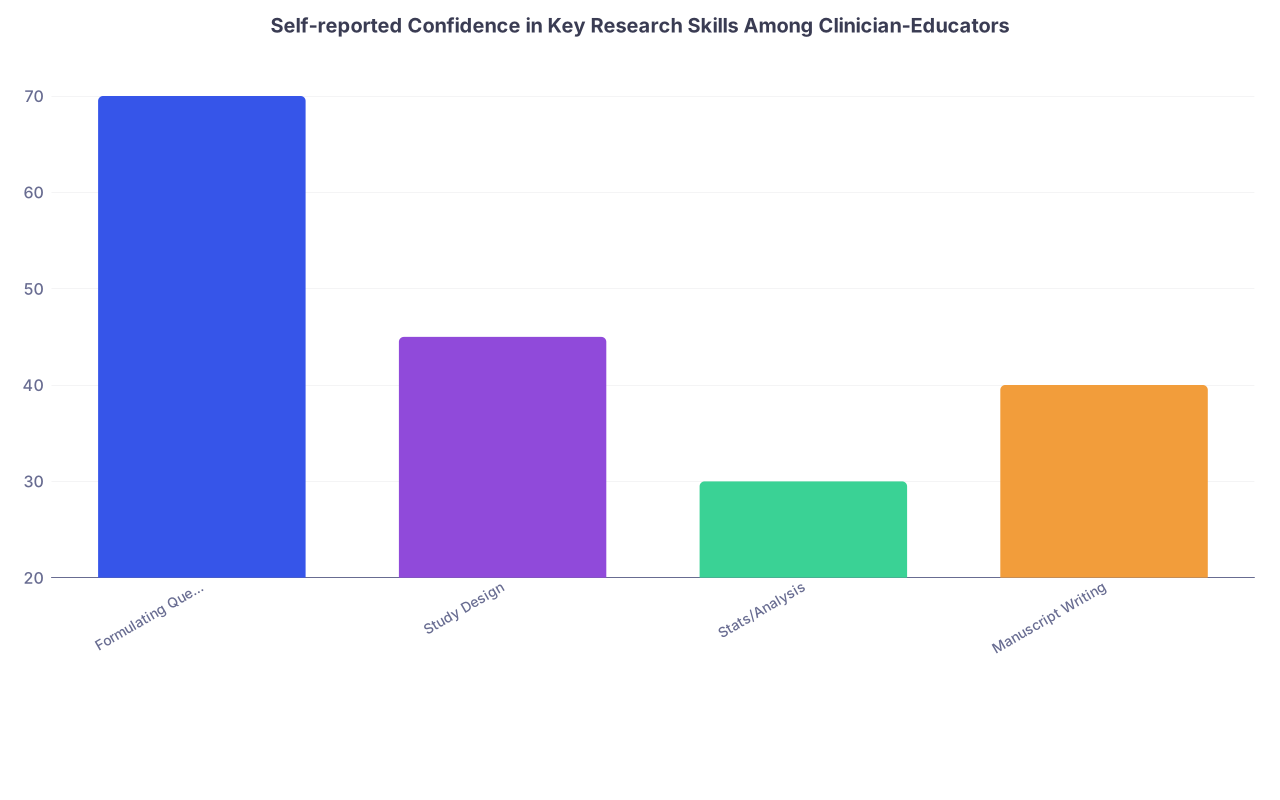
The problem: a lot of MDs assume “I’ll just learn it as I go.” Here’s what the data actually shows.
| Category | Value |
|---|---|
| Formulating Question | 70 |
| Study Design | 45 |
| Stats/Analysis | 30 |
| Manuscript Writing | 40 |
In multiple faculty development surveys from large academic centers, MDs without formal research training consistently:
- Overestimate their ability to design rigorous studies
- Underestimate the complexity of statistics and measurement
- Struggle to get projects past “we collected some data” into publication
So no, you don’t have to be doing CRISPR or animal surgery. But if you’re in academic medicine and cannot:
- Critically appraise a study
- Spot obvious design flaws
- Work with a biostatistician intelligently
- Draft a paper that doesn’t make reviewers roll their eyes
…then your “I don’t need research training” stance is just setting yourself up to be sidelined.
The Hidden Currency of Academic Medicine: Not Just RVUs
You’re told RVUs and patient volume are king. That’s half-true—for your paycheck. For your career capital and institutional power? Research output wins.
Look at who gets:
- Protected time
- Division chief roles
- Leadership in residency and fellowship programs
- Invitations to guideline committees and national panels
- The mic at major conferences
It’s not just “great clinicians.” It’s people who produce citable work.
Here’s a pattern I’ve seen repeatedly on promotions and leadership committees:
- Two mid-career faculty up for division leadership
- Both clinically solid, both well liked
- One has 5–10 first/last author papers in the last 5 years and a small education or QI grant
- The other has nothing but “excellent clinical care” and some teaching awards
The committee’s discussion lasts about 90 seconds. They choose the one who clearly knows how to generate scholarship. Because that person can bring visibility, funding, and academic credibility to the division.
Protected time is similar. Departments justify it with:
- Grants brought in
- Publications generated
- National reputation built
If you can’t connect your work to those metrics, you’re volunteering to work more clinical shifts so someone else can get paid to think.
MD vs MD/PhD vs “Just MD with Training”
Here’s another myth: “If I didn’t do a PhD, I’m locked out of serious research.” Also wrong.
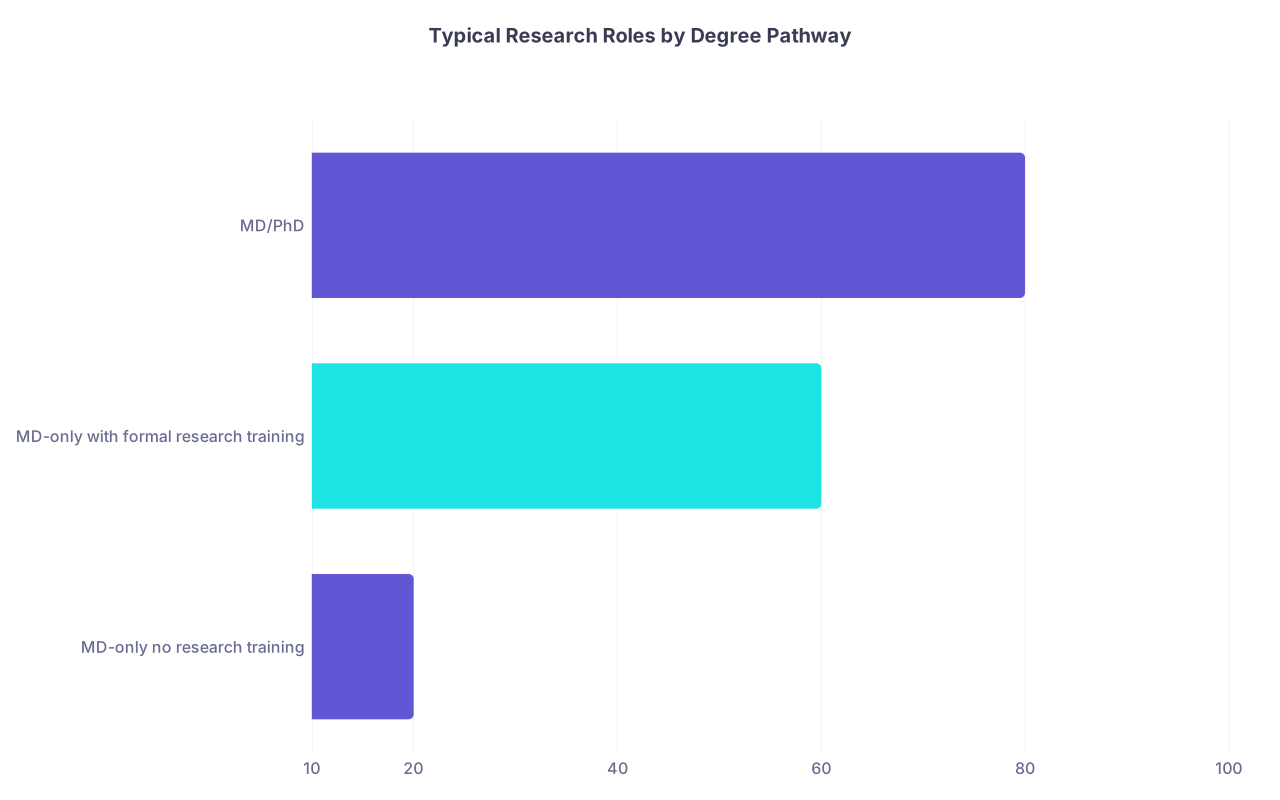
The research landscape in academic medicine actually looks more like this:
| Category | Value |
|---|---|
| MD-only no research training | 20 |
| MD-only with formal research training | 60 |
| MD/PhD | 80 |
Those numbers aren’t “accuracy scores”; they reflect relative likelihood of:
- Leading grants
- Being PI on multicenter trials
- Becoming tenure-track or similar
MD-only with real research training often outperform MDs coasting off a dusty PhD they finished a decade ago in a niche field. Why? Because:
- Their questions are deeply clinical
- Their access to patients and real-world data is excellent
- They’re often more pragmatic and less perfectionist about methodologic purity
But there’s a condition: they obtained solid research training somewhere—Master’s (MPH, MS in Clinical Research, MEd for education), formal research fellowship, or heavily mentored productivity during residency/fellowship.
The worst category by far is “MD-only, no real research training, occasional collaborator.” Lots of effort, low impact, constant frustration.
“Teaching Track” Without Research Training: A Trap
Let’s talk clinician-educators, because they’re usually the loudest defenders of the myth.
You see versions of this all the time:
- A hospitalist who runs the residency rotation and does all the schedules
- A surgeon who’s beloved by residents and runs the skills lab
- An internist who spends 60% of their time precepting and giving lectures
They tell themselves: “My scholarship is my teaching.”
That’s not how your promotions committee sees it anymore. They now talk in terms of “educational scholarship,” which has a specific definition: systematic, peer-reviewed, disseminated work that others can use and cite.
Examples:
- A validated assessment tool
- A curricular innovation studied with pre/post data
- A multi-site education study
- A high-quality MedEd portal publication with downloads and impact metrics
None of that is possible at scale if your “research training” is just reading UpToDate and occasionally skimming JAMA.
I’ve watched clinician-educators hit a familiar mid-career wall:
- Promoted to assistant professor without much trouble
- Around the associate professor discussion, their CV shows: thousands of teaching hours, “Best Teacher” awards, maybe a few co-authored case reports
- Minimal first/last author peer-reviewed educational scholarship
The committee response is polite but clear: “Good teacher, not an academic leader.” That’s the tax you pay for dismissing research training when it was offered.
What Research Training Actually Buys You (That You Do Not Get Otherwise)
Strip away the romanticism. What does formal research training really give an MD?
Not perfection. Just enough fluency in five critical domains:
Question refinement
Turning “Our discharge process sucks” into:- A measurable outcome
- A specific population
- A testable intervention
Design literacy
Knowing when:- A randomized trial is overkill
- A simple pre/post or stepped-wedge design is enough
- A survey is useless unless you validate it
- Your sample size makes your results noise
Stats realism
You don’t need to personally run complex models. You do need to:- Understand what your statistician is doing
- Avoid obvious abuses (p-hacking, multiple comparisons, underpowered fishing expeditions)
- Interpret confidence intervals and effect sizes like an adult, not an MS1
Writing that passes peer review
Not pretty prose. Functional structure:- Clear methods
- Transparently reported results
- Honest limitations
- Tight, evidence-grounded discussion
Project management
Moving from idea → protocol → IRB → data collection → analysis → manuscript → revision → publication.
Without losing momentum for three years because of night float and clinic.
These are skills. You can learn them the hard way over 10 chaotic years. Or in 1–2 structured years with mentorship.
And you know what else it buys? A universal translator badge. You can talk to:
- Stats people
- Data scientists
- Health economists
- Implementation scientists
…without sounding lost. That alone makes you far more useful in academic networks.
The “I’ll Just Be Clinical” Escape Hatch (That Isn’t)
At this point someone will say: “Fine, I’ll just be a full-time clinician. I don’t care about promotion.”
Sometimes that’s honest. Often it’s defensive.
Here’s what being “just clinical” in an academic center really means long-term:
- More nights, weekends, and holidays
- Less schedule control
- Lower probability of leadership roles
- Less say in how the department operates
- You are the first line used to “cover gaps” and the last line considered for protected opportunities
And ironies abound. The people who say they “don’t care about titles” later discover:
- Promotions are tied to salary scales
- Titles determine eligibility for certain leadership roles
- National reputation (built through scholarship) heavily influences external job offers and negotiation leverage
Meanwhile, their classmates with basic research training:
- Take on a bit less clinical time
- Build a small but consistent body of work
- End up with options—inside and outside academia
You do not have to love research. But you should at least understand that refusing research training inside academic medicine is choosing fewer options later for marginal comfort now.
So What Does Smart, Minimalist Research Training Look Like?
You don’t need a seven-year MD/PhD detour to avoid this myth’s trap. Smart, targeted moves work fine:
- During residency/fellowship: one or two serious projects with a mentor who publishes consistently, not “the nice attending with 3 case reports.”
- Short, focused courses: statistics for clinicians, intro to clinical research design, medical education research bootcamps.
- A one- or two-year research or education fellowship if you want heavy academic careers (hospitalist research tracks, MedEd fellowships, health services research fellowships).
- A master’s degree if you’re serious about building a long-term academic presence: MPH (epi/biostats focus), MS in Clinical Investigation, MSc in Health Policy, MEd in Health Professions Education.
The point isn’t chasing letters. It’s getting to the point where:
- You can lead a modest but real scholarly niche
- Your name appears as first/last author often enough to matter
- You’re not permanently dependent on others to “do the research part”
That’s what makes “MD-only” entirely viable in academia.
The Bottom Line: The Myth Costs You, Not the System
Let me wrap it up clearly.
Modern academic medicine quietly but firmly expects scholarship from MDs, even on “teaching” and “clinical” tracks. Promotions, leadership, and protected time are heavily biased toward people with real research training.
You do not need to become a bench scientist or get a PhD. But you do need enough research training to design, execute, and publish meaningful work in your domain—clinical, QI, outcomes, or education.
Saying “I don’t need research training” inside academia is not a neutral choice. It’s choosing more clinical service, fewer leadership options, weaker negotiation power, and a career ceiling you’ll hit right when you think you should be hitting your stride.
Believe the myth if you want. But do not pretend there is no bill to pay later.