
You can absolutely pivot from a stalled PhD to a serious, competitive MD application—if you stop drifting and start treating this like a salvage operation with a clear plan.
Most people in your situation do the worst possible thing: they stay stuck in limbo. Half in the PhD, half on SDN and Reddit reading horror stories, doing nothing decisive in either direction. That is how you burn 2–3 more years and still have a weak application.
You are going to do something else: stabilize your current situation, convert your PhD mess into an MD asset, and build a credible application timeline.
Let me walk you through how.
Step 1: Get Clear on Your Situation (No Self-Delusion)
You cannot fix what you are not willing to describe honestly. Start with a brutal inventory.
A. Define your current PhD status
Write it down in one sentence, like a progress note:
- “3rd-year neuroscience PhD, no first-author papers, 1 poster, PI relationship deteriorating, project stuck.”
- “5th-year chemistry PhD, one first-author, committee wants ‘one more paper,’ I am mentally done, no clear graduation date.”
- “2nd-year PhD, failed qualifying exam once, allowed to repeat, but I want out.”
You are not writing this for your CV. You are describing the reality you need to manage.
B. Clarify what ‘stalled’ really means for you
Stalled usually falls into one or more of these buckets:
- Technical: experiments not working, project poorly designed, impossible scope.
- Relational: toxic or absent PI, lab culture problems, misaligned expectations.
- Institutional: program rules, funding ending, shifting requirements.
- Personal: burnout, depression/anxiety, lost interest in the research question.
Each of these has different implications for how you talk about it later in MD interviews.
C. Decide your primary objective
You have three real options. Pick one. Not “maybe all of the above”.
| Option | Core Goal |
|---|---|
| Finish PhD then apply MD | Maximize credentials |
| Exit with a master’s then apply MD | Cut losses, move forward |
| Leave entirely and build application otherwise | Hard reset |
Your choice depends on:
- How many real years to graduation (not the fantasy version your PI uses).
- Your mental health and burnout level.
- Funding security.
- Strength of your current academic record.
I have seen people lose 4–5 extra years “finishing PhD” when they could have gotten an MD in the same time. Do not be that person. If your program cannot give you a realistic, concrete plan to finish within 18–24 months, your default assumption should be: cut losses.
Step 2: Stabilize the PhD (Even If You Plan to Leave)
Your PhD situation, no matter how bad, will follow you into MD admissions. LORs, transcripts, gaps, explanations. You are going to clean it up as much as possible.
A. Have the uncomfortable talk with your PI
You need information and containment, not catharsis. Script the meeting.
Goals:
- Clarify realistic time-to-degree in months, not vibes.
- Define minimum requirements for completion (papers, experiments, dissertation scope).
- Explore master’s exit option if available.
- Keep the relationship functional enough to get a letter.
Script skeleton:
- “I have been reflecting seriously about my career path and I am strongly considering medicine. That means I need a realistic timeline for finishing here, or potentially exiting with a master’s if that is feasible.”
- “Given where my project stands today, what do you see as the minimum publishable unit and realistic time frame to defend?”
- “If we aimed for a 12–18 month plan, what would absolutely have to happen?”
You are not asking for permission to want MD. You are negotiating scope and expectations.
If your PI is supportive, good. If they are hostile or manipulative (“you’re throwing your career away,” “no one leaves my lab”), file that away. That is exactly how you will later frame the situation in interviews: misaligned mentorship, not lack of resilience.
B. Protect your letter of recommendation pipeline
You cannot apply MD with a black hole where your PhD PI should be, unless you have a very compelling reason and alternative advocates.
Optimal scenario: you get at least a neutral-to-positive letter from your PI, plus strong letters from:
- Another committee member.
- A collaborator.
- A course director or program director who knows your work.
To get those, you need to:
- Keep doing your job at a baseline competent level. No disappearing for months.
- Hit agreed-upon milestones on the scaled-back plan.
- Communicate like a professional, even if you plan to leave.
Your emotion: “I am done with this.”
Your behavior: “I am still reliable, organized, and collaborative.”
That contrast is what MD programs will see.
Step 3: Design the MD Application Strategy Around Your Reality
Now we move from damage control to offense.
A. Decide on timing: when are you actually applying?
Look at the calendar. Be specific.
You want your AMCAS/AACOMAS submission to line up with:
- A plausible exit date (PhD or master’s).
- Enough clinical and shadowing experience to not look like a tourist.
- MCAT prepared and taken with a competitive score for your targets.
Most people in your shoes should apply no earlier than 12–18 months from the moment they decide to pivot. Why? Because you likely:
- Do not have enough recent clinical exposure.
- Have not prepped for the MCAT.
- Need time to stabilize your academic story.
Trying to cram this into 6 months is how you end up with a 507 MCAT, thin experiences, and a “maybe I’ll finish the PhD someday” narrative that no committee trusts.
B. Clarify your target bucket: US MD vs DO vs international
Be honest about competitiveness:
- Undergrad GPA.
- Any grad coursework grades.
- Likely MCAT range (based on diagnostic).
- Research output (which you probably have more of than the average applicant).
Then sketch rough goalposts:
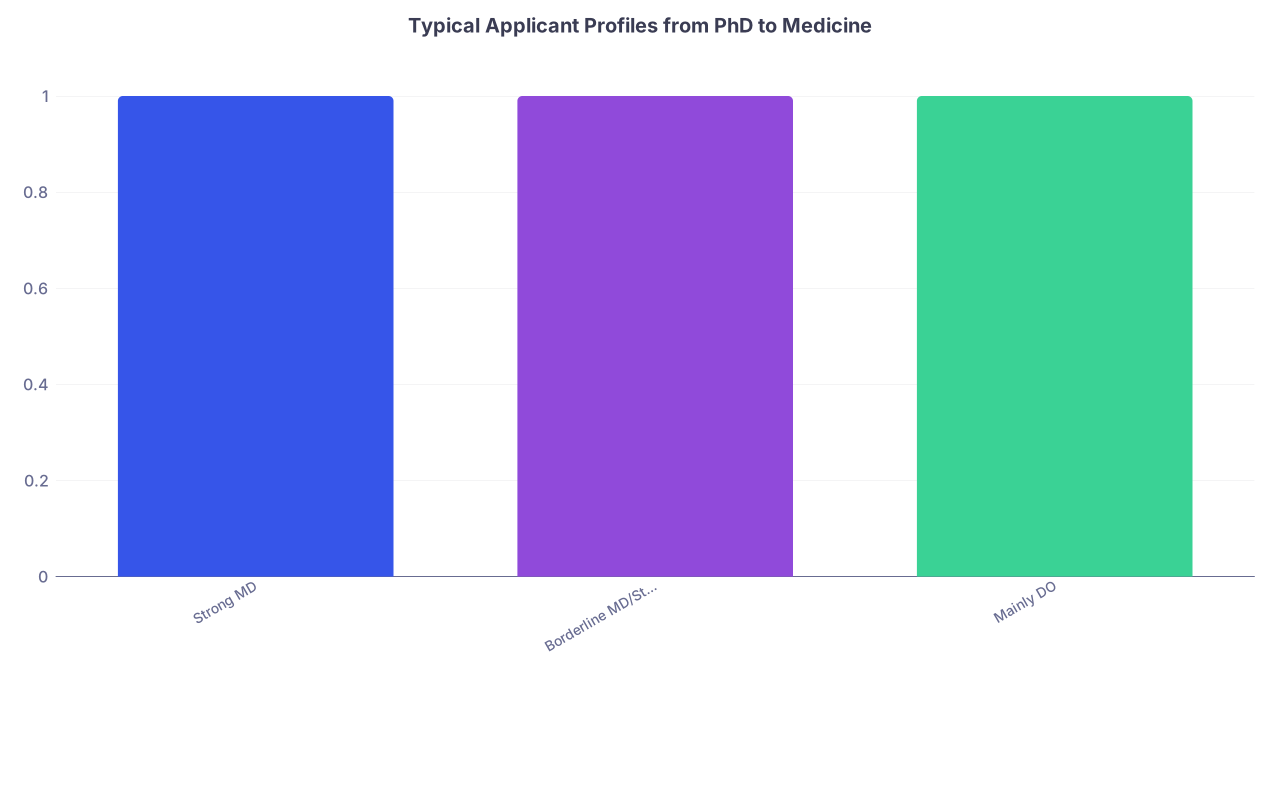
| Category | Value |
|---|---|
| Strong MD | 1 |
| Borderline MD/Strong DO | 1 |
| Mainly DO | 1 |
Interpretation:
- Strong MD: uGPA ≥ 3.6, MCAT goal ≥ 515, at least some publications, clear clinical exposure.
- Borderline MD/Strong DO: uGPA 3.3–3.6, MCAT goal 508–514, good story and research, strong LORs.
- Mainly DO: uGPA < 3.3 or serious academic issues, MCAT 500–508, needs upward trend and really strong narrative.
Your PhD does not magically erase a low undergraduate GPA. It helps, but the numbers still matter.
Step 4: Turn the Stalled PhD into a Narrative Asset
Done right, a messy PhD can make you more compelling than a straight-through premed.
A. Reframe “stalled” as “course-corrected”
You are not going to say:
- “My PhD failed.”
- “I could not handle it.”
- “I was bored.”
You are going to say something like this, adapted to your reality:
- “During my third year, I realized I was more energized by working directly with patients in our clinical collaborations than by focusing exclusively on long-term bench projects. That forced me to reevaluate whether a career as an independent investigator was the right fit.”
- “My project became increasingly dependent on a method that was not yielding reproducible results. After multiple attempts and discussions with my committee, it became clear that the scope of the work would add several more years. Given my evolving interest in patient care, I made a deliberate decision to transition toward medicine.”
The key elements:
- You recognized misalignment.
- You took responsibility to reassess.
- You made a deliberate, not impulsive, decision.
- You still delivered what you reasonably could (papers, presentations, teaching).
B. Extract every tangible win from the PhD
Before you walk away or downshift, squeeze it for all it is worth on your future MD application:
- Manuscripts
- Even if not published yet, get submitted. Preprints count as progress.
- Posters / talks
- Local conferences, departmental seminars, student symposia.
- Teaching
- TA evaluations, formal titles, any teaching awards.
- Leadership
- Lab mentoring, organizing journal clubs, departmental committees.
Make a one-page “PhD accomplishments” document. This becomes your reference list when building your AMCAS activities and your CV for letters.
C. Build clean activity entries from messy years
On AMCAS, each experience is not “perfect career arc”; it is a box with:
- Organization.
- Role.
- Dates.
- Hours.
- Description.
So for a chaotic 3–4 year span, you might create:
- “Graduate Research Assistant, Department of X”
- “Teaching Assistant, Course Y”
- “Graduate Student Organization Officer”
Each with concrete tasks, skills, and outcomes. No need to mention lab drama, committee politics, or failed experiments there. Save the “why I changed direction” for the personal statement and interviews.
Step 5: Plug the Holes in Your MD Application Profile
PhD folks almost always have the same gaps when they pivot:
- Weak or zero clinical exposure.
- Little to no physician shadowing.
- Service activities that never left the campus bubble.
You will fix these while you finish/exit your PhD.
A. Clinical exposure: non-negotiable
You need real, longitudinal contact with patients. Not just “my lab collected patient samples.”
Concrete options that work well with a grad schedule:
- Hospital volunteer roles
- ED, inpatient transport, patient liaison, pre-op / post-op waiting rooms.
- Hospice volunteering
- High emotional impact, very real patient/family contact.
- Free clinic roles (especially for bilingual applicants).
Plan for at least 3–4 hours per week, consistently, for 9–12 months if possible.
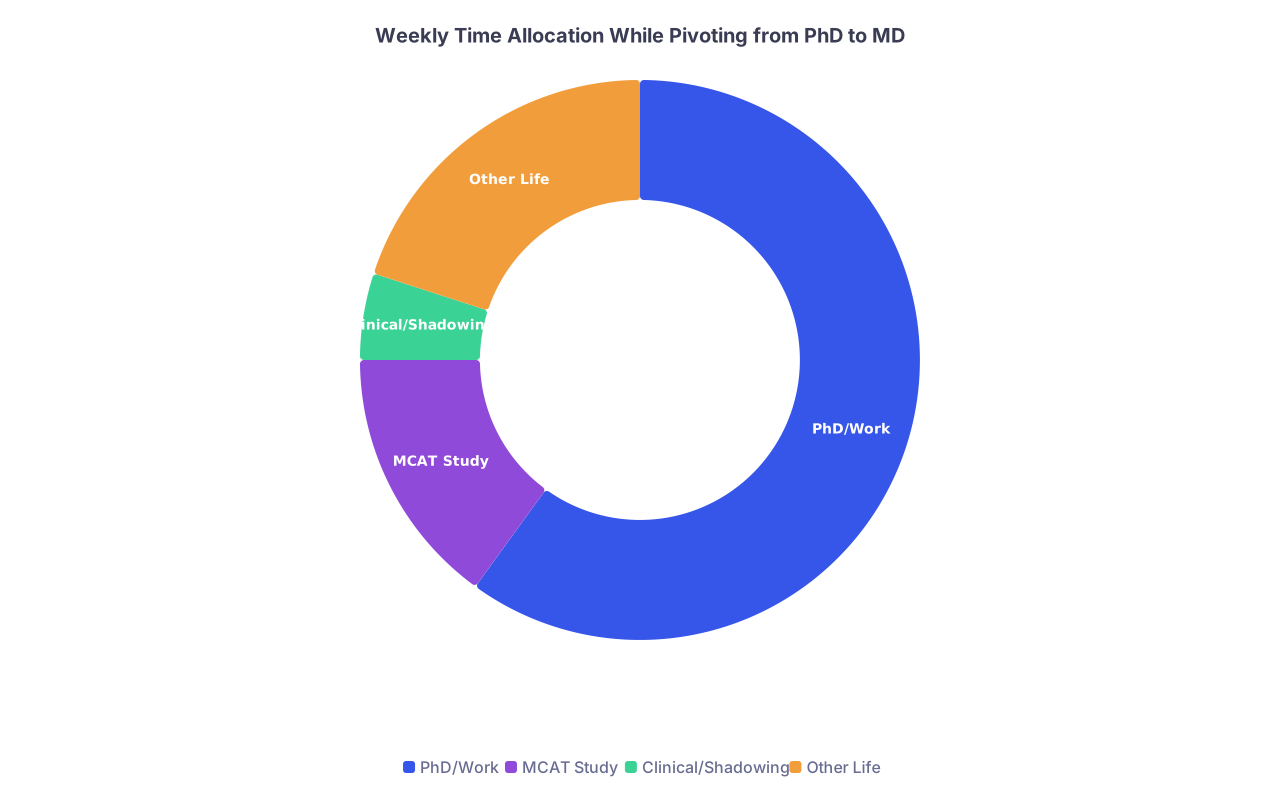
| Category | Value |
|---|---|
| PhD/Work | 60 |
| MCAT Study | 15 |
| Clinical/Shadowing | 5 |
| Other Life | 20 |
You will be tired. This is what triage looks like: some hobbies go on hold.
B. Shadowing: targeted and efficient
Shadowing is not about racking up 200 hours watching someone type notes. It is about:
- Seeing day-to-day reality of clinical work.
- Gathering specific stories and insights for your essays/interviews.
- Building relationships with physicians who can potentially write letters.
Practical protocol:
- Aim for 20–50 hours across 2–3 specialties.
- Prioritize outpatient settings where you can see the flow of visits.
- Take notes immediately after each day: what cases, what dynamics, what surprised you.
You will use those notes later when you answer, “What experiences confirmed your decision to pursue medicine?”
C. Service and non-clinical volunteering
If all your activities are lab, you look one-dimensional. That is a problem.
Choose one meaningful, ongoing service activity outside the hospital. Examples:
- Tutoring underserved students in STEM or literacy.
- Working with refugee or immigrant support programs.
- Crisis hotline (if you can commit to the training and rotations).
Consistency beats flash. One year of 2–3 hours a week at the same place looks better than 10 random one-off events.
Step 6: Build a Realistic MCAT and Timeline Plan
Too many PhD-to-MD applicants assume, “I have a PhD, I will crush the MCAT with 6 weeks of Anki.” Then they score 506 because they underestimated CARS and content breadth.
A. Baseline and study plan
Protocol:
- Take a full-length diagnostic (AAMC or high-quality third-party).
- Use that score to define your starting point.
Then:
- If you are ≥ 510 on the diagnostic and just rusty:
- 3–4 months of part-time focused review (10–15 hours/week).
- If you are < 505:
- 4–6 months, ramping up to 15–20 hours/week.
All while still doing your PhD and new experiences. Yes, it is a grind.
Where do people from PhDs usually struggle?
- CARS: reading dense but non-technical passages and moving quickly.
- Psych/Soc: breadth of definitions and frameworks you never saw in your field.
Treat those as priority lanes early, not after you burn out on Bio/Biochem.
B. Align MCAT with your application year
You want your MCAT:
- Done before the application cycle opens (May/June).
- High enough that you are not “hoping for a miracle” on a retake mid-cycle.
Example timeline (if you decide in January of Year 0):
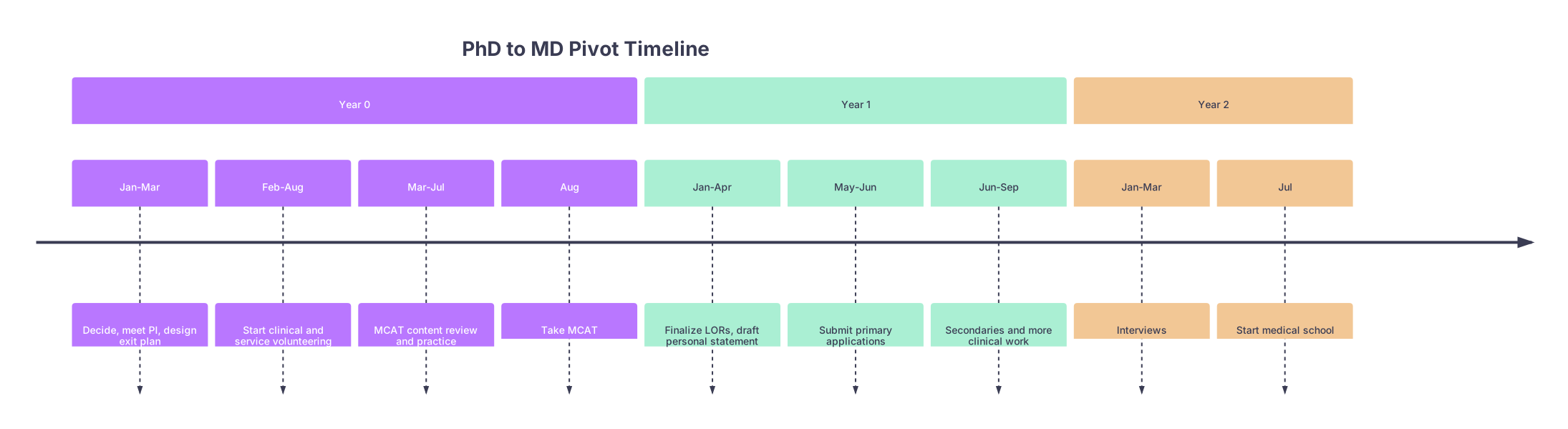
| Period | Event |
|---|---|
| Year 0 - Jan-Mar | Decide, meet PI, design exit plan |
| Year 0 - Feb-Aug | Start clinical and service volunteering |
| Year 0 - Mar-Jul | MCAT content review and practice |
| Year 0 - Aug | Take MCAT |
| Year 1 - Jan-Apr | Finalize LORs, draft personal statement |
| Year 1 - May-Jun | Submit primary applications |
| Year 1 - Jun-Sep | Secondaries and more clinical work |
| Year 2 - Jan-Mar | Interviews |
| Year 2 - Jul | Start medical school |
If your situation is more complex, you simply shift everything by 6–12 months, but the order of operations stays the same.
Step 7: Decide: Finish, Master’s Exit, or Walk Away
This is the part people procrastinate on for years. You will not.
A. When it makes sense to finish the PhD
You should seriously consider pushing through if:
- You are ≤ 18–24 months from a realistic defense date.
- You have at least one first-author paper in the pipeline.
- You are not actively being harmed by the environment (toxic is one thing, abusive is another).
- Your funding is secure enough to keep you afloat until defense.
Why? Because:
- MD programs respect completion and follow-through.
- You will have the “Dr.” title and more research capital if you ever want academic medicine.
- The sunk cost is partly recouped by finishing.
But do not believe fantasies. Demand specifics:
- A written dissertation outline with agreed scope.
- Clear agreement with your committee about what is “enough.”
- A timeline you review every 3–4 months and adjust.
B. When a master’s exit is the smartest move
If your program allows it, a terminal master’s can be the optimal middle ground when:
- Your project has hit a technical or scope wall.
- Your mental health is eroding.
- You have completed substantial coursework and some research.
Framed correctly, a master’s exit says:
- “I learned what I needed from this stage.”
- “I completed a defined academic program.”
- “I am not someone who disappears when things get hard; I negotiated a structured transition.”
You will need to:
- Talk to the graduate program director, not just your PI.
- Clarify requirements for the master’s (thesis vs non-thesis, credits, defense).
- Set a deadline: “By X date, I will either be on a defined PhD completion path or will switch to the master’s track.”
C. When walking away is justified
Harsh truth: in some labs and programs, finishing is not worth it. Situations like:
- Documented harassment or discrimination.
- PI repeatedly blocking reasonable paths to completion to keep cheap labor in lab.
- Funding cutoffs with unrealistic demands to “do it anyway.”
- Your mental health is dangerously compromised.
If you leave with nothing formal (no degree), your job becomes:
- Showing a clear pattern of productivity until the point you left (papers, presentations, teaching).
- Demonstrating that you planned and executed a transition, not a flail.
- Getting strong letters from people other than the problematic PI (committee members, course directors, collaborators).
You will need a crisp, calm explanation:
- “I made the decision to leave the PhD without an additional degree after X years when it became clear that the mentoring relationship and project scope were not compatible with a timely completion. I focused on completing [A, B, C] before leaving and then transitioned to [clinical work/teaching/etc.]. That experience clarified the kind of problem-solving and patient-facing work I now pursue in medicine.”
No ranting. No gossip. Just facts and reflection.
Step 8: Communicate Your Story Without Sounding Unstable
Final hurdle: how you talk about all of this on paper and in person.
A. Personal statement: spine of the story
The spine is not “I hate my PhD.” It is:
- Exposure to something patient-centered → motivation.
- Deep dive in research → skills, rigor, understanding of science.
- Realization of misalignment → thoughtful pivot.
- Concrete experiences in clinical and service settings → confirmation.
Common mistakes:
- Making the PhD sound like a total waste. (It was not. You gained tools.)
- Over-emphasizing frustration and conflict.
- Under-explaining what you actually did for patients or communities beyond the lab.
B. Secondary essays: controlled vulnerability
Every school will basically ask you some variant of:
- “Why medicine?”
- “Explain any academic difficulties or unexpected changes.”
You already know your answers. You prepared them when you wrote that initial one-sentence PhD status and then built a plan.
When addressing the stall:
- Acknowledge the difficulty: “Progress stalled in my original project after X.”
- Show agency: “Here is what I did in response.”
- Show reflection: “Here is what I learned about how I work best.”
- Connect to medicine: “That is exactly why clinical work is a better fit.”
C. Interviews: own your decisions
If you seem ashamed or defensive, interviewers will assume the worst: you quit when it got hard. Your job is to show:
- You can commit to long, difficult paths (you already did).
- You can reassess and change course when data changes.
- You are not running from difficulty, you are choosing a better-aligned difficulty.
Practice specific questions:
- “Why did you not finish the PhD?”
- “How did your PI respond to your decision?”
- “Looking back, would you start the PhD again?”
Your answers should be calm, specific, and short. No 10-minute saga about lab drama.
Step 9: Protect Your Sanity and Energy While You Execute
One more piece that people ignore until they crash.
You are about to:
- Repair or exit a stressful academic situation.
- Study for a brutal standardized exam.
- Build a whole new set of experiences.
- Possibly move, deal with finances, and handle personal life.
If you treat this like a sprint, you will burn out. You need a sustainable protocol.
A. Weekly structure that actually works
Simple but effective template for someone still in lab:
- 40–50 hrs/week: PhD work (or job).
- 10–15 hrs/week: MCAT/academic prep (3–4 focused blocks).
- 3–5 hrs/week: Clinical exposure.
- 2–3 hrs/week: Service / non-clinical volunteering.
- 1–2 hrs/week: Application prep (journaling, updating CV, reading about schools).

Not glamorous. But it works.
B. Mental health is not optional
If your PhD is stalled, odds are good you already have:
- Imposter syndrome.
- Anxiety.
- Some degree of depression or learned helplessness.
You cannot “willpower” your way through this indefinitely. Use resources:
- University counseling (even if you are leaving, you often still have access for a term).
- Peer support—other grad students who made similar pivots.
- Therapy outside the institution if the conflict is within your department.
Not because “self-care is nice.” Because you must be functional and emotionally stable enough to sit in interviews and handle clinical training later without imploding.
Step 10: Execute, Adjust, Do Not Drift
Here is the final piece. Write down:
- Your target application year (e.g., “I submit AMCAS June 2026”).
- Your decision on PhD: finish, master’s exit, or leave.
- Your MCAT test date.
- Two concrete clinical roles you will apply for.
- At least three letter writers you will cultivate.
Then put this somewhere you see weekly. Every 2–3 months, review and ask:
- What has moved forward?
- What is stuck?
- Do I need to adjust my timeline or my exit plan?
If you find yourself spinning again—months pass and nothing changes—you either:
- Recommit to this path with new structure.
- Or consciously decide to step away from MD applications for now.
What you do not do anymore is “maybe in a couple years once the PhD gets better.” That mindset is exactly what created your current problem.
Three Things to Remember
- A stalled PhD is not a permanent stain. If you stabilize the situation, extract your wins, and present a clear, mature narrative, it can strengthen your MD candidacy.
- You must choose: finish the PhD, exit with a master’s, or walk away. Indecision is the real enemy. Pick a path and align your MCAT, experiences, and application timeline around it.
- Your value to medicine is not your perfect trajectory. It is your ability to handle complex, messy realities, take responsibility, and move deliberately toward work that fits you better. Show that, and committees will listen.