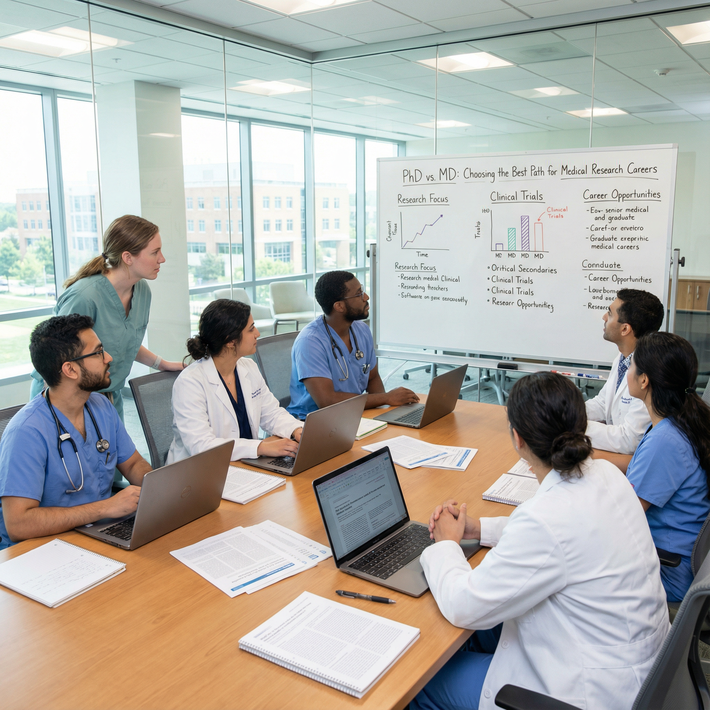
The worst time to realize you want an MD is halfway through a PhD. And yet, that is exactly when a lot of smart people finally admit it to themselves.
If that is you, you are not “late.” You are just at a fork in the road that most advisors are terrible at mapping. So let me map it for you.
Below is a step-by-step operational plan, not vague encouragement. You will know:
- Whether you should pivot at all
- Whether to finish your PhD first or leave early
- How to position your PhD so admissions committees see value, not confusion
- Exactly what to do in the next 30, 90, and 365 days
Step 1 – Get Brutally Clear on Why You Want the MD
You do not start with logistics. You start with motive. Because it will leak into your essays, your interviews, your recommendation letters, and how much pain you are willing to tolerate in the transition.
Ask yourself three specific questions. Write the answers down. Not in your head.
What do I want to do all day 5–10 years from now?
- In clinic with patients?
- In the OR?
- Running a translational lab with access to patients and tissue samples?
- Leading clinical trials and writing guidelines?
What is missing from what I am doing right now?
- No patient contact?
- No decision-making authority on patient care?
- My work feels too abstract / too far from bedside?
- I keep deferring to MDs and want that responsibility myself?
What am I not willing to give up?
- Deep research time?
- Geographic flexibility?
- Family plans / income stability?
If your honest answers look like:
- “I want to diagnose and treat patients myself,”
- “I keep imagining myself as the attending in these case discussions,”
- “I want to run clinical trials where I am both PI and treating physician,”
…then the MD is a rational, not impulsive, move.
If instead it is:
- “I hate my PI,”
- “I am bored with my project,”
- “I think the MD will give me automatic respect,”
…then you have a different problem: a bad environment or misaligned lab, not necessarily the wrong degree.
Action today:
Block 30 minutes. Write one page answering those 3 questions. Keep that document. Everything else will build on it.
Step 2 – Decide: Finish the PhD, Leave With a Master’s, or Pivot Completely
This is the decision most people overcomplicate and most PIs oversimplify (“You’re already here, just finish”). That advice is not always good.
Here is the real calculus:
| Option | Pros | Cons |
|---|---|---|
| Finish PhD before MD | Stronger CV, research credibility | 2–4 extra years before MD income |
| Leave with Master’s (if allowed) | Faster path to MD, less sunk time | Explaining exit, weaker research signal |
| Apply to MD while still in PhD (plan to finish) | Demonstrates drive, continuity | Brutal workload, timeline juggling |
When finishing the PhD makes sense:
- You are within ~1–2 years of realistic completion
- Your thesis topic and skills are at least somewhat clinically adjacent (immunology, cancer biology, bioengineering, outcomes research, etc.)
- You can extract publications (first- or co-first-author papers) that will matter for residency
- You are considering MD/PhD-type careers (physician-scientist, academic medicine track)
When leaving early is defensible:
- You are 3+ years from finishing with no clear path
- The project or PI is dysfunctional (chronic funding issues, endless scope creep, abusive culture)
- You can exit with a terminal master’s and explain coherently that:
- You gained rigorous research training
- You recognized your primary drive is direct patient care
- You chose not to spend several additional years on work misaligned with that goal
Hard truth:
Dropping a PhD midstream with no degree and no coherent narrative is a red flag. Programs will assume you might quit again. You avoid that by either:
- Finishing, or
- Leaving with a Master’s plus a tight “why” story and clear evidence of commitment to medicine (clinical exposure, MCAT, etc.).
Action for the next 1–2 weeks:
- Meet with your graduate program director (not just your PI) and ask:
- “If I chose to exit early, is a terminal Master’s an option? What would that require?”
- Then rough out two timelines on paper:
- Path A: finish PhD then MD
- Path B: exit with Master’s then MD
See which one you can actually tolerate living through.
Step 3 – Check Your Academic and MCAT Reality
PhD or not, admissions still care about numbers. They will not wave this just because you are older and have a thesis.
You need three things in good shape:
- Undergrad GPA (especially science GPA)
- Any post-bacc or grad courses with relevant grades
- MCAT score
GPA triage
Look at:
- Overall undergrad GPA
- BCPM (biology, chemistry, physics, math) GPA
If one or both are weak (<3.4), you must begin repair:
- Post-bacc courses
- SMP (Special Master’s Programs) if you really need a reset
Your existing PhD courses can help if:
- They are graded (not all are)
- They are in biomedical or quantitative fields with high rigor
- You have mostly A-level work
But a 3.0 undergrad with a strong PhD transcript is “complicated” to adcoms. Not impossible, but you need a clear academic upward trend and a strong MCAT.
MCAT planning
You are not exempt from the MCAT because you passed quals. Different test. Different game.
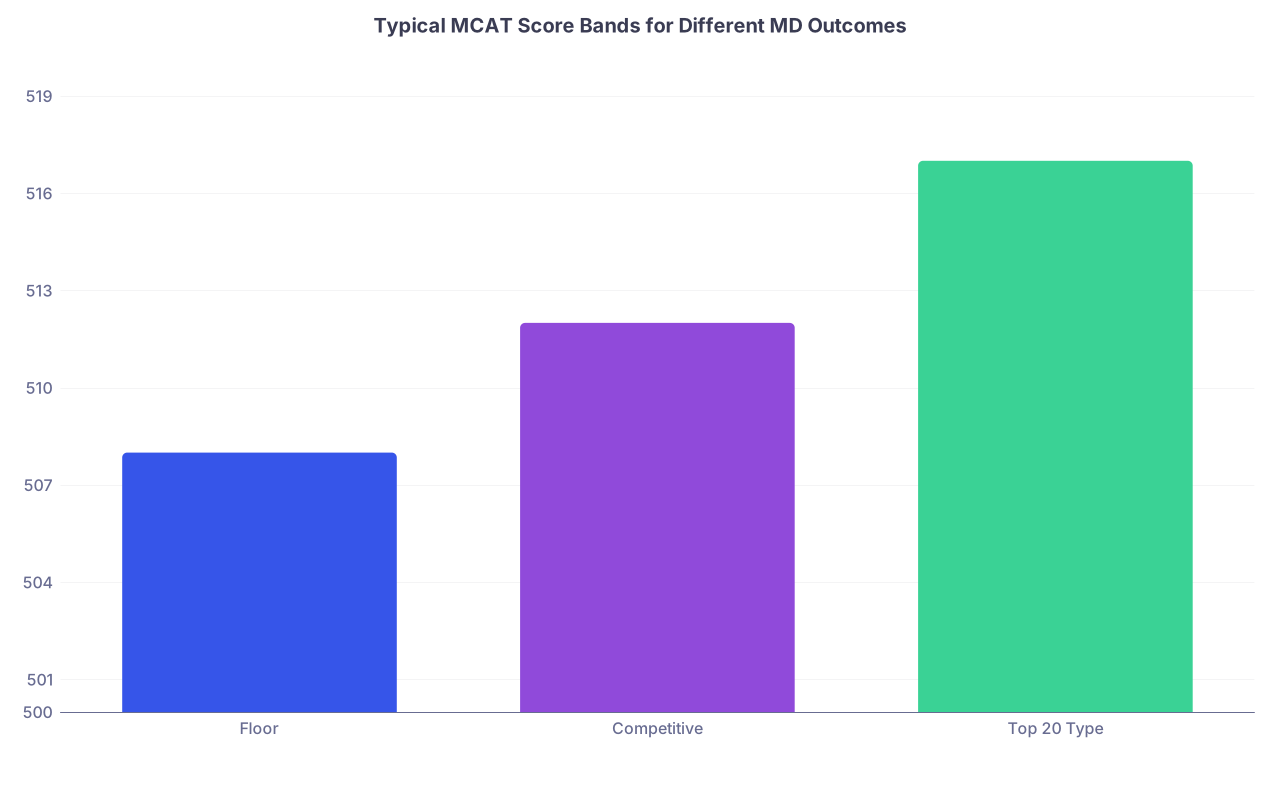
For competitive MD programs, I consider these rough benchmarks:
| Category | Value |
|---|---|
| Floor | 508 |
| Competitive | 512 |
| Top 20 Type | 517 |
- Below ~508: uphill, especially for MD (DO more forgiving)
- 510–513: good range for many MD programs if GPA is solid
- 515+: makes your PhD + MD ambition plausible at top research schools
Reality check:
Studying for MCAT while doing experiments is brutal. I have seen:
- One student doing MCAT questions in the cold room between centrifuge spins. It was ugly but he scored 518.
- Another tried to juggle a heavy teaching load and MCAT and bombed with a 503. Had to retake and lost a year.
Do not wing it. Plan like a project.
Action for the next month:
- Order or borrow full-length MCAT practice exams (AAMC first, then Kaplan/Blueprint/etc.).
- Take a diagnostic exam under real conditions. No pausing.
- Based on that score, build a schedule:
- If you are within ~5 points of goal: 2–3 months of focused study, 15–20 hrs/week.
- If you are more than 7–8 points below goal: 4–6 months, 15–25 hrs/week.
Step 4 – Build a Timeline That Respects Reality (Not Fantasy)
You are juggling:
- PhD experiments / writing
- Possibly qualifying exams or defense
- MCAT prep and test
- Clinical exposure and shadowing
- Application cycle (AMCAS/AACOMAS + secondaries + interviews)
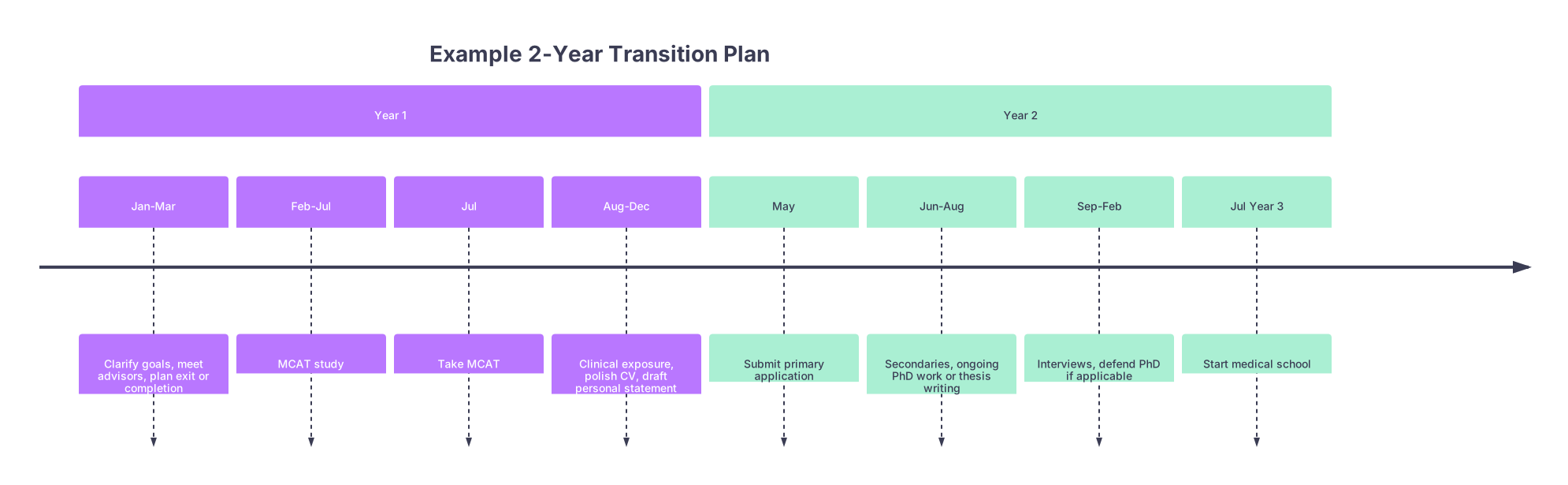
Use a simple visual. Do not keep this in your head.
| Period | Event |
|---|---|
| Year 1 - Jan-Mar | Clarify goals, meet advisors, plan exit or completion |
| Year 1 - Feb-Jul | MCAT study |
| Year 1 - Jul | Take MCAT |
| Year 1 - Aug-Dec | Clinical exposure, polish CV, draft personal statement |
| Year 2 - May | Submit primary application |
| Year 2 - Jun-Aug | Secondaries, ongoing PhD work or thesis writing |
| Year 2 - Sep-Feb | Interviews, defend PhD if applicable |
| Year 2 - Jul Year 3 | Start medical school |
This example assumes:
- You are 1–2 years from finishing your PhD
- You can study for MCAT while in the lab
If you are planning to leave earlier, the timeline compresses academically but may expand for financial and life logistics.
Action this week:
Draft your own timeline in months, not vague “someday.” Anchor it to:
- Specific MCAT test date
- Target application cycle (e.g., applying June 2027 to start August 2028)
- Planned thesis defense or graduate exit
Step 5 – Position Your PhD as a Strength, Not a Detour
Admissions committees have seen two types of PhD applicants:
The clear physician–scientist type:
- Strong publications
- Coherent story: “I need clinical training to translate my science and to lead meaningful trials.”
- Has real clinical exposure to back it up
The ran away from lab type:
- Vague dissatisfaction
- No specific plan for integrating research and medicine
- Limited exposure to actual clinical work
- Sounds like they just want to “try something new”
You want to be Type 1, even if internally you are partly Type 2.
Translate your PhD into MD language:
- Instead of: “I work on CRISPR screens in yeast.”
Say: “My research develops high-throughput genetic tools that can be adapted to study cancer drug resistance and optimize treatment strategies.” - Instead of: “I got tired of long hours at the bench.”
Say: “I realized I was most engaged when discussing patient cases with the clinical collaborators on our project, and I want the training to care for those patients directly.”
Concrete steps to make your PhD look aligned:
Highlight:
- Any clinical collaborators (MDs you have worked with)
- Human–relevant aspects (disease models, translational aims, pharmacology, outcomes)
- Skills that matter in medicine:
- Data analysis and interpretation
- Handling uncertainty
- Long-term persistence
- Clear communication of complex ideas
Downplay:
- Internal lab drama
- Purely theoretical rabbit holes with no connection to human health
Action over the next 1–2 months:
- Draft a 1–2 paragraph “PhD to MD” story. Show:
- What you studied
- What you learned
- The precise moment(s) you realized you needed to be on the clinical side
- How you see the MD enabling work you cannot do now
You will reuse this in:
- Personal statement
- Secondaries (“Why MD now?” / “Why not just stay in research?”)
- Interviews
Step 6 – Fix Your Clinical and Service Exposure Gap
Most PhD students are overdeveloped in one dimension (research) and underdeveloped in two:
- Direct patient exposure
- Service / community work
Committees will ask themselves: “This person has been in the lab for 5–7 years. Do they actually know what clinical medicine looks like?”
You need proof.
Clinical exposure
Aim for:
- Shadowing: At least 40–60 hours, more if possible. Spread across:
- Primary care
- At least one specialty that interests you
- Clinical volunteering:
- Free clinics, hospitals, hospice, EMT, patient transport, etc.
You are not trying to “collect hours.” You are trying to:
- Confirm for yourself that you want this
- Gather observations and stories you can speak about in interviews
Common options I have seen work for busy PhD students:
- Weekly 3–4 hour shift at a free clinic in the evenings
- Shadowing an MD collaborator 1–2 days a month
- Scribing part-time if your schedule allows (but be careful not to destroy your thesis progress)
Non-clinical service
Admissions still care about broader service:
- Tutoring underserved students
- Community outreach
- Mental health hotlines, crisis text lines
- Food banks, shelters
You already know how to “grind” from grad school. Use that discipline on short, consistent weekly commitments, not sporadic 20-hour bursts.
Action for the next 2 weeks:
- Identify 2–3 realistic options near you (hospital volunteer office, student-run free clinic, crisis hotline).
- Apply / onboard to at least one weekly commitment.
Step 7 – Get Your Recommendation Letters Lined Up Early
You have one big advantage: serious people can vouch that you are not flaky. Use that.
You will likely need:
- 1–2 science faculty (could include your PI, committee members, or course instructors)
- 1–2 letters specifically addressing your clinical potential / human skills (from MD collaborators, volunteer supervisors, or shadowing physicians)
- Optional: one letter focusing on research potential for research-heavy schools
Challenges:
- Your PI may not be thrilled you are leaving the track they imagined for you.
- Some professors have no idea how to write MD-style letters. They write “this student is good at Western blots” and nothing else.
To handle this:
Be direct but respectful with your PI.
- “I have realized I want to pursue clinical training and apply to MD programs. My plan is to [finish by X / exit with a Master’s by Y]. I hope you can support me in this next step.”
Their reaction will fall somewhere between supportive and hostile. Plan accordingly.
- “I have realized I want to pursue clinical training and apply to MD programs. My plan is to [finish by X / exit with a Master’s by Y]. I hope you can support me in this next step.”
Give letter writers a packet:
- Your CV
- Draft personal statement (even if rough)
- Bullet points of projects you did with them
- A short note: “If you are comfortable, it would help if you could comment on my [work ethic / independence / communication skills / maturity].”
For MD collaborators you shadow or work with:
- Ask once they know you reasonably well, not after one afternoon.
- “I am applying to MD programs and would value a letter commenting on my suitability for clinical training. Are you comfortable writing a strong, supportive letter?”
Action for the next 4–8 weeks:
- Identify at least 3 likely letter writers.
- Have honest conversations with them about your plan.
- Confirm who will write, and track deadlines for them.
Step 8 – Decide: MD, MD/PhD, or DO?
You are already in a PhD. Many will assume you should apply MD/PhD. That is not always correct.
Here is the blunt breakdown:
| Path | Best For | Drawbacks |
|---|---|---|
| MD | Want clinical focus with some research | Less protected research time |
| MD/PhD | Want physician-scientist career | Much longer, redundant PhD training |
| DO | Want clinical practice, flexible options | Slightly tougher for some specialties |
Key points:
- If you already have or will have a PhD, you do not need another PhD via MD/PhD.
- Some MD/PhD programs will not even take you if you already have a PhD. Others may treat you as MD-only or give flexible research support.
- If your main goal is high-level clinical practice with optional research, MD or DO is enough.
- If you want hardcore lab-based physician-scientist roles at major academic centers, MD plus strong research fellowship / K awards later is a common route from your starting point.
I tend to recommend:
- Apply MD (and DO if you want more options), not MD/PhD, unless:
- You do not yet have a PhD, and
- You really want the fully integrated dual-degree training.
Action over the next month:
- Build a preliminary school list:
- Include several state schools
- A mix of mid-tier and a few research-heavy programs that value nontraditional applicants
- Add DO programs if your GPA/MCAT are modest or you are flexible on the degree
Step 9 – Financial and Life Logistics (Do Not Skip This)
You are older than the typical premed. You may have:
- A partner or spouse
- Kids
- Loans
- Geographic constraints
Pretending those do not exist is how people burn out or back out.
You must answer:
Debt tolerance:
- Add projected remaining PhD time (if finishing) + 4 years MD + residency pay period.
- Look up typical MD tuition (public vs private).
- Run a quick scenario: total debt vs physician salary in your intended specialty.
Geographic flexibility:
- Are you willing to move anywhere, or do you need to stay regional?
- That will shrink or expand your school list drastically.
Timing with family planning / major life events:
- Is it worse to be pregnant in med school or residency for you? (People do both; neither is easy.)
- Can your partner relocate or handle more load while you are on 80-hour weeks later?
I have seen smart people ignore this until March of M4, then panic about child care and mortgage payments. Do not be that person.
Action over the next 2–4 weeks:
- Schedule a brutally honest conversation with your partner (if applicable) about timeline and money.
- Use a simple loan calculator to model:
- $200–400k in new debt at 5–7%
- Repayment on $200–350k attending salary with PSLF or standard plans
- Decide what level of debt and delay you can tolerate.
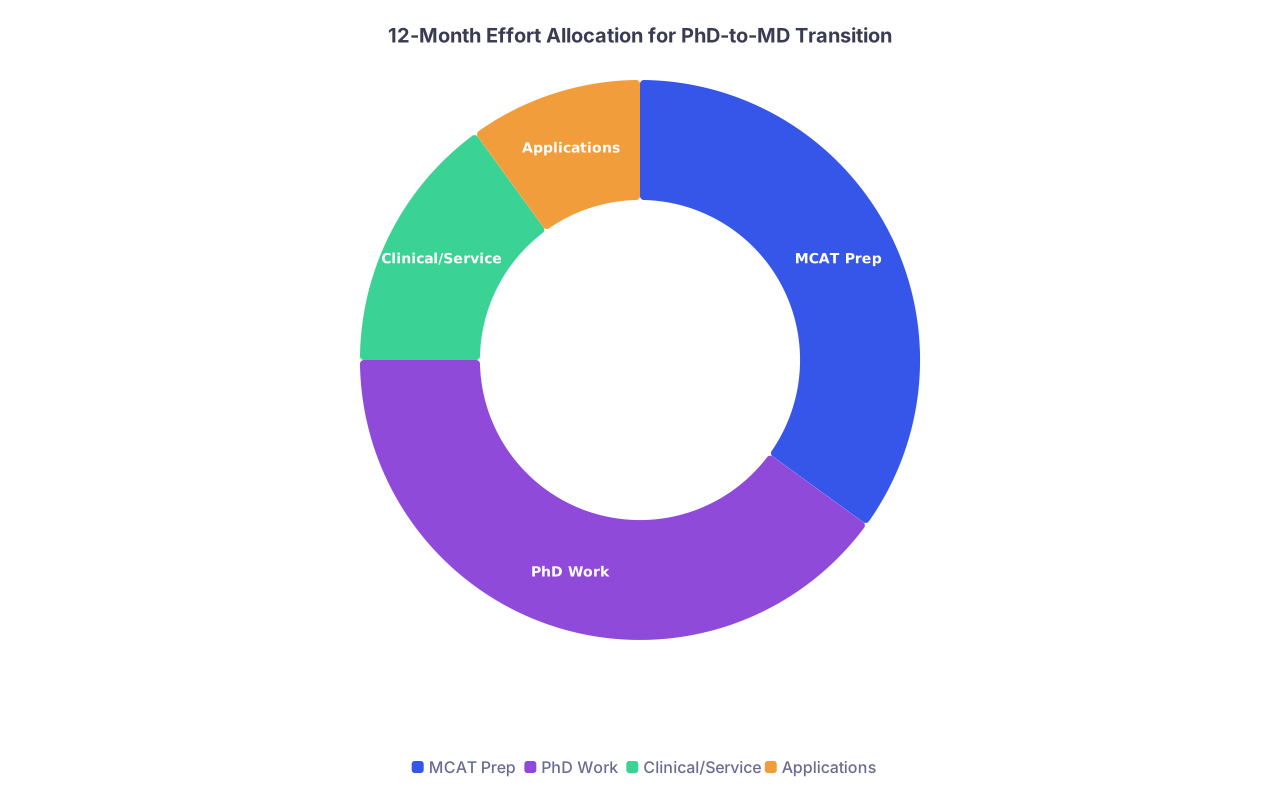
Step 10 – Execute: 12-Month Example Action Plan
Let me put this into a concrete 12-month checklist assuming:
- You are 1–2 years from finishing your PhD
- You have not yet taken the MCAT
- You aim to apply in the next cycle
| Category | Value |
|---|---|
| MCAT Prep | 35 |
| PhD Work | 40 |
| Clinical/Service | 15 |
| Applications | 10 |
Months 1–3
- Finalize your decision to pursue MD (not just daydream).
- Meet with:
- PI
- Graduate program director
- Possibly a trusted MD mentor
- Map PhD completion or exit plan.
- Begin or ramp up clinical exposure (start 1 weekly commitment).
- Take a diagnostic MCAT; choose a target test date.
Months 4–6
- Structured MCAT study 15–20 hrs/week.
- Maintain steady PhD work (do not let your lab implode).
- Start shadowing an MD regularly (monthly is fine).
- Draft your personal statement and “PhD to MD” narrative.
Months 7–9
- Take MCAT.
- Request letters of recommendation.
- Polish activities section entries, finalize school list.
- If it is application year:
- Submit primary early (June)
- Turn around secondaries within 2 weeks of receipt
Months 10–12
- Continue PhD milestones: paper, defense planning, or Master’s exit.
- Attend interviews, refine your story with each one.
- Keep up clinical volunteering (do not stop just because application is in).
- If finishing PhD: coordinate defense so you are done before M1 starts, if possible.
Step 11 – Mentally Prepare for Being “Older” and Starting Over
One more thing nobody tells you.
You will be:
- Older than most of your classmates
- More experienced in research
- Less experienced clinically
- Probably more cynical about bureaucracy and institutional nonsense
You will have to relearn humility. You can design a CRISPR screen, but you will not know how to write a basic admission order set. That gap can sting.
The way you make this work:
- Use your PhD maturity to:
- Handle long hours
- Study efficiently
- Manage stress
- Do not use it to:
- Talk down to 22-year-old classmates
- Correct every minor scientific inaccuracy on rounds
- Dominate small groups with “Well, in my research…”
The best ex-PhDs in med school that I have seen:
- Quietly crush the basic science years
- Help classmates without being condescending
- Ask smart, humble questions on the wards
- Slowly rebuild a research angle once they understand clinical realities
Your Next Concrete Step Today
Do this right now:
Open a blank document and title it “MD Transition Plan.”
Create three headings:
- Why I Want the MD – write 3–5 honest sentences.
- Timeline – write your target MCAT month and your target application year.
- This Month’s Actions – list exactly 3 things:
- One academic (e.g., schedule MCAT diagnostic)
- One exposure-related (e.g., email volunteer coordinator)
- One structural (e.g., meeting with PI or grad director)
Once you have those written, you are no longer “someone in a PhD thinking about an MD.” You are someone with a plan. And that is the difference admissions committees – and frankly, your future self – will respect.