
The biggest mistake premeds make about MD vs PhD vs MD–PhD is waiting too long to choose.
By the time you “feel ready,” the most important decision points have already passed. Programs are reading your file looking for a story, and if your trajectory has been random and last‑minute, they will see it. Every time.
So let us walk through this the right way: semester by semester, month by month, down to the point where you hit submit.
Big Picture: How Early You Really Need to Decide
Before we get granular, here is the blunt overview:
- You should start testing the three paths (MD, PhD, MD–PhD) by late high school / early college.
- You should have a working preference (MD vs PhD vs “maybe MD–PhD”) by the end of sophomore year.
- You should be acting as if you have chosen by junior year:
- MD: clinically heavy + decent research
- PhD: research heavy + some shadowing
- MD–PhD: research dominant, but not research only
- You must be fully committed to a track before you build your school list and personal statement. For most people, that is summer before senior year if applying straight through, or the summer before your application year if taking a gap.
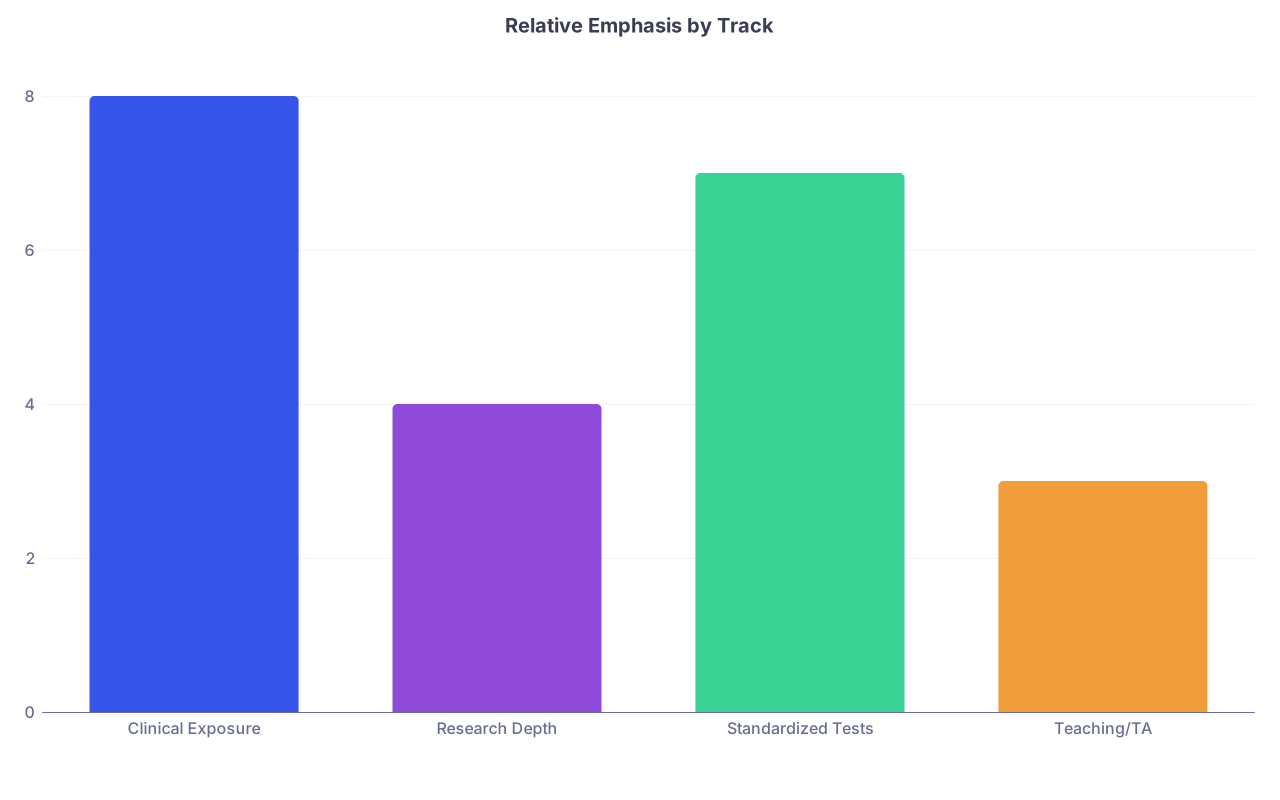
| Category | Value |
|---|---|
| Clinical Exposure | 8 |
| Research Depth | 4 |
| Standardized Tests | 7 |
| Teaching/TA | 3 |
(Scale 1–10 for a typical strong MD applicant; PhD and MD–PhD priorities will look very different, which I will spell out in the timeline.)
High School to First College Semester: Exploration, Not Commitment
At this stage, you do not “decide” anything. You collect data on yourself.
Late High School (Junior–Senior Year)
At this point you should:
- Take the hardest bio/chem/physics you can reasonably handle.
- Join one science‑oriented activity where real adults do real work:
- Hospital volunteer program
- Summer science research program
- Local university lab internship (even if you mostly wash glassware)
Red flag I see often: Students say, “I love research” but have never spent a summer in a lab. That is fantasy, not data.
What you are watching for:
- Do you enjoy being around patients and clinical chaos? MD world.
- Do you enjoy slow, repetitive, sometimes frustrating problem‑solving? PhD world.
- Do both pull you? MD–PhD might be real, not just prestige‑chasing.
First College Semester (Freshman Fall)
Your only real job now: keep options open.
At this point you should:
- Load standard premed/science courses:
- General chemistry I (or intro chem)
- Biology I
- Calculus or statistics
- Visit:
- Premed advising
- Undergraduate research office
- Attend at least one:
- Pre‑health info session
- Research fair / lab open house
Do not try to pick MD vs PhD vs MD–PhD in week 3 of college. You do not know enough yet. But you start laying tracks.
Freshman Spring to Sophomore Fall: Test Each Path On Purpose
This is where serious mistakes begin. People drift instead of design.
Freshman Spring
At this point you should:
- Continue core science:
- Gen chem II
- Bio II
- Start testing clinical vs research:
Aim for:
- 2–4 hours/week shadowing or hospital volunteering.
- 5–10 hours/week in a lab, even if purely observational at first.
If you cannot get a lab position on campus, email 10–15 PIs with a short, specific email and a 1‑page resume. Half your peers never do this. That is why they cannot credibly say “I love research” later.
By the end of freshman year, you should be able to answer:
- Did I hate/like/love being in the hospital?
- Did I hate/like/love being at the lab bench or in front of code?
You are not choosing yet, but you are collecting strong signals.
Summer After Freshman Year
This summer is a low‑stakes experiment.
At this point you should do one dominant thing:
- Clinical‑leaning:
- Hospital volunteer, EMT training, scribe work, camp for kids with chronic illness.
- Research‑leaning:
- REU program, full‑time lab assistant, basic science or public health project.
- If you suspect MD–PhD: choose research this first summer.
You are asking: Can I tolerate 40 hrs/week of this, or do I want to run away after two weeks?
Sophomore Year: First Real Fork in the Road
This is the year where “I might want MD–PhD” either becomes credible or dies quietly.
Sophomore Fall
Coursework:
- Organic chemistry I
- Physics I or statistics
- Maybe a higher‑level bio (genetics, cell bio) if you have room
At this point you should:
- Be in a consistent lab position (same PI, >6–8 hrs/week).
- Maintain some clinical exposure:
- 2–3 hrs/week is enough right now.
Track‑specific signals you should be watching:
- Emerging MD‑lean:
- You look forward to patient contact more than pipettes.
- You respect research but do not crave more of it.
- Emerging PhD‑lean:
- You are fine skipping clinical volunteering for extra time on a project.
- You find methods sections more interesting than case reports.
- Emerging MD–PhD‑lean:
- You want to understand disease at the molecular/system level and you keep picturing yourself seeing patients.
- You enjoy lab meeting debates and also like hospital rounds.
Sophomore Spring: Time to Make a Provisional Call
By the end of sophomore spring, I expect you to have a working track hypothesis:
- “Most likely MD.”
- “Most likely PhD.”
- “Most likely MD–PhD.”
- Or, occasionally: “I am not sure whether MD or MD–PhD, but pure PhD is unlikely.”
At this point you should:
- Sit down with:
- Premed advisor
- One research mentor
- One physician or MD–PhD you have met
- Ask each of them, explicitly:
- “Given what you have seen of me, do you think MD, PhD, or MD–PhD fits better?”
You are not handing them your fate. You are pressure‑testing your own self‑story.
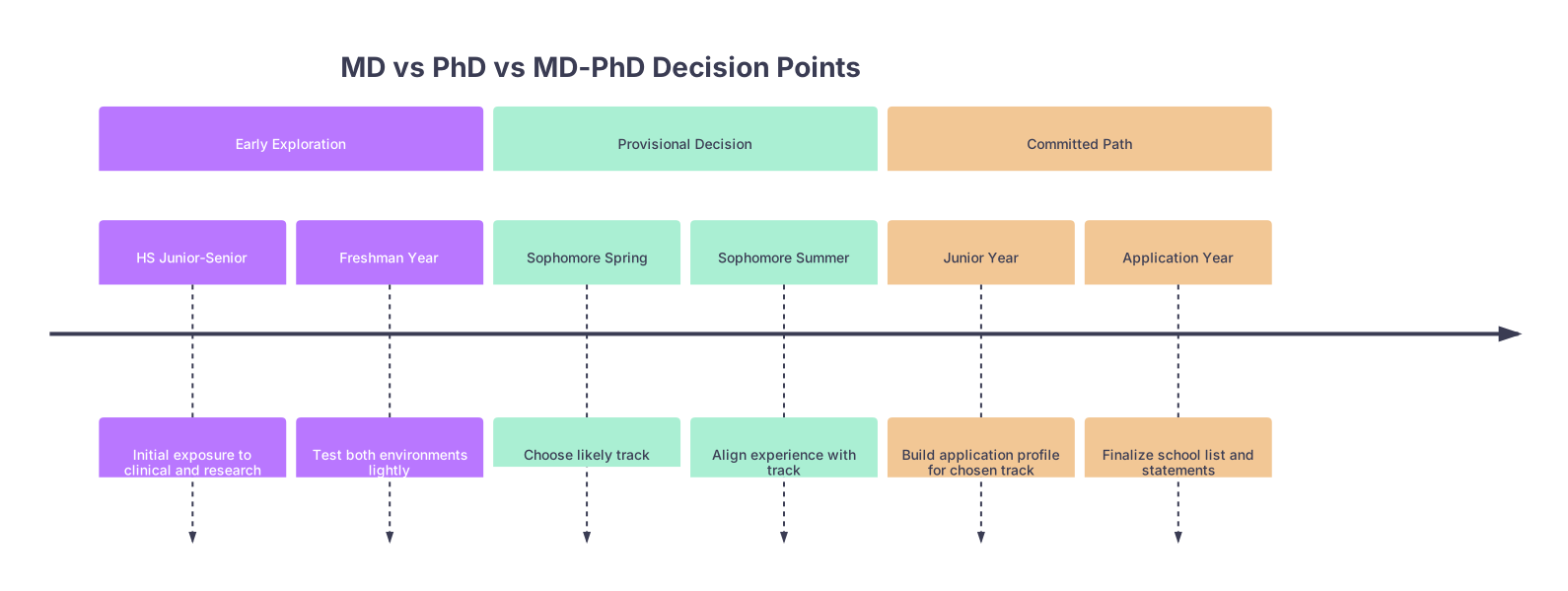
| Period | Event |
|---|---|
| Early Exploration - HS Junior-Senior | Initial exposure to clinical and research |
| Early Exploration - Freshman Year | Test both environments lightly |
| Provisional Decision - Sophomore Spring | Choose likely track |
| Provisional Decision - Sophomore Summer | Align experience with track |
| Committed Path - Junior Year | Build application profile for chosen track |
| Committed Path - Application Year | Finalize school list and statements |
Summer After Sophomore Year: Now Your Choice Starts To Matter
This is the first summer where your track choice directly shapes what you do.
At this point you should choose based on your provisional track:
- If you are leaning MD:
- Option A: Scribe job or intense clinical role (ED tech, CNA, etc.).
- Option B: Mix of clinical and some ongoing lab work.
- If you are leaning PhD:
- Full‑time research (REU, NIH, major lab with own project).
- Aim for poster or manuscript in the next 1–2 years.
- If you are leaning MD–PhD:
- You almost certainly should be in full‑time research.
- Ideal: basic science or translational project.
- Get close enough to a project to talk methodology and failure, not just “I helped.”
This is where MD–PhD vs MD divergence really starts showing up on the CV.
Junior Year: You Act As If You Have Decided
By junior year, dithering hurts you. Your time is finite; you must bias it.
Junior Fall: Build a Track‑Specific Profile
At this point you should:
Maintain GPA with serious upper‑level coursework that matches your track:
- MD: physiology, anatomy, microbiology, maybe public health.
- PhD: advanced courses in your field (e.g., molecular biology, biostats, algorithms).
- MD–PhD: a mix, but with clear depth in a research‑relevant area.
Rebalance your weekly hours based on track:
| Activity Type | MD Focus | PhD Focus | MD–PhD Focus |
|---|---|---|---|
| Research (hrs/wk) | 5–10 | 15–25 | 15–20 |
| Clinical (hrs/wk) | 6–10 | 0–3 | 4–6 |
| Shadowing (hrs/mo) | 4–6 | 0–2 | 4–6 |
| Service/Leadership | 2–5 | 2–5 | 2–5 |
If your reality is far from this table, you are out of alignment with your claimed goal.
Start MCAT or GRE planning:
- MD: MCAT usually spring of junior year or the following summer.
- MD–PhD: MCAT same as MD, but you must crush it relative to your GPA and research.
- PhD: Decide if you need GRE (many programs have dropped it, but some fields still care).
Junior Fall: Decide Your Application Year
This is another subtle fork:
- Straight‑through (apply at end of junior year → start right after senior year).
- Gap year(s).
At this point you should:
- If straight‑through:
- Treat this fall as your last full semester before your file is frozen.
- If planning a gap year:
- Map what that year will highlight:
- MD: full‑time clinical or service with some research.
- PhD: full‑time research assistant position.
- MD–PhD: research, ideally in a strong lab or NIH/fellowship.
- Map what that year will highlight:
Gap years can rescue a late MD–PhD or PhD pivot. But you must be intentional.
Junior Spring: You Lock In Your Track
This is the true decision deadline for anyone applying without multiple gap years.
For Straight‑Through Applicants (No Gap Year)
At this point you should:
- Commit to one primary track:
- MD only
- PhD only
- MD–PhD (often applied through MD–PhD specific application paths like MSTP)
- Take the appropriate exam:
- MCAT between January–June (ideally by May).
- GRE during junior spring or early summer if needed.
Here is what “locking in” looks like in practice:
- Your personal statement concept is now track‑specific.
- Your research PI knows which track you are aiming for and can tailor letters.
- Your school list is being drafted with the right balance:
- MD: mix of state, private, reach, and realistic schools.
- PhD: programs where at least 2–3 PIs do work you genuinely want.
- MD–PhD: significant focus on institutions with MSTP or robust dual‑degree programs.
If you are still telling people “I am not sure if MD or MD–PhD” this late, adcoms will read you as uncommitted. MD–PhD is not a casual checkbox.
For Gap‑Year Applicants
You get a bit more runway, but not that much.
At this point you should:
- Choose the gap‑year job that matches your track:
- MD: scribe, clinical research coordinator, community health, AmeriCorps health roles.
- PhD: RA in a lab, industry research, data science positions in your field.
- MD–PhD: RA in a strong lab, NIH postbac IRTA, HHMI, or equivalent.
Your “decision by” deadline shifts about 12 months later, but the structure is the same: you must be clearly aligned before you write your statement and ask for letters.
Application Year: The Point Of No Return
Once you are in the application cycle, your track is effectively chosen. Yes, you can reapply different paths later. It is painful and avoidable.
Summer Before Application Submission
At this point you should have absolutely no ambiguity about your track.
- MD applicants:
- Primary statement focused on patient care, clinical reasoning, professional identity.
- Research discussed as supporting detail, unless you are very heavy on it.
- PhD applicants:
- Statement of purpose is research‑first:
- Your prior work
- Your questions
- Why specific labs fit you
- Statement of purpose is research‑first:
- MD–PhD applicants:
- Personal statement: coherent story of clinical motivation.
- MD–PhD essays: clear articulation of your research trajectory and how it intersects with patients.
- You must sound like you understand what 7–9 years of dual training actually feels like.
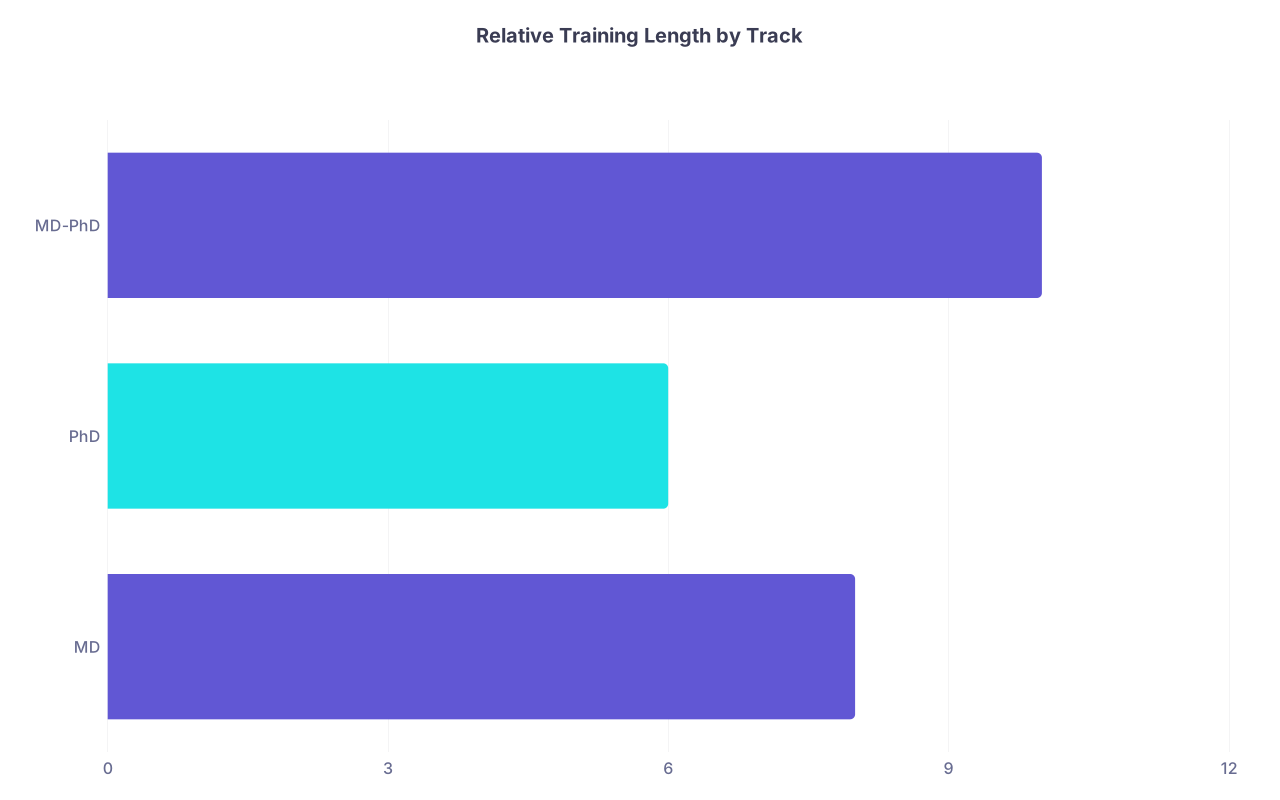
| Category | Value |
|---|---|
| MD | 8 |
| PhD | 6 |
| MD-PhD | 10 |
(Approximate total years from college graduation to independent attending/PI level; actuals vary, but MD–PhD is always the longest path.)
During Interviews
Interviews are where sloppy decisions are punished.
At this point you should be able to answer, without flinching:
- MD interview:
- “Why medicine and not nursing, PA, or PhD?”
- “Tell me about a patient who affected you.”
- PhD interview:
- “What is a research question you want to work on here?”
- “Describe a time your experiment failed and how you responded.”
- MD–PhD interview:
- “Why do you need both degrees to do what you want?”
- “If you had to give up the MD or the PhD, which would you keep and why?”
If you cannot answer those cleanly, you made your decision too late or for the wrong reasons.
What If You Decide “Wrong” And Need To Switch?
People change paths. It is not the end of the world. But the correction has a cost.
Common Late‑Stage Pivots
Started as MD‑only mindset, now want MD–PhD (junior/senior year).
- At this point you should:
- Strongly consider at least 1–2 gap years.
- Build substantial research output (posters, maybe a paper).
- Get a very detailed letter from a PI describing your research maturity.
- Applying MD–PhD without that looks unserious.
- At this point you should:
-
- At this point you should:
- Decide whether to finish the PhD (often wise) or leave early.
- Accumulate fresh clinical exposure before MD applications.
- Committees will ask, “Why now?” You need a specific answer.
- At this point you should:
Started MD–PhD and want to drop one side.
- Programs have workflows for this. It is not rare.
- But it is emotionally and professionally expensive.
- The earlier you had an honest timeline with yourself, the less likely you end up here.
Quick Milestone Map: When You Should Decide What
Use this as a sanity check.
| Stage | MD Only | PhD Only | MD–PhD |
|---|---|---|---|
| End of Freshman Year | Still exploring | Still exploring | Still exploring |
| End of Sophomore Year | Provisional MD lean | Provisional PhD lean | Provisional MD–PhD lean |
| Summer After Sophomore Year | Track‑aligned activities | Track‑aligned research | Track‑aligned research |
| Junior Fall | Behaving as MD applicant | Behaving as PhD applicant | Behaving as MD–PhD applicant |
| Junior Spring (no gap year) | Track locked for apps | Track locked for apps | Track locked for apps |
| Gap‑Year Start (if any) | Reinforcing MD profile | Reinforcing PhD profile | Reinforcing MD–PhD profile |

Final Checklist by Year
End of Freshman Year – 5‑Minute Audit
You should be able to say:
- I have:
- Seen both a lab and a clinical environment.
- At least some idea of which one felt more natural.
- I am planning:
- A summer that leans slightly clinical or slightly research.
End of Sophomore Year – 10‑Minute Audit
You should be able to say:
- My default track today would be: MD / PhD / MD–PhD.
- I have:
100 hours in at least one domain (clinical or research).
- A mentor who could imagine writing me a letter in that domain.
- My summer is:
- Explicitly chosen to test and reinforce that default track.
End of Junior Fall – 15‑Minute Audit
You should be able to say:
- My resume looks clearly more like one of:
- MD applicant
- PhD applicant
- MD–PhD applicant
- I have concrete answers for:
- Why that track.
- What I will do with it.

The Core Takeaways
- You do not need to “decide forever” as a freshman. You do need to intentionally test both research and clinical work by the end of sophomore year.
- By junior year, you must act as if you have chosen: your time, summers, and mentors should clearly align with MD, PhD, or MD–PhD.
- Your track is effectively locked the moment you start your personal statement and school list. If you are still wavering then, you are already behind.