
The worst mistake in MD–PhD land is not starting a PhD you do not love. It is staying in one two years longer than you should.
If you are leaning toward MD only, your question is not “Should I be a scientist?” anymore. Your question is “When do I step off this track without torching my career, my sanity, or my finances?”
I am going to walk you through that timing decision step by step. Semester by semester. Month by month. What to do, what to say, and when to pull the ripcord.
Big Picture: The Decision Windows From Premed Through Residency
Before we zoom in, you need the high‑altitude map. There are distinct “off‑ramps” where stepping away from the PhD track is common, expected, and relatively clean.
| Stage | Typical Timing | Cleanest Exit? | Main Risk |
|---|---|---|---|
| Premed / before applications | Sophomore–Junior year | Yes | None, just sunk EC time |
| Application cycle | Before submitting AMCAS | Yes | Reframing activities, letters |
| During MD–PhD preclinical years | M1–M2 | Moderate | Program politics, funding shifts |
| During early PhD | Year 1–2 of PhD | Moderate | Lab fallout, degree status |
| Late PhD (ABD, years 3–5) | Hard but possible | No | Wasted years, publications incomplete |
| Residency/fellowship | Post‑MD decision only | N/A | Career direction, not PhD exit |
If you’re already in a formal MD–PhD program, the cleanest transition to MD only usually happens:
- Before you fully commit to a lab (early PhD year 1), or
- Right after a contained milestone (e.g., completion of a master’s, qualifying exam, or a publishable project).
If you are still premed or only thinking about MD–PhD, your timeline is different and much easier. I will cover both.
Phase 1: Premed Years – When You’re Considering MD–PhD
At this point you should be brutally honest about what you actually enjoy on a week‑to‑week basis.
Freshman–Sophomore Year: Exploration, Not Identity
If you are here:
- You like science.
- You might like patients.
- And someone told you “You love research, you should do an MD–PhD.”
At this stage you do not commit to the MD–PhD path. You test it.
By the end of sophomore year, you should have:
- At least 6–12 months of continuous lab experience, where you:
- Show up weekly.
- See how it feels when experiments fail.
- Have at least one independent mini‑project.
- Shadowing or clinical volunteering (even 20–40 hours) to see if patients energize you or drain you.
Red flag timeline cues to step off the PhD idea now:
- You consistently dread lab days, even in a good lab with a decent mentor.
- You catch yourself resenting time in the lab because you would rather be in clinic or with patient‑facing activities.
- The only attractive thing about MD–PhD is “free tuition” or “it is more prestigious.”
At this point, if those red flags are there, you step off the MD–PhD idea before junior year. Shift your CV toward:
- More clinical experiences.
- Some depth in research (fine), but you stop pretending you want 5–7 more years of it full‑time.
You can still mention research interest in your MD applications, but you stop saying the words “I’m planning an MD–PhD” to advisors and letter writers. They will remember.
Junior–Senior Year: Application Planning
If you are leaning MD only by now, the moment to formalize that decision is before you build your school list and personal statement.
At this point you should:
- Decide: MD only vs MD–PhD no later than 3 months before AMCAS opens (so by February–March for a May/June submission).
- Tell your letter writers what story you are actually selling.
If you decide to step off MD–PhD track now:
- Reframe your research:
- Instead of “I want to run a lab,” talk about
- Understanding evidence,
- Improving patient care through research literacy,
- Maybe contributing to clinical/translational projects during residency.
- Instead of “I want to run a lab,” talk about
- Avoid MD–PhD specific language:
- No “I want to be a physician–scientist splitting 80/20 research/clinic” if you do not mean it.
- Rebuild your school list:
- Emphasize strong clinical MD programs.
- Throw in research‑heavy MD programs only if you genuinely want optional research years.
That is your first and easiest off‑ramp. You owe no one an explanation. You simply apply MD.
Phase 2: MD–PhD Applicants – When To Pivot During the Cycle
Some of you are mid‑cycle. You wrote the MD–PhD essays, sent the AMCAS, maybe got a few interviews, and now you are thinking: “I might have made a mistake.”
The timing here is delicate.
Before Submitting AMCAS: Clean Pivot
If you are not yet submitted, and you feel 60–70% sure you prefer MD only:
- Strip the MD–PhD section from your primary.
- Do not check the MD–PhD boxes.
- Rewrite your personal statement focusing on:
- Clinical motivations first.
- Research as a supporting character, not the lead.
That is the correct time to step away. Quietly. No drama.
After Submitting but Before Secondaries: Strategic Containment
If AMCAS is already in and you checked MD–PhD, but doubt is creeping in:
At this point you should:
- Keep everything as‑is for this cycle. Do not start emailing programs midstream saying “Actually I changed my mind” unless you are absolutely certain you will not attend MD–PhD even if accepted.
- Use secondaries and later communications to:
- Subtly emphasize your enthusiasm for clinical training.
- Avoid locking into rigid research career language.
- Talk to a trusted advisor (not Reddit, not random classmates) about:
- Whether to ride out this cycle as is,
- Or withdraw, regroup, and reapply MD only if your application is still salvageable.
The real “step off” point in this scenario is usually before you accept a spot in an MD–PhD program. If you are not excited about the idea of 7–9 years of training before residency, you do not commit. Say no. That is the cleanest pivot.
Phase 3: Early MD–PhD Training – M1 to Early PhD
This is where I have seen the most quiet misery.
You started MD–PhD. The tuition is covered. The stipend checks land. Everyone congratulated you as if you won the Nobel. Now in the back of your mind you are thinking, “I just want to be a doctor.”
You are not trapped. But your timing matters.
M1–M2 Years: Before You Enter the Lab
At this point you should be watching your own behavior more than your stated preferences.
By the end of M1, ask yourself:
- Do I look forward to research seminars, journal clubs, and meeting PIs?
- Or do I grin and bear them while counting down to clinical skills and patient contact?
By the midpoint of M2, you should have:
- Talked with:
- The MD–PhD program director,
- At least one senior MD–PhD student who quit or nearly quit (they exist; programs know who they are).
- Clarified:
- What happens if you step off and do MD only:
- Will your tuition still be covered?
- Do you owe any money back?
- Do you join the regular MD class seamlessly?
- What happens if you step off and do MD only:
There is often a “protected” off‑ramp before formally entering the PhD phase.
If by the end of M2 you are 70% sure you do not want a long research career, the least painful move is:
- Tell the MD–PhD director early, ideally 6–12 months before your planned PhD transition.
- Request transition to MD only before you choose a lab and formally start your thesis work.
This minimizes:
- Lab drama (you never actually join).
- Sunk intellectual cost (you are not halfway through a half‑baked project).
- Administrative headache.
Yes, programs will be disappointed. Good ones will prefer you leave now rather than become a disengaged, resentful PhD student who drags projects down.
Phase 4: Early PhD Years – Year 1–2 in the Lab
Now it gets messier.
You have joined a lab. You have a desk. You are on a project. Your PI is introducing you as “our MD–PhD student.” And your internal monologue is: “This is…not my future.”
You are not alone. I have seen students step off here and still have excellent careers.
Year 1 of PhD: The Reality Check
At this point you should keep a mental (or literal) 6‑month clock.
By 6–12 months into your PhD, you should know:
- Do you enjoy troubleshooting experiments?
- Are you okay with slow, incremental progress?
- Does writing and reading papers feel energizing or exhausting?
Ask yourself on a month‑by‑month timeline:
- Month 1–3: You feel lost. Normal. Do not decide yet.
- Month 4–6: You start to understand the techniques and questions. Pay attention to whether enjoyment is trending up or flatlining.
- Month 7–12: If you still dread going to lab most days and fantasize about third year clerkships, this is your sign.
This is the best time inside the PhD to step off. Not fun, but better than year 4.
Concrete steps, roughly over 2–3 months:
- Month 0:
- Track your day‑to‑day in a short log. Dread vs interest. Not vibes—data.
- Month 1:
- Have a confidential meeting with the MD–PhD director:
- Phrase it as “I am struggling to see myself in a long‑term research career and am considering MD only.”
- Have a confidential meeting with the MD–PhD director:
- Month 1–2:
- Clarify exit options:
- Can you leave with a master’s degree after X credits or a small project?
- Will they count this as a “completed research year” on your MD transcript?
- Clarify exit options:
- Month 2–3:
- Talk to your PI after you understand the formal structure:
- Be simple and firm: “I have realized I want a fully clinical career. I’m planning to transition back to MD only after completing [agreed milestone].”
- Talk to your PI after you understand the formal structure:
The milestone could be:
- A small first‑author or co‑author paper,
- A completed project with a clear end,
- Or simply the master’s thesis if formal.
Do not drift for another two years “to see if it gets better” if all evidence says it will not.
Phase 5: Late PhD – Years 3–5, ABD and Stuck
If you are already advanced to candidacy, all but dissertation (ABD), and staring down your 5th or 6th year, the calculus changes.
Here is the harsh reality:
Quitting at this point is not usually the smartest move unless the PhD is actively damaging your mental health, physical health, or financial stability beyond repair.
At this point you should:
- Make a 12–18 month plan:
- What exactly is required to finish?
- Number of remaining experiments,
- Required papers,
- Dissertation structure,
- Defense schedule.
- What exactly is required to finish?
- Turn an endless project into a finite one with dates.
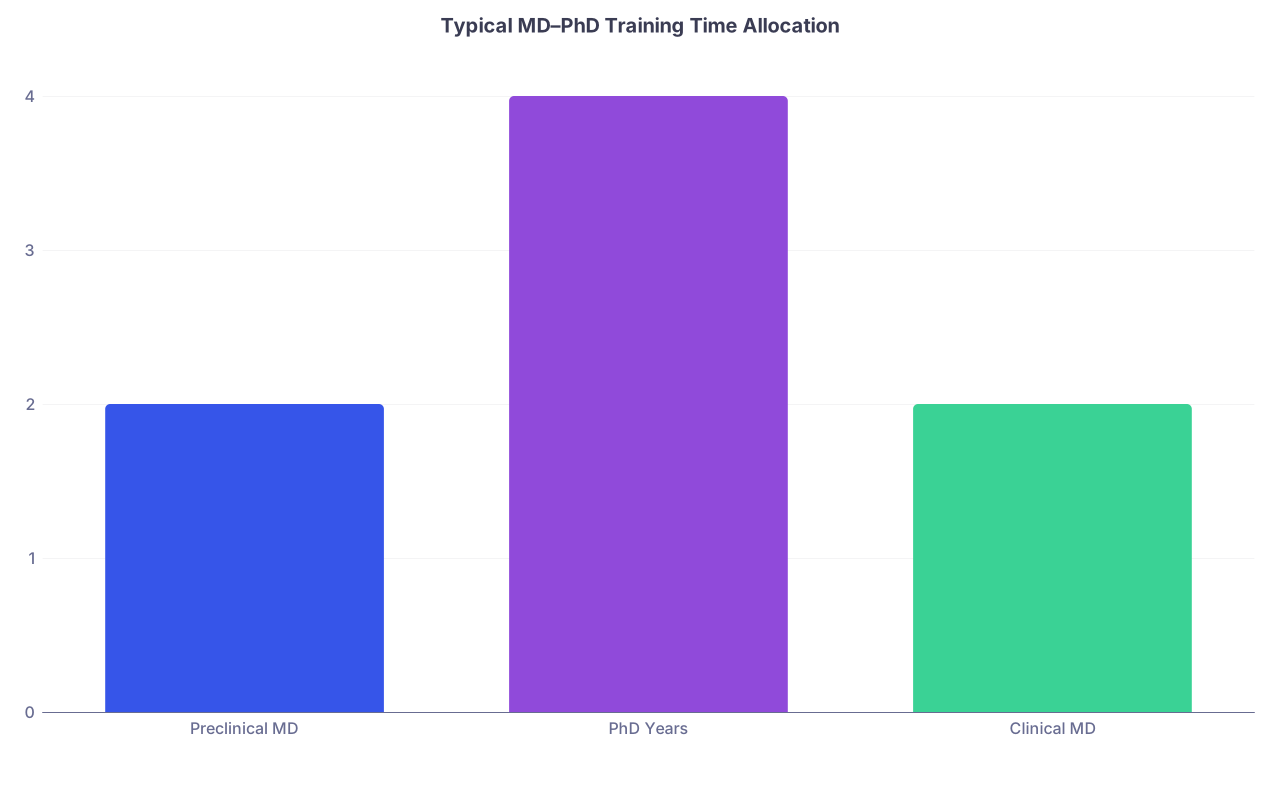
| Category | Value |
|---|---|
| Preclinical MD | 2 |
| PhD Years | 4 |
| Clinical MD | 2 |
You have already invested 3–5 years. If you can realistically finish in 12–18 months, most of the time, you swallow the frustration and complete it.
You only step off now if:
- Your PI is abusive or clearly blocking graduation with moving goalposts.
- The program cannot provide a path to completion that does not involve another 3–4 years.
- You are clinically or psychologically at a breaking point.
But even then, before you walk away entirely, ask if there is an option to:
- Convert to a master’s degree,
- Or submit a “compilation” dissertation from existing work.
Your timing trigger here is:
- If you have not defended and have no realistic defense date within 18 months, and the environment is toxic, you seriously consider stepping off and cutting losses.
Phase 6: After MD – Residency and Beyond
By the time you are in residency, the “step off the PhD track” question is gone. You either have the PhD or you do not.
What you do have now is a separate decision: how research‑heavy you want your career to be.
At this point you should:
- Decide by PGY1–PGY2 whether you are:
- Clinician‑educator (mostly clinical, some teaching),
- Clinician–researcher (protected time, grants, etc.),
- Or predominantly research‑focused.
If you bailed on a PhD earlier, you can still have:
- Research‑oriented fellowships,
- Clinical research careers,
- Quality improvement or outcomes work.
The PhD track is over, but your academic options are not.
Practical Signals: A Timeline Checklist For “Is It Time To Step Off?”
Use these time‑anchored checks. If too many hit, you are probably past due.
Within 6 Months of Starting PhD or Committing to MD–PhD
At this point you should reconsider if:
- You said “yes” to MD–PhD mainly for:
- Free tuition,
- Prestige,
- Pressure from mentors or family.
- You cannot name a type of research you could imagine doing for 10–20 years.
12–18 Months Into PhD
You should strongly consider stepping off if:
- Your enjoyment of lab work is flat or decreasing.
- The thought of returning to medical school is the only thing keeping you moving.
- You find yourself doing the bare minimum in lab repeatedly for >3 months.
2–3 Years Into PhD
You should ask hard questions if:
- You still have no first‑author paper in sight,
- Your PI’s expectations are vague and constantly shifting,
- You have no credible graduation timeline from your committee.
This is when you either:
- Negotiate a strict completion plan with deadlines, or
- Open the conversation about leaving with whatever terminal degree is available.
Communication Timing: When To Tell Whom
The “how” matters almost as much as the “when.”
At each stage, your order of operations should look like a structured timeline.
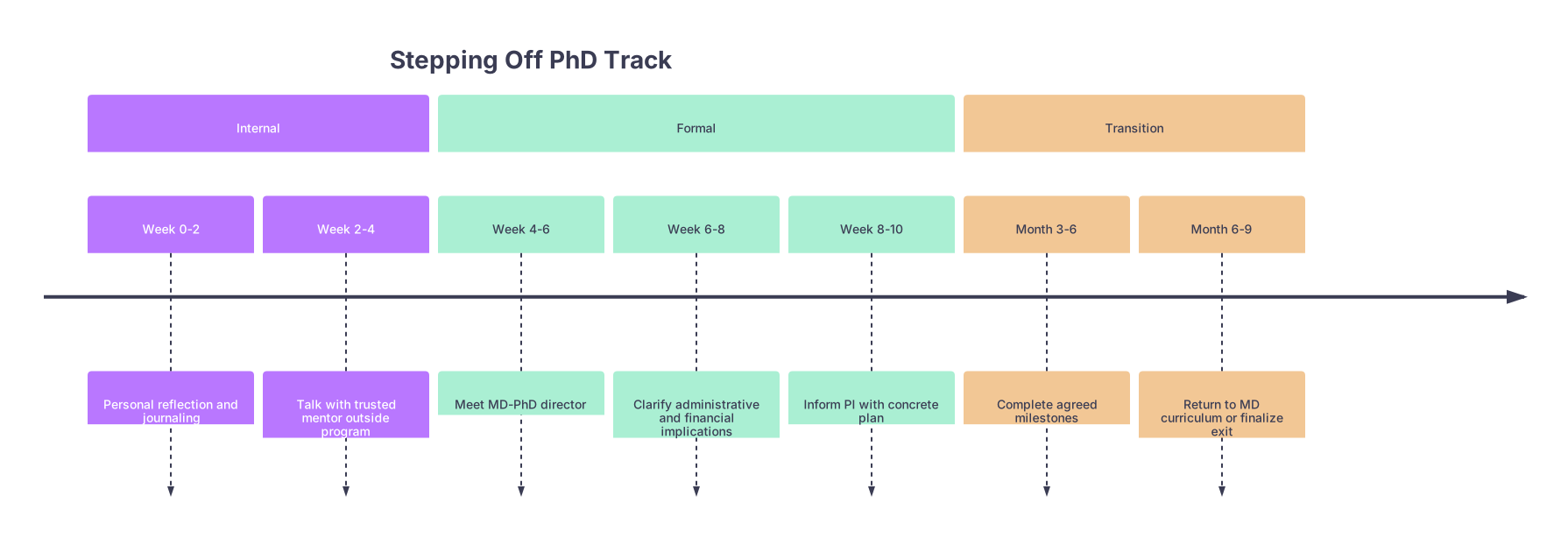
| Period | Event |
|---|---|
| Internal - Week 0-2 | Personal reflection and journaling |
| Internal - Week 2-4 | Talk with trusted mentor outside program |
| Formal - Week 4-6 | Meet MD-PhD director |
| Formal - Week 6-8 | Clarify administrative and financial implications |
| Formal - Week 8-10 | Inform PI with concrete plan |
| Transition - Month 3-6 | Complete agreed milestones |
| Transition - Month 6-9 | Return to MD curriculum or finalize exit |
Notice the sequence:
- Weeks 0–2 – You:
- Write down why you are considering leaving.
- Make sure this is not just the normal dip everyone feels when things are hard.
- Weeks 2–4 – You talk to:
- A mentor not directly invested in your program (could be a clinician, another department’s PI, older student).
- Weeks 4–6 – You talk to:
- MD–PhD or graduate program director.
- Weeks 6–8 – You:
- Get written clarity on funding, degree status, and timeline options.
- Weeks 8–10 – You:
- Tell your PI with a concrete, time‑bound transition plan.
Do not reverse this order. Telling a PI first, without understanding formal structures, is how people end up cornered into staying “just one more year” indefinitely.
At This Point, Here’s What You Should Do Today
You do not need to solve your entire career in one night. You need the next small, specific step.
Today, before you do anything else:
- Open a blank document.
- Title it: “MD vs PhD – Reality Check.”
- Make two sections:
- “What I actually enjoy week to week.”
- “Where I want to be in 5–7 years (not the title, the daily life).”
Fill it out honestly. No aspirational nonsense. Just what your days look like.
If that document screams “clinic, patients, teams” and whispers “lab, experiments, grants,” then your job over the next month is simple:
- Schedule one conversation with someone who left the PhD track or MD–PhD path.
- Ask them exactly when they knew and how late they wish they had decided.
That is how you start stepping off at the right time, instead of realizing five years from now that you stayed on a track that stopped fitting you long ago.