
The worst time to “figure out” whether to do a PhD or postdoc is during residency. You should be testing that decision long before you sign your residency contract.
You want timelines. So here’s how this works—year by year, then decision point by decision point.
Big Picture: Where Postdoc/PhD Fit In an MD Timeline
Before we zoom in, you need the basic map of where people usually wedge in advanced research training.
| Stage | Typical Add-On |
|---|---|
| After M3/M4 (rare) | Interrupt MD for PhD |
| After Graduation / Prelim | Research fellowship |
| During Residency | PhD or lab-heavy years |
| After Residency | Postdoc or T32 program |
| During Fellowship | Research-track fellowship |
Now let’s walk this chronologically, starting before residency and running through your PGY years.
MS3–MS4: The “Do Not Wing This” Planning Window
At this point you should be:
- Getting honest about whether you actually like research or just like the idea of “academic prestige.”
- Mapping how research-heavy your target specialty is.
6–18 Months Before Residency (Late MS3 → Mid MS4)
Focus:
Reality-check your research appetite
- Think back to actual days in the lab:
- Did you hate debugging protocols?
- Did you enjoy long, quiet analysis days?
- Did reviewer #2’s comments ruin your week—or energize you to prove them wrong?
- If every research block felt like punishment, a PhD or postdoc is probably a bad idea.
You might still do shorter targeted fellowships or certificate programs instead.
- Think back to actual days in the lab:
Look at your target specialty
- Rough rule:
- Highly academic/competitive: heme/onc, cardiology, GI, pulm/crit, rheum, neurology (research-focused), radiation oncology.
- Procedure-heavy community lean: EM, anesthesia, OB/GYN, ortho (unless clearly academic).
- Ask faculty:
- “In your field, who actually needs a PhD to be successful?”
- “Are postdocs common after residency or mainly for MD/PhD folks?”
- Rough rule:
Talk to people 5–10 years ahead of you
- Find:
- An MD-only clinician–scientist who did no PhD/postdoc.
- An MD who added a postdoc after residency.
- An MD who did a late PhD during/after residency.
- Ask:
- “If you were me—MS4, [specialty interest], medium research background—when would you add research training, if at all?”
- Find:
You’re not deciding yet. You’re collecting data and exposing yourself to real paths, not brochure versions.
Residency Application Year (MS4 Fall–Winter): Decide Your Track, Not Your Degree
At this point you should be:
- Choosing whether you’ll apply categorical clinical vs research-heavy/physician–scientist tracks.
- Positioning yourself for flexibility.
MS4 Fall: ERAS / SOAP / Rank List Planning
- Categorize programs by research culture
Use a simple 3-bucket system:
Bucket A – Purely clinical/community-focused
- Minimal protected research time.
- Few MD investigators on faculty.
- Postdocs from these programs are possible but harder; you do it later, often at another institution.
Bucket B – Academic but clinically dominant
- Research is valued but mostly in fellowship.
- Residents might get 3–6 months research total.
- Good if you might want research but aren’t ready to commit to heavy training.
Bucket C – Research-track + physician–scientist pathways
- Explicit research tracks (e.g., “ABIM Research Pathway”, “Physician Scientist Training Program”).
- Protected time built into PGY2–PGY4 or beyond.
- Ideal if you’re already leaning toward postdoc/PhD.
At this stage, you’re not signing up for a postdoc yet. You’re choosing an environment that either keeps that door wide open—or quietly welds it shut.
PGY1: Build Optionality, Not Commitments
PGY1 is for survival and signal gathering. Don’t sign up for a PhD program 6 months into internship because you’re tired and disillusioned. That’s how bad decisions happen.
At this point you should be:
- Proving you can be a solid clinician first.
- Quietly positioning yourself for future research options.
First 6 Months of PGY1 (July–December)
Lock down your clinical reputation
- Be the intern attendings want again:
- Notes on time.
- Follow-up calls done.
- Night float: present clean, precise sign-outs.
- A future PhD/postdoc is dead in the water if your PD thinks you’re barely safe on the wards.
- Be the intern attendings want again:
Scan for research mentors
- Watch who:
- Quotes actual data on rounds.
- Talks about grants, not just “a little QI project.”
- Ask residents:
- “Who here is actually running a research lab or big clinical trials?”
- Keep it light: “I’m interested in academic work down the line. Would it be OK if I grabbed 15–20 minutes sometime to hear about your path?”
- Watch who:
Do not commit to big projects yet
- Small is fine:
- Case reports.
- Retrospective chart reviews with narrow scope.
- Huge multi-year projects in the first few months: usually a trap.
- Small is fine:
Second 6 Months of PGY1 (January–June)
Now you can actually start testing your research threshold.
Take one “real” project
- Criteria:
- A clear question.
- A mentor with real publications in that question area.
- A timeline that lets you see meaningful progress within 6–12 months.
- You’re not trying to build your entire CV. You’re stress-testing your tolerance for real research work on top of a resident schedule.
- Criteria:
Have the first explicit conversation: PhD vs Postdoc vs Nothing
- With your main mentor or research-oriented faculty:
- “Given my goals [spell them out], is a PhD worth it after MD, or would structured postdoc/fellowship-level research be better?”
- Ask them to be blunt about:
- Opportunity cost.
- Competitiveness.
- Funding realities.
- With your main mentor or research-oriented faculty:
By the end of PGY1, you should know:
- Do you still want a strong research component in your career?
- Do you want it enough to sacrifice income and time?
If the answer is already “probably not,” that’s actually a win. You just avoided 4–6 years of unnecessary pain.
PGY2–PGY3: The Real Decision Window
This is where timing matters. Most MDs who add PhD or deep postdoc-style research commit mentally between late PGY2 and mid PGY3.
At this point you should be:
- Converting vague interest into a concrete pathway and timeline.
- Choosing one of three directions.
Here’s the basic fork:

| Step | Description |
|---|---|
| Step 1 | Late PGY1 |
| Step 2 | Finish residency clinically |
| Step 3 | PGY2 Deepen research |
| Step 4 | Plan PhD during/after residency |
| Step 5 | Plan postdoc or research fellowship |
| Step 6 | Apply PGY3/early PGY4 |
| Step 7 | Identify programs and funding |
| Step 8 | Still want research heavy career |
| Step 9 | By mid PGY2 - Need PhD? |
PGY2: Test Depth, Not Just Interest
PGY2 early (July–December) – Escalate research commitment
- If your program allows, arrange:
- 1–2 research electives.
- Clinical schedules with lighter nights when possible.
- During that time:
- Try writing an IRB.
- Draft at least one abstract or manuscript.
- Sit through a real lab meeting or research conference every week.
- If your program allows, arrange:
PGY2 mid (January–March) – Make a preliminary call: PhD vs postdoc vs “good enough”
- If you love:
- Fundamental mechanisms.
- Lab-based work.
- Long timescales of multi-year projects. → PhD might be on the table.
- If you prefer:
- Clinical trials.
- Outcomes research.
- Data science with patient-facing relevance. → Structured postdoc or research fellowship is usually smarter than a full PhD.
- If you love:
You’re aiming for a working decision by the end of PGY2, not a fantasy. That means talking to programs about actual positions and realistic start dates.
When a PhD During/After Residency Actually Makes Sense
PhDs for MD-only folks are often oversold. In reality, they make sense in a pretty narrow set of circumstances.
At this point (late PGY2/early PGY3) you should only pursue a PhD if:
You want to run a heavily basic-science or methods-focused lab
- Think:
- Molecular immunology.
- Neuroscience circuits.
- AI method development (not just “using tools that others build”).
- Your field strongly favors PhD-level training for high-end R01-style investigators.
- Think:
You’re at an institution with a clear MD-to-PhD-on-ramp
- Examples:
- Internal PhD programs that accept residents at reduced time because of prior MD coursework.
- Interlocked “physician–scientist pathway” combining PGY2–3 + PhD + clinical finishing years.
- You have:
- Guaranteed funding.
- A clear timeline.
- Written confirmation that your residency spot is protected during the PhD years.
- Examples:
You’re ready to accept the opportunity cost
- You’re adding:
- Usually 3–5 years of training.
- You’re delaying:
- Attending salary.
- Home buying, family plans, etc.
- If you flinch hard at that math? That’s your answer.
- You’re adding:
A Rough Timeline Example: MD → IM Residency → PhD
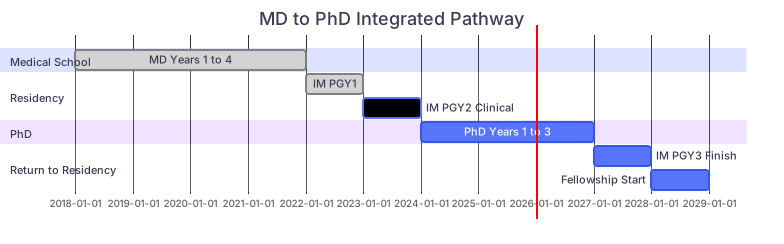
| Task | Details |
|---|---|
| Medical School: MD Years 1 to 4 | done, 2018, 4y |
| Residency: IM PGY1 | done, 2022, 1y |
| Residency: IM PGY2 Clinical | active, 2023, 1y |
| PhD: PhD Years 1 to 3 | 2024, 3y |
| Return to Residency: IM PGY3 Finish | 2027, 1y |
| Return to Residency: Fellowship Start | 2028, 1y |
If that looks exhausting, that’s because it is. Make sure the endpoint actually requires this path.
When a Postdoc or Research Fellowship Is the Smarter Move
Most MDs who want serious research careers should be thinking postdoc or research fellowship, not retrofitted PhD.
At this point (late PGY2 to mid PGY3) you should strongly prefer a postdoc/research fellowship if:
Your research question lives closer to patients
- Examples:
- Health services research.
- Epidemiology.
- Translational “bench-to-bedside” where you’re the link, not the bench chemist.
- AI in clinical care, outcomes, implementation science.
- Many of these fields care more about:
- Strong methods training (can be done via MS, certificate, or mentored postdoc).
- A track record of productivity.
- Good grants (K awards) later on.
- Examples:
You can leverage a structured research-track fellowship
- Think:
- Cardiology fellowship with a built-in 2-year research block.
- Pulm/crit with NIH T32 support.
- Hem/Onc with 80% protected research time after first clinical year.
- These effectively function like “postdocs for doctors.”
- Think:
You want flexibility
- Postdocs:
- 2–3 years typical.
- Easier to pivot back to pure clinical if research doesn’t pan out.
- PhD:
- Harder to justify then walk away from midstream.
- Postdocs:
PGY3: Lock the Path and Start Applications
This is your “put up or shut up” year. Either you:
- Commit to a research-augmented path (postdoc/PhD/fellowship with research), or
- Accept that you’ll be a primarily clinical physician who may still do meaningful but limited research.
At this point you should be:
- Choosing one specific plan to execute.
- Getting applications and mentors aligned.
Mid PGY3: Concrete Timelines
Use this as a planning grid:
| Path | When to Decide | When to Apply |
|---|---|---|
| PhD during residency | Late PGY1–PGY2 | 6–12 months in advance |
| PhD after residency | PGY2–early PGY3 | PGY3 (rolling/varies) |
| Research fellowship/postdoc | PGY2–mid PGY3 | PGY3 application cycle |
| Pure clinical fellowship | PGY2 | Standard fellowship cycle |
You don’t get to keep infinite doors open forever. Missing these windows mostly means pushing your research dreams further down the line—or watching them quietly die.
Key Tasks in PGY3
Identify and commit to 1–2 primary mentors
- Criteria:
- Active funding (R01, equivalent, or strong institutional support).
- A track record of getting trainees onto K awards, good jobs, or faculty roles.
- Ask directly:
- “If I join your group as a postdoc / PhD trainee, where do you see me in 5 years?”
- “What would success look like by the end of my time with you?”
- Criteria:
Build a realistic training plan
- For PhD:
- Program requirements.
- Coursework you can waive.
- Timeline to defense.
- For postdoc or research fellowship:
- Specific projects.
- Expected publications.
- Grant-writing milestones (F32, K awards, equivalent).
- For PhD:
Clarify funding and salary
- Do not assume:
- That your attending-level salary will magically appear.
- That “we’ll work something out” is acceptable.
- Get precise:
- Stipend/salary number.
- How many years guaranteed.
- Benefits and call expectations.
- Do not assume:
Practical Month-by-Month Snapshot
Here’s a stripped timeline from late med school through early attending life, focused only on when you should be making decisions.
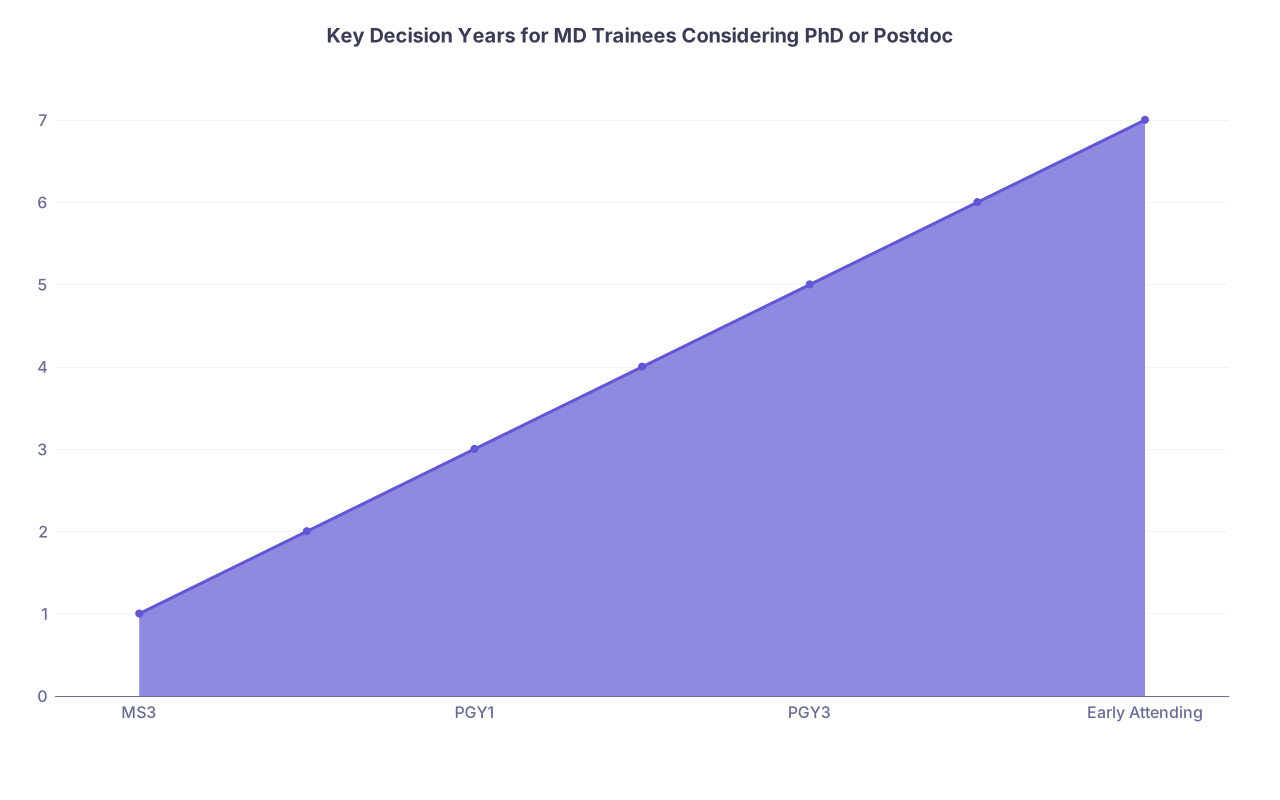
| Category | Value |
|---|---|
| MS3 | 1 |
| MS4 | 2 |
| PGY1 | 3 |
| PGY2 | 4 |
| PGY3 | 5 |
| Fellowship/Postdoc | 6 |
| Early Attending | 7 |
Interpret this as a sequence, not literal values:
MS3–MS4
- Clarify whether you like research enough to consider serious training.
- Target residencies that keep options open.
PGY1
- Establish clinical credibility.
- Sample one meaningful project.
- Decide if research is still on the table.
PGY2
- Intensify research involvement.
- Decide: Do you want deep research training or occasional side projects?
- Begin exploring PhD vs postdoc/research fellowships concretely.
PGY3
- Lock in path.
- Apply for:
- PhD programs (if truly necessary).
- Research-track fellowships or postdocs.
- Or consciously walk away from major additional training.
Fellowship/Postdoc
- Focus on productivity and early grant groundwork.
- This is where your decision either pays off or becomes expensive regret.
How to Gut-Check Yourself at Each Step
At the end of each major year, ask:
End of MS4:
“Do I want to keep the option of a research-heavy career alive?”
If yes → Match at a program where research is legitimately supported.End of PGY1:
“Did doing research during residency energize me or drain me?”
If drain → downgrade research ambitions.Mid PGY2:
“Do I care more about being an excellent clinician who understands research, or someone whose primary job is producing research?”
Your answer here strongly predicts whether PhD/postdoc is worth it.Early PGY3:
“Am I willing to delay significant income and flexibility for 2–5 more years of structured training?”
If your honest answer is no, do not let prestige drag you into a PhD or long postdoc.
One More Hard Truth
You don’t need a PhD or postdoc to be a thoughtful, evidence-based, occasionally publishing physician.
You do need one of them—or serious equivalent protected time—if you want:
- To run large independent labs.
- To compete for major investigator-level grants.
- To have research be the main reason your job exists.
The mistake I see over and over: residents drifting into long research training because it feels like “the academic thing to do,” then hitting 40 with burnout, limited funding, and delayed life milestones they quietly resent.
Do not drift. Decide.
Today, take one concrete step: write down your current training year and answer this on paper in one sentence—“In 10 years, I want research to be ___% of my job.”
Then circle the number. That percentage is your anchor. Everything else—PhD, postdoc, or neither—should line up with it or be thrown out.