
The biggest lie you hear about MD vs MD–PhD vs PhD→MD is that they’re “all about the same length in the end.” They are not. The order you choose can easily cost you an extra 3–8 years.
I am going to walk you through how long each path really takes, year by year, and what your life actually looks like at each point. No brochure fluff. Just the clock, the milestones, and when you finally get to practice with real autonomy.
Big-Picture Time Comparison
Before we zoom into year‑by‑year timelines, you need the rough numbers in your head. At this point you should be asking a simple question: “When am I an independent attending?”
| Pathway | School (Pre‑Residency) | Residency/Fellowship | Total to Independent Practice |
|---|---|---|---|
| Straight MD | 4 years | 3–7 years | 7–11 years |
| MD–PhD | 7–9 years | 3–7 years | 10–16 years |
| PhD → MD | 8–9 years (PhD+MD) | 3–7 years | 11–16 years |
Now let’s lay this out chronologically. What are you doing at 24? 28? 35? Earning a salary? Still on stipend? Still taking exams?
Straight MD: The Leanest Route To Clinical Practice
If your primary identity is “clinician who might do some research” rather than “scientist who also treats patients,” the straight MD is almost always the most time‑efficient.
College Years (Age ~18–22)
At this point you should:
- Front‑load hard sciences (Gen Chem, Bio, Physics, Org Chem) by the end of junior year.
- Insert research if you care about competitive specialties, but do not stretch college just for that.
Rough sequence:
- Year 1–2:
Basic sciences, maybe shadowing, maybe a low‑stakes lab experience. - Year 3:
Serious MCAT prep. Summer MCAT is ideal. Start clinical volunteering or scribe work if you have none. - Year 4:
Apply in late spring/summer. Interview throughout fall and early spring.
If you do this cleanly and avoid gap years, you start medical school right after college.
Medical School: Year‑by‑Year (4 Years)
Assume matriculation at 22.
MS1 (Age 22–23)
You are:
- Learning anatomy, physiology, biochemistry.
- Maybe doing a few evenings or summers in a lab if you’re research‑curious.
At this point you should:
- Decide if you are remotely interested in a research‑heavy career.
If yes, get one solid longitudinal project started. Not “dabble for 6 weeks.”
MS2 (Age 23–24)
- Systems‑based pathophysiology, pharmacology, etc.
- Step 1 (now pass/fail, but still a major gate).
Timeline:
- Fall–Winter: Heavy content study.
- Spring: Dedicated Step 1 block (4–8 weeks).
- Summer: Transition to clinicals.
If you’re flirting with the MD–PhD idea at this stage, you are already late. Switching now usually means extra years and lost benefits.
MS3 (Age 24–25)
- Core clinical clerkships: Internal, Surgery, OB/Gyn, Peds, Psych, Neuro, Family.
- You start seeing what real life looks like in different specialties.
At this point you should:
- Narrow to 1–2 specialties.
- Get at least one mentor letter in your chosen field.
MS4 (Age 25–26)
- Away rotations (if needed).
- Residency applications and interviews.
- Light electives after interview season.
You graduate at ~26. You are still not done. But you are done with tuition.
Residency and Beyond (3–10+ Years)
Example timelines (starting residency at 26):
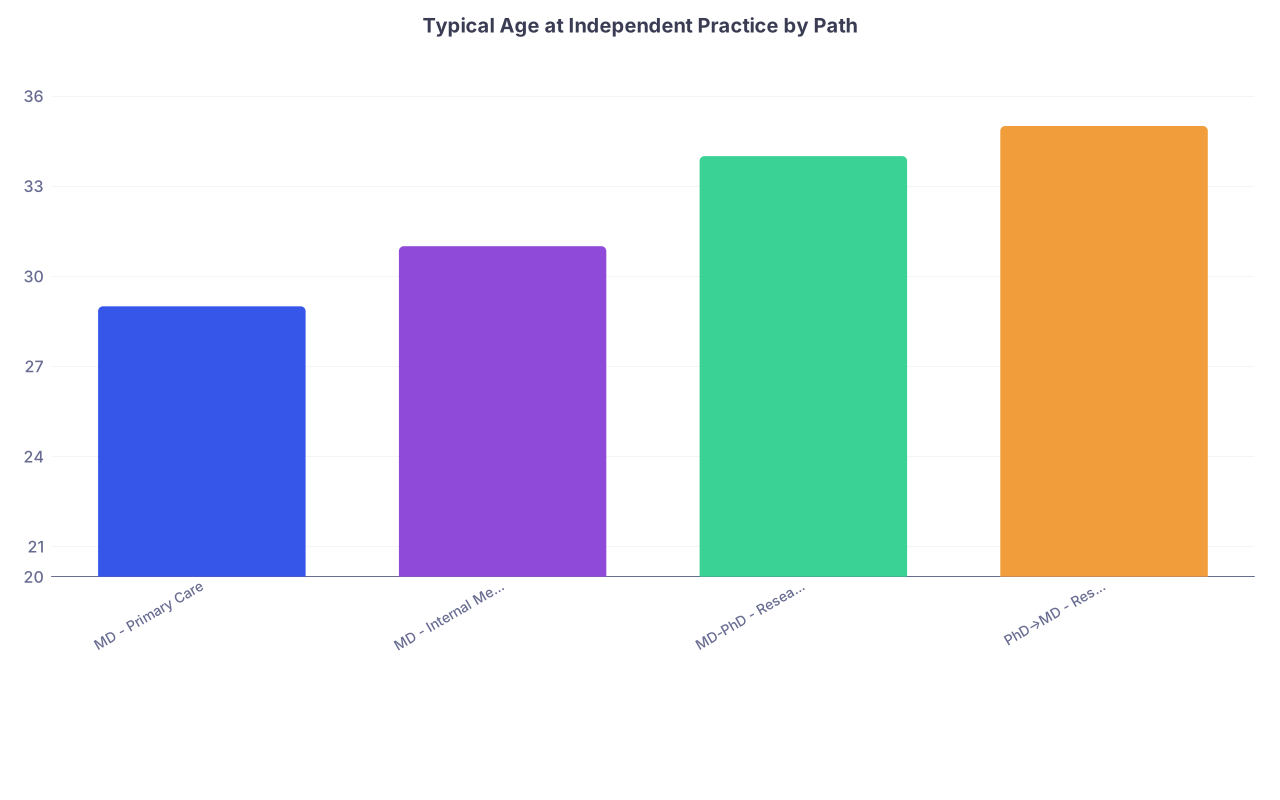
| Category | Value |
|---|---|
| MD - Primary Care | 29 |
| MD - Internal Med + Fellowship | 31 |
| MD-PhD - Research Heavy | 34 |
| PhD→MD - Research Heavy | 35 |
- Family Medicine / Pediatrics / Psychiatry: 3 years
- Age ~29 as an attending.
- Internal Medicine → subspecialty (e.g., Cardiology, GI): 3 + 3 years
- Age ~32.
- General Surgery: 5 years
- Age ~31; add 1–2 for complex fellowships (CT surgery, etc.).
- Neurosurgery: 7 years
- Age ~33 as a new attending.
Straight MD is the shortest calendar route to independent practice almost every time.
At this point you should choose MD alone if:
- You like research but do not need it to be the core of your career.
- You care about starting your attending life earlier.
- You want flexibility to adjust later (clinician‑educator, admin, QI).
Integrated MD–PhD: The “Scientist–Physician” Track
Here is the hard truth: MD–PhD is not “just a free MD.” It is a commitment to years of lower income and higher responsibility for research output. The time cost is real.
Most combined programs take 7–9 years pre‑residency. Typical MSTP: 8 years.
Pre‑Med and Application Phase
You cannot stumble into MD–PhD. By application time you must look like a scientist in the making.
At this point (college) you should:
- Have at least 2+ years of continuous research, ideally with:
- One poster or publication.
- A letter from a PI who describes you as an almost‑junior‑colleague.
- Apply directly to MD–PhD during your regular AMCAS cycle (not “add on later and hope”).
Integrated Timeline: Year‑by‑Year
Assume college → MD–PhD without gap years. Matriculate at 22.
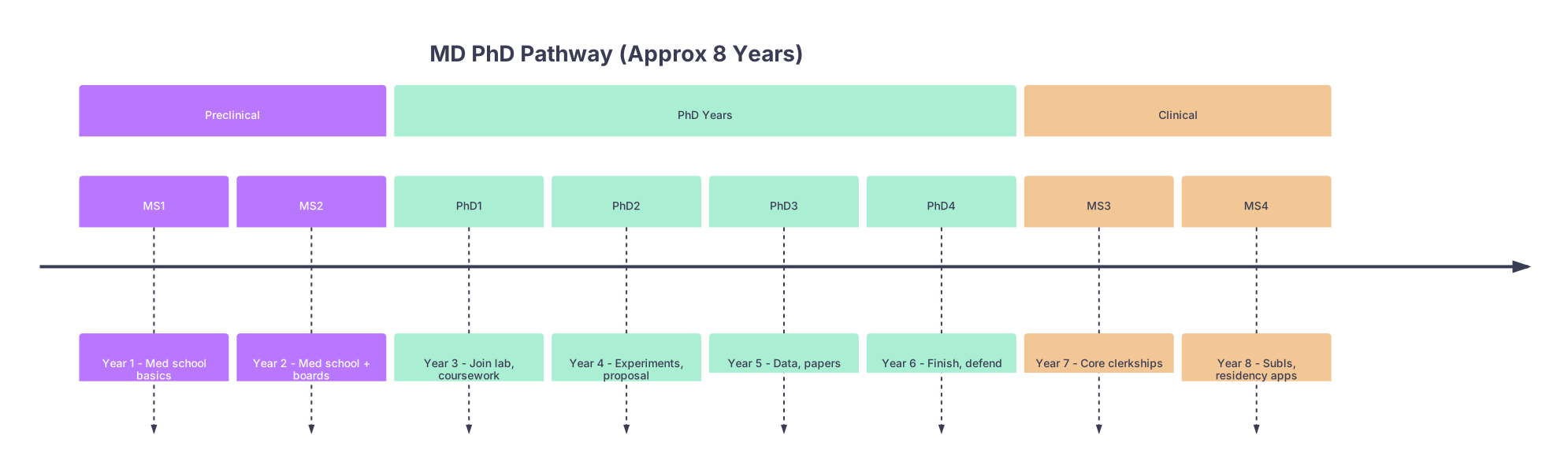
| Period | Event |
|---|---|
| Preclinical - MS1 | Year 1 - Med school basics |
| Preclinical - MS2 | Year 2 - Med school + boards |
| PhD Years - PhD1 | Year 3 - Join lab, coursework |
| PhD Years - PhD2 | Year 4 - Experiments, proposal |
| PhD Years - PhD3 | Year 5 - Data, papers |
| PhD Years - PhD4 | Year 6 - Finish, defend |
| Clinical - MS3 | Year 7 - Core clerkships |
| Clinical - MS4 | Year 8 - SubIs, residency apps |
Phase 1: Preclinical MD (Years 1–2)
Year 1 (Age 22–23)
You are:
- Doing the normal MS1 curriculum.
- Often taking part in a “physician–scientist seminar” or extra MD–PhD program meetings.
- Usually not in full‑blown thesis research yet, but you should be scoping out labs.
At this point you should:
- Identify 2–3 serious potential thesis mentors.
- Use summer after MS1 for a full‑time lab block. Not weekend drop‑ins.
Year 2 (Age 23–24)
- Finish preclinical curriculum.
- Step 1 (pass/fail, but you still want it over and done).
Then the big pivot.
Phase 2: PhD Years (Years 3–5/6)
Year 3 (Age 24–25)
- Full‑time PhD.
- Join a lab. Take remaining graduate coursework, pass qualifying exams, formalize dissertation proposal.
At this point you should:
- Lock in a project that can realistically become 2–3 first‑author papers or strong manuscripts, not 17 side projects that never finish.
- Protect your time. You are not an MD student who “helps” in lab. You are the engine.
Year 4–5 (Age 25–27)
- Core experimental years.
- Data collection, analysis, conference abstracts, manuscripts.
Year 6 (often) (Age 27–28)
- If your project cooperates: finish up, write, defend.
- If it does not: welcome to year 6 of the PhD. This is common.
At this point you should:
- Coordinate your PhD defense timing with when you need to re‑enter clerkships. Programs hate idle gaps; so will you.
Phase 3: Return to MD Clinical Training (Years 6/7–8/9)
Re‑entry is a shock. Your classmates moved on, guidelines changed, you have not written a progress note in 3 years.
MS3 (Age 27–29)
- Full clerkship year, same as straight MDs, but later in life.
- You need to re‑prove your clinical chops.
MS4 (Age 28–30)
- Sub‑internships, residency applications, interviews.
- Often applying to research‑friendly or physician–scientist tracks in specialties like:
- Internal medicine (then research‑heavy cards/onc/ID).
- Neurology.
- Radiation oncology.
- Occasionally surgery, but the time burden stacks heavily.
You graduate around age 29–30, frequently with 1–3 first‑author papers and solid research credibility.
Residency and Beyond After MD–PhD
Now stack on residency.
Example (start residency at 29):
- Internal Medicine (3) + Hem/Onc fellowship (3): Attend at ~35.
- Neurology (4) + neuro fellowship (1–2): Attend at 34–35.
- Pediatrics (3) + NICU fellowship (3): Attend at 35.
The tradeoff:
- You are older when you hit attending salary.
- You are better positioned for NIH K awards, R01 tracks, and substantial protected time earlier in your career.
At this point you should choose MD–PhD if:
- You want running a lab to be central, not optional.
- You are comfortable adding 3–5 extra years compared to MD only.
- You are willing to accept delayed financial independence in exchange for high‑level research training integrated with medicine.
PhD → MD: The Sequential “Second Degree” Route
This is the path many people underestimate. They tell themselves, “I will finish a PhD, then decide if I want the MD too.” That “then” can quietly cost you a decade.
The Typical Pattern
- College (4 years).
- Straight into a PhD (5–7 years).
- Then medical school (4 years).
- Then residency/fellowship (3–7+ years).
Do the math: 12–15+ years after undergrad before you are a fully trained attending. You will be mid‑30s to early‑40s.
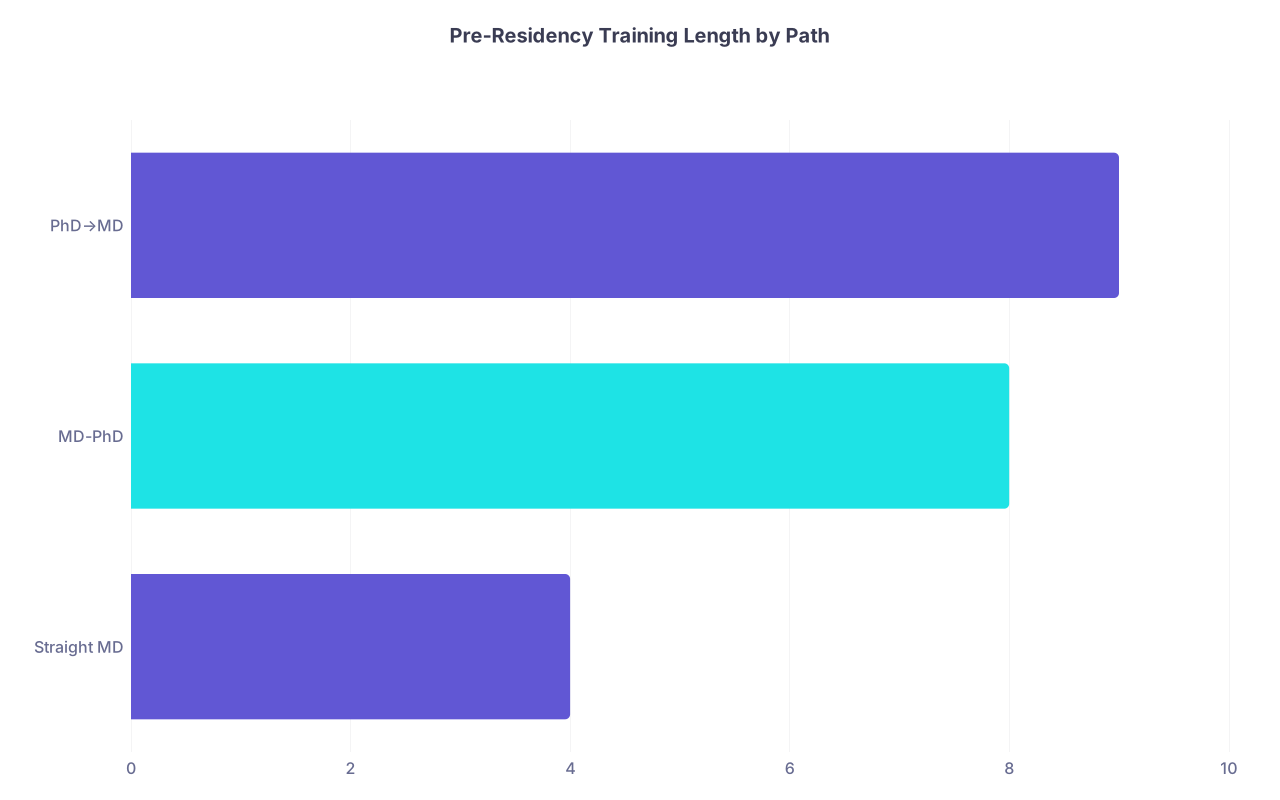
| Category | Value |
|---|---|
| Straight MD | 4 |
| MD-PhD | 8 |
| PhD→MD | 9 |
Phase 1: PhD First (Years 1–5/7 Post‑College)
Assume you graduate college at 22 and start a PhD.
PhD Year 1–2 (Age 22–24)
You are:
- Taking graduate coursework.
- Rotating in labs.
- Choosing a thesis advisor.
At this point you should:
- Be honest: do you want to be a career scientist? If yes, MD may be optional. If you already feel the pull toward patients now, do not ignore it for 6 more years.
PhD Year 3–5+ (Age 24–27/29)
- Focused full‑time research.
- Publications, conference presentations, dissertation writing.
Most science PhDs in the U.S. run 5–6 years, easily 7 in some fields or if a project collapses.
You defend around age 27–29.
The Decision to Add MD
Two common scenarios:
- You discover during your PhD that you are drawn to translational work, patient‑adjacent questions, clinical trial design.
- Your academic job prospects look bleak (and they often are), and clinical training feels like a safer or more appealing path.
Now you face:
- MCAT prep (again, or for the first time).
- Med school applications and interviews.
- 4 years of medical school.
At this point you should:
- Ask bluntly: Do I want to primarily practice medicine, or am I trying to “fix” a rough PhD job market? The MD is not a patch. It is another full profession.
Phase 2: Medical School After PhD (4 Years)
Assume matriculation at 29–30.
MS1–MS2 (Age 29–31)
You have an advantage in:
- Basic science content.
- Research literacy.
You have a disadvantage in:
- Being older than many peers and possibly more financially constrained.
- Re‑learning structured studying and high‑stakes exams after years of self‑directed work.
At this point you should:
- Decide early whether you want to leverage your PhD heavily (e.g., physician–scientist tracks) or aim for a more clinical focus where the PhD is a bonus.
MS3–MS4 (Age 31–33)
- Same as any MD: clerkships, electives, residency applications.
- If your PhD is tightly aligned with your chosen specialty (e.g., immunology PhD → rheumatology or heme‑onc), it can be a powerful differentiator.
Phase 3: Residency and Fellowship
Start residency at 33.
Examples:
- Internal Medicine (3) + fellowship (3): Attend at 39.
- Psychiatry (4): Attend at 37.
- Family Med (3): Attend at 36.
Age at first attending job: mid‑ to late‑30s, sometimes 40+, depending on detours.
At this point you should go PhD→MD if:
- You already have (or are very close to) a PhD and only then discover a sustained desire for clinical work.
- You are okay not optimizing for earliest attending age.
- You want to anchor yourself as a deep expert in one scientific domain who later adds a clinical dimension.
What you should not do is choose PhD→MD from scratch if you already know now that you want both. That is almost always worse on time, money, and integration than a good MD–PhD program.
Side‑By‑Side: What Your Life Looks Like At Each Age
Here is what I have seen play out again and again.
Assume no gap years before first degree.
| Age | Straight MD Path | MD–PhD Path | PhD→MD Path |
|---|---|---|---|
| 24 | MS2 | MS2 | PhD Year 2 |
| 26 | MS4 / Start Residency | PhD Year 1–2 | PhD Year 4 |
| 29 | Early Attending (FM/Peds) | PhD Year 3–4 or MS3 | PhD Graduate / Med School Applicant |
| 32 | Attending w/ Fellowship | New Attending (if short path) | MS3–MS4 |
| 36 | Mid‑career attending | Mid‑career faculty | New Attending |
And visually, pre‑residency time:
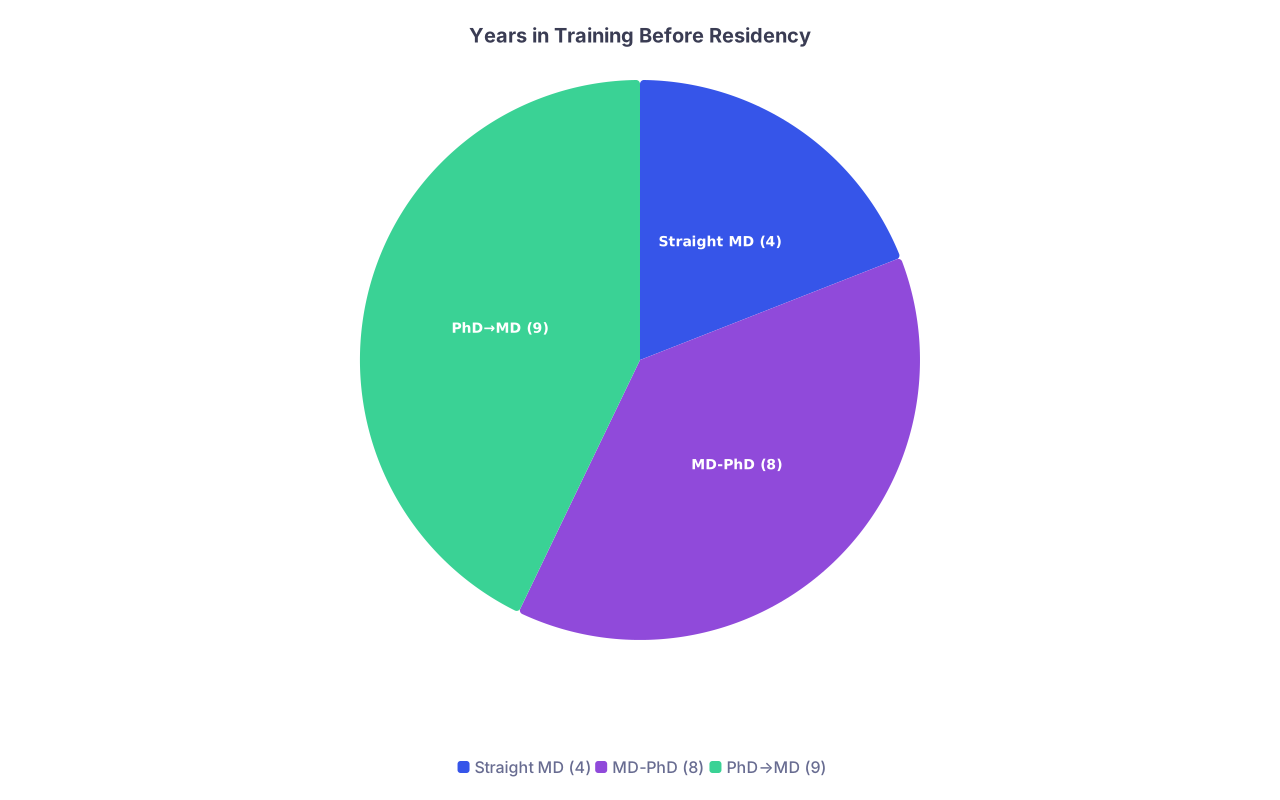
| Category | Value |
|---|---|
| Straight MD (4) | 4 |
| MD-PhD (8) | 8 |
| PhD→MD (9) | 9 |
You do not “lose” these years. You gain skills, credentials, experiences. But your 30s only happen once. You should at least know how you are spending them.
How To Decide, Chronologically, What To Do Next
You cannot answer “MD vs MD–PhD vs PhD→MD” in the abstract. You answer it at specific decision points. Here is how those checkpoints usually fall.
In College (or Early Post‑Bacc): MD vs MD–PhD
At this point you should:
- Look at your research track record:
- No sustained lab work? MD–PhD is a stretch right now.
- 1+ year, strong letter, maybe a poster? MD–PhD is on the table.
- Ask yourself bluntly:
- Do I want to spend 3–5 extra years before residency to become a serious scientist?
- Will I be frustrated as a primarily clinical doctor with research as a side hobby?
If yes to both, aim straight for MD–PhD now. Do not bank on doing a PhD later “just in case.”
During MD (Years 1–2): Late MD–PhD Switch?
Students ask about this all the time.
- Switching from straight MD into MD–PhD during MS1–2:
- Possible at some schools.
- Usually means applying internally and adding extra PhD years without the full MSTP financial structure.
- Timeline from this point: still ~3–5 extra years vs MD alone.
At this point you should only consider this if:
- You discovered a sustained love for research, not just one fun summer.
- You have a concrete research area and a willing mentor, not a vague idea.
During PhD: Considering MD Afterward
If you are already mid‑PhD, the time calculus changes.
At this point you should:
- Finish the PhD you started. Walking away empty‑handed wastes too much sunk time.
- Shadow clinicians in fields related to your science.
- Talk with actual MD–PhD and PhD→MD faculty about how they split their week.
If, after sustained exposure, you still want to treat patients, then yes, PhD→MD is a rational second step. But you must go in knowing you are committing to being a late‑30s attending.
The Hidden Variable: How Much Research You Actually Want
All three paths can lead to research.
- I have seen straight MDs with one year of research fellowship become productive clinician‑investigators.
- I have also seen MD–PhDs who never submit another grant after residency because they decide they prefer full‑time clinical work.
The difference is:
- MD keeps the time cost lean and flexible. You can always add research training later.
- MD–PhD front‑loads research time and identity. Best if you already know that is your core.
- PhD→MD is what happens when you discover medicine later or want maximal depth in a single scientific area before layering on clinical skills.
So:
- If you are 19 and already living in the lab, devouring papers, arguing about methods: MD–PhD is probably your natural habitat.
- If you are 21 and love patient stories more than pipettes: straight MD.
- If you are 26, three years into a PhD, and wake up thinking about patients and diseases rather than Western blots: finish the PhD, then consider MD.
Your Next Action Today
Do not try to “decide your life” in one sitting. Instead, take one concrete, time‑anchored step.
Today, block off 30 minutes and draw three horizontal lines on a page: “MD”, “MD–PhD”, and “PhD→MD.” Mark your current age on each, then sketch out where you would be at 25, 30, 35, and 40 on each line—student, resident, attending, PI, whatever is realistic for that path.
When you are done, look at which timeline makes you least angry and most energized. That is the path you should investigate more deeply, starting this week.