
The worst career mistake new attendings make is deciding about a PhD based on vibes instead of a five‑year plan.
You’re not a med student fantasizing anymore. You’re an attending. Your time costs real money, your decisions have inertia, and “maybe I’ll do a PhD later” is not a plan. It’s procrastination disguised as ambition.
Here’s how to structure the first five years after residency/fellowship so you can answer one question with brutal clarity: “Do I add a PhD, or do I double down as an MD (or MD + short‑form training)?”
I’ll walk you year by year. At each point: what you should be doing, what data you should collect on yourself, and when it’s actually time to commit—or walk away—from the PhD idea.
Year 0–1: Landing as a New Attending – Set the Baseline
Primary job in Year 1: learn what your real life actually looks like. Not the fantasy schedule you told yourself during fellowship.
At this point you should:
- Lock in your job structure (clinical vs academic vs hybrid)
- Get brutally accurate about your time and energy
- Start testing whether you actually like the work that a PhD would amplify (research, methods, grants)—not just the identity
Month 0–3: Contract, Role, and Reality Check
You’ve just started or are about to start.
At this point you should:
Clarify your official FTE split
Get it in writing, not vibes:- Clinical % (e.g., 0.7 FTE)
- Protected time % (e.g., 0.3 research/education/admin)
- Call responsibilities and weekends
- Any “expectation” for research or teaching
Ask your division chief one very direct question
“In 5 years, what would someone here need to have done to be considered a serious candidate for promotion on an academic track without a PhD?”If the answer is some version of “uh… almost no one does that here,” file that. You’re in a PhD‑heavy ecosystem.
Start a time log for four representative weeks
Nothing fancy. But real. Category buckets:- Direct clinical care
- Documentation/admin
- Teaching
- Research tasks (even tiny ones)
- Meetings
- Personal/family
You’re collecting baseline data: how much slack do you truly have?
Month 3–6: Mini‑Experiments in Academic Identity
Do not sign up for a PhD yet. You’re still in the “dating” phase with academic life.
At this point you should:
Get on 1–2 low‑risk academic projects
- A retrospective chart review
- A QI project with publishable potential
- A co‑authorship on a study your mentor already has rolling
Attend core academic meetings
- Department research conference
- Grand rounds
- Any research‑in‑progress meetings
During this phase, ask yourself:
- Do I like generating questions and methods?
- Or do I only enjoy the “results and talk about it” part?
If you hate crafting methods and reading stats sections, a PhD is likely the wrong door. You’d be signing up to specialize in the parts you already avoid.
Month 6–12: First Reality Check – What Actually Energizes You?
By the end of Year 1, you should have some data on you, not just the environment.
At this point you should:
- Review your calendar and time logs
- List specific tasks that:
- You’d gladly do more of unpaid
- You dread even when they “look good” on the CV
Examples I’ve seen:
- One new hospitalist realized she loved teaching residents on rounds and hated every research meeting. She thought she “needed a PhD” for credibility; what she actually needed was a clinician‑educator niche and maybe a masters in education later.
- Another ICU attending found he was rewriting everyone’s aims pages and arguing about methodology. He didn’t need a PhD for fun; he was already acting like someone who’d thrive in one.
If research‑method work is already creeping into your evenings because you want it to, that’s one data point toward the PhD path.
Year 2: Define Your Career Track Before You Add Degrees
Year 2 is strategic. This is when you decide: “What kind of attending am I becoming?” Not in abstract. On paper.
At this point you should:
- Choose a preliminary lane
- Map what success in that lane looks like in 5 years
- Compare: PhD vs alternative training options
Quarter 1 (Months 13–15): Choose a Provisional Career Lane
You don’t need a final answer yet, but you need a working hypothesis.
Pick one primary lane:
- Clinician‑Scholar / Physician‑Scientist – you want grants, hypothesis‑driven work, and to lead research programs
- Clinician‑Educator – you want to teach, build curricula, maybe do education research
- Clinical Operations / QI Leader – you want to fix systems, lead service lines, maybe move toward administration
- Pure Clinician (plus side interests) – you want high clinical volume, income, and maybe small academic contributions
| Lane | PhD Impact | Better Alternatives |
|---|---|---|
| Physician-Scientist | Often very helpful | MPH, MS Clinical Research (if limited) |
| Clinician-Educator | Usually low | MEd, MHPE, teaching certificate |
| QI / Operations Leader | Low to moderate | MPH, MHA, Lean/Six Sigma certificates |
| Pure Clinician | Minimal | CME, niche procedural skills |
Be honest. If your lane is anything but physician‑scientist, the bar for “PhD is worth it” gets very high.
Quarter 2 (Months 16–18): Map the Five‑Year Target
For your chosen lane, sketch a concrete Year‑5 snapshot. Not “be more academic.” Specific.
Examples:
Physician‑Scientist:
- 1–2 first‑ or last‑author papers per year
- At least one small grant (foundation/departmental) and 1 major grant submission (e.g., K‑level, equivalent)
- Recognized locally as “the [topic] person”
Clinician‑Educator:
- One named educational role (clerkship director, site director, etc.)
- Completed a formal teaching/education program
- 1–2 education‑related scholarly products per year
Then ask: Which of these actually require a PhD at my institution and in my specialty?
Go talk to:
- A mid‑career faculty member 5–10 years ahead of you with a PhD
- A similar person without a PhD but successful
Ask both of them the same pointed questions:
- “If you were me, would you add a PhD now?”
- “What doors did a PhD actually open—and which would have opened anyway?”
You’ll hear very different answers in, say, oncology at a top‑5 research hospital vs community pediatrics. That contrast is the point.
Year 3: Decision Year – Commit to a Path, Not Just a Degree
By Year 3, you should stop lingering in indecision. Waffling is what kills momentum, not the wrong certification.
At this point you should be able to answer: “Am I building a research‑heavy career that demands deeper methods training—and is a PhD the best version of that?”
Quarter 1 (Months 25–27): Evaluate Objective Signals
You’re looking for evidence that the system thinks you’re on a research trajectory, not just that you like the idea.
Signals that support considering a PhD:
- You’ve already:
- Co‑authored at least 2–3 papers
- Played a real role (not just data grunt) in at least one project
- Presented at a regional/national meeting
- People invite you, specifically, for:
- Study design questions
- Statistics/epidemiology input
- Methodological collaboration
Red flags that a PhD is mostly fantasy:
- You can barely get protected time honored now
- You’ve done zero original research since training
- Your division has no track record of supporting PhD‑seeking attendings
Quarter 2 (Months 28–30): Compare PhD vs Short‑Form Options
Do this like a grown‑up. With numbers.
At this point you should:
Sketch a cost‑benefit comparison:
- Direct costs (tuition, fees)
- Opportunity cost (lost clinical income)
- Time (3–6 years depending on program and structure)
- Impact on family, geography, visas if relevant
Identify alternative training that might give 80% of the benefit:
- MS in Clinical Research / Epidemiology
- MPH with methods concentration
- Biostatistics or data science masters
- Education master’s for clinician‑educators
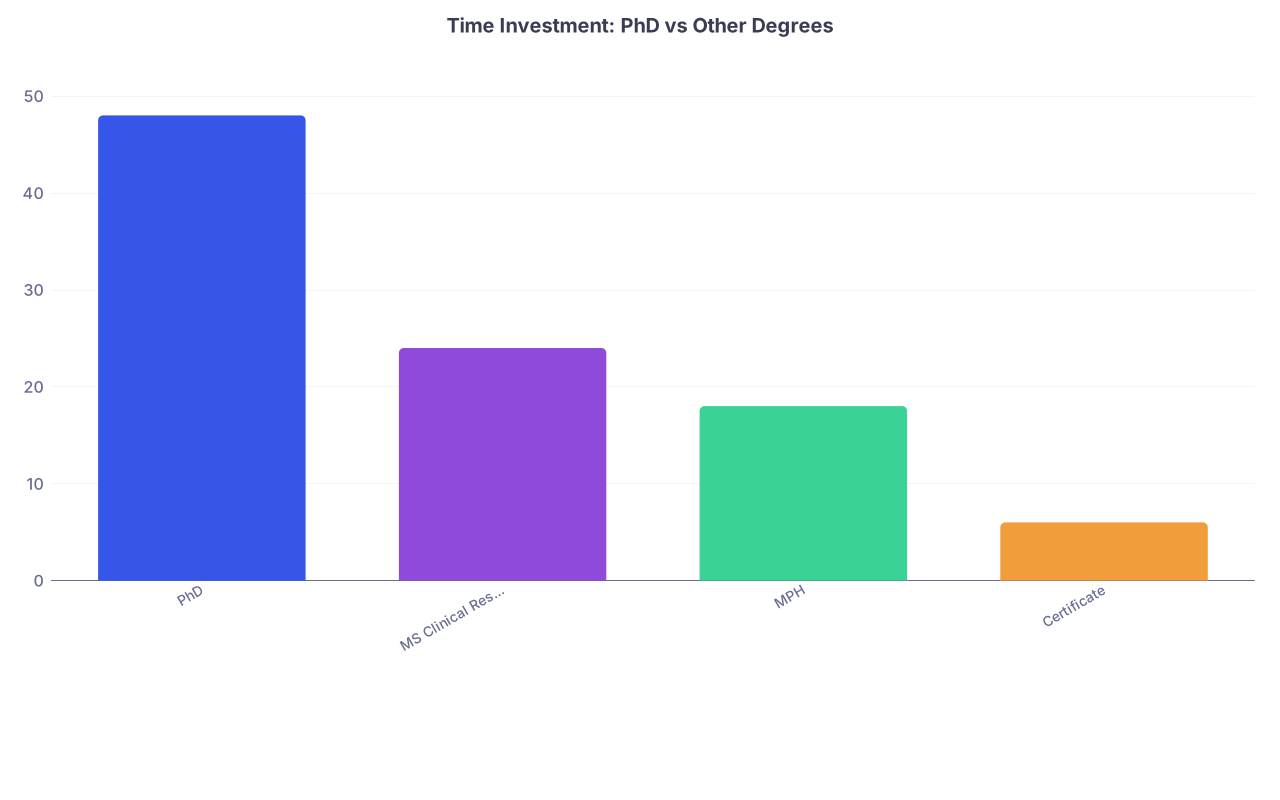
| Category | Value |
|---|---|
| PhD | 48 |
| MS Clinical Research | 24 |
| MPH | 18 |
| Certificate | 6 |
(Values above are rough months of part‑time study. Programs vary, obviously.)
If you can hit your Year‑5 research targets with an MS and serious mentorship, a PhD is probably overkill.
Quarter 3–4 (Months 31–36): Make the Call and Align Your Life
By the end of Year 3 you should decide:
- Path A: “Yes, I’m going to pursue a PhD, starting in Years 4–5”
- Path B: “No PhD; I’ll pursue alternative training and a focused MD track”
No “maybe in a few years unless something changes.” That’s how you end up 10 years in with nothing aligned.
Years 3–4: If You’re Leaning PhD – Prep or Pivot Intentionally
Let’s split paths now.
If You Decide: “Yes, PhD Is Worth It for Me”
Your job in Years 3–4 is to become a competitive, realistic PhD candidate who knows exactly what they want from the degree.
At this point you should:
Define your PhD question area, not just your specialty Bad: “Critical care.” Better: “Long‑term outcomes after ICU admission, focusing on health services and resource utilization.” The PhD is about methods and questions, not just organ systems.
Identify 2–3 potential PhD programs that fit your life
- Local university (part‑time or integrated)
- Institutional program for clinician‑scientists
- Structured MD‑PhD style pathway for attendings (less common, but some places have these)
Have three hard conversations:
- With your division chief – about FTE changes, salary, expectations
- With your mentor – about your research plan, feasibility
- With your family/partner – about time, money, stress
If any of those three say “this seems unrealistic,” don’t ignore it. Fix the plan or reconsider.
Year 4: Concrete PhD Preparation Steps
Break this year down.
Quarter 1–2 (Months 37–42) – Application Prep At this point you should:
- Draft a clear research statement (1–2 pages)
- Update your CV with:
- All publications and abstracts
- Teaching roles
- Any preliminary grants or awards
- Secure 2–3 letters from:
- Your main research mentor
- Division chief or department chair
- A collaborator who can speak to your research potential
Quarter 3–4 (Months 43–48) – Logistics and Negotiation You should be:
- Finalizing:
- Program choice
- Start date
- FTE breakdown during PhD years
- Negotiating:
- How protected time is funded
- What happens to your clinical responsibilities
- Whether your promotion clock is paused or adjusted
I’ve watched people skip this step and get annihilated. They start a PhD, but clinical creep eats their time, nobody covers their call, and suddenly they’re half‑committed everywhere and exhausted.
If your institution won’t structurally support the PhD (funding, protected time, realistic call coverage), that’s a signal, not an obstacle to “power through.”
If You Decide: “No, a PhD Isn’t Worth It for Me”
Good. You made a decision instead of drifting.
Now your job is to build a five‑year plan that makes you excellent as an MD without a PhD, not to feel vaguely “less than.”
At this point you should:
Pick one focused advanced training asset that actually matches your lane:
- Clinician‑Scientist‑lite: MS in Clinical Research, Biostats, Data Science
- Clinician‑Educator: MEd, MHPE, or strong teaching certificate
- QI/Leadership: MPH, MHA, or formal QI/fellowship programs
Lock in a concrete start window (Year 4 or 5) Not “someday.” Put it on a timeline.
Build output, not degrees For the next 2–3 years, focus on:
- Completing projects to publication
- Taking on 1–2 defined roles (course director, QI lead, etc.)
- Building a niche reputation in one focused area
You should be aiming to arrive at Year 5 with a track record that makes people say: “Oh yeah, that’s the person who does X,” not “That’s the person who’s always talking about maybe doing a PhD.”
Year 5: Reassessment, Not Regret
By Year 5, one of three things should be true:
- You’re in a PhD program with clear milestones
- You’ve completed or are deep into an alternative masters/certificate and have real career momentum
- You’ve decided that you’re primarily a clinician with selective academic or operational contributions—and you’re actually content with that
At this point you should:
- Review your 5‑year snapshot from Year 2
- Compare against reality:
- Publications completed
- Grants submitted/awarded
- Roles held
- Time distribution (clinical vs academic)
- Burnout level and home life
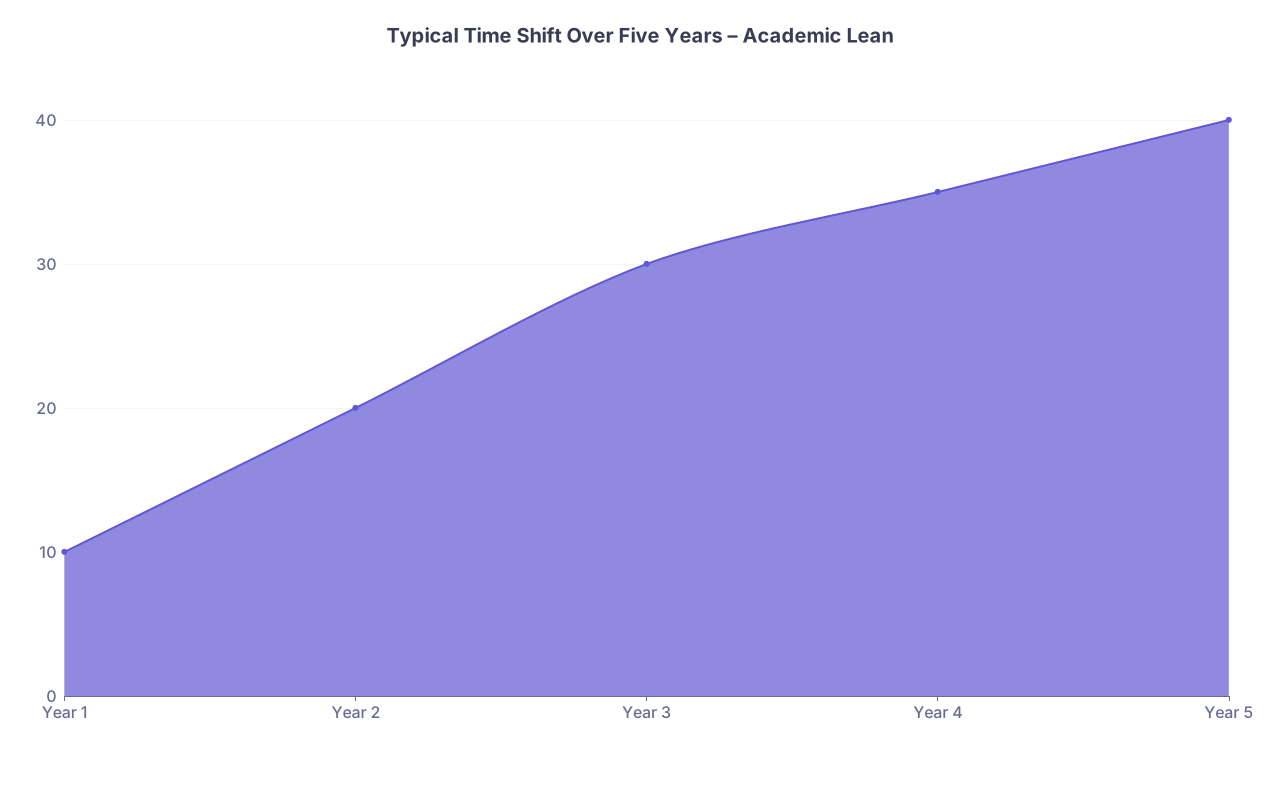
| Category | Value |
|---|---|
| Year 1 | 10 |
| Year 2 | 20 |
| Year 3 | 30 |
| Year 4 | 35 |
| Year 5 | 40 |
(Values represent % of total work time in academic activities for someone intentionally shifting toward research/academics.)
If you chose not to pursue a PhD and your output and satisfaction are solid, don’t reopen the question just because a colleague started one. That’s insecurity, not strategy.
If you did start a PhD and you’re miserable, overextended, and no longer believe in the path, you’re allowed to reassess. Better to adjust in Year 5 than in Year 10 with sunk‑cost misery.
Day‑to‑Day and Week‑to‑Week Habits that Actually Matter
PhD or not, your five‑year trajectory is built in the boring increments.
At this point (any year) you should:
Weekly:
Block 2–4 hours of protected “deep work” time for academic work
- No inbox
- No pager if possible
- One task: write, analyze, or plan
Track:
- One “forward motion” on a project (figure, paragraph, data check)
- One relationship touch (mentor, collaborator email)
Monthly:
- Review:
- Active projects list (kill or advance stalled ones)
- Alignment with your chosen lane (did this month look like a future you’d want more of?)
You’re not “preparing for a PhD” or “being academic” in the abstract. You’re building evidence: do you thrive on this work enough to justify 3–6 more years of it in concentrated form?
The Core Truths Most People Don’t Say Out Loud
Let me be blunt to close this.
A PhD is not a prestige ornament.
It’s a commitment to a specific type of work: methods‑heavy, question‑driven, often slower gratification. If that’s not what lights you up now, a degree won’t fix it.Five intentional years as an MD can beat ten drifting years as an MD‑PhD.
Clear lane, focused training, consistent output. That’s what builds a career. Letters after your name are secondary.Indecision is more damaging than either choice.
Spending Years 1–5 in “maybe I’ll do a PhD later” mode is how you end up burned out, overcommitted, and underdeveloped in any direction.
If you use this five‑year frame—baseline in Year 1, lane choice in Year 2, decision in Year 3, execution in Years 4–5—you’ll have something most new attendings never get: a career that’s built, not stumbled into. Whether you add a PhD or not.