
The way most students drift through a “gap year” is a waste of time.
You’re not drifting. You’re using that year to make a hard call: PhD, MD–PhD, or strictly MD.
Below is a month‑by‑month roadmap for a 12‑month gap year focused on deciding and vetting PhD vs MD–PhD options before you apply. I’ll assume:
- You’ve finished (or nearly finished) undergrad.
- You’re at least mildly research‑curious, not just “I liked my lab class.”
- You’re not applying this cycle; you’re teeing up the next one.
Adjust the calendar start to whenever your gap year begins, but keep the order.
Month 0: Pre–Gap Year Reality Check (The Summer Before You “Start”)
At this point you should stop hand‑waving and force a first decision draft.
Your goals in this pre‑month:
- Audit your credentials and trajectory.
- Clarify what you think you want: research‑heavy life (PhD or MD–PhD) vs clinical‑dominant life (MD).
- Map the gap year structure on paper.
Do this in one focused weekend.
Checklist:
Pull up your:
- GPA (overall + science)
- MCAT score (or realistic practice average if you haven’t taken it yet)
- Research history (labs, length, productivity)
- Clinical exposure (shadowing, volunteering, scribing, etc.)
Write a blunt one‑page self‑summary:
- “I’ve spent ~X years in research, ~Y hours in clinical.”
- “I have / do not have publications or posters.”
- “I can / cannot see myself in clinic 2–4 days a week in 15 years.”
- “I enjoy / tolerate / hate writing and reading long papers.”
If this feels painful, good. Clarity usually does.
Early filter questions (write actual answers):
- Would I feel intellectually bored if I stopped doing serious research after med school?
- Do I care more about:
- Discovering mechanisms and building new knowledge, or
- Applying known tools to fix specific patients?
- Am I okay earning a PhD stipend for 4–7 years while my MD peers earn attending salaries?
If you dodge these questions now, you’ll just panic later in the application cycle.
Months 1–2: Deep Exposure and Baseline Information (No Decisions Yet)
At this point you should go wide: collect data and stories, not make final choices.
Core tasks:
- Shadow three types of people
- A pure clinician MD (no research, community setting if possible).
- A physician–scientist (MD–PhD or MD with heavy research).
- A PhD principal investigator (PI) in a biomedical or related field.
Aim for at least one full day with each, not a 2‑hour “tour.”
- Read up on actual training paths and timelines
| Pathway | Typical Length | Core Components |
|---|---|---|
| PhD only | 4–7 years | Full‑time research, coursework, thesis |
| MD only | 4 + 3–7 years | Medical school + residency/fellowship |
| MD–PhD | 7–9+ years | Integrated MD + PhD + residency/fellowship |
- Have 3–5 brutally honest conversations
Find:
- One MD–PhD student or grad (preferably in years 5–8 of their training).
- One PhD student past qualifying exams.
- One faculty member who hires MD–PhDs and PhDs.
Ask them:
- “What do people not understand about this path when they apply?”
- “Who do you wish had not chosen this path?”
- “If I want to be a serious scientist, do you think MD–PhD is an efficient path for me personally?”
Deliverable by end of Month 2
A one‑page doc with three columns: PhD, MD–PhD, MD. Under each, list:
- Top 3 pros for you personally.
- Top 3 cons for you personally.
- Questions you still cannot answer.
You’re not ready to choose, but you should be done being “vaguely curious.”
Months 3–4: Structured Exploration and Real‑World Vetting
Now you start stress‑testing your interest. Less dreaming, more doing.
If you’re leaning toward PhD or MD–PhD
At this point you should:
- Be in a serious research position (full‑time RA, NIH IRTA, post‑bac program, or long‑term lab job).
- Start taking ownership of a defined project, not just running gels or surveys for someone else.
Concrete steps:
Ask your PI for:
- A project you can take from start to at least a solid figure or data set.
- Regular 1:1 meetings (even 30 minutes every other week).
Track your weekly breakdown:
- Time reading papers.
- Time doing experiments / coding / data analysis.
- Time writing or assembling data.
If you hate 10+ hours/week of deep thinking and troubleshooting, you have your answer. That’s what the next decade will look like in some form.
If you’re still neutral or leaning MD only
You do not get a pass. You need high‑quality clinical immersion:
- Scribe or MA work in a high‑volume clinic or ED.
- Regular shadowing with a doc who has:
- 20–30 patient encounters in a day.
- Real burnout or satisfaction you can see, not a curated Instagram‑version of medicine.
Ask yourself after a few intense days:
“Can I see myself doing a version of this for 20+ years without resenting it?”
End of Month 4 checkpoint
You should be able to answer, without rambling:
- “Here’s what my actual day looks like in research.”
- “Here’s what my actual day looks like in patient care.”
- “Here’s which one leaves me more energized most weeks.”
If you still say “I don’t really know,” it’s not because it’s unknowable—it’s because you’re not exposed enough. Fix that in Months 5–6.
Visualizing How Your Time Shifts Over Training
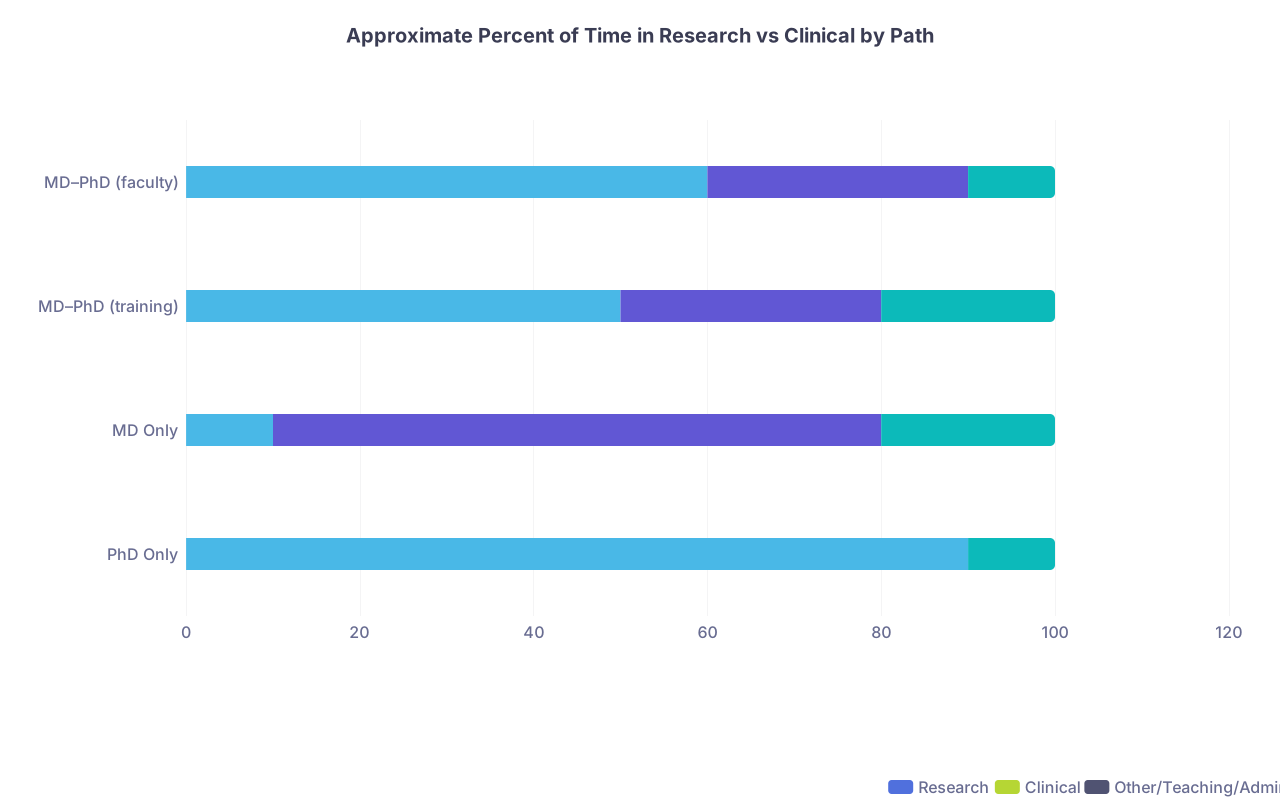
| Category | Research | Clinical | Other/Teaching/Admin |
|---|---|---|---|
| PhD Only | 90 | 0 | 10 |
| MD Only | 10 | 70 | 20 |
| MD–PhD (training) | 50 | 30 | 20 |
| MD–PhD (faculty) | 60 | 30 | 10 |
Look at that and ask: “Which bar do I actually want to live inside?”
Months 5–6: Commitment Draft and Target Profiles
By now, you should stop pretending every door is equally open.
At this point you should:
- Draft a provisional path choice:
- “Top choice: MD–PhD aiming for physician–scientist roles in X field.”
- “Top choice: PhD in Y field, then postdoc and academic or industry track.”
- “Top choice: MD only, maintain research interest but not a dual degree.”
It’s not binding. But you’re no longer “undecided.”
Build your “future self” scenario
Write 3 short vignettes, 8–10 sentences each:
- You at age 40 as a PhD PI.
- You at age 40 as an MD–PhD physician–scientist.
- You at age 40 as a clinically dominant MD with occasional research/QI work.
Include:
- A typical Tuesday.
- What annoys you.
- What satisfies you.
- What people email or page you about.
Then circle the one that feels the least fake and the least miserable.
Reality check with competitiveness
Use your actual numbers now.
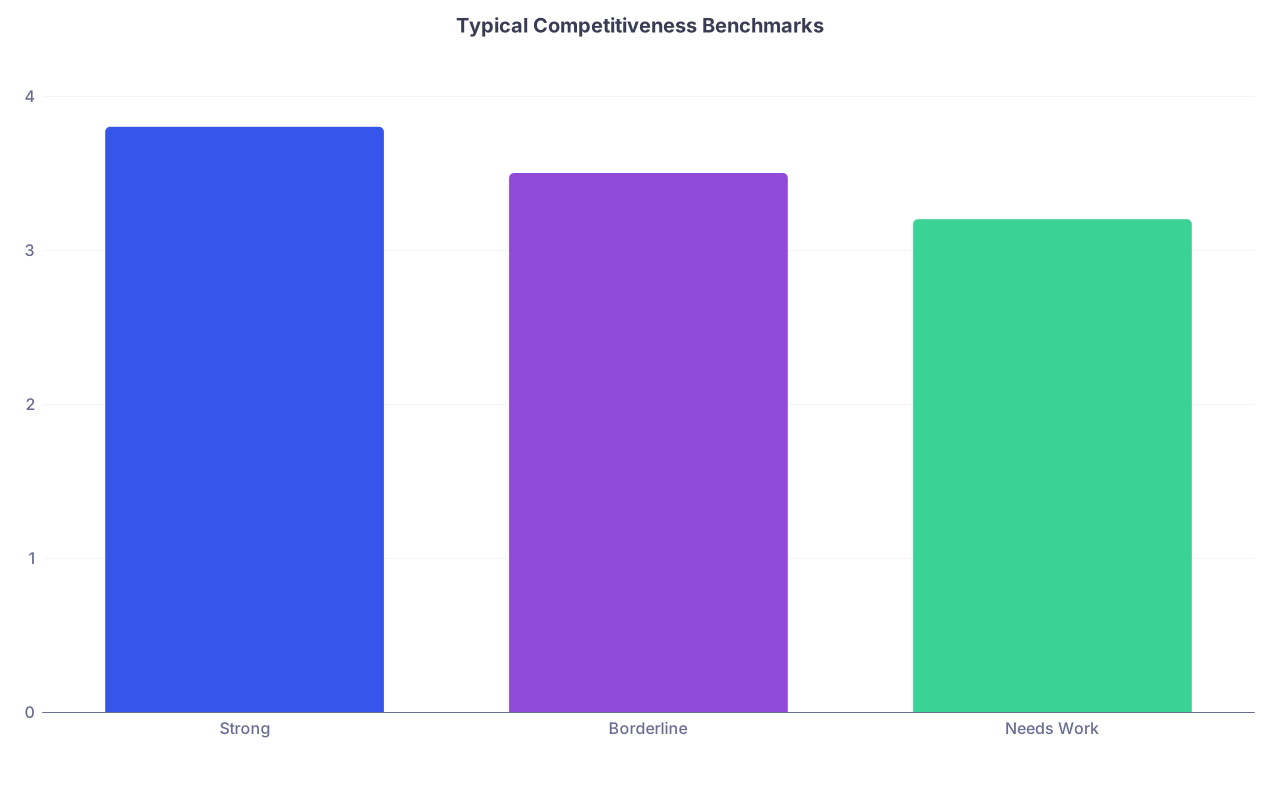
| Category | Value |
|---|---|
| Strong | 3.8 |
| Borderline | 3.5 |
| Needs Work | 3.2 |
Pretend those bars are GPAs for MD–PhD/PhD admissions. If you’re sitting at a 3.3 with uneven research and no publications, top‑tier MSTPs may be fantasy. You might still get in somewhere, but “somewhere” comes with consequences—funding, mentorship, job prospects.
By end of Month 6 you should have:
- Provisional choice: PhD vs MD–PhD vs MD.
- A realistic competitiveness snapshot:
- GPA
- MCAT (or date scheduled + practice range)
- Research output (abstracts, posters, paper status)
- Letters of recommendation prospects (names, not vague “a PI”)
Months 7–8: Program Vetting and Informational Interviews
Now we shift from “Who am I?” to “Where do I fit?”
At this point you should start acting like an applicant, even if you haven’t opened AMCAS/ERAS/PhD portals yet.
Build a focused school / program list
For each path, sketch a draft list:
PhD list: 6–10 programs where:
- At least 3 PIs’ work makes you excited enough to read a whole paper.
- Funding is stable (not eternal soft‑money roulette).
- Placement of grads over the last 5–10 years looks solid.
MD–PhD list: 8–15 programs where:
- There’s a real track record of graduates getting K awards, R01s, or solid physician–scientist roles.
- You’re realistically competitive based on school‑published stats, not just wishful thinking.
MD list (if still in play): Mix of reach/target/safety, but with known support for research (scholarly concentrations, funded research year, strong mentors).
Use a structured vetting approach
| Criterion | PhD Focus | MD–PhD Focus |
|---|---|---|
| Funding stability | High | High |
| Mentor track record | Critical | Critical |
| Clinical exposure | Low | High |
| Time to degree | Important | Very important |
| Alumni outcomes | Critical | Critical |
Start informational interviews
You’re not “bothering” people. You’re doing due diligence.
- Email:
- 2–3 current MD–PhD students per target school.
- 2–3 PhD students or postdocs per potential lab.
- Ask:
- “What’s the biggest gap between how the program markets itself and how it actually feels?”
- “How responsive is your PI / program when things go wrong?”
- “What do people here quietly regret?”
Take actual notes. Patterns matter.
Visual: Year‑Long Decision and Prep Flow
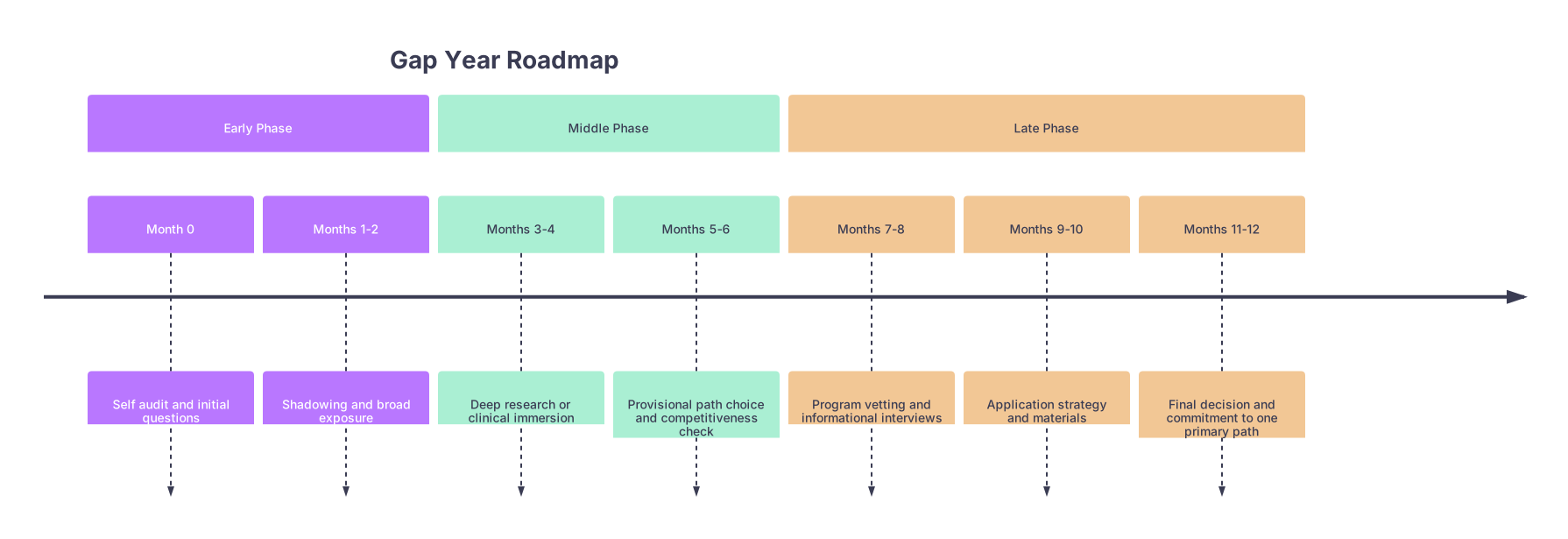
| Period | Event |
|---|---|
| Early Phase - Month 0 | Self audit and initial questions |
| Early Phase - Months 1-2 | Shadowing and broad exposure |
| Middle Phase - Months 3-4 | Deep research or clinical immersion |
| Middle Phase - Months 5-6 | Provisional path choice and competitiveness check |
| Late Phase - Months 7-8 | Program vetting and informational interviews |
| Late Phase - Months 9-10 | Application strategy and materials |
| Late Phase - Months 11-12 | Final decision and commitment to one primary path |
Keep that mental picture. It prevents you from wasting half the year stuck in “Maybe everything.”
Months 9–10: Application Strategy and Dry‑Run Drafting
Now you start acting like you’re really applying—because soon you will.
At this point you should:
- Have your primary path locked (PhD vs MD–PhD vs MD).
- Have a secondary plan you’d accept if Plan A fails.
Tailor your story by path
If leaning MD–PhD:
Your narrative should prove:
- You understand the integrated nature of training (you’re not just stacking degrees).
- You’ve actually done research long enough to:
- Hit dead ends.
- Change hypotheses.
- Still want more.
If leaning PhD:
Your narrative should prove:
- You’re chasing questions, not just prestige.
- You can handle failure and delayed gratification.
- You understand funding realities and job markets (especially if chasing academia).
If leaning MD with research interest:
Your narrative should prove:
- You want to be a clinician first.
- You can still contribute to science through:
- Clinical research
- Quality improvement
- Collaborations with PhD/MD–PhD colleagues
Draft key pieces now (even if you won’t submit for months)
One core personal statement with modular sections:
- Origin story.
- Research arc.
- Clinical arc.
- Long‑term vision.
Then adapt:
- For PhD: Emphasize research depth, methods, and questions.
- For MD–PhD: Balance research depth with patient‑oriented motivation.
- For MD: Center patients and clinical reasoning; keep research as support, not the star.
Letters of recommendation
At this point you should:
Have at least two research mentors ready to write letters that say:
- You think independently.
- You handle frustration like an adult.
- You contributed meaningfully to a project, not just lab chores.
And, if MD or MD–PhD is in play, at least:
- One clinician who has seen you interact with patients or teams.
- One non‑science or character reference (depending on program requirements).
Months 11–12: Final Decision and Commitment
This is where people often panic and keep all three doors open. That’s a mistake.
At this point you should:
- Commit to one primary path for the upcoming cycle.
- Decide explicitly:
- Am I applying PhD only?
- Am I applying MD–PhD (with or without parallel MD‑only apps)?
- Am I applying MD only, and saving PhD thoughts for later?
How to make the final call
Sit down with your:
- Pros/cons document from Month 2.
- Future‑self vignettes from Month 5–6.
- Program notes from Months 7–8.
- Draft application materials from Months 9–10.
Then answer, in writing:
- Which path best matches how I like to spend my actual days?
- Which path gives me a realistic shot at the work I want in my 40s?
- Which path makes the sacrifice of my 20s and early 30s feel justified?
If all three answers converge on one path, you’re done.
If they don’t, prioritize day‑to‑day fit over fantasy prestige.
Clean up loose ends
By the end of Month 12 you should have:
- Finalized:
- CV
- Personal statement(s)
- Contacted letter writers with clear deadlines
- A calendar of:
- Application open dates
- Likely submission targets
- MCAT (if needed) or GRE deadlines
Energy and Motivation Check Over the Year
One of the best real‑world signals is how your motivation behaves over time, not during a single hype week.
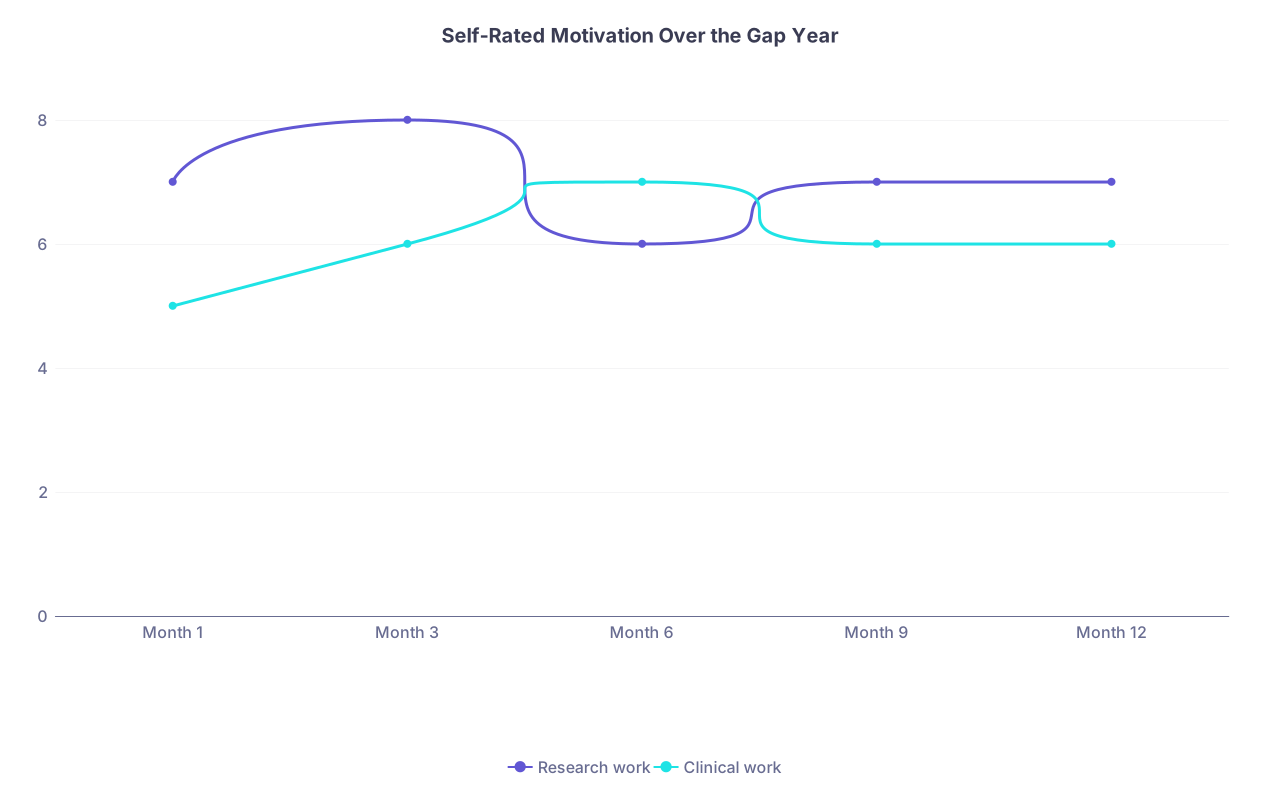
| Category | Research work | Clinical work |
|---|---|---|
| Month 1 | 7 | 5 |
| Month 3 | 8 | 6 |
| Month 6 | 6 | 7 |
| Month 9 | 7 | 6 |
| Month 12 | 7 | 6 |
If one line is consistently higher—even when things are hard—that’s your compass.
FAQ (Exactly 4 Questions)
1. What if I still genuinely can’t choose between PhD and MD–PhD by the end of the gap year?
Then you haven’t pushed hard enough into real versions of both lives. The fix is not more abstract thinking—it’s deeper immersion. Add:
- Another 3–6 months of high‑responsibility research (writing, analysis, not just bench tasks).
- Another 80–100 hours of shadowing or scribing in a demanding clinical setting.
If after that you’re still torn, lean PhD if research lights you up more than patient care; lean MD (with possible later research training) if clinical work feels more meaningful. MD–PhD is for people who can’t imagine giving up either, not people who are equally indifferent.
2. Is it a mistake to apply MD–PhD and MD‑only in the same cycle?
Not inherently, but you have to be strategic. If your MD–PhD narrative screams “I want to be a full‑time scientist,” and your MD‑only narrative screams “I only care about patients,” adcoms will smell the inconsistency. The right way:
- Keep a coherent core story: you’re serious about research but also serious about patient care.
- Be honest: MD–PhD is your ideal path, MD is your alternate route to meaningful clinical + research work.
Programs see this all the time; what they hate is sloppy, copy‑pasted essays that contradict each other.
3. How important is having a publication before applying MD–PhD or PhD?
Nice to have. Not mandatory. I’ve seen strong MD–PhD admits with no first‑author paper but sustained, multi‑year research and glowing letters about independence and resilience. For PhD, especially at top programs, a publication helps, but serious, long‑term involvement with real intellectual contribution matters more than a token middle‑author line. If your gap year is your first deep research experience, focus on:
- Taking ownership of a clear piece of the project.
- Getting a poster or abstract out.
- Having your PI ready to write a detailed letter about your thinking, not just your lab hours.
4. What if my stats are average—should I still consider MD–PhD?
Average stats don’t automatically disqualify you, but they change your target list. Many MSTPs expect:
- Solid GPA (often 3.6+)
- Strong MCAT
- Serious research years, not semesters
If you’re sitting below that, your best play might be: - Strengthen your profile with a longer research commitment (2+ years).
- Consider PhD first, then MD later if you still want direct patient care.
- Or pursue MD with heavy research during med school and residency.
The mistake is forcing yourself into a hyper‑competitive MD–PhD pool where you’re an obviously weak fit, instead of building a credible, sustainable path that matches your strengths.
Key points to keep in your head:
- Your gap year is not “time off”; it’s a structured 12‑month experiment to test PhD vs MD–PhD vs MD in real life, not in fantasy.
- Make a provisional decision halfway through the year, then spend the second half pressure‑testing that decision and vetting programs.
- When you finally commit, commit. A clear, coherent story aimed at the right programs beats a scattered, “maybe everything” approach every single time.