
The worst mistake MDs and PhDs make with their first R01 is simple: they aim for the right grant at the wrong time.
You can write a beautiful application, have decent data, strong letters—and still get shredded in review because you mis-timed when you went for it. For MDs vs PhDs, the “right time” is not the same. Different training paths, different expectations, different clocks.
I’m going to walk you through when to target your first R01 as an MD vs a PhD, and what you should be doing year by year so that when you hit submit, you’re actually ready—on paper and in real life.
Big Picture: How the R01 Clock Differs for MD vs PhD
At this point, you need a mental model of the two timelines.
Typical First-R01 Age and Path
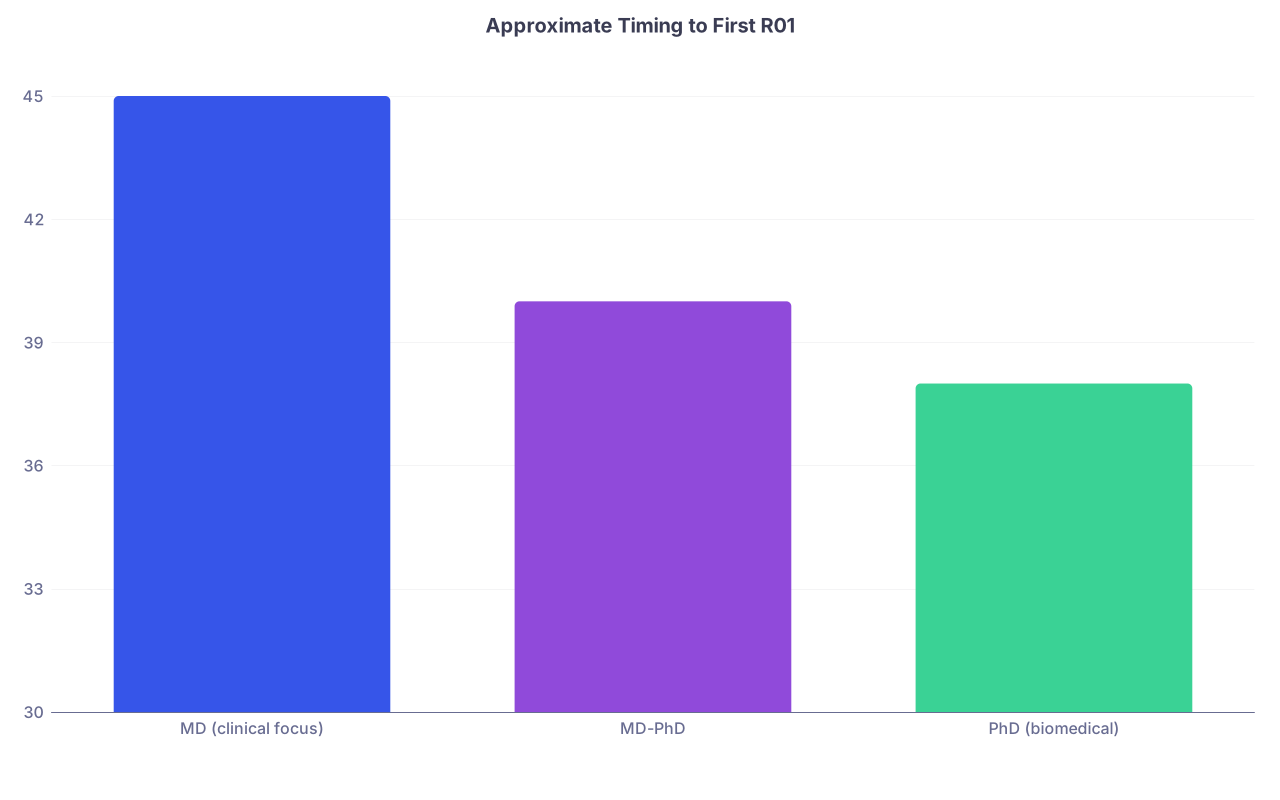
| Category | Value |
|---|---|
| MD (clinical focus) | 45 |
| MD-PhD | 40 |
| PhD (biomedical) | 38 |
These are averages I keep seeing:
- PhD basic scientists: first R01 around 37–40
- MD-PhD clinician-scientists: around 40–43
- Clinically heavy MDs trying to pivot to research: often 45+ (or never)
Why the gap?
- PhDs hit the lab full-time early; their entire postdoc is R01 prep.
- MDs lose years to residency and fellowship, which almost never count as true “R01-prep” research unless you carve it out intentionally.
- Expectations differ: a PhD hire on tenure-track is judged primarily by research; an MD hire on a clinical track is often judged by RVUs and service, with research as extra.
So the core strategic question is:
When do you want your clock to start?
As a PhD: it starts at first faculty job.
As an MD/MD-PhD: it effectively starts when you get protected time + a semi-independent project.
Let’s break this down phase by phase.
Medical School vs PhD Program: What Should Be True by Graduation?
At this point—end of med school or PhD—you’re not “R01-ready.” You’re laying seeds.
If You’re PhD-Trained
By PhD defense (year 4–6):
You should already have:
- 1–3 first-author papers, at least one solid original research article
- Clear technical niche (e.g., single-cell RNA-seq in immunology, advanced imaging in cardiology)
- A defined mentor network: PhD mentor plus at least 1–2 external collaborators
- At least one grant experience:
- Either a F31 (or equivalent) you applied for (funded is nice, submitted is better than nothing)
- Or you helped write major sections of your PI’s R01/AHA/ACS grants
Your focus in these years is not “when will I submit my R01?” The focus is:
- Build a clear research identity
- Learn how grants get written and scored
- Start a track record of productivity
If You’re MD-Trained
Most MDs waste med school for research. You cannot afford that if you want an R01.
By end of medical school, if you’re R01-ambitious, aim for:
- 2–3 publications total, at least one where you did meaningful work, ideally first- or co-first-author
- At least one real research mentor who actually knows you and your work
- Some exposure to:
- Study design
- IRB process
- Data analysis basics
If you’re MD-only and med school was totally research-free, you’re not doomed. But your R01 clock will likely start later—probably not before late fellowship or early junior faculty.
Residency & Fellowship vs Postdoc: When the Real Countdown Begins
Here’s where MD vs PhD timing truly diverges.
PhD Route: Postdoc = R01 Feeder Phase
At this point—start of postdoc—you should think:
“This is my 3–6 year runway to my first R01.”
Years 0–2 of Postdoc
Goals:
- Lock in a specific R01-worthy niche question
- Generate your first independent-feeling dataset (not just feeding your PI’s project)
- Get at least 1 first-author paper out as quickly as humanly possible
- Start early-career grants:
- K99/R00
- Society-specific career awards (AHA, AACR, etc.)
Timeline mindset:
- By postdoc year 2: you should have one solid paper out and one in progress that looks like a future Aim.
- By postdoc year 3–4: you’ll ideally be ready for K99/R00 or equivalent.
- R01? Not yet. Your first real R01 target is usually early in your first faculty position, but the science and preliminary data start now.
Years 3–5 of Postdoc
At this point, you should:
- Be writing or holding a K99/R00 or similar transition award
- Have 2–4 first-author papers
- Have an emerging reputation in a very specific, narrow topic
You start sketching your first R01:
- Draft 1–2 versions of Specific Aims and float them:
- To your postdoc PI
- To potential future department chairs
- To collaborators you’d want on the R01
You’re not submitting the R01 yet, but you’re aligning your postdoc work with your future R01 Aims.
MD Route: Residency & Fellowship = Mostly Lost Years Unless You Fight for Time
Here is where many MDs go off the rails. Residency gobbles time. Clinics, calls, notes. You blink and three years vanish.
If you want to be R01-competitive as an MD, your mentality during training must be different.
Residency (PGY1–3/4)
Real talk: residency is not R01 prep for most people. At this point, minimum expectations:
- Keep light research involvement alive:
- Case reports or small clinical series
- Join a mentor’s retrospective study
- Help with data cleaning/analysis for existing datasets
- Build relationships with research-active faculty in your specialty
Your real objective:
Position yourself to land a research-oriented fellowship or a physician-scientist track that actually gives protected time.
If your residency has a serious research track (some IM, neuro, peds, psych programs do):
- Use dedicated research blocks to:
- Attach yourself to one strong mentor
- Start a project that can follow you into fellowship
- Learn study design, biostats, and maybe some coding (R, Python, STATA)
Fellowship (especially for subspecialties)
This is where MDs can finally start the R01 runway.
At this point—start of fellowship—your mindset should be:
“These 2–3 years are my equivalent of a compressed postdoc.”
Fellowship Year 1
You should:
- Pick one main research mentor whose lab/clinical research program is R01-funded
- Nail down:
- A project that can yield 3–4 years of data
- A niche narrow enough to own but broad enough to build a career
- Aim for:
- 1–2 papers from residency/early fellowship work submitted
- A career development award in your sights (K08, K23, foundation CDA)
Fellowship Year 2–3
At this point, if you want a timely first R01, you must:
- Submit a K award (K08/K23 or equivalent foundation CDA)
- Ideally by end of fellowship year 2
- Absolute latest: early in your first faculty year
- Start collecting data that could be preliminary data for your future R01:
- Pilot patient cohorts
- Feasibility data
- Small mechanistic studies
- Clarify your post-fellowship job type:
- Research-heavy track (70–80% research)
- Balance track (50% research)
- Clinical track (20% or less research—R01 is much harder here)
The R01 is not fellowship’s job. Fellowship’s job is:
- Get you into a job with protected time
- Get you a K award or equivalent
- Give you enough data and publications to launch
Early Faculty Years: When Should You Actually Submit the R01?
Now we’re at the real question. You’re in a faculty job. When do you pull the R01 trigger?
I’ll separate this clearly.
For PhD Faculty
At this point—start of first faculty job (assistant professor):
You should have:
- 4–8 first-author papers
- Often a K99/R00 or similar career award, or at least a strong T32/postdoc pedigree
- A clearly defined independent project that is related to but distinct from your postdoc PI’s work
The realistic R01 submission timeline:
- Year 1 of faculty:
- Set up lab
- Hire first tech/student
- Lock in startup-funded preliminary experiments
- Write and submit smaller grants (R21, foundation, internal pilots)
- Draft Specific Aims for a future R01
- Year 2 of faculty:
- Submit first R01 or at least a very close cousin (R35, equivalent mechanism)
- Some submit earlier, but year 2 is where I see rational timing for most
- Year 3–4 of faculty:
- Resubmit improved R01 with new data if first one didn’t hit
- Have at least 1–2 first- or senior-author papers from your own lab
So for a PhD who starts postdoc at 28–30, finishes by 33–35, starts faculty at 35–37:
- First R01 submission around age 36–39
- First R01 funding around age 38–42 (assuming a cycle or two of revision)
For MD or MD-PhD Faculty
Now the tricky part. Because the biggest variable here is protected time and K award status.
At this point—start of your first real faculty job:
You should aim for one of these setups:
| Track Type | Research % | Typical First-R01 Target |
|---|---|---|
| Research-heavy | 70–80% | Years 2–4 faculty |
| Mixed-clinical | 40–60% | Years 3–6 faculty |
| Mostly clinical | 20–30% | Often unrealistic |
| With K award | 75%+ | Years 3–5 of K |
Scenario 1: MD/MD-PhD with a K Award
This is the ideal runway.
At this point—K award start (year 0):
You should:
- Have 2–5 first-author papers
- A funded K08/K23/K99/R00/foundation CDA
- A clear 5-year plan where the K project leads directly to an R01-scale program
K Years 1–2
You focus heavily on:
- Building preliminary data for your future R01
- Expanding method skills
- Publishing at least 2 manuscripts from K work
You should be drafting R01-level Aims already. Sharing them with mentors. Tuning them.
K Years 3–4
This is the sweet spot for first R01 submission.
At this point, aim to:
- Submit your first R01 between years 3–4 of the K
- Why? Because:
- You have enough data
- You still have K salary protection while revising
- Why? Because:
- Have:
- At least 3–6 total first- or senior-author papers
- At least 1–2 papers clearly stemming from your K project
K Year 5 (final year)
If your R01 wasn’t funded earlier:
- Resubmit improved R01 as you near the end of the K
- Or submit a second, more focused R01 or R21 to raise odds
So for MD/MD-PhD:
- Fellowship ends around 32–36
- K starts ~33–38
- First R01 submission around 36–42
- Realistic funding around 38–45
Scenario 2: MD Without a K Award (But With Some Protected Time)
This is much harder but not impossible.
At this point—start of faculty without a K:
Make a cold-eyed assessment:
- Do you truly have 40–50% protected time for research?
If it’s “protected” only on paper and your clinic keeps creeping up, your R01 odds plummet. - Do you have:
- At least 3 solid papers
- A supportive, R01-funded mentor
- Access to infrastructure (stats, coordinators, lab space, etc.)?
Years 1–2 Faculty
You should:
- Try for:
- Foundation grants (Doris Duke, AHA, ACS, specialty society awards)
- Internal pilot funding
- Build clean, targeted preliminary data for 1–2 strong Aims
- Stay brutally disciplined about your clinical time. If your “protected time” erodes, stop pretending you’re on an R01 track and renegotiate or move.
Years 3–5 Faculty
Realistic R01 target:
- First R01 submission around years 3–5 of faculty, if:
- You’ve published at least 3–5 new papers from your own work
- You have a cohesive story that looks like:
- Solid preliminary data
- Clear methods
- A long-term program, not just a “one-off project”
For many MDs without a K, the first R01 comes much later, if at all. That’s not about talent; it’s about time and structure.
Red Flags: Signs You’re Submitting Too Early (Or Too Late)
At this point, do a gut-check before you march into an R01 cycle.
You’re likely TOO EARLY if:
- Your preliminary data can be summarized in one weak figure and a PowerPoint talk
- You have fewer than 3 first- or senior-author papers in the proposed area
- Your Aims read like “fishing expeditions” instead of a tight, testable set of hypotheses
- You can’t name three prior NIH reviewers (even hypothetically) who’d look at your application and say, “Oh yeah, I know their work”
You’re drifting TOO LATE if:
- You’re >5–6 years into a tenure-track job with:
- No R01
- No K
- No major equivalent external grant
- You’ve been recycling essentially the same R01 Aims for 3+ cycles with minor tweaks and no major new data
- Your department chair has started casually asking about your “long-term role on the clinical side”
Timing is not just about your CV. It’s also about how your department and reviewers perceive your trajectory.
Concrete Timeline Examples
To make this real, here’s what a sane trajectory looks like for each.
Example 1: PhD Scientist
- Age 24–30: PhD, 3 first-author papers
- Age 30–34: Postdoc, 3 more first-author papers, K99/R00
- Age 34–35: Start R00/assistant professor
- Age 36: First R01 submission (rejected, discussed)
- Age 38: Resubmission, funded
Example 2: MD-PhD Cardiologist with K08
- Age 24–32: MD-PhD, decent publications
- Age 32–35: IM residency, light research
- Age 35–38: Cardiology fellowship + heavy research
- Age 37: K08 submitted, funded at age 38
- Age 38–41: K years 1–3, generates strong mechanistic and pilot clinical data
- Age 41: First R01 submission
- Age 43: R01 resubmission funded
Example 3: MD Hospitalist Trying to Pivot Late
- Age 26–29: MD, minimal research
- Age 29–32: IM residency, one QI paper
- Age 32–40: Full-time hospitalist, occasional co-author papers
- Age 40: Decides to “get serious” about research, 10–20% research time
- Age 40–45: Builds small project portfolio, foundation grant possible, R01 unlikely without dramatic structural change (like a research fellowship or 50–70% protected time)
This third scenario is common. It’s not hopeless, but it’s a different game. Often the better move is a mid-career K or a formal re-tooling period, not an immediate R01 push.
MD vs PhD: Strategic Takeaways on Ideal R01 Timing
Summing up the timing in one snapshot:
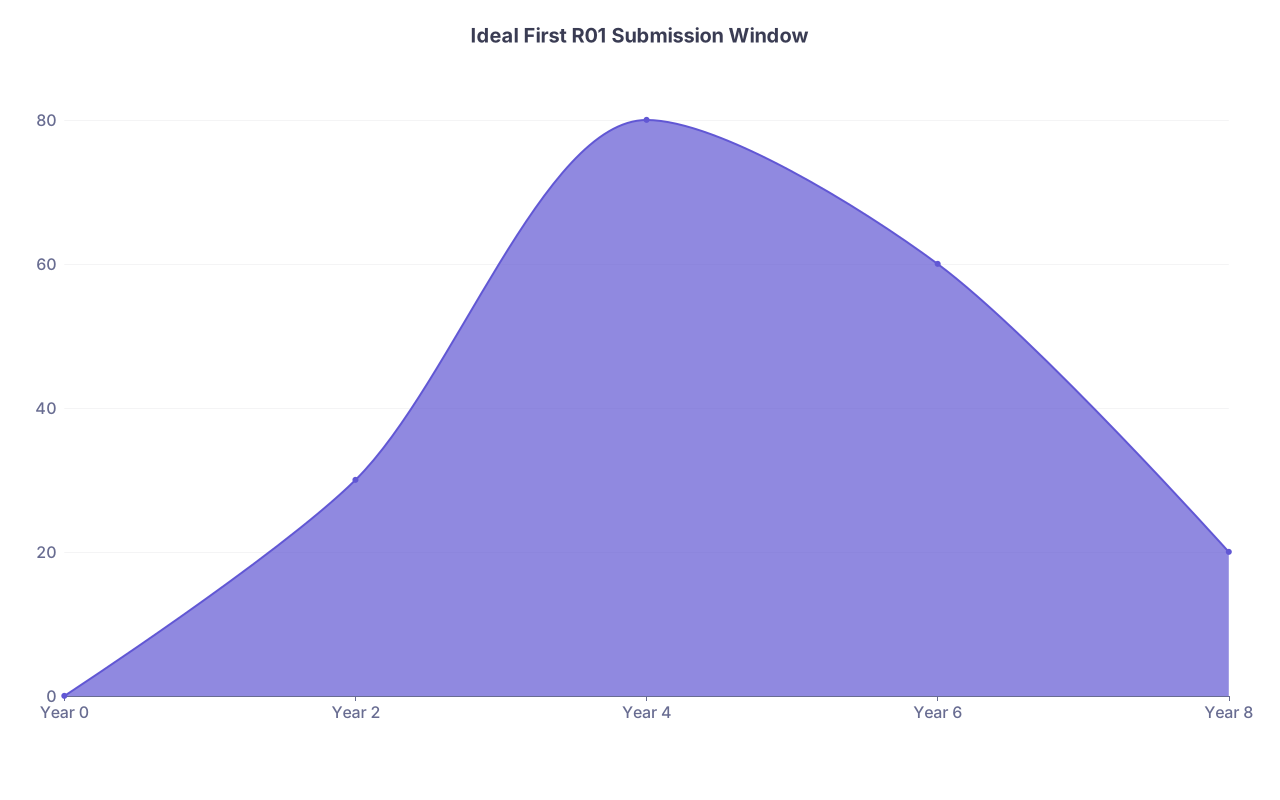
| Category | Value |
|---|---|
| Year 0 | 0 |
| Year 2 | 30 |
| Year 4 | 80 |
| Year 6 | 60 |
| Year 8 | 20 |
Think of that “peak probability window” like this:
- PhD: 2–4 years into faculty → prime time for first R01 submission
- MD-PhD with K: 3–5 years into K award → prime time
- MD with real protected time but no K: 3–6 years into faculty → possible, but demands sharp focus
- MD mostly clinical: R01 is not impossible, but the timing is “whenever your job actually gives you a true research runway”—which might be never in the current role
What You Should Do This Week
You do not need to decide your exact R01 submission date today. But you do need to anchor your timing.
Here’s your immediate move:
Right now, open a blank page and write:
- Your current stage (MS4, PGY2, fellow, postdoc year 3, junior faculty year 1, etc.)
- Your realistic research % time right now
- The earliest calendar year you could see yourself having:
- 3+ first- or senior-author papers in your niche
- Solid preliminary data supporting 2–3 specific aims
- At least one strong letter writer who can call you an independent investigator
Then write a single sentence:
“My first serious R01 submission target is [Month/Year].”
If that date is less than 18 months away and you have almost no prelim data or papers, you’re too early. Adjust.
If that date is more than 7–8 years away and you’re already in a faculty-style role, you’re drifting. Adjust.
Pin that page somewhere visible. Every major decision—job choice, K submission, project selection—should move that date from fantasy to reality, step by step.