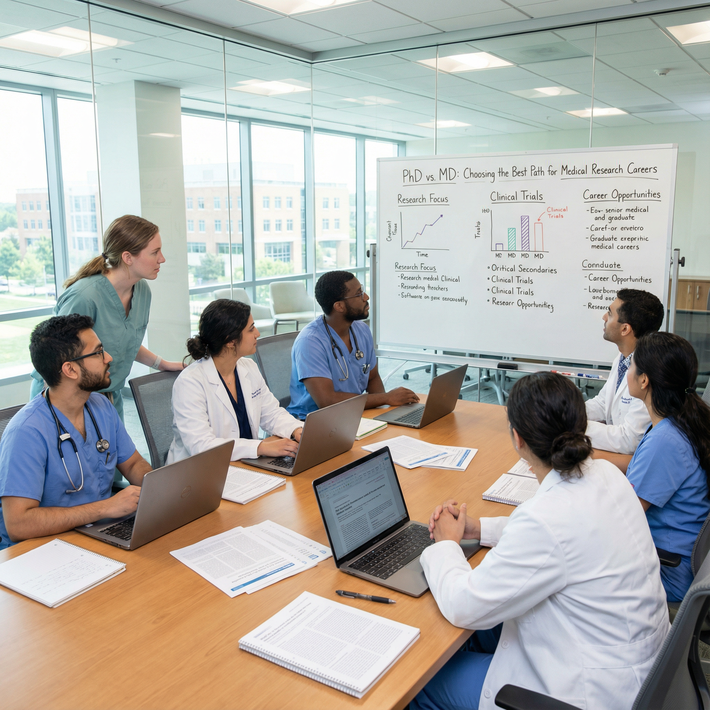
The biggest mistake PhDs make when starting med school is treating it like “just another degree.” It isn’t. It’s a complete identity shift on a brutally tight clock.
You’ve been the expert in the room. Now you’re about to be the least clinically competent person on the ward. That’s jarring. The way you use the 6–12 months from thesis defense to M1 start will determine whether you hit M1 ready… or get steamrolled in the first 8 weeks.
Here’s the timeline I give PhDs heading into MD programs. Month-by-month, then week-by-week as you approach orientation, then day-to-day in that crucial first week.
Big Picture: Your Transition Map
At this point you should zoom out. Forget individual to‑dos for a second and lock in the overall phases.
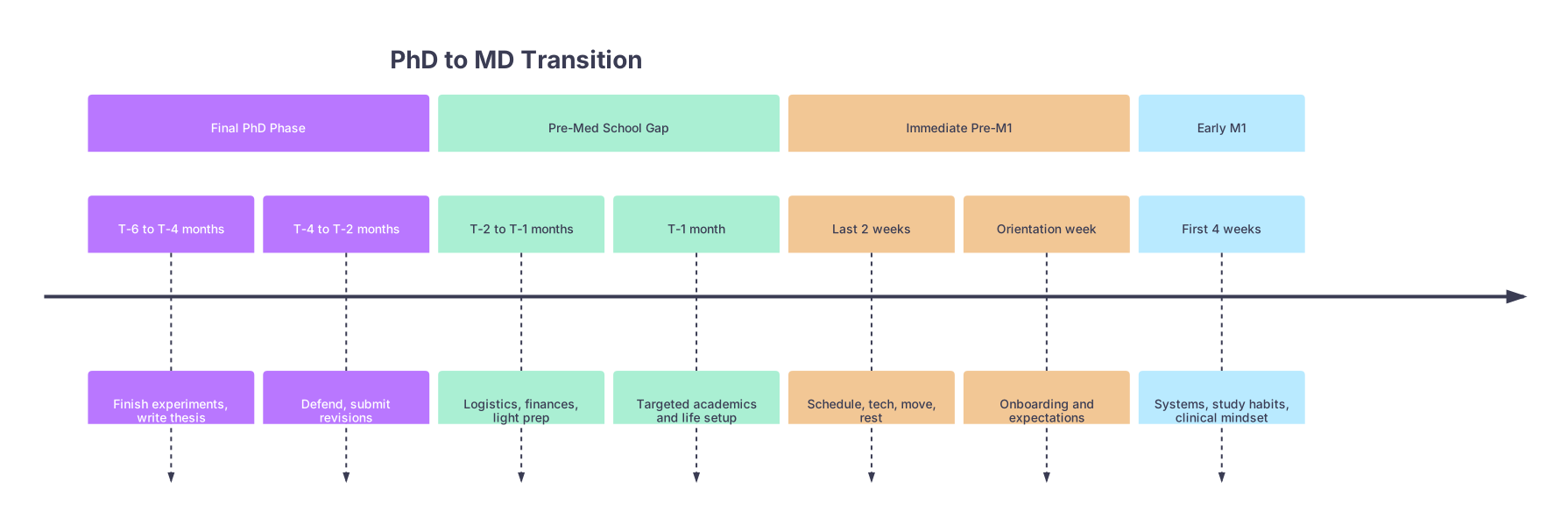
| Period | Event |
|---|---|
| Final PhD Phase - T-6 to T-4 months | Finish experiments, write thesis |
| Final PhD Phase - T-4 to T-2 months | Defend, submit revisions |
| Pre-Med School Gap - T-2 to T-1 months | Logistics, finances, light prep |
| Pre-Med School Gap - T-1 month | Targeted academics and life setup |
| Immediate Pre-M1 - Last 2 weeks | Schedule, tech, move, rest |
| Immediate Pre-M1 - Orientation week | Onboarding and expectations |
| Early M1 - First 4 weeks | Systems, study habits, clinical mindset |
“Today” = thesis defense. “M1 Day 1” is the start of classes.
T‑6 to T‑4 Months Before M1: Lock Down the PhD Exit
You might still be writing, resubmitting, or finishing experiments. At this point you should treat med school as a fixed launch date and back‑plan ruthlessly.
Academic & Administrative
- Finalize your defense date and med school start date in one calendar.
- Map deadlines:
- Thesis submission
- Defense
- Revisions
- Degree conferral
- Tell your PI clearly: “My last full‑time day in lab is [date].” Not “sometime in the summer.”
Concrete weekly targets in this phase:
- 4–5 days/week: thesis writing or revisions
- 1 day/week: future‑you tasks (med school forms, housing scouting, financial planning)
- 1 day/week: recovery/time off (yes, really, or you’ll limp into M1 already exhausted)
Medical School Coordination
At this point you should:
- Confirm:
- Start date
- Orientation week schedule
- Required summer assignments (some schools give prework)
- Ask the admin office directly:
- “When will I get access to the student portal?”
- “When do immunization and background check forms open and close?”
- “Any required summer courses, online modules, or readings?”
Make a simple comparison of what’s coming:
| Item | Typical Deadline Window |
|---|---|
| Final thesis submission | 4–5 months before M1 |
| Defense date | 3–4 months before M1 |
| Med school deposit | 3–5 months before M1 |
| Housing application | 2–4 months before M1 |
| Immunization records | 1–3 months before M1 |
Goal of this phase: no loose academic ends rolling into the last 2 months. If you’re still in full crisis mode with your PhD at T‑2 months, you’ll have no runway to recover before M1.
T‑4 to T‑2 Months: Defense, Emotional Whiplash, and Basic Foundations
Once you’re ~3–4 months out from M1 and you’re defending or have just defended, the psychological shift starts.
The Week of the Defense
At this point you should:
- Clear the deck. Do nothing med‑school‑related the 3 days before and 3 days after defense except urgent paperwork.
- After your committee signs off:
- Submit final thesis/revisions on the earliest possible timeline.
- Confirm your degree conferral date (registrar).
- Get 2–3 official transcripts ordered and ready for med school upload if required.
You’re closing one identity. Let it close. You’ll think more clearly about M1 prep once the PhD is truly done.
2–4 Weeks After Defense: Light Academic Reboot
You do not need to “pre‑study med school” like a maniac. But if you’ve been living in a narrow research niche (say, protein folding or condensed matter), your broad biology and physiology might be rusted.
At this point you should spend 3–5 hours/week on:
- Brushing up:
- Basic cell biology
- Physiology overview
- Biochemistry fundamentals
- Tools I’ve seen work well:
- A concise review book (e.g., BRS Physiology as a gentle skim, not full memorization)
- Pathoma Chapter 1 (just to see how clinical explanation feels)
- Sketchy/Anki only if you enjoy them; this is optional now
Keep it light. The point is to wake up dormant circuits, not “get ahead.”
Here’s what the time balance should roughly look like in this mid‑transition stretch:
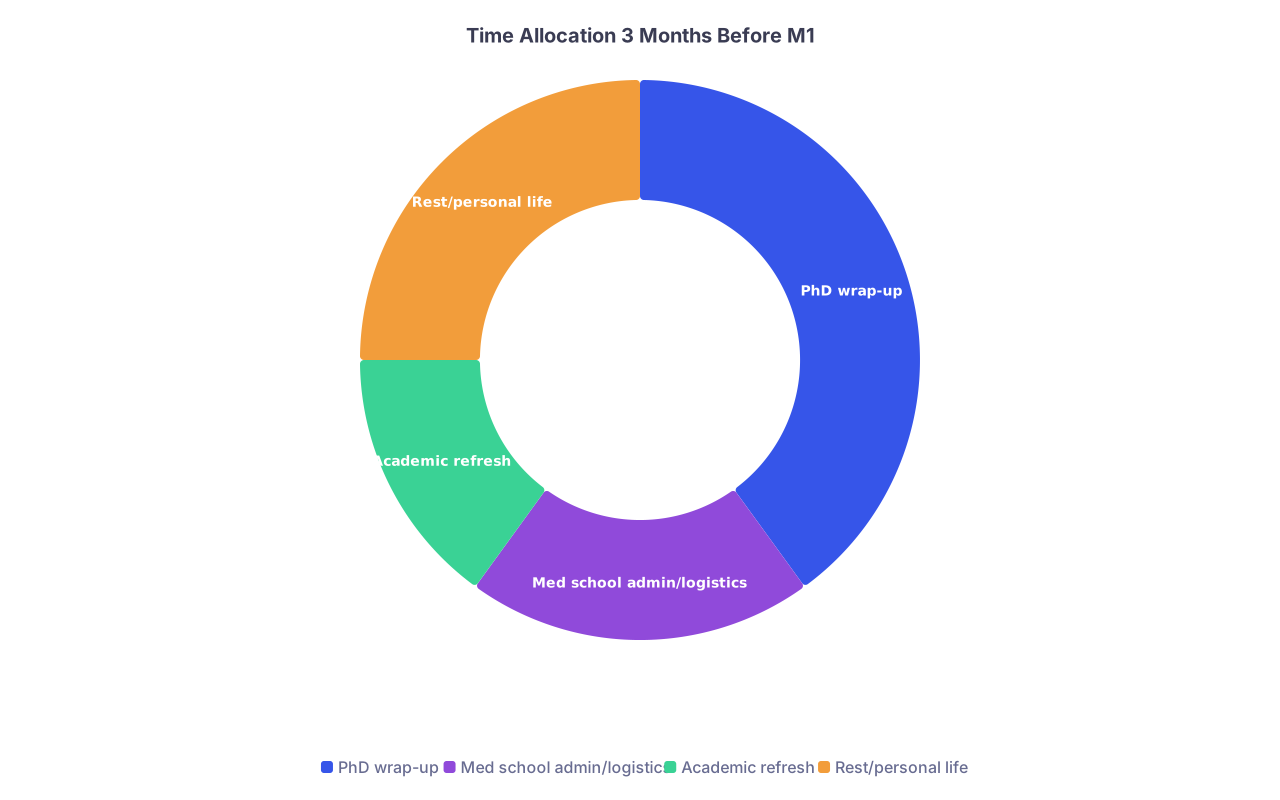
| Category | Value |
|---|---|
| PhD wrap-up | 40 |
| Med school admin/logistics | 20 |
| Academic refresh | 15 |
| Rest/personal life | 25 |
If “academic refresh” is >25%, you’re overdoing it this far out.
T‑2 to T‑1 Months: Life Logistics and Financial Reality
This is where a lot of PhDs screw up. They keep tinkering with a manuscript and ignore their life setup. Then they’re building IKEA furniture the night before anatomy starts.
At this point you should be ruthlessly practical.
Housing & Moving (6–8 Weeks Out)
- Decide:
- On‑campus vs off‑campus
- Roommates vs solo
- Lock in:
- Lease start date at least 2–3 weeks before orientation
- Moving date on a clearly scheduled weekend
To‑do checklist:
- Set up:
- Utilities (electric, internet, water)
- Renter’s insurance
- Change of address (postal service + banks + licensing boards if relevant)
- If moving across state:
- Plan DMV visit for new license and vehicle registration
- Check state requirements for vehicle insurance
You want your “new life” to be physically in place at least 1 week before classes.
Finances (6–8 Weeks Out)
At this point you should:
- Build a 12‑month budget:
- Tuition + fees
- Rent + utilities
- Food and transport
- Board prep / resources
- Confirm:
- Financial aid package
- Disbursement dates (when the money actually hits)
A simple view of your upcoming financial split helps:
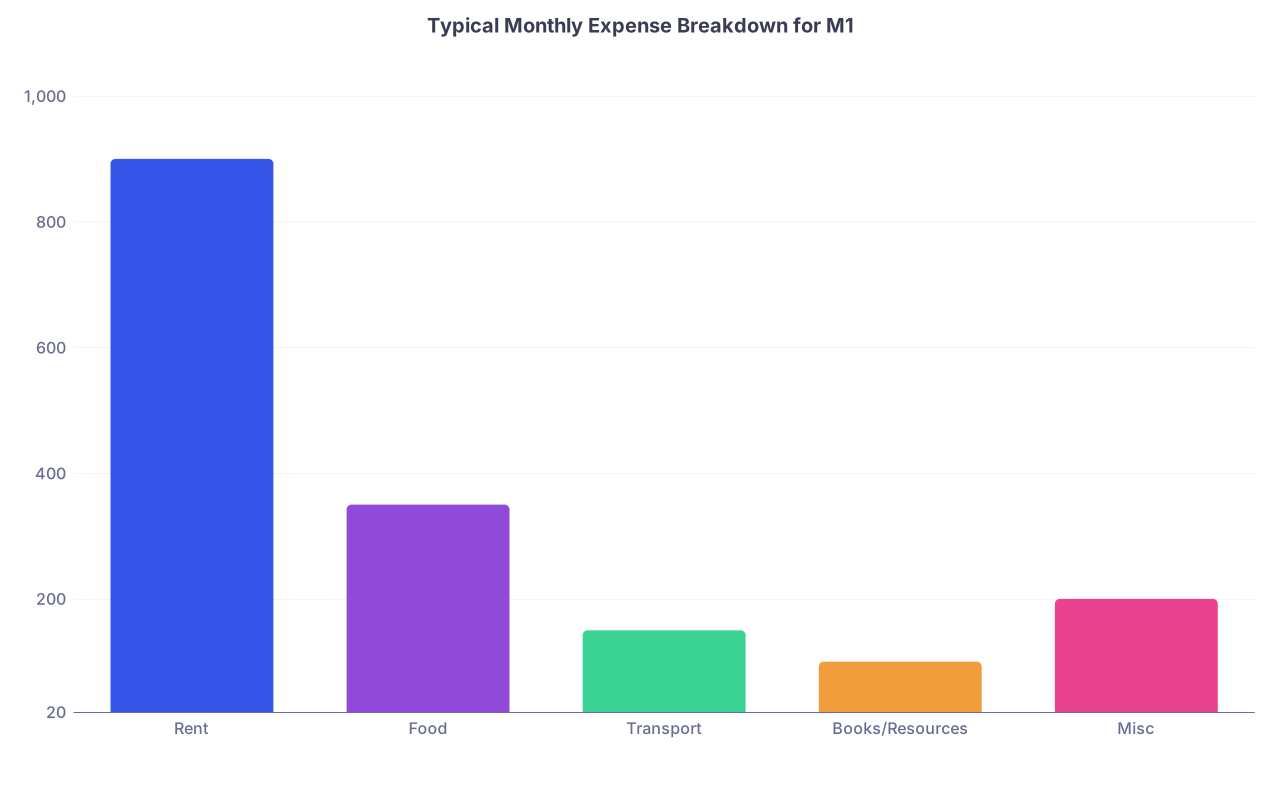
| Category | Value |
|---|---|
| Rent | 900 |
| Food | 350 |
| Transport | 150 |
| Books/Resources | 100 |
| Misc | 200 |
If you’re coming from a salaried PhD, the drop is painful. You need to feel that now, not mid‑October when loans are already bleeding.
Medical Requirements & Paperwork
At this point you should:
- Knock out:
- Immunization titers and boosters
- TB test
- Drug screen
- Background check
- Upload:
- Health insurance proof
- Final transcripts
- Emergency contact info
Do not leave this until the last 2 weeks. Clinics get backed up, titers need repeats, HR portals break.
T‑1 Month: Targeted Academic Prep and Identity Reset
This is the critical “sharpen, don’t burn out” window. Now you start aiming directly at how M1 will feel day‑to‑day.
Week 4–3 Before M1: Understand the Curriculum
At this point you should:
- Get your actual M1 schedule (block/organ/system‑based, PBL vs lecture‑heavy).
- Identify first 2 blocks (e.g., “Foundations + MSK,” or “Molecules to Cells,” or “Anatomy + Embryology”).
- Ask second‑years (via GroupMe, Discord, whatever):
- “What resources actually mattered in Block 1?”
- “What would you have reviewed, as a PhD, before starting?”
Ignore random Reddit advice. Your school’s specifics matter more than some anonymous post.
Create a one‑page “resource map”:
- Required:
- School lectures
- Required small group/PBL readings
- Supplemental (as recommended by upperclassmen):
- One anatomy resource (e.g., Complete Anatomy or Netter)
- One physiology resource
- One board‑style Qbank (often Boards & Beyond videos + a small Qbank)
Commit now: you will not chase 10 resources at once. That’s grad‑school perfectionism; it kills med students.
Week 3–2 Before M1: Academic Warm‑up
At this point you should spend ~1–2 hours/day, 5 days/week, on concrete, limited prep:
- If Anatomy is early:
- Learn directional terminology (proximal, distal, etc.)
- Re‑learn basic musculoskeletal groups and major joints
- If Foundations/Cell/Mol:
- Review:
- DNA replication, transcription, translation
- Basic metabolism (glycolysis, TCA)
- Membrane transport, receptors
- Review:
Do it through med‑school‑style lenses:
- Short explanations
- Clinical vignettes
- Diagrams over dense paragraphs
You’re not here to re‑write a review paper. You’re training for rapid recognition.

Final 2 Weeks Before M1: Schedule, Tech, and Sleep
At this point you should stop trying to “get ahead” and start making your life boringly predictable.
Week 2 Before M1: Build Your Daily Template
Draft a realistic weekday schedule based on your actual class calendar:
- Fixed:
- Class blocks (e.g., 8–12)
- Mandatory small groups
- Then block:
- 2–3 hours/day of focused study
- 1–1.5 hours/day of review (Anki or equivalent)
- Meals, commute, and one protected hour of non‑med‑school time
Something like:
- 7:00–7:30: Wake, breakfast
- 8:00–12:00: Class
- 12:00–13:00: Lunch, decompress
- 13:00–15:00: Study new content
- 15:00–16:00: Review / flashcards
- 16:00–18:00: Exercise / chores
- 19:00–21:00: Light review or free time, bedtime routine
You will adjust, but having a template keeps your PhD “I’ll just work until midnight” habit from reappearing.
Tech Setup
At this point you should:
- Decide on your note‑taking system:
- PDF annotator (Notability, OneNote, GoodNotes) vs typed notes vs printed slides
- Install and test:
- School VPN
- Learning management system (Canvas, Brightspace, etc.)
- Note apps synced across devices
- Anki (if you’ll use it) and a simple backup system
Run a dry‑run:
- Download a sample lecture PDF
- Annotate it
- Make 5–10 recall‑based flashcards or a summary page
This 1‑hour run‑through prevents tech chaos during week 1, when you really don’t want it.
Week 1 Before M1: Calm, Not Cram
At this point you should prioritize:
- Sleep: lock in a consistent wake time
- Exercise: 20–30 minutes/day
- Social setup:
- Join class chats
- RSVP to any pre‑orientation mixers if you feel up to it
- Pack:
- Backpack with:
- Laptop + charger
- Simple notebook
- One set of pens/highlighters
- Water bottle
- ID and basic documents
- Backpack with:

Stop all heavy “studying” 3–4 days before orientation. Review a few broad overview diagrams if you must, but the real exam is your ability to sustain focus for months, not memorize another Krebs cycle detail right now.
Orientation Week: Don’t Try to Impress Anyone
Orientation is not the time to demonstrate how smart you are. It’s the time to learn the rules of the game.
At this point you should:
- Show up rested and on time. Every day.
- During sessions:
- Write down:
- Grading system (P/F, H/HP/P/F)
- Exam frequency and format
- Attendance policies
- Required vs suggested materials
- Ask quietly after talks:
- “What happens if I fail a block?”
- “What’s the remediation structure?”
- Write down:
Socially
- Aim for:
- 2–3 genuine conversations/day
- Exchange contact with a couple of people who live near you or seem like they work similarly
- Don’t:
- Launch into your thesis abstract on day 1
- Correct lecturers or show off prior knowledge
You’re building reputation as reliable, not brilliant.
First 2 Weeks of M1: Shift from Depth to Throughput
PhDs struggle most here. The instinct is to go deep. That’s wrong. The metric now is coverage + retention, not novel insight.
Week 1: Collect Data on Your Own Habits
At this point you should:
- Run your “template day” and then tweak based on reality.
- After each day, 5‑minute check:
- What time did I actually start studying?
- How many hours of focused work did I get?
- What got in the way?
By Friday, you should:
- Know:
- How long it takes you to process a 1‑hour lecture
- When your mental energy peaks
- Cut:
- Any resource you are not using consistently (drop it early)
Content Strategy
Your study loop, starting now:
- Before class (5–10 minutes max):
- Glance at learning objectives.
- During class:
- Take lean, structured notes (headings, key mechanisms).
- Same day, after class:
- Review notes once.
- Turn major facts into recall questions or flashcards.
- End of week:
- 1–2 hour cumulative review of the whole block so far.
- 10–20 board‑style questions if available.
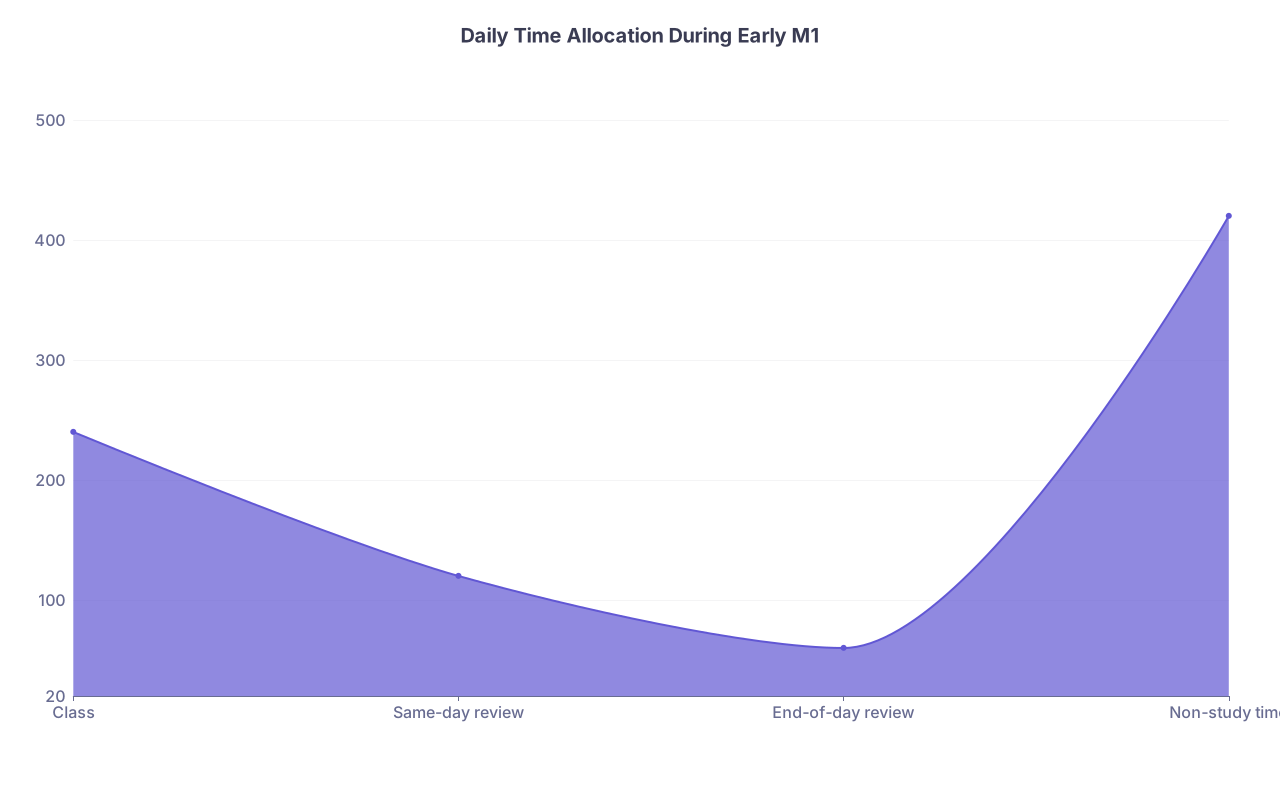
| Category | Value |
|---|---|
| Class | 240 |
| Same-day review | 120 |
| End-of-day review | 60 |
| Non-study time | 420 |
The exact numbers don’t matter. The pattern does: same‑day review, then spaced retrieval.
Weeks 3–4 of M1: Guardrails Before You Accelerate
By the end of the first month, you’re at a fork. Either you’ve set up sustainable systems—or you’re already behind and hiding it.
At this point you should:
- Do a 30‑minute diagnostic each weekend:
- How many lectures behind am I? (If >3, change something now.)
- How many hours/week am I actually studying? (Not just “sitting with laptop open.”)
- How many questions (school, Qbank) have I done on current material?
If you’re behind:
- Immediately:
- Go to office hours or academic support.
- Talk to a second‑year you trust about what to cut.
- Short‑term fix:
- Prioritize:
- Core lecture learning objectives
- High‑yield summaries
- Practice questions
- Drop:
- Extra textbooks
- Deep dives on tangential mechanisms
- Prioritize:
PhD brain wants to understand everything. MD training wants you to manage risk: “What can I safely not know deeply right now?”

Putting It All Together: Month‑by‑Month Snapshot
Here’s the no‑fluff picture of what should be true at each point:
| Time to M1 Start | What Should Be True |
|---|---|
| 6–4 months | Defense date set, med school start confirmed |
| 4–2 months | Thesis defended/near done, light refresh |
| 2–1 months | Housing, finances, medical forms in progress |
| 1 month | Clear resource plan, basic review started |
| 2 weeks | Daily schedule drafted, tech fully tested |
| 0–4 weeks into M1 | Systems solid, content backlog minimal |
The 3 Things That Actually Matter
- Front‑load closure. Finish the PhD cleanly at least 2 months before M1. You need emotional and cognitive space, not another half‑finished manuscript during anatomy.
- Design your systems, not your heroics. A realistic schedule, a simple resource set, and same‑day review will beat last‑minute “I’ll just work harder” every time.
- Drop the depth ego early. You’re not here to be the smartest in the room. You’re here to be the most reliable at covering, retaining, and applying a massive volume of information, week after week.