
Rushing into an MD‑PhD because you “like research” is a terrible idea. The MS1–MS2 years are your test period. Your job is not to collect lines on your CV. Your job is to pressure‑test whether you actually want a second degree or just want to match well. Those are not the same thing.
I’m going to walk you from day 1 of MS1 through the end of MS2, step by step, so that by the time you hit dedicated Step/Level study, you’ve basically answered the question:
“Do I need a PhD on top of my MD, or do I just need serious research in medical school?”
Let’s set up a two‑year experiment on you.
Big Picture: Your 2‑Year “MD vs PhD” Experiment
At this stage you do not need to decide “MD vs MD‑PhD forever.” You need to:
- See what real research life feels like
- Learn how you react to slow projects, failed experiments, and revision‑after‑revision
- Talk to people who live on each side: clinician‑educators, clinician‑scientists, and MD‑PhDs
- Track your own excitement vs dread when you’re doing research vs clinical stuff
Think of MS1–MS2 as one long A/B test:
- Path A: You like research but hate living in it
- Path B: You like research and keep choosing more of it, even when it’s hard
- Path C: You mostly like patients and teaching; research is fine but optional
Your timeline will force you to find out which path you’re on.
Month 0–1 of MS1: Set the Baseline (No Commitments Yet)
At this point you should not be joining 3 labs and 5 interest groups. Calm down.
Your goals in the first 4–6 weeks:
- Stabilize your academics
- Start a simple “MD vs PhD journal” (yes, seriously)
- Map the research ecosystem at your school
Week 1–2: Survive and Observe
Focus: classes, anatomy, your study system.
But quietly, in the background:
- Notice classmates who already “have a PI” and “secured a project”
- Listen for phrases like “I’m thinking MD‑PhD” vs “I just want something on my CV”
- Make a note: most of those people will change their tune by MS2
Start a tiny log (could be a Google Doc):
- Once a week, answer:
- “What sounded more exciting to me this week: clinical content, research talks, or neither?”
- “If I had a free afternoon, would I rather shadow, do research, or sleep?”
You’re looking for patterns, not perfection.
Week 3–4: Reconnaissance, Not Commitment
At this point you should schedule:
- One meeting with:
- A clinician‑scientist (MD who runs a lab / does serious research)
- A pure clinician (teaching but no major research)
- If possible, an MD‑PhD in your field of interest
Ask them bluntly:
- “If you had to do it over, would you still get the PhD?”
- “What work do you actually do in a given week?”
- “Is there anything you can only realistically do with a PhD?”
You are gathering data, not making a decision.
Month 2–4 of MS1: Low‑Risk Research Exposure
Now you can start dipping your toes in, but the rule is clear:
No multi‑year commitments and no overpromising.
Month 2: Light‑Touch Entry
At this point you should:
- Attend 1–2 research seminars / grand rounds that involve basic science, translational, or outcomes research
- Join at most one research‑heavy interest group (e.g., physician‑scientist society, MSTP‑linked group)
Your checklist for the end of Month 2:
- I’ve heard at least two people present their research live
- I’ve noticed which type of talk pulls my attention:
- Bench lab mechanisms
- Clinical trials
- Outcomes / epidemiology
- Education research
- I still have my grades under control
If you’re already drowning academically, stop here. MD‑PhD life is heavier, not lighter.
Month 3–4: Try a Micro‑Project
Now you can test actual work.
Kinds of micro‑projects:
- Data extraction for a chart review
- Helping clean a dataset
- Simple literature review or background section for a resident’s project
- Joining a small retrospective study with well‑defined tasks
At this point you should:
- Commit to something that:
- Has a clear end point in 6–12 weeks
- Has a defined mentor (resident/fellow/PI)
- Requires <3–5 hours a week
Your job is not to publish a Nature paper. Your job is to feel:
- Do I like this type of thinking?
- Do I mind that progress is slow and messy?
- How do I feel sitting alone with a dataset or manuscript vs in small groups in small group sessions?
Mid‑MS1 (Month 5–8): The First Reality Check
By now, the shine of “being in med school” is wearing off. Good. That’s when your preferences show up.

Month 5–6: Evaluate Your First Project
At this point you should sit down and do a blunt self‑audit.
Ask yourself:
When I see an email from my research mentor, do I:
- Feel mildly excited / curious?
- Feel neutral?
- Feel dread and delay opening it?
Which feels more satisfying:
- Understanding a tricky pathophysiology concept
- Getting a cleaner dataset / writing a better paragraph in a manuscript
How do I respond when:
- Results are negative
- The project stalls because of IRB
- A draft comes back with heavy edits
If, even with negative results and annoying delays, you keep wanting to push the project forward, that’s a green flag for more research—and maybe a PhD down the line.
If you only care about “getting your name on something,” that’s not PhD energy. That’s “do solid med school research and move on” energy.
Month 7–8: Deliberate Exposure to Different Research Types
At this point you should intentionally sample two very different research flavors.
For example:
- One clinical/retrospective project
- One basic science or translational seminar/short‑term experience
Or:
- One QA/QI (quality improvement) hospital project
- One education research project with a faculty mentor
You are testing fit, not prestige. I’ve seen people think they hate research because they only ever saw:
- Endless pipetting in a basement lab, or
- Horribly organized chart reviews with no support
Bad projects don’t mean you hate research. They mean you hate bad projects.
Late MS1 (Month 9–12): Decide Your MS2 Strategy
By the end of MS1, you should decide which lane you’ll occupy during MS2:
- Lane 1: “Likely MD‑only, research for residency competitiveness”
- Lane 2: “Genuinely considering PhD/physician‑scientist path”
You’re not binding yourself legally here. You’re setting a working hypothesis.
Month 9–10: Mentor Conversations 2.0
At this point you should schedule follow‑ups with:
- A trusted research‑active faculty mentor
- A resident or fellow who does research
- If accessible, someone on your school’s MD‑PhD or PSTP (physician‑scientist training program) committee
You say plainly:
“I’m trying to test whether I need a PhD on top of my MD. Here’s what I’ve done so far. Here’s what I liked and hated. What would you recommend I do during MS2 to really test this?”
You’ll hear one of a few patterns:
- “You absolutely do not need a PhD for what you’re describing.”
- “Honestly, if you’re this on the fence, I’d do MD only and stack strong research.”
- “If you can see yourself running a lab or leading major trials, a PhD could make sense; here’s what you should try next year.”
Take notes. Compare their opinions to your gut.
Month 11–12: Build a Concrete MS2 Plan
Now you lock in an MS2‑year research plan aligned to your lane.
| Lane | Weekly Research Time | Project Type Focus |
|---|---|---|
| MD‑only | 3–5 hours | One solid clinical project |
| Leaning PhD | 5–8 hours | Longitudinal + side pilot |
| Strong PhD interest | 8–12 hours | Deeper lab/clinical trial role |
If you’re Lane 1 (likely MD‑only):
- Choose 1–2 projects max
- Prioritize:
- Clear authorship expectations
- Reasonable timeline (submission by end of MS3)
- Clinically relevant topic in fields you might apply into
If you’re Lane 2 (genuinely considering PhD):
- At this point you should:
- Anchor yourself in one lab or group where you can grow
- Take on a project that will last >1 year (ideally multi‑aim)
- Negotiate for deeper involvement: design, analysis, presentations
This is the year you see if you like being the engine, not just a cog.
Early MS2 (Month 13–16): Simulated “Mini‑PhD Life”
Now we stress‑test.
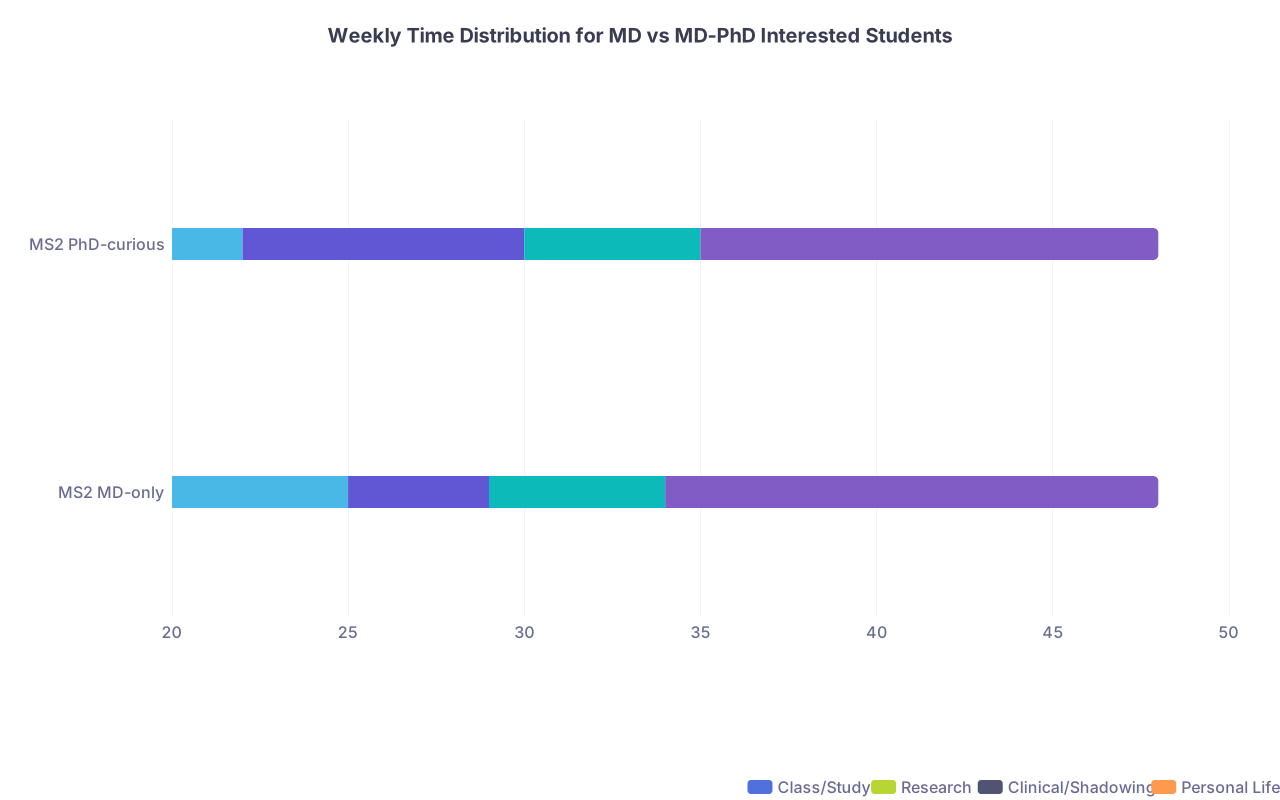
| Category | Class/Study | Research | Clinical/Shadowing | Personal Life |
|---|---|---|---|---|
| MS2 MD-only | 25 | 4 | 5 | 14 |
| MS2 PhD-curious | 22 | 8 | 5 | 13 |
Month 13–14: Start Your “Mini‑PhD Block”
At this point you should aim for a consistent weekly rhythm:
- Fixed research block(s): e.g., Tuesday 2–5 pm, Saturday morning
- Standing meeting with your mentor or lab group every 2–4 weeks
- One small deliverable every 4–6 weeks:
- Abstract draft
- Data collection milestone
- Analysis first pass
- Slide deck for lab meeting
Then you watch yourself:
- Are you looking forward to these blocks or trying to swap them away?
- Do you find yourself thinking about the project between scheduled times?
- Are you naturally reading related papers at night without being forced?
People who truly need a PhD often can’t help going deep. It leaks into their “free time.”
Month 15–16: Present Something Publicly
At this point you should force a public test:
- Submit a poster to:
- Your school’s research day
- A regional specialty conference
- Or present at:
- A lab meeting
- A departmental works‑in‑progress session
This does two things:
- Shows you if you enjoy talking about data and ideas in front of smart people
- Gives you realistic feedback on the quality of your work and your comfort in the research world
If presenting your work is the best part of your month? That’s a clue.
If it feels like pure obligation and you’re checked out at the Q&A? Also a clue.
Mid‑MS2 (Month 17–20): Hard Questions, Hard Answers
This is where you stop being hypothetical and start being honest.
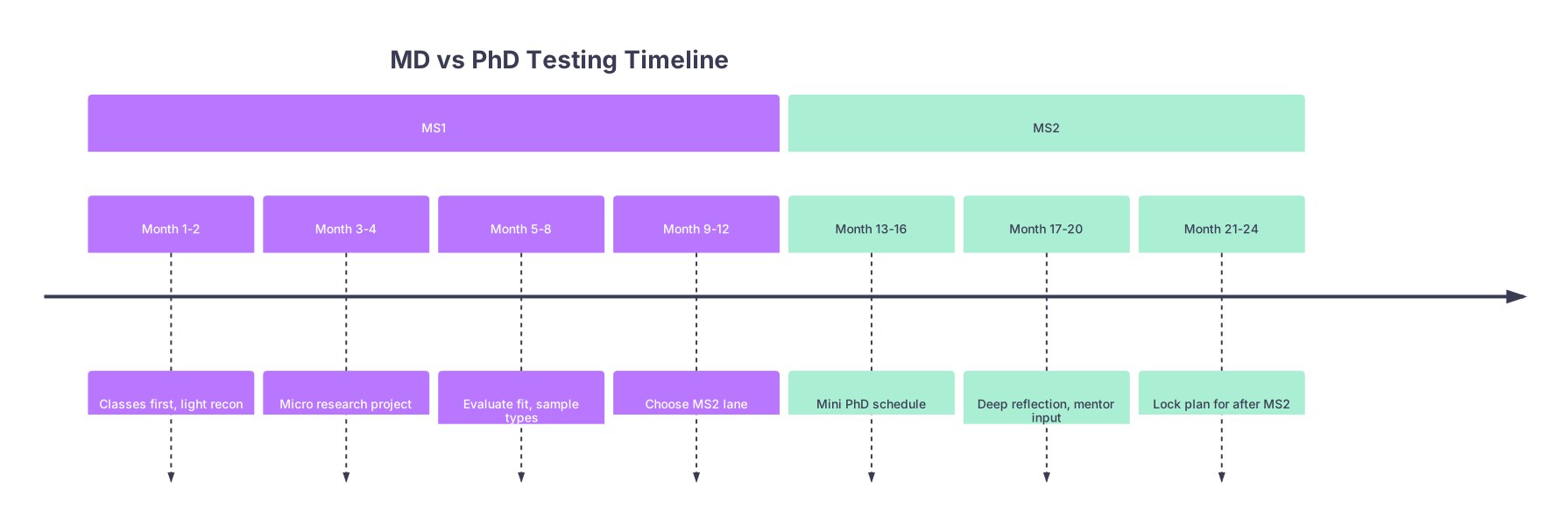
| Period | Event |
|---|---|
| MS1 - Month 1-2 | Classes first, light recon |
| MS1 - Month 3-4 | Micro research project |
| MS1 - Month 5-8 | Evaluate fit, sample types |
| MS1 - Month 9-12 | Choose MS2 lane |
| MS2 - Month 13-16 | Mini PhD schedule |
| MS2 - Month 17-20 | Deep reflection, mentor input |
| MS2 - Month 21-24 | Lock plan for after MS2 |
Month 17–18: Structured Reflection
At this point you should do a more formal self‑interview. Write the answers, do not just think them.
Questions:
If someone offered me:
- A top MD‑only spot with 2–3 protected research months
- A longer MD‑PhD path with 3–4 extra years
Which would I actually choose today, and why?
Do I enjoy:
- Generating hypotheses from messy clinical patterns
- Designing and troubleshooting studies
- Sitting with statistical output or bench results
How do I react to:
- Rejection emails from journals
- IRB revisions
- Reviewer #2 asking for “one more analysis” or “one more experiment”
PhD life is 50–70% dealing with the above on repeat. If that thought exhausts you, listen to that.
Month 19–20: External Reality Check
At this point you should go back to your core mentors and show them:
- Your CV with current projects
- A summary (1 page) of:
- What research you’ve done MS1–MS2
- What you liked
- What you couldn’t stand
- Where you see yourself in 10 years (real answer, not brochure‑speak)
Then ask directly:
“Given what you’ve seen of me in the last 2 years, do you think I’d actually benefit from and enjoy doing a PhD, or should I focus on being a strong research‑oriented MD?”
Notice:
- Do they hesitate when you say “PhD”?
- Do they say, “You definitely don’t need it for what you want”?
- Or, “If you want to compete for X/Y/Z, a PhD will open doors and you actually seem to like this stuff”?
You’re not outsourcing the decision, but you should be using data from people who’ve watched you work.
Late MS2 (Month 21–24): Lock Your Post‑MS2 Direction
By the time you’re nearing dedicated Step/Level study, you must stop waffling. The worst outcome is half‑committing to a PhD while building an MD‑only CV and vice versa.

Scenario A: You Decide “MD‑Only, Strong Research”
At this point you should:
- Double down on:
- Finishing current projects to publication or at least submission
- Taking leadership in at least one project (first‑ or second‑author if possible)
- Plan for:
- A research‑heavy summer / early MS3 block
- Possibly a research year later only if you need it for hyper‑competitive specialties
You do not need a PhD if:
- You want to be a strong clinician who collaborates on research
- You enjoy research as a side dish, not the main course
- You care more about education, leadership, or clinical innovation than R01s
Many successful academic physicians are exactly this.
Scenario B: You Decide “I Probably Need the PhD”
If, after two years of trying to talk yourself out of it, you still:
- Crave deeper methods training
- Enjoy the process even when it’s tedious
- Get more satisfaction from moving the science than from individual patient encounters
…then you’re probably in the group that should seriously plan for a PhD or equivalent advanced research training.
Your next steps might include:
- Exploring:
- MD‑PhD transfer options (rare, school‑specific)
- Taking time after MS2 or after Step for a formal research year or Master’s with the clear intent to apply to PhD or PSTP‑style paths
- Talking to:
- Your MSTP director or equivalent
- Current MD‑PhD students about how they sequenced things
- Strategically aligning:
- Your projects with a specific niche (not just random research buffet)
You still don’t decide your entire life right now. But you stop pretending the PhD question is hypothetical.
Quick Reality Filters: Do You Actually Need a PhD?
If you’re still confused, run yourself through these rough filters:
You likely do NOT need a PhD if your future vision is:
- “I want to be a great clinician who publishes a few papers a year.”
- “I like QI, education research, or clinical outcomes at a collaborator level.”
- “I care more about teaching, mentoring, and patient care.”
You might genuinely benefit from a PhD if your future vision is:
- “I want to run a lab or be PI on multi‑center trials routinely.”
- “I want deep expertise in methods (genomics, biostats, health policy modeling, etc.).”
- “I’m okay with slower clinical training if it means higher ceilings in research.”
That’s the distinction most applicants ignore.
FAQ (4 Questions)
1. If I already know I love research, should I commit to MD‑PhD now and stop this two‑year “test”?
No. Loving research as an undergrad and loving research while juggling med school are different things. Use MS1–MS2 to see how you handle research on top of heavy clinical content and exams. If you still love it then, your decision will be stronger and more realistic.
2. Will doing “too much” research in MS1–MS2 hurt my grades or Step score?
If your grades or practice scores are slipping, yes. Programs will not be impressed by six posters if your board score is weak. Cap research time (e.g., 5–8 hours/week) and protect your exam prep. The point of this two‑year plan is to test fit, not to wreck your transcript chasing publications.
3. Is taking a dedicated research year after MS2 a good alternative to a PhD?
For many students, yes. A well‑structured research year with a strong mentor can give you serious research chops, publications, and clarity about whether you ever need a full PhD. If you finish that year and still want more, you can reconsider formal dual‑degree or PSTP‑type paths later.
4. What if my school’s research options are weak—can I still test whether I’d want a PhD?
You can, but you’ll need to be more proactive. Look for collaborations with nearby institutions, remote data projects, or national networks (e.g., specialty societies). Focus on at least one project where you’re involved in design and analysis, not just grunt work. The key question remains: when you’re doing real intellectual work on a project, do you feel more alive or more drained?
Open your calendar right now and block a 30‑minute slot this week labeled “MD vs PhD check‑in.” In that block, write down what you’ve actually done for research so far and how it felt. That’s the first real data point in your two‑year experiment.