
You tell yourself it's manageable.
You didn't match. SOAP is moving fast. You're tired, embarrassed, and not operating at full speed. A few emails wait. One document still needs cleanup. You miss a window, then another, and the story you tell yourself is simple: If this cycle doesn't work, I'll just reapply stronger next year.
That's the mistake.
I've seen applicants treat late SOAP readiness like a temporary inconvenience when programs often read it as something else entirely: unreliable logistics, weak follow-through, shaky fit, poor readiness under pressure. Fair or not, that perception can stick. And once it sticks, your reapplication doesn't start from zero. It starts with questions.
This article is here to protect you from that quiet damage. I'm going to show you how late SOAP behavior creates bad downstream signals, the red flags programs notice immediately, and the exact steps to stabilize your situation before "late" turns into "forgettable."
The Data Problem: Why Late SOAP Declines Can Follow You
Programs don't need to think you're a bad person to move on from you. They just need to decide you're risky.
That's the core problem.
During SOAP, timing is not a cosmetic detail. It's a readiness signal. If your responsiveness starts slipping, your packet is incomplete, your scheduling energy drops, or your availability keeps changing, programs don't usually interpret that as "this person had a rough week." They interpret it as operational risk.
And programs hate operational risk.
Here's what "declining SOAP late" really looks like in the real world:
- Repeated delays answering outreach
- Long silent gaps after an initial fast response
- Documents that arrive in pieces instead of as a clean packet
- A CV that's outdated or inconsistent with the application record
- Recommendation letter issues you should have solved earlier
- Interview scheduling that feels hesitant, vague, or hard to pin down
- Last-minute statements like "I'm trying to figure out travel/logistics"
None of this has to be malicious to hurt you. It just has to make a program wonder whether the rest of your year will look the same.
And don't cling to the worst misconception in this whole process: "It won't matter because I'll reapply." Wrong. Reapplication is not a magical reset button. It's a second review of your judgment, your progress, and your ability to fix prior weaknesses. If your SOAP behavior this year suggested disorganization, next year's application has to overcome that narrative.
That's why timing matters so much. Not because a late response is morally bad. Because it becomes evidence.
Read that chart the right way. It is not claiming an exact match rate. It's showing the pattern I keep seeing: once an applicant's SOAP behavior becomes fragmented, other trust signals usually fall with it.
That's the part people miss. Late behavior rarely stays isolated. It spreads:
- slower replies become fewer interviews
- fewer interviews become weaker momentum
- weaker momentum becomes a vague reapply story
- vague reapply stories lose
Where Applicants Get Burned: The 6 Mistakes That Look Small, Until They Aren't
These are the mistakes that feel minor in the moment and expensive later.
1) Treating late SOAP as "optional" instead of a trust test
This is the dumbest mistake because it's so preventable.
SOAP is not the part of the cycle where you get casual. It is the part where programs are actively testing whether you can function under compressed timelines. If your response pattern says "I'll get to it," they hear, "You may be hard to manage."
Avoid it:
- Set a personal response SLA: same-day, every time
- Check channels at fixed intervals
- Use one device setup that you actually monitor
- If you need time for a full answer, send a brief acknowledgment first
A short "Received, sending complete packet by 3 PM Eastern" is far better than silence.
2) Submitting incomplete materials
Incomplete materials scream one thing: you were not ready when readiness mattered.
I've seen applicants lose ground over:
- unexplained CV gaps
- personal statement versions that don't match their current target
- missing updates after graduation
- letters delayed because no one followed up aggressively enough
- date inconsistencies across documents
Programs don't enjoy detective work. They won't reward you for creating it.
Avoid it with a final completeness checklist:
- CV updated and date-checked
- personal statement aligned to specialty and current year
- letters verified and timed
- transcript/MSPE status confirmed
- contact info current
- all files named consistently
- one master packet reviewed by another human
Don't hit send on a patchwork application. That's how people get quietly screened out.
3) Waiting for program-specific cues before acting
Another common trap. You sit there waiting for a perfect signal from each program before preparing outreach, scheduling language, or your packet. By the time you act, the window has moved.
Programs reward readiness, not hesitation.
Avoid it: Prepare a standard, high-quality outreach set in advance:
- a concise email template
- a 30-second phone script if needed
- a clean packet ready for immediate transmission
- a one-line explanation of your availability
- a short summary of why you fit the program
Not a six-paragraph essay. Not emotional unloading. Just professional readiness.
4) Slow turnaround after outreach
This one burns applicants fast. They respond once, then disappear while trying to "get organized." That gap is deadly.
Programs often compare applicants in real time. If one candidate confirms an interview slot, updates documents, and answers logistics immediately while another candidate drifts for hours, guess who looks safer?
Exactly.
Avoid it by rehearsing logistics before you need them:
- know where your documents live
- know who can retrieve or resend files if needed
- have your calendar blocked and visible
- test your interview platform
- know your truthful travel and location constraints
Don't improvise your operational life in the middle of SOAP.
5) Over-explaining in a way that reduces confidence
Applicants get embarrassed and start writing apology novels. Big mistake.
Long explanations often make things worse because they sound unstable, defensive, or needy. Programs don't need your spiral. They need a competent correction.
Bad version:
- "I'm so sorry, it's been such a crazy week and I've had several things going on and I wasn't sure if..."
Better version:
- "Thank you for the outreach. I've updated my packet and am available today from 2-6 PM Eastern and tomorrow 8 AM-1 PM Eastern. Attached are the corrected materials."
That's it. Own the issue. Fix it. Move.
Use this formula:
- acknowledge
- correct
- state availability
- state next step
Short. Clean. Calm.
6) Building a reapply plan too late
This mistake is poison because it feels reasonable.
Applicants think reapplication planning starts after SOAP ends. No. If SOAP is not going your way, remediation starts now, during the current cycle, while details are fresh and before weak habits harden into your next application.
Start immediately:
- identify document problems now
- request feedback where appropriate
- map letter writers now, not six months later
- schedule interview prep early
- define measurable additions to your CV
- fix your workflow system before next season
The strongest reapplicants are not people who "try again." They are people who can prove they changed something concrete.
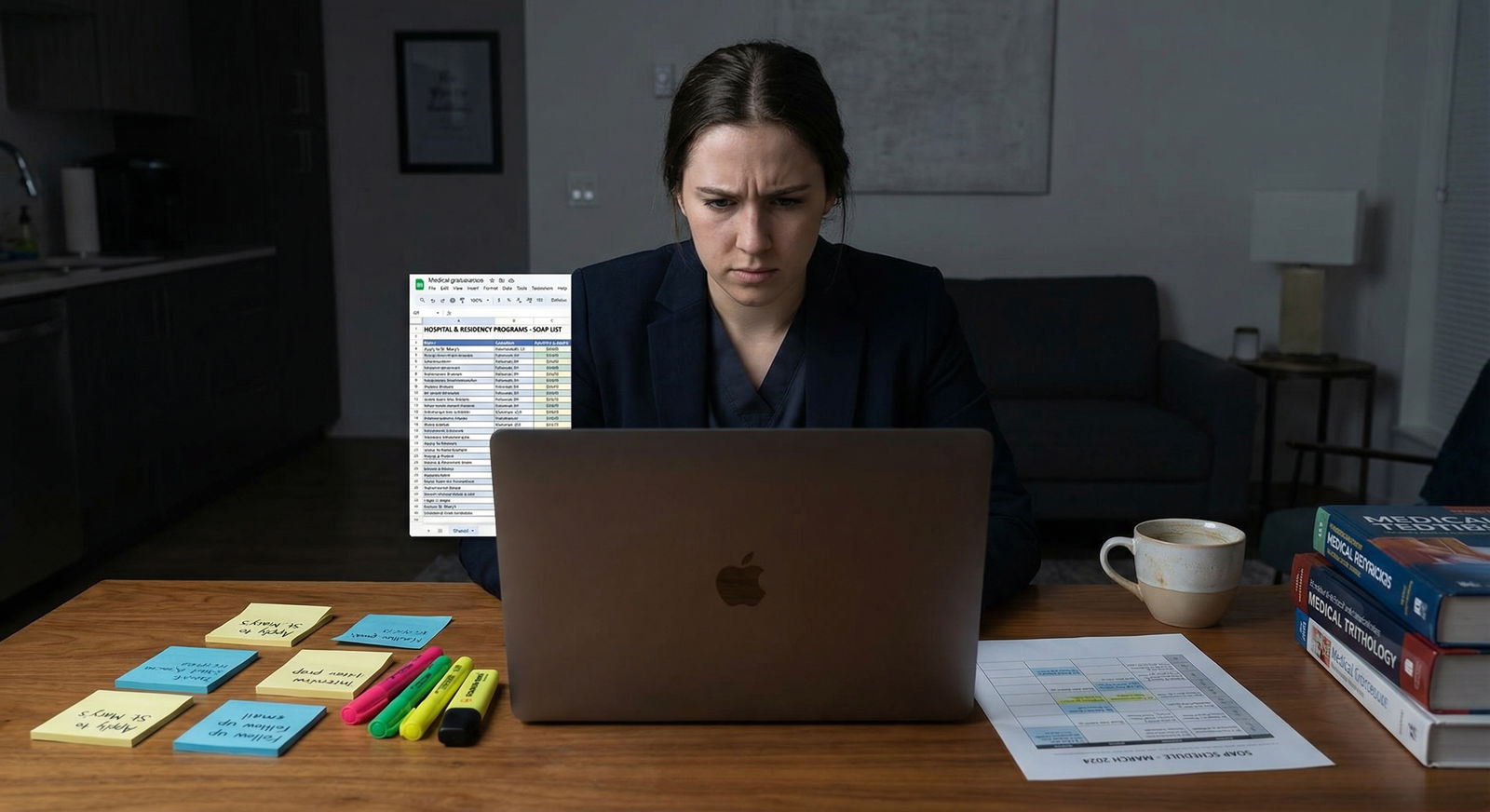
Red Flags Programs Notice Immediately (Even If You Think They Won't)
You are being read for patterns. Fast.
Here are the red flags that jump off the page:
Inconsistent availability statements
If you say you're available anytime, then can't take a call for six hours, you've damaged trust. If you give one window to one program and a conflicting story to another, that gets noticed too.
Protect yourself: lock a truthful availability window and update it promptly when something changes.
Document version drift
Old CV. Missing publication update. Personal statement not aligned. Different dates in different files. This looks sloppy, and sloppy applicants are not reassuring in March.
Protect yourself: use one master SOAP packet and strict version control.
Communication volatility
Fast reply. Then silence. Then urgent follow-up. Then silence again.
That pattern makes people nervous because it hints at chaos behind the scenes.
Protect yourself: maintain a predictable cadence. If you'll follow up at 4 PM, follow up at 4 PM.
Deferred accountability language
Phrases like:
- "I was going to work on that next cycle"
- "I haven't had time to fully revise it yet"
- "I plan to address that eventually"
That language tells a program you know the issue exists but don't treat it as urgent.
Protect yourself: use ownership language. "I identified the gap, corrected X, and scheduled Y."
Reapply narrative with no concrete changes
Saying you'll be stronger next year means nothing unless you can name what will be different.
Protect yourself: specify measurable changes:
- new letters
- research output
- sub-I improvement
- interview coaching
- updated scheduling system
- clear specialty targeting
Asking for exceptions without showing preparedness
If you need flexibility, fine. But pair the request with competence.
Bad:
- "Could you make an exception? I'm still trying to gather things."
Better:
- "My updated packet is attached. I can interview tomorrow morning or afternoon, and if needed I can provide the remaining letter by 5 PM Eastern."
What "Good Late SOAP" Actually Looks Like: A Practical Standard
If you are already late, your goal is not perfection. Your goal is recovery without self-sabotage.
Here's the standard. Non-negotiable.
1) Fast response
Not "when I get a moment." Fast.
Target:
- acknowledge same day
- send complete follow-up as promised
- never let a message sit because you're crafting the perfect wording
2) Complete materials
A late applicant with a clean packet can still look serious. A late applicant with broken materials looks finished.
Your packet should include:
- updated CV
- correct and current supporting documents
- consistent dates
- specialty-appropriate narrative
- accurate contact information
3) Clear availability boundaries
Don't pretend to be infinitely available if you're not. That backfires.
Use language like:
- "I'm available today 1-5 PM Central and tomorrow 8-11 AM Central."
- "If an alternate time is needed, I can adjust with two hours' notice."
That sounds adult. Because it is.
4) A short late-response template
Use this structure:
Subject: Updated materials and availability
Body:
- Thank you for reaching out.
- I've attached my updated packet.
- I'm available [specific windows].
- If helpful, I can also provide [specific missing item] by [time].
- I appreciate your consideration.
That's enough. Don't send your autobiography.
5) Scheduling readiness
If logistics are uncertain, decide quickly.
Know:
- where you can interview from
- what device you'll use
- what backup internet option you have
- whether travel is realistic
- who you need to notify if timing changes
A truthful no is better than a flaky yes.
6) Reframing "I'm late" without sounding weak
You do not need to grovel. You do need to demonstrate correction.
Good framing:
- "I identified an inconsistency in my packet and corrected it immediately."
- "My availability is now confirmed, and I'm prepared for next steps."
- "I've attached the updated materials in one file set for easier review."
That language restores confidence.
Professionalism matters here more than people admit:
- calm tone
- consistent formatting
- accurate dates
- no frantic punctuation
- no contradictions across messages
Tiny details. Big consequences.
Action Steps: Don't Wait, Run the 72-Hour SOAP Stabilization Plan
If your SOAP readiness is slipping, stop improvising. Run a controlled recovery.
Hour 0-6: Lock the master packet
Build one source of truth.
- final CV
- updated documents
- correct dates
- verified contact info
- one folder, one naming system
No duplicates. No mystery versions. No "final_FINAL2."
Hour 6-24: Set your response SLA and outreach cadence
Decide how you will respond before messages arrive.
- same-day acknowledgment
- follow-up windows on your calendar
- prewritten outreach for likely program scenarios
- one concise script for email and phone
Hour 24-48: Confirm real availability and logistics
This is where people lie to themselves. Don't.
- block truthful interview windows
- test tech
- identify backup location/internet
- decide travel contingencies
- alert anyone helping you with documents
Hour 48-72: Send updates and correct deficiencies
Now act.
- send targeted updates
- attach corrected packet
- close document gaps
- keep a log of every outreach and response
- follow through exactly when promised
Reapply bridge: start remediation now
Don't wait for the season to officially end.
- map your letters plan
- fix CV weaknesses
- begin interview prep
- identify measurable achievements for the next cycle
- build a better scheduling and communication system

Here's the blunt truth: late SOAP behavior can absolutely bleed into weaker reapply odds if it broadcasts unreliability, confusion, or passivity. Don't make the mistake of assuming next year will forgive what this year exposed.
Your protection is operational, not emotional. One master packet. One response standard. Verified availability. Immediate remediation.
Don't wait. That's how applicants sink quietly.