SOAP not working is not the end of your career. Failing to respond strategically to it is.
If you did not match and then came out of SOAP still empty-handed, you are in a high‑risk category—but not a doomed one. I have watched applicants go from “completely unmatched” to “solid categorical spot” the next cycle. The difference was never luck. It was structure, honesty, and execution.
This is the blueprint I wish every post‑SOAP applicant would follow the week after Match, not three months later when panic finally wears off.
Step 1: Stabilize Your Situation (First 72 Hours)
You cannot build a competitive reapplication on chaos.
1.1 Get your basic year plan on paper
Before you obsess over ERAS, you must answer three non‑negotiable questions:
- Where will you physically be for the next 12 months?
- How will you support yourself financially?
- What will you be able to list under “current position” on your next ERAS?
Take one evening and write this out. Not vibes. A real, written plan.
Options most people use for the “gap” year:
- Research position (paid or unpaid)
- Preliminary or transitional year (if you got any offers outside SOAP)
- Clinical instructor / teaching fellow roles
- Dedicated clinical observerships / externships (for IMGs)
- Non‑clinical work (scribe, telemedicine support, quality improvement roles, etc.) paired with structured volunteer clinical exposure
If none of that is lined up yet, that is fine right now—but you need to know which direction you are targeting so your next steps are coherent.
1.2 Stop the random emailing
The worst pattern I see: people start blindly emailing 50–100 programs asking for “any open positions” the week after SOAP. Almost none of that converts, and it burns your mental energy fast.
Instead:
- Give yourself a 7‑day pause before mass outreach.
- Use that week for analysis and strategy only.
- After that, outreach will be narrow and targeted, not desperate spam.
Step 2: Perform a Ruthless Post‑Mortem
If you reapply with the same profile and same behavior, you will almost certainly get the same result. Your job now is to figure out which buckets your problem lives in.
| Category | Typical Red Flags |
|---|---|
| Academics | Multiple fails, low Step 2, gaps |
| Application Strategy | Too few programs, wrong mix, late apps |
| Specialty Fit | Hypercompetitive choice with weak stats |
| Clinical Record | Weak letters, no US experience, red flags |
| Communication | Poor interviewing, generic PS |
2.1 Pull your actual numbers
Write them down, do not guess:
- USMLE/COMLEX scores and attempts
- Class rank / decile / GPA if applicable
- Number of programs applied to (by specialty)
- Number of interview invites and attended
- Number of programs ranked
- SOAP applications sent and any responses
Then compare, not to Reddit, but to realistic benchmarks.
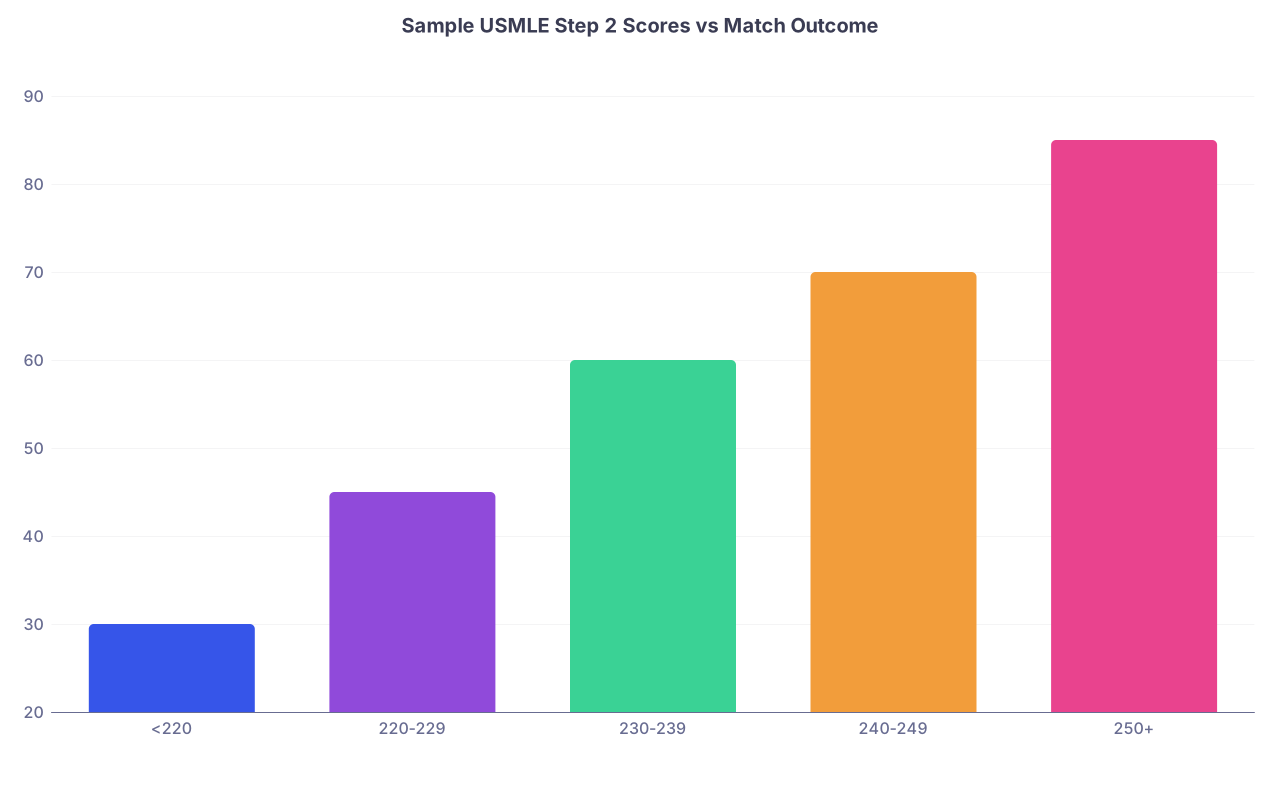
| Category | Value |
|---|---|
| <220 | 30 |
| 220-229 | 45 |
| 230-239 | 60 |
| 240-249 | 70 |
| 250+ | 85 |
Those numbers represent rough “match success likelihood” in relatively non‑competitive specialties when the rest of the application is decent. If you are sitting at 212 with multiple failures and applied to dermatology, we do not need a 3‑hour autopsy. Your issue is obvious: mismatch between profile and specialty.
Be honest about which of these describe you:
- Low or multiple‑attempt board scores
- Borderline or failing clinical grades
- Very late application submission
- Too few interviews (<10 in IM, <8 in FM, etc.)
- Overly competitive specialty given your stats
- Weak or generic letters
- Red flag(s): professionalism issues, leaves, unexplained gaps
You want to circle 2–3 primary causes of not matching. Not 12. If everything is “sort of a problem,” nothing gets fixed.
Step 3: Decide—Reapply Same Specialty, Pivot, or Hybrid
This is where most people make the biggest mistake: they cling to a specialty that no longer matches their risk profile.
3.1 Hard questions to answer (in writing)
- Did I get enough interviews for my specialty?
- Example: IM categorical – fewer than ~10 US interviews is a bad sign.
- Did programs actually rank me? (Ask yourself honestly: did I have strong interview days and post‑interview contact?)
- Would a reasonable PD say, “I would gladly work with this person 80 hours a week”?
If you had:
- Reasonable stats
- 10–15+ interviews
- Decent feedback
- And still did not match
Then your problem is more likely:
- Interview performance
- Personality fit
- Application story coherence
If you had:
- Weak stats or multiple fails
- Very few interviews
- Or chose an ultra‑competitive specialty
Then specialty choice and raw competitiveness are probably the main issues.
3.2 Three paths that actually work
Reapply same specialty, improved application
- You were close. You had interviews, reasonable numbers, and positive signals.
- Focus: interview skills, stronger letters, better narrative, tighten red flags.
Pivot to a less competitive specialty
- You were far off. Low scores, weak interview count, or chose something like derm, ortho, plastics, ENT, IR, etc.
- Focus: rebuild around FM, IM, psych, peds, pathology (for some profiles), or prelim year route.
Hybrid: apply to primary specialty + backup seriously
- Not “I threw 5 apps to FM.” That does not count.
- Example: 60 IM + 80 FM, both with tailored materials, real interest, and mentors in both.
If you cannot say, out loud, which of those three you are choosing by May, you are already behind.
Step 4: Build the Year‑Long Recovery Plan
Here is where we stop diagnosing and start fixing.
4.1 Non‑negotiable elements for this year
You need at least three of these during your gap year:
- Clinical exposure in your intended specialty (US‑based if possible)
- New, strong letters of recommendation
- Concrete productivity: research, QI, teaching, leadership
- Demonstrable professionalism and reliability in a team setting
Let me turn that into a real blueprint.
4.2 Sample one‑year reapplication blueprint
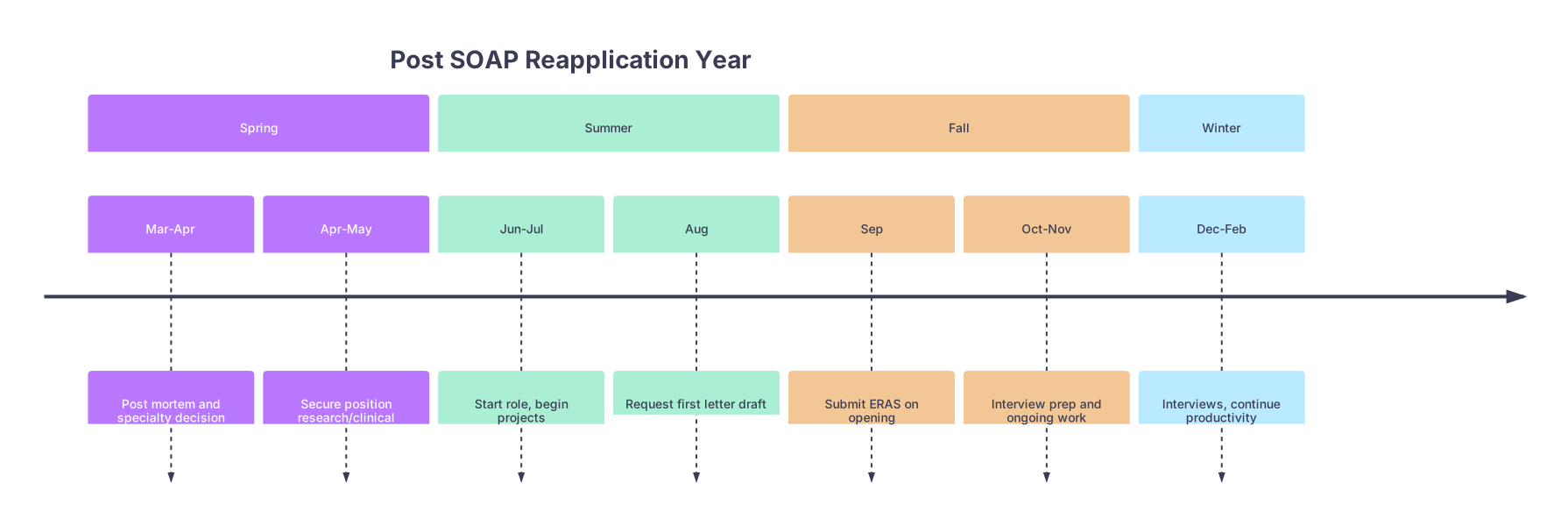
| Period | Event |
|---|---|
| Spring - Mar-Apr | Post mortem and specialty decision |
| Spring - Apr-May | Secure position research/clinical |
| Summer - Jun-Jul | Start role, begin projects |
| Summer - Aug | Request first letter draft |
| Fall - Sep | Submit ERAS on opening |
| Fall - Oct-Nov | Interview prep and ongoing work |
| Winter - Dec-Feb | Interviews, continue productivity |
Months 1–2 (March–April)
- Decide on specialty / backup strategy.
- Meet with:
- Your Dean or student affairs advisor.
- At least one program director or associate PD in your target field.
- Secure something concrete:
- Research assistantship
- Clinical fellowship / observer job
- Teaching fellow role
- Strong longitudinal volunteering with clinical exposure if nothing else exists
If you do none of this and simply “rest and see,” you will show up to ERAS almost unchanged.
Months 3–6 (May–August)
- Start your new role.
- Immediately become “the reliable person”:
- Show up early.
- Volunteer for extra tasks.
- Ask for a QI project or small research question you can own.
- Target: at least one poster/abstract submission by fall, or at minimum a QI project clearly described.
By August:
- Identify 2–3 letter writers who:
- Know you well.
- Work in your target specialty or closely related.
- Are willing to comment on your growth, reliability, and clinical aptitude.
Step 5: Fix Each Major Weakness Systematically
You are not going to fix everything. You will fix the top 2–3 weaknesses that cost you the match.
5.1 If your Step scores or attempts are the main issue
You cannot change past failures, but you can do three things:
- Crush any remaining exams
- Step 3, COMLEX Level 3, or a key shelf/exam if you are still a student.
- A strong Step 3 (for example, >230 in a context of prior low 220s) shows upward trend and readiness for unsupervised practice.
- Have a PD or faculty letter explicitly contextualize
- “Yes, this applicant failed Step 1 once. That is not consistent with their day‑to‑day performance with us. They have been clinically strong, reliable, and their knowledge base is appropriate.”
- Remove any sign of “excuses” from your narrative
- Briefly acknowledge, explain concrete changes, and then pivot to current performance.
5.2 If clinical performance / letters were weak
You cannot reapply with the same mediocre letters and expect a different outcome.
Actions:
- New rotations in target specialty:
- Aim for 2–3 months of strong performance in U.S. clinical settings if you are IMG, or at your home institution / affiliates if you are AMG.
- Explicit letter conversations:
- Tell attending: “I did not match this year. I am working hard to build a stronger clinical record. If things go well this month, would you feel comfortable writing me a supportive letter for residency?”
- Ask for specific feedback mid‑rotation:
- “Are there any specific areas I need to improve before you would feel comfortable strongly recommending me?”
- Then fix those in real time.
5.3 If your problem was interview performance
If you had 10–15 interviews and still did not match, I am almost certain this is a major factor.
You fix this like an exam:
- Record yourself answering standard questions:
- “Tell me about yourself.”
- “Why this specialty?”
- “Tell me about a time you had conflict on a team.”
- “What will you do if you do not match again?”
- Get brutal external feedback:
- Faculty mentor
- Career services
- A friend already in residency
- Script and refine 8–10 core stories:
- One about leadership
- One about failure
- One about ethical dilemma
- One about conflict
- One “proudest clinical moment”
- One “most difficult patient”
- Fix basic presentation issues:
- Over‑talking.
- Monotone delivery.
- Rambling, no clear structure.
- Sounding bitter about not matching.
You become “good enough” at interviewing with 10–15 high‑quality practice sessions, not 2–3.
5.4 If your strategy and timing were bad
Many applicants quietly sabotage themselves with logistics:
- They apply late (October).
- They apply to 20 programs instead of 80.
- They send generic personal statements to 5 specialties.
Next cycle:
- Submit ERAS on day 1. Not “sometime in September.”
- Apply broadly:
- For non‑competitive specialties, 60–100 programs is not excessive if your profile has weaknesses.
- For IMGs, higher.
- Use specialty‑specific materials:
- Separate personal statements.
- Specialty‑appropriate letters in the top 3–4 ERAS slots for each specialty.
Step 6: Rebuild Your Application Documents from Zero
Do not recycle last year’s documents with light edits. Start clean.
6.1 Personal statement: the second‑chance version
You are no longer a generic MS4. You are someone who did not match. Pretending that never happened reads as evasive.
Guidelines:
- Brief, direct acknowledgment in one sentence if you have a clear reason:
- “I did not match during my initial application cycle. Since then, I have spent the past year working full‑time in [role], which has confirmed my commitment to [specialty] and strengthened my skills in [X, Y].”
- Then pivot quickly to:
- What you did this year.
- What you learned about yourself.
- How that makes you a stronger intern.
- Avoid:
- Long emotional narratives about how painful not matching was.
- Blaming others or the system.
- Over‑explaining exam failures.
Your PS should read like someone who took a hit, looked hard at themselves, and got back to work.
6.2 Letters: upgrade or replace
Minimum target:
- 3–4 fresh letters, at least 2 from this gap year.
- At least 1 from a program director, associate PD, or department chair if possible.
You can keep a strong prior letter if:
- The writer is well‑known.
- It is clearly supportive.
- You have fewer recent letters.
But if old letters were generic (“hard‑working, pleasant to work with”) and did not get you interviews, they are not going to save you this time.
6.3 CV and experiences: make them tell a story
Your ERAS experiences should make it obvious that you used this year intentionally:
- Longitudinal role from spring → fall in one main position.
- 1–2 specific projects with measurable outcomes:
- “Reduced clinic no‑show rate by 12% by implementing reminder workflow.”
- “Co‑authored abstract submitted to [conference].”
- Clear leadership and teaching moments.
Do not fill your CV with 10 micro‑volunteering roles that lasted 2 weeks each. One committed position beats scattered noise.
Step 7: Use Targeted Outreach, Not Desperation
Now we talk about emails. The right way.
7.1 Pre‑ERAS relationship‑building
Between May and August:
- Identify 10–20 programs where:
- Your stats are within reasonable range.
- You have some connection (school, region, mentor knows PD, former residents from your school).
- Ask your mentors:
- “Is there any program where you would feel comfortable sending a brief email on my behalf?”
- Send short, specific emails yourself:
- To coordinators asking if they accept reapplicants.
- To faculty you rotated with, updating them on your role and plans.
This is not “begging for interviews.” It is showing that you are serious and organized.
7.2 Post‑ERAS targeted updates
After you submit ERAS:
- Send polite, concise update emails to:
- Programs where you have a real connection.
- Programs where faculty have previously expressed support.
- Content:
- One line about who you are.
- One line about your current role.
- One line about your strong interest and fit.
Do not send 200 identical emails. That looks desperate and is usually ignored.
Step 8: Prepare Emotionally and Logistically for Another Tough Season
Reapplying after SOAP failure is mentally brutal. You will be interviewing while working full‑time and carrying the fear of another failure.
You need systems, not vibes.
8.1 Simple mechanics
- Spreadsheet for:
- Programs applied to
- Interview offers
- Interview dates
- Contacts and notes
- Email template bank:
- Thank‑you email baseline you customize.
- Update letter.
- Interest letter.
8.2 Support and boundaries
- Identify 2–3 people who know your situation and can be your reality check:
- Not the friend who panics with you.
- Someone who will say, “That email sounds desperate. Delete it.”
- Decide now what you will and will not do again:
- How many interviews you can realistically travel to.
- How much money you can spend.
You are not just trying to match. You are trying to survive the process without burning out so much you show up flat in interviews.
Step 9: If You Still Do Not Match—Contingency Inside the Contingency
Here is the harsh truth: reapplicants after SOAP have a higher risk of not matching again. You are fighting uphill. That means you must have a parallel plan.
Reasonable contingencies:
- Pursue a research or teaching path more formally, with an eye toward academic roles that do not require residency.
- Consider non‑physician clinical roles if you are an international graduate with limited US pathways (NP/PA are not easy switches, but some move toward clinical research, administration, or informatics).
- Explore another healthcare‑adjacent career path:
- Informatics
- Public health (MPH)
- Medical education
- Pharma / medical affairs
You do not talk about these in your interviews, obviously. But you owe it to yourself to have them sketched out so this process does not feel like all‑or‑nothing annihilation.
Quick Reality Check: Who Actually Succeeds After SOAP Failure?
Let me be blunt about the pattern I have seen work:
- They do not vanish for six months and “heal.”
- They own their situation quickly and seek uncomfortable feedback.
- They choose a specialty strategy that fits their current profile, not their ego from MS1.
- They spend the gap year in one main role where people can see them work, not 12 fragmented things that pad a CV.
- They practice interviews like they would study for Step.
And they stop telling themselves a story about how they were “unlucky” and start treating this like a solvable problem with clear variables.
Key Takeaways
- Do not reapply with the same profile and story. Identify 2–3 core reasons you did not match/SOAP and build a year around fixing those specifically.
- Anchor your gap year in one strong role that gives you new letters, real responsibilities, and a narrative of growth in your target specialty.
- Treat the next cycle like a structured project, not a redo. Early, broad, strategic applications, rebuilt documents, upgraded letters, and disciplined interview preparation are what move you from “SOAP failed” to “resident.”