
The worst decision you can make after not matching is to pick a “gap year” that doesn’t fix what actually went wrong.
The Core Answer: Research Year vs Clinical Gap Year
Here’s the blunt truth:
- If your biggest problem was your application metrics (Step scores, research, lack of scholarly output, weak CV for competitive specialties), a research year is usually better.
- If your biggest problem was your clinical readiness (weak letters, no strong advocates, limited US clinical experience, performance issues, or needing to change specialties), a clinical gap year is usually better.
- If you’re not sure what your problem was, your first job is to figure that out. Not to sign up for the first random research position you see.
Most unmatched applicants jump to “I’ll do a research year” because it sounds prestigious and productive. For many, that’s the wrong move.
Let’s break this down so you can choose the option that actually increases your chances next cycle.
Step 1: Diagnose Why You Didn’t Match
Before you decide research vs clinical, you need a working diagnosis of why you didn’t match. Otherwise, you’re treating the wrong disease.
Here are the big buckets:
| Main Issue | Better Option | Why |
|---|---|---|
| Low research / weak academic CV in competitive specialty | Research year | Directly addresses competitiveness |
| Weak letters / limited advocacy | Clinical year | Gives you fresh, strong letters |
| Limited or no US clinical experience (USCE) | Clinical year | Fixes biggest red flag |
| Applied too narrowly or only to ultra-competitive specialty | Depends | Might need both: shift specialty + targeted work |
| Step failures or low scores but otherwise OK | Either + score repair | Strategy-driven; often clinical with strong mentorship |
| Poor interview skills | Either | But you must deliberately practice interviews |
How to actually get this diagnosis:
- Talk to your home program director (if you have one in your chosen specialty).
- Ask a mentor to review:
- Your ERAS CV
- Personal statement
- LoRs list (not the content, obviously)
- Score report
- Programs list you applied to
- Ask them one direct question:
“If I change nothing, what are the chances I match next cycle?”
If they hesitate or say “hard to say” for too long, you need substantial change.
If no one can or will give you feedback, that itself is data. You may have a mentorship / advocacy problem. That leans toward a clinical year with strong supervisors who can back you.
Step 2: What a Research Year Really Does (And Doesn’t Do)
A research year isn’t magic. It’s powerful in the right context and almost useless in the wrong one.
A research year is usually best for:
Competitive specialties
Dermatology, plastics, ortho, ENT, neurosurgery, radiation oncology, some ophthalmology programs.
These fields often expect:- Multiple publications
- Posters, presentations
- Evidence you understand the specialty’s academic landscape
Applicants with decent clinical performance but thin academic portfolio
You have:- Solid letters
- No big red flags
- Reasonable scores
But your research is basically: “one poster in M2 at a random conference.”
Applicants who can join a research team tied to a residency program
Key point. Not “any PI anywhere.” Ideally:- At an institution with a residency in your specialty
- With a mentor who has real influence in the match process
Because you’re not just building a PubMed list. You’re building relationships with people who might rank you.
A research year is not very helpful if:
- You bombed multiple rotations or have serious professionalism concerns.
- You need US clinical experience to even be considered (especially for IMGs).
- You’re switching out of a hyper-competitive specialty to something more holistic like FM, IM, psych, peds. Those programs prioritize clinical work and letters over “I have 3 case reports.”
What a strong research year looks like
Not: “I did some data cleaning and maybe a case report.”
You want something like:
- 1–3 first- or co-first-author manuscripts submitted/accepted
- Multiple abstracts/posters at national or major regional conferences
- A PI who:
- Knows you well
- Will write a detailed, personalized letter
- Will pick up the phone or email colleagues when you apply
- Evidence of ownership: leading a project, not just being assigned low-level tasks
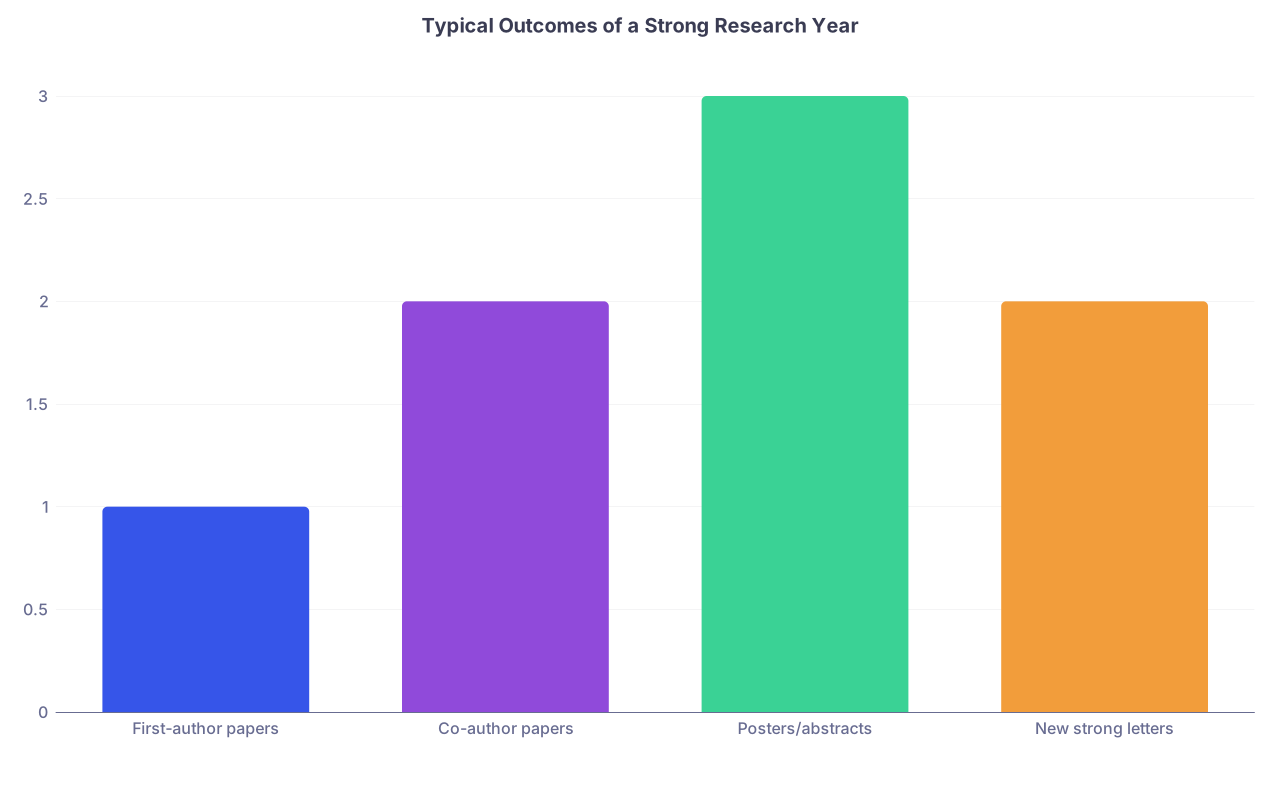
| Category | Value |
|---|---|
| First-author papers | 1 |
| Co-author papers | 2 |
| Posters/abstracts | 3 |
| New strong letters | 2 |
If the research position can’t realistically give you that level of output or connection, it might not be worth burning a year for.
Step 3: What a Clinical Gap Year Really Does (And When It Wins)
A “clinical gap year” can mean a lot of different things:
- Preliminary year (prelim medicine or surgery)
- Transitional year (TY)
- Non-training clinical job (scribe, NP/PA extender role if licensed, hospitalist assistant, clinical instructor)
- Observerships / externships / paid clinical fellow roles (common for IMGs)
Clinical year is usually best for:
Weak or generic letters of recommendation
If your previous letters read like: “X was a fine student, showed up on time, will make a good doctor,” you’re in trouble.
You need fresh letters that say:- “They were in the top 10% of rotators I’ve worked with.”
- “I’d be happy to have them as a resident in our program.”
Limited US clinical experience (especially for IMGs)
Many programs filter out applicants without:- Recent USCE (within 1–2 years)
- Multiple months in the US system A clinical gap year directly fixes this.
Performance or professionalism questions
If someone hinted you had:- Spotty evaluations
- Concerns about reliability, communication, or judgment
A year of strong, documented clinical performance can rehabilitate your reputation.
Changing specialties
Applied to ortho, now pivoting to internal medicine?
You need:- Solid IM rotations or a prelim year
- Letters from IM faculty
- A story that makes sense: you didn’t just fail to match, you discovered a better fit and proved it clinically.
Strong clinical year vs weak clinical year
Strong:
- Prelim/TY where:
- You’re known by name by attendings and PDs
- You get 2–3 very strong letters
- You get explicit support applying to next year’s match
- Or for IMGs:
- Multiple hands-on or closely supervised clinical experiences
- Faculty who can vouch for your skills and reliability
- Documented performance (evals, letters, possibly mini-CEXs)
Weak:
- Random observerships with no evaluation structure
- Shadowing where no one sees you actually do anything
- Scribe or MA work where you never interact with physicians meaningfully for letters

| Step | Description |
|---|---|
| Step 1 | Unmatched Applicant |
| Step 2 | Research Year |
| Step 3 | Clinical Gap Year |
| Step 4 | Get honest feedback |
| Step 5 | Join team linked to residency |
| Step 6 | Work where you can earn strong letters |
| Step 7 | Meet PD or mentor for review |
| Step 8 | Main Weakness? |
Step 4: Special Cases – Where The Answer Changes
Case 1: You failed Step 1 or Step 2, or barely passed
Research year vs clinical year is secondary here. Your main jobs:
- Fix the testing narrative (strong Step 2 or Step 3, no further failures)
- Show consistent, reliable performance over time
Best move usually:
- If you haven’t taken Step 3: plan to take and pass it during your gap year
- Choose the environment where you’ll be best supported and less overworked, so you can actually study and score well
For some, that’s a research year with predictable hours. For others, a lighter clinical role.
Case 2: You applied to 1–2 hyper-competitive specialties only
Example: you only applied to plastics and ortho with 220s and zero research. You didn’t match. No surprise.
You have to decide:
- Double down on that specialty:
- Then you probably need a research year in that field and a much smarter application strategy.
- Or pivot to a less competitive field:
- Then a clinical year + strong new letters in your new specialty may be better.
Doing a generic research year in a totally unrelated field while planning to apply to, say, internal medicine next year? Not very efficient.
Case 3: International Medical Graduate (IMG)
For IMGs, the calculus is different:
- If you have no or minimal recent USCE, a clinical year almost always beats a pure research year.
- If you already have solid USCE and okay scores but no research in a competitive field, then a targeted US research year at a big academic center with that specialty can help.
A hybrid option can be best: research role that also lets you do clinics, inpatient service, or observerships with the same department.
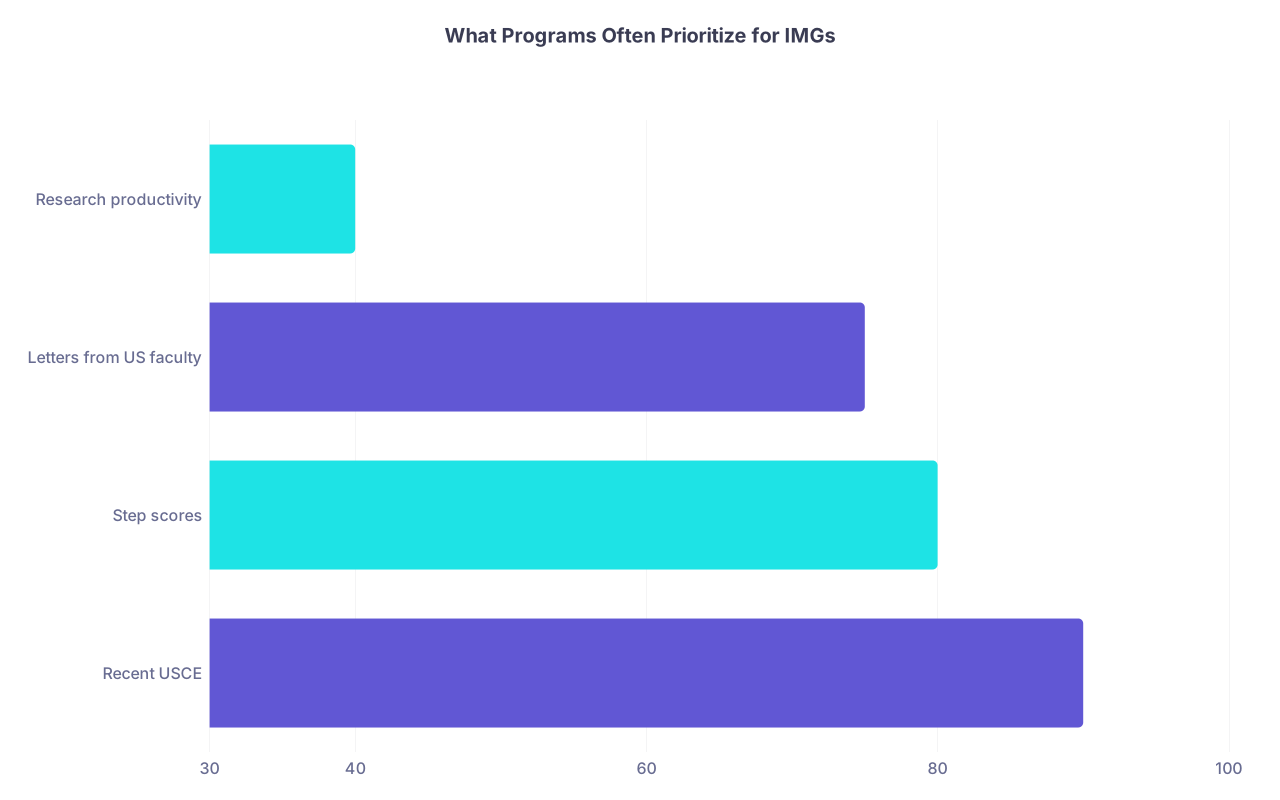
| Category | Value |
|---|---|
| Recent USCE | 90 |
| Step scores | 80 |
| Letters from US faculty | 75 |
| Research productivity | 40 |
(Percentages here represent how often I see these factors mentioned by PDs; not official stats, but the trend is real.)
Step 5: How Programs Actually View Each Option
Programs don’t care that you “kept busy.” They care if your last year moved you closer to being a safe, effective intern.
Roughly how PDs tend to see each:
| Aspect | Research Year | Clinical Gap Year |
|---|---|---|
| Clinical readiness | Neutral to slightly negative (stale skills) | Positive if solid performance |
| Academic potential | Strong positive if productive | Neutral |
| Letters of recommendation | Strong if from well-known PI | Strong if from respected clinicians |
| USCE evidence | Weak unless hybrid role | Strong |
| Specialty commitment | Strong in that field | Strong if gap year in target specialty |
So if your last clinical work was 18–24 months ago and you did only bench research this past year, some PDs will ask: “Are their clinical skills rusted?” For IM, FM, EM, etc., that matters a lot.
Step 6: Red Flags To Avoid In Any Gap Year
I’ve seen people waste a year by doing the right “category” in the wrong way. Avoid the following:
- Unguided research: No clear project, no timeline, no expected output. You end the year with “I helped on some things” and nothing on PubMed.
- Paper-only observerships: Places that give you a “certificate” but no meaningful interaction or letter.
- No plan for letters: If you can’t answer, “Who will write my 3 best letters next cycle?” your plan is incomplete.
- No interview prep: Many unmatched applicants actually got enough interviews but tanked them. If that’s you, any gap year must include structured interview practice.
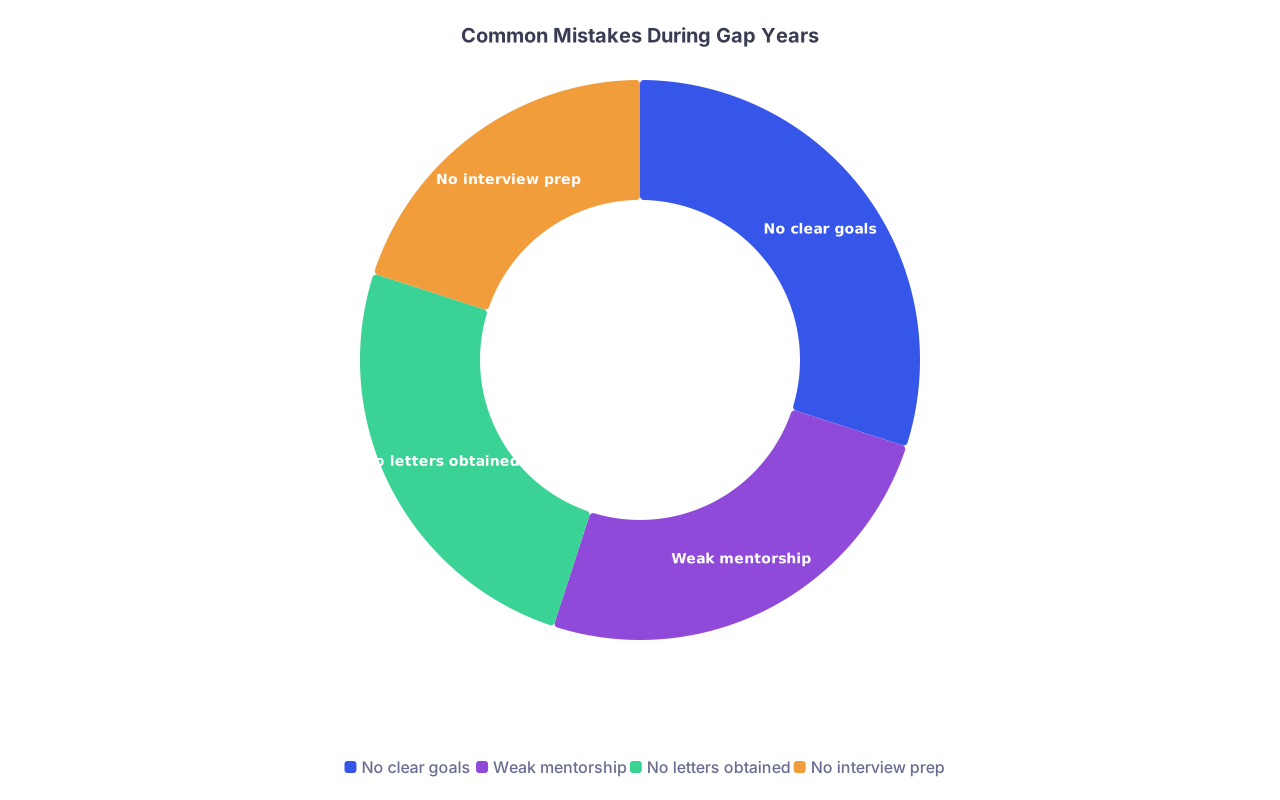
| Category | Value |
|---|---|
| No clear goals | 30 |
| Weak mentorship | 25 |
| No letters obtained | 25 |
| No interview prep | 20 |
Step 7: How To Decide – A Simple Framework
If you want a decision rule, use this:
Was lack of research / academic productivity specifically mentioned as a major weakness, especially for a competitive specialty?
- Yes → Strongly consider a research year connected to that specialty.
- No → Go to 2.
Do you lack strong, recent, specialty-specific letters from people who know you well?
- Yes → Clinical gap year in that specialty.
- No → Go to 3.
Are you an IMG without recent USCE?
- Yes → Prioritize clinical year / USCE, potentially with hybrid research.
- No → Go to 4.
Did you receive several interviews but no rank or no match?
- Might be primarily an interview / fit problem. Either path can work, as long as you:
- Build a consistent story
- Fix any other glaring hole
- Practice interviews intensively
- Might be primarily an interview / fit problem. Either path can work, as long as you:
Which option gives you a clearer path to 2–3 powerful, specific letters and one clear narrative about growth?
- That’s your better choice.

| Step | Description |
|---|---|
| Step 1 | Main Weakness Identified |
| Step 2 | Research Year in target specialty |
| Step 3 | Clinical Gap Year with strong supervision |
| Step 4 | Plan for output and strong PI letter |
| Step 5 | Plan for new letters and evals |
| Step 6 | Academic vs Clinical? |
FAQs
1. Is a prelim or transitional year better than a pure research year?
If your main issue is clinical readiness, letters, or USCE, then yes, a prelim/TY is usually more valuable than a pure research year. Programs like seeing you function as an actual intern. But if you’re dead-set on a hyper-competitive specialty that lives and dies by publications, and you already have decent clinical evaluations, a research year embedded in that specialty can be more strategic.
2. Can I combine research and clinical work in the same gap year?
Yes, and often that’s ideal. Many departments will let you:
- Do 60–80% research
- Attend clinic, rounds, or do structured observerships
- Earn letters from both researchers and clinicians
If you can find a position like “research fellow in dermatology” where you also attend clinics and conferences, that’s gold.
3. Will doing a research year hurt my application for non-academic or community programs?
Usually not, if you can explain it clearly. Community programs don’t reject you just because you did research. They do worry if you haven’t touched patients in 2–3 years and look clinically rusty. So if you go the research route and plan to apply broadly (including community programs), try to keep some clinical exposure or at least be ready to address how you’ve kept your skills and knowledge up.
4. What if I can’t get a formal research or clinical position right away?
Then you need a patchwork strategy:
- Short-term observerships or externships
- Remote or part-time research with a faculty mentor
- Intensive exam prep if you still need to fix score issues
You don’t need a fancy titled position. You do need: specific activities that turn into lines on your CV and letters in ERAS. Keep everything documented with dates, duties, and supervisor names.
5. How do I explain my gap year in interviews next cycle?
You frame it as intentional repair and growth, not “I just had to do something.” For example:
- Research year:
“I realized for dermatology I needed a stronger academic foundation. I joined Dr X’s lab, led two projects on Y, presented at Z, and it deepened my interest in A and B aspects of the field.” - Clinical year:
“I wanted more hands-on experience and feedback in internal medicine. This year as a prelim/TY at [Hospital], I’ve managed a wide range of patients, received structured evaluations, and earned letters that reflect who I am now as a clinician.”
Open a blank document right now and write two columns: “Research year” and “Clinical year.” Under each, list exactly which weaknesses that path would fix for you—by name. If one column isn’t clearly solving your actual problems, don’t choose it.