

The blunt truth: most unmatched applicants either overshare or completely ignore it in their personal statement—and both approaches can kill your application.
You should almost never pretend it did not happen. But you also should not turn your personal statement into a confession letter. The trick is knowing when to address it, how directly, and how briefly.
Let me walk you through it like I would with a resident reapplying this cycle.
The Core Question: Should You Explain It At All?
Here’s the answer you’re looking for:
- Yes, you should usually acknowledge being unmatched.
- No, you should not make your whole personal statement about being unmatched.
- You must frame it around growth, readiness, and fit for this specialty—not around pain, grievance, or excuses.
Programs will see your SOAP history, gaps, and reapplication through ERAS and your CV. They are not stupid. If you ignore it completely, they do not think, “Oh maybe this person just took a peaceful year off.” They think, “Why is this not addressed?”
But there are right and wrong ways to bring it up.
When You Must Address Being Unmatched
If any of these apply, you should address your unmatched status directly but briefly in your personal statement:
- You are reapplying to the same specialty.
- You have no new major credential that obviously explains the gap (e.g., research year, MPH, full-time clinical job).
- Your application has clear weaknesses from last cycle (low scores, limited experiences, red flags) that you’ve since worked on.
If you are switching specialties and the story is clean (for example, applied to surgery, realized you truly want FM, now have strong FM experiences), you might minimize the unmatched discussion in the personal statement and let your MSPE/letters explain more. But you’ll still need a line or two acknowledging what happened.
Where you absolutely cannot stay silent:
- You went unmatched more than once.
- You have a large time gap (1+ year) with no clear structured activity.
- Your prior specialty choice and new specialty choice look completely misaligned with no explanation.
Where To Explain It: PS vs Other Parts of ERAS
The personal statement is not the only place to talk about this. In fact, it should not carry the entire burden.
Think of it as a three-part package:
| Section | Primary Purpose |
|---|---|
| Personal Statement | Brief acknowledgment and framing |
| Experiences/Gap | Concrete description of what you did |
| LoRs | External validation of growth |
You should:
Use the personal statement to:
- Acknowledge being unmatched.
- Very briefly state what changed.
- Pivot back to why you’re now a stronger, prepared applicant.
Use the Experience section / gap explanation to:
- Describe exactly what you did during the interim year(s).
- Include clinical, research, teaching, or work responsibilities.
Lean on letters of recommendation to:
- Confirm you’ve improved.
- Show current clinical performance.
- Vouch that you’re residency-ready now.
If you try to cram the entire story into the personal statement, you end up sounding defensive and self-focused instead of patient- and specialty-focused.
How Direct Should You Be?
You want clear, neutral, concise. Not dramatic. Not vague.
Bad:
“I was devastated to go unmatched. This was the worst time of my life. I felt the system was unfair and biased…”
Programs read that and think: emotional volatility, blame, and not ready.
Better:
“I did not match into internal medicine in 2024. In reviewing my application with mentors, I recognized weaknesses in my clinical exposure and letters. Over the past year, I have focused on improving those areas through …”
Short. Factual. Ownership without self-flagellation.
Here’s a simple structure I give reapplicants:
- 1 sentence: State what happened.
- 2–3 sentences: Own specific shortcomings (without over-explaining).
- 3–5 sentences: Describe what you did and how it made you more prepared.
- Then get out and return to your core “Why this specialty, why me, why now” narrative.
Sample Language You Can Adapt
You do not need to reinvent wording from scratch. You just need to sound like an adult who took a setback seriously and acted on it.
Example – Reapplying to Same Specialty
“I did not match into pediatrics in the 2024 cycle. Looking back with my advisors, I recognized that my application lacked sustained US clinical experience and recent letters in pediatrics. Over the past year, I have completed two pediatric sub-internships, worked as a full-time clinical assistant in an ambulatory clinic, and engaged in a quality improvement project focused on asthma follow-up. These experiences have strengthened my clinical judgment, communication with families, and understanding of continuity of care. I now bring a much clearer sense of how I want to contribute as a pediatric resident and a more mature appreciation of the daily work of this field.”
That’s enough. You’ve:
- Named the unmatched cycle.
- Owned specific weaknesses.
- Shown concrete steps.
- Pivoted back to preparedness.
Example – Switching Specialties
“I initially applied to general surgery in the 2024 Match and did not match. During that process, I recognized that what I valued most were longitudinal relationships, complex medical management, and team-based outpatient care. Over the past year I have sought out additional internal medicine experiences, including an acting internship and a hospitalist observership, which confirmed that internal medicine is the right fit for my strengths and interests. I now apply to internal medicine with more clarity about my goals and direct evidence that I can contribute meaningfully on the wards.”
Notice this does two things at once: it explains the unmatched status and explains the specialty switch. Cleanly.
What To Avoid Saying (Common Mistakes I See)
Here’s where people sabotage themselves:
Over-explaining the pain
You’re allowed to be disappointed. You’re just not writing a grief memoir. A single phrase like “While disappointing, this outcome forced me to reflect…” is enough.Blaming others or the system
“I was limited by visa issues.”
“Most programs did not evaluate me fairly due to my Step 1 score.”
Mentioning structural realities is fine, but if your tone sounds like blame, you’re done. Stick to: what you controlled and changed.Vague platitudes
“I used this year to grow personally and professionally.”
That tells them nothing. They want specifics: clinics, research, call, responsibilities, skills.Turning the PS into a chronological log of the gap year
Your PS is not a CV in paragraph form. Mention the 2–3 most relevant things, then move on.Sounding desperate or apologetic
No “I beg for the opportunity” language. You are not begging. You are making a rational case for your current readiness.
How Much Space Should This Take?
A solid rule of thumb: no more than 15–20% of the personal statement should be about being unmatched.
If your PS is roughly one page:
- 2 short paragraphs at most.
- Or a single mid-sized paragraph if you’re concise.
The rest of your statement should look almost like any other strong applicant’s:
- Why this specialty.
- Key clinical experiences that shaped you.
- The kind of resident you will be.
- What you’re looking for in training.
Here’s a visual of how to balance it:
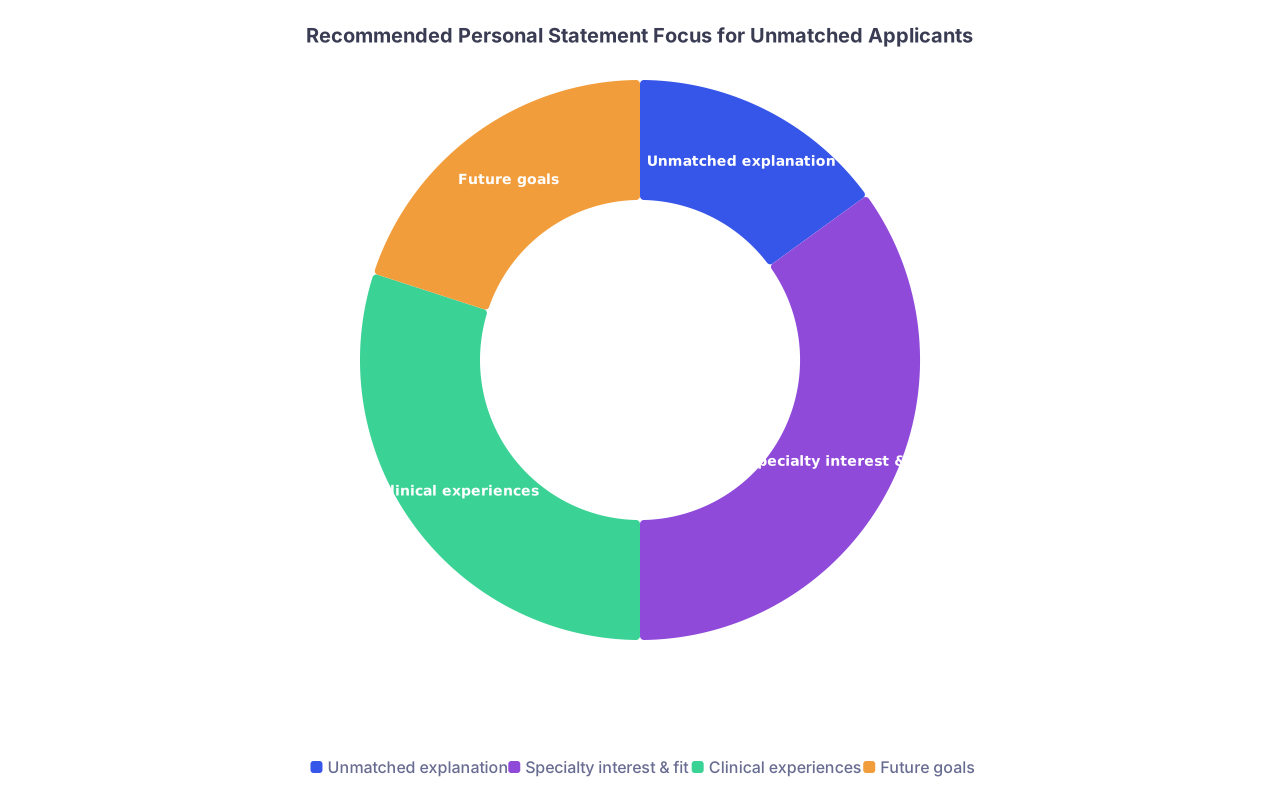
| Category | Value |
|---|---|
| Unmatched explanation | 15 |
| Specialty interest & fit | 35 |
| Clinical experiences | 30 |
| Future goals | 20 |
If half the statement is about the match failure, you’ve anchored your identity to it. Programs want to see it as a single chapter, not the whole story.
Should You Ever Not Mention It?
A few edge cases.
You might minimize or omit explicit “I went unmatched” wording in the PS if:
- You graduated this year, applied late, and clearly pivoted to a structured research year with strong academic mentorship.
- You’re an international grad with multiple recent U.S. rotations and fresh letters that already speak to your current ability, and you handle the gap more in the ERAS experiences and MSPE addendum.
Even then, I usually recommend at least one clear sentence like:
“After my initial application cycle in 2024, I began a dedicated research and clinical year in cardiology at X institution, which has significantly deepened my interest in internal medicine and strengthened my clinical skills.”
You do not explicitly say “unmatched,” but any program director reading that understands exactly what it means.
If you’re unsure whether to be explicit: err on the side of clear. Vague is almost always worse.
How Programs Actually Read This
Let me be blunt: most PDs and APDs are not reading your statement word-for-word the first time.
They scan for:
- Red flags.
- Maturity.
- Insight.
- Evidence you actually understand their specialty.
For reapplicants, they’re asking:
- Did this person learn anything from not matching?
- Are they clinically more ready now?
- Are they going to have trouble under pressure?
- Are we taking on a long-term problem, or a short-term late bloomer?
Your unmatched explanation is not there to win them over emotionally. It’s there to answer “Is this going to be a headache?” with a calm “No. Here’s why.”
Practical Framework: Drafting Your Paragraph
Use this fill-in-the-blank skeleton as a starting point. Do not copy it verbatim. Make it sound like you.
- “I did not match into [specialty] in [year].”
- “In reviewing my application with [advisors/mentors], I recognized that [specific weaknesses: e.g., limited U.S. clinical experience, late specialty decision, weaker letters, low Step score].”
- “Over the past [time period], I have [concrete actions: completed X rotations, worked in Y role, joined Z project, improved A skill].”
- “These experiences have [how you’ve changed: strengthened my clinical reasoning, improved my communication, clarified my commitment to this specialty].”
- “I now apply to [specialty] with [short phrase: greater clarity, stronger preparation, a more realistic understanding of residency training].”
Put that somewhere in the middle of the statement, not in the first two lines and not in the last two lines. Front and back should be about your fit and future, not your failure.
Example Flow: Where It Sits in the PS
Here’s a high-level structure that works well:

| Step | Description |
|---|---|
| Step 1 | Opening story or reason for specialty |
| Step 2 | Key clinical experiences |
| Step 3 | Brief unmatched explanation and growth |
| Step 4 | Current strengths and contributions |
| Step 5 | Future goals and what you seek in a program |
You’re not starting with “I didn’t match.” You’re not ending with it either. You’re putting it where it belongs: in context.
Final Check: Before You Submit
Run your unmatched paragraph through this quick checklist:

Ask yourself:
- Is it factual and non-dramatic?
- Do I take ownership of what I could control?
- Do I clearly state what I did to improve?
- Can someone reading just that paragraph understand why I’m a better applicant now?
- Does the rest of the statement still read like a normal strong PS, not a damage-control essay?
If yes, you’re where you need to be.
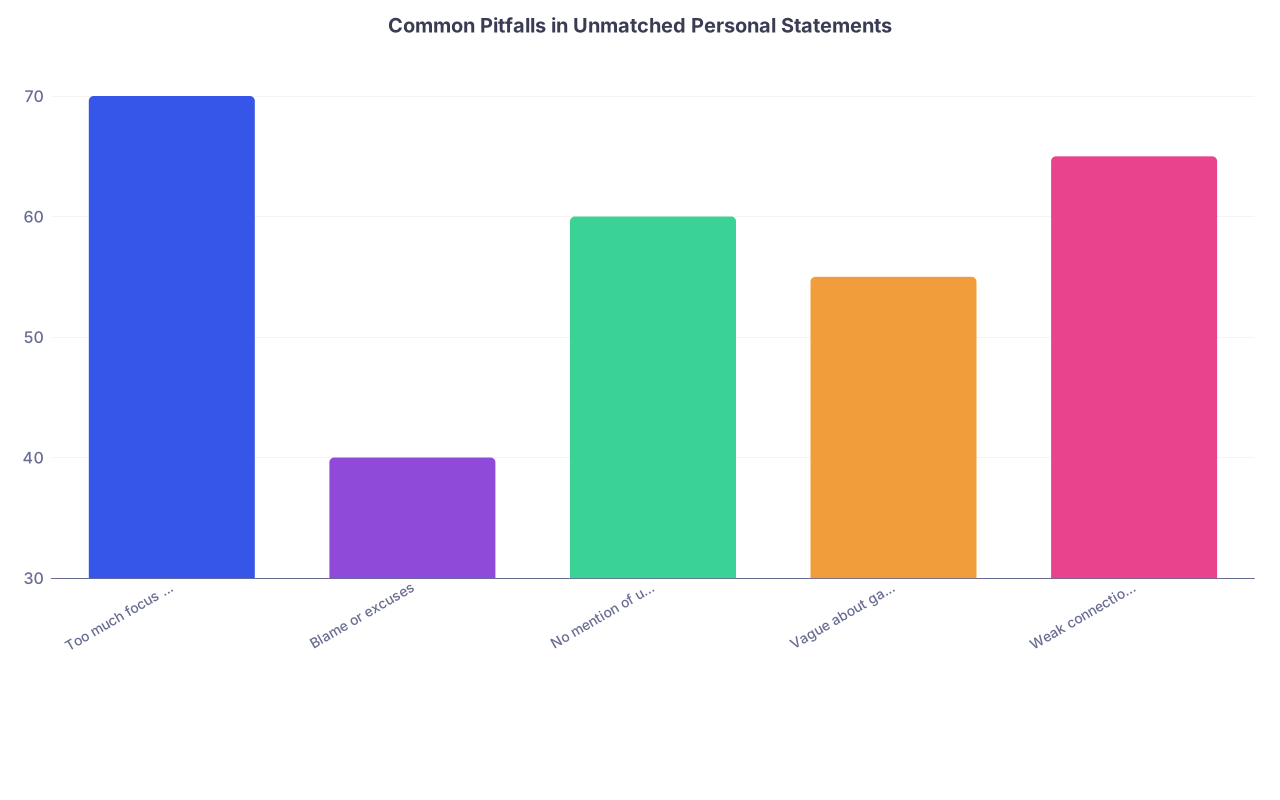
| Category | Value |
|---|---|
| Too much focus on failure | 70 |
| Blame or excuses | 40 |
| No mention of unmatched | 60 |
| Vague about gap year | 55 |
| Weak connection to specialty | 65 |
FAQ (Exactly 7 Questions)
1. Do I have to literally use the word “unmatched” in my personal statement?
No. You can say “after my initial application cycle in 2024” or “after not securing a position in the 2024 Match.” What matters is that it’s clear you applied, did not secure a spot, and then did something productive about it.
2. What if the main reason I did not match was low scores—do I mention that?
Briefly, yes, but without turning it into an essay on testing. A line like “In my prior application, my Step scores limited my competitiveness” is fine, followed immediately by what you’ve done since (strong clinical performance, new letters, additional experiences) to show you’re more than your score.
3. I had significant personal issues (illness, family crisis) that affected my application. Should I explain them here?
Only if they directly explain a concrete application weakness (failed exam, gap, limited availability) and you can say clearly that the situation is now resolved or managed. Keep it factual and short—no extended detail. You can also consider using the ERAS “impactful experiences” or a dean’s letter addendum for more context instead of centering it in your PS.
4. I am an IMG and have been unmatched for several cycles. Should I still explain each cycle?
You don’t need a play-by-play of every year. A single consolidated explanation like “After previous unsuccessful applications, I focused on strengthening my candidacy through…” is enough. Then list current, high-yield activities that prove you’re clinically active and engaged now.
5. Can my letters of recommendation address my unmatched status instead of my personal statement?
They should support your story, not replace it. A strong letter saying “This applicant has grown significantly since their prior cycle and is now ready for residency” is powerful—but if you’re silent in your PS, it looks like avoidance. Use both, briefly and consistently.
6. How honest should I be about initially choosing the wrong specialty?
Honest but composed. It’s fine to say you realized your interests align better with another specialty after more exposure. What you must show is that this new choice is informed, tested, and stable—not a panic pivot after not matching.
7. If I used last year’s personal statement, can I just add one paragraph about being unmatched?
You can start there, but usually last year’s PS needs more work than that. Your experiences, perspective, and narrative should have evolved. Use the unmatched paragraph as the middle piece of a more mature, updated statement that better reflects who you are now.
Key takeaways:
- Yes, you should usually explain your unmatched status—briefly, clearly, and without drama.
- Own specific weaknesses, show concrete growth, and then pivot back to why you’re now a strong fit for the specialty.
- Do not let the unmatched story dominate your personal statement; it’s one chapter, not the whole book.


