
Only 42% of unmatched applicants meaningfully change their application strategy the following year. Most just add “Research Fellow” to their CV and repeat the same mistakes.
You are not going to be one of those people.
You are asking how to use a home institution research year to rebuild your CV. Good. Because done right, this is one of the most efficient, high‑yield, and politically powerful post‑match moves you can make. Done badly, it is a padded gap year with a fancy email signature.
Let me walk you through how to make it the former.
1. First Decision: Is a Home Institution Research Year Actually the Right Move?
Before we talk tactics, we need to be blunt about strategy.
A research year at your home institution helps you most if:
- You were close to matching but fell short (e.g., some interviews, maybe a couple of waitlists).
- Your specialty is moderately to highly competitive.
- Your application weakness is research output, academic productivity, or weak departmental advocacy.
- There are faculty at your home institution who actually matter in your target specialty (PDs, division chiefs, well‑published attendings).
It is less useful if:
- You had almost no interviews and glaring red flags (multiple failures, professionalism issues) that research will not fix.
- Your main problem was late applications, terrible letters, or zero home support. If the department does not value you, being physically closer will not magically change that.
- You pick a project with someone who has no track record of getting students into residencies.
You are using this year to fix match‑relevant deficits, not just to “stay productive.”
Let’s be specific.
| Situation | Research Year Usefulness |
|---|---|
| 4–8 interviews, no match | Very high |
| Competitive specialty, minimal research | Very high |
| Strong research, weak clinical evals | Moderate |
| Failed Step, no remediation plan | Low–Moderate |
| No support from home department | Low |
If you are in the very high or high group, keep reading. If not, you may still do a research year, but you must combine it with other repairs (exam retakes, extra clinical time, different specialty, etc.).
2. Positioning the Research Year: What Story Are You Building?
Program directors do not care that you “took a research year.”
They care about:
- What problem you identified in your application.
- What you did about it, specifically.
- What you produced.
- Who is now willing to vouch for you.
Your research year must have a clear narrative you can put into one sentence:
- “I recognized my application was weak in academic productivity, so I completed a dedicated research year in orthopedic trauma outcomes, producing X manuscripts and strong mentorship under Dr. Y.”
- “My goal was to strengthen my candidacy for internal medicine by building a track record in quality improvement and hospital medicine research, while gaining additional clinical exposure with faculty who know my work ethic.”
If you cannot define that kind of sentence now, then you are about to drift for 12 months and call it “research.”
Set 3–4 outcome goals before day one:
- Manuscripts submitted (not just “in progress”).
- Presentations (local/regional/national).
- Named role on at least one project (first or second author).
- One to two strong, detailed letters from well‑connected faculty.
3. Choosing the Right Mentor and Project: This Is Where Most People Blow It
Your mentor choice is almost more important than the project itself.
You want a combination of:
- Name recognition in your specialty or your institution.
- Productivity—people who actually publish, not just talk.
- A history of getting people where you want to go (residency match, fellowships).
Ask around quietly. Ask residents: “Whose name on a letter actually moves the needle?” not “Who’s nice?” Niceness is a bonus. Influence is mandatory.
What to look for in a mentor
You are looking for someone who:
- Has ongoing projects that can include you right now.
- Has prior med students with successful match outcomes.
- Replies to email within a reasonable time frame.
- Will let you into conferences, division meetings, journal clubs.
And just as important: someone who is not using you exclusively as free data entry with zero authorship.
You should be explicit in the first real meeting. I say things like:
“My priority is to strengthen my residency application this coming cycle. That means I need tangible outputs within 6–9 months—submissions, abstracts, presentations. I’m happy to work very hard. I just want to be sure the projects we choose align with that timeline.”
If a faculty member bristles at that level of clarity, they are probably not your mentor.
What kind of projects to choose
You need projects that:
- Can move from conception to submission within 6–9 months (retrospective studies, database work, systematic reviews, educational projects).
- Are realistically publishable in journals that PDs actually recognize (not predatory, not totally obscure).
- Tie into your target specialty or at least your desired type of residency (e.g., QI projects in inpatient medicine for IM, ED throughput for EM).
Avoid:
- Long‑term, underpowered prospective trials with no end in sight.
- Very basic science if you have zero background and one year to “get something.”
- Being the 8th author on everything.
You do not have to love every topic. You do need projects that will finish.
4. Structuring the Year: Weekly Reality, Not Aspirational Schedules
If you do not structure your time, the year will evaporate.
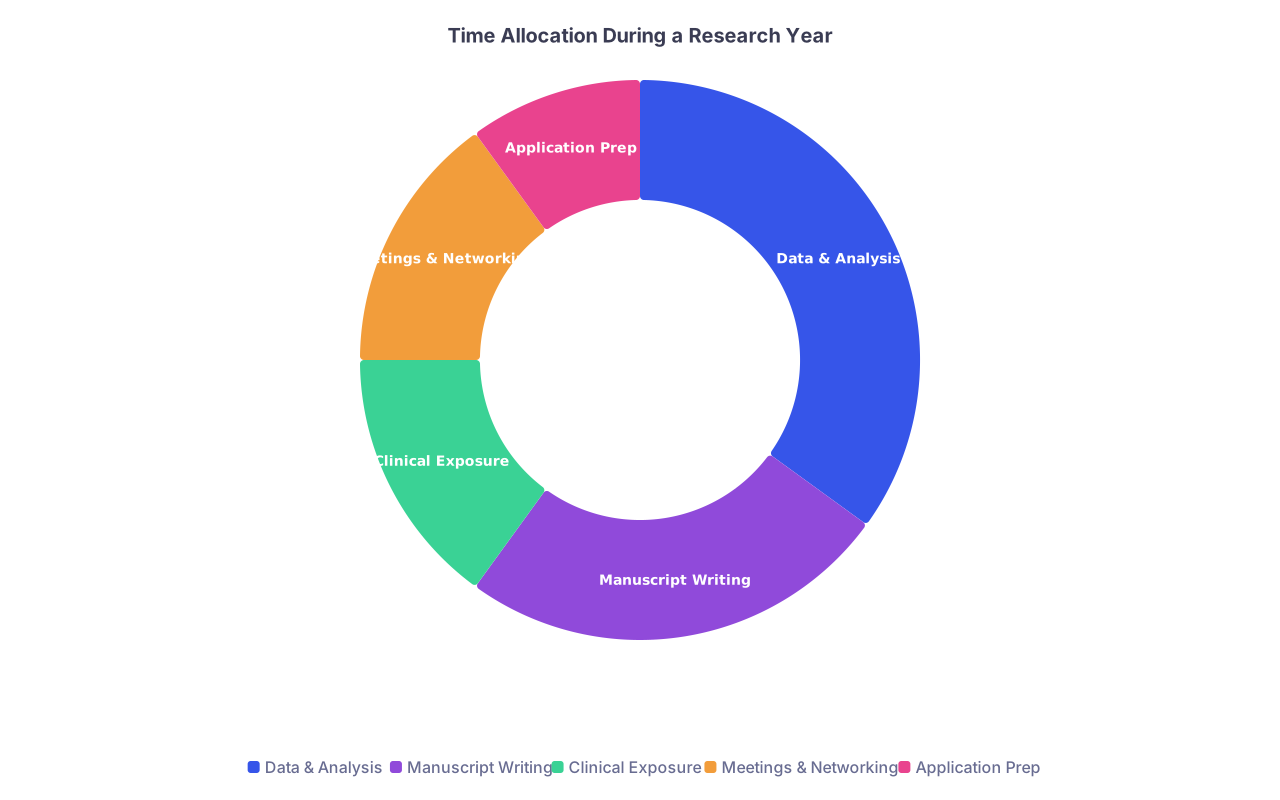
Here is the rough breakdown I recommend for a research year that is explicitly being used to rebuild a CV and prepare a reapplication.
| Category | Value |
|---|---|
| Data & Analysis | 35 |
| Manuscript Writing | 25 |
| Clinical Exposure | 15 |
| Meetings & Networking | 15 |
| Application Prep | 10 |
Target weekly structure (assuming 40–50 hours/week):
- 14–18 hours: data collection, chart review, analysis work.
- 10–14 hours: writing, revising manuscripts, abstracts.
- 6–8 hours: clinical shadowing/participating in clinic/OR rounds if your role allows.
- 3–4 hours: scheduled check‑ins, journal clubs, departmental meetings.
- 2–3 hours: dedicated application prep (CV updates, personal statement drafts, ERAS planning), increasing as application season approaches.
Do not “get around” to writing. That is where the CV comes from.
Set specific, written milestones:
- Month 2: IRB submitted for at least one project; abstract drafted for local meeting.
- Month 4: First manuscript in submission; at least one conference abstract submitted.
- Month 6: Second manuscript near completion; at least one poster or oral presentation completed.
- Month 9–10: Third project in advanced stage; letters requested with updated CV.
And yes, you will fall behind somewhere. That is normal. But if you do not have milestones, you will not even know that you are behind.
5. Using the Home Institution Advantage: Visibility, Not Just Productivity
You took a research year at your home institution for a reason: you want that place to vouch for you, and you want their name on your file.
So you must stop acting like a remote statistician and start acting like a junior colleague inside the department.
Tactics that actually build visibility
- Attend every relevant grand rounds and case conference. Sit near the front. Ask 1–2 intelligent questions over the month, not 20.
- Show up at resident didactics occasionally. Residents will talk about you. This is good if they are saying, “Yeah, she’s always here and helping with projects.”
- Present at internal research days, department meetings, or morbidity and mortality if appropriate. Internal podium time counts with your own people.
- Volunteer for low‑glamour but visible tasks: organizing journal club, helping compile data for an annual report, prepping figures for the chair’s talks. It puts your name in front of leadership repeatedly.
And the part everyone underuses: sit with the coordinator or chief resident who runs the residency admin side and ask what they actually care about. They know who gets ranked and why.
6. Rebuilding Specific CV Components: Line by Line
Let me break it down by what PDs will scan on your ERAS.
6.1 Research and Publications
Your goal is to move from:
“Some research experience, no publications”
to
“Tangible output with clear trajectory and specific roles.”
Prioritize:
- One or two first‑author or second‑author original research papers or substantive reviews.
- A couple of posters or oral abstracts at regional or national meetings.
- An observable pattern: all in the same or closely related area.
You want your “Research Experience” section to show:
- Clear continuity with your specialty (e.g., “Retrospective cohort analysis of septic shock outcomes in ICU patients” for IM, not “Cell signaling in zebrafish retina” unless you are aiming academic/neuro‑heavy).
- Defined roles: data collection, analysis, manuscript drafting.
PDs hate vague phrases like “assisted with project.” Spell out your role.
6.2 Presentations and Posters
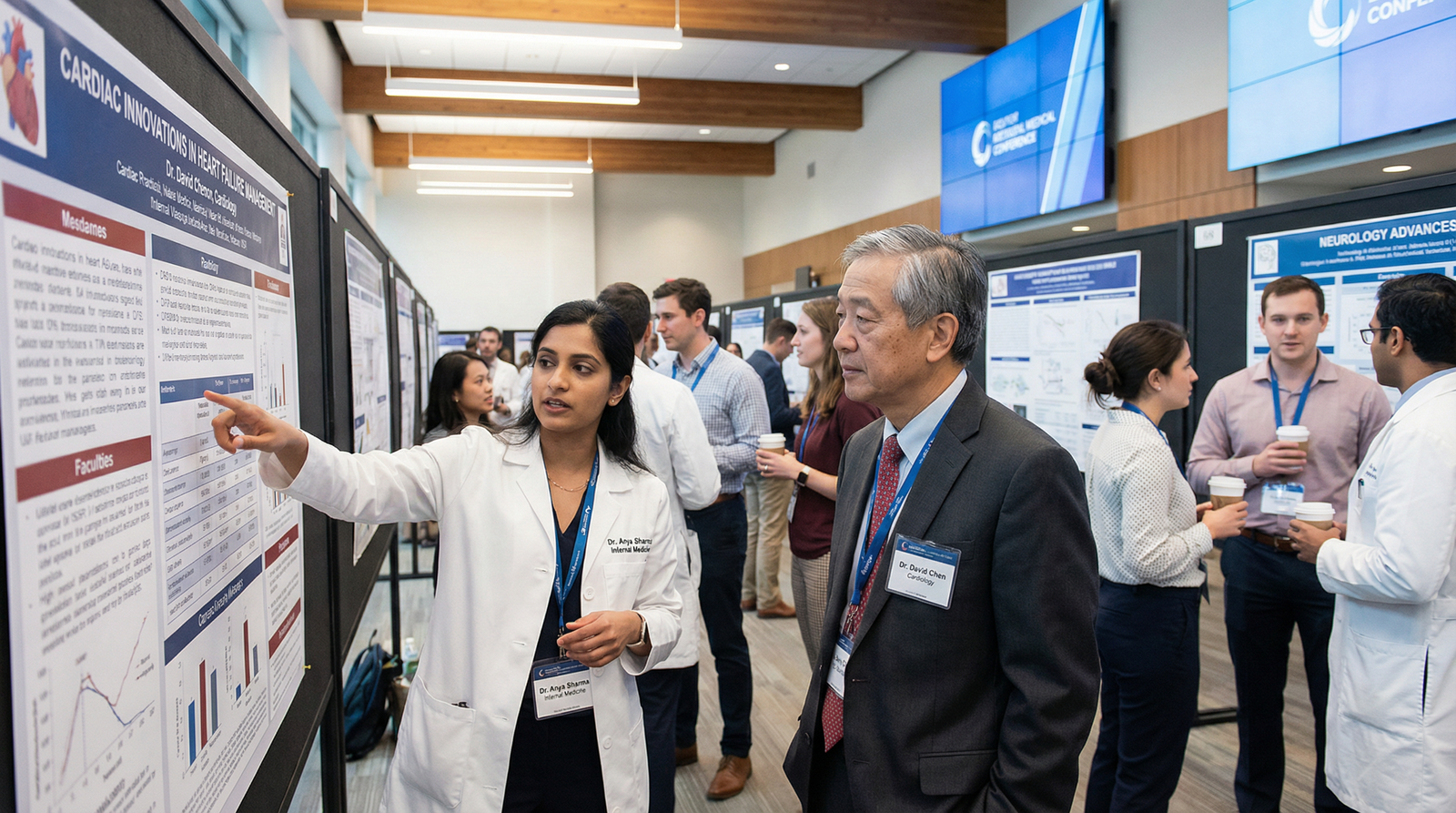
Posters and talks are underrated when they involve faculty who know you.
If your institution has:
- Department research day
- Medical school research symposium
- Institutional quality improvement conference
You should be on that schedule. It adds both a line on the CV and a social moment where people hear your name introduced professionally.

6.3 Clinical Experience
Even in a research year, you must not disappear clinically.
Red flag scenario: PD opens the application and sees zero clinical activity for 12–18 months. They immediately wonder about skill atrophy and motivation.
Solution:
- Arrange 0.5–1 day per week of clinic, OR observation, or inpatient rounding with your research faculty or allied clinicians.
- If that is impossible, schedule concentrated clinical blocks (e.g., 2 weeks full‑time every few months as visiting student, sub‑I, or observer).
You want to be able to honestly write in ERAS:
“Maintained ongoing clinical engagement through weekly outpatient clinics and participation in inpatient rounds, working closely with residents and attendings in [specialty].”
This gives your future letters more substance as well: “Even during a research year, she remained involved clinically…”
6.4 Letters of Recommendation
For most unmatched applicants doing a research year, letters are the single most decisive academic product of the year.
Your goal: 1–2 new letters from research‑year mentors that say all of the following:
- You are reliable, rigorous, and productive in academic work.
- You have the temperament and work ethic to be a strong resident.
- The letter writer would like to see you in their program or confidently recommends you to others.
You will not get that letter if you are an email ghost who just sends spreadsheets.
You must:
- Meet regularly (biweekly or monthly) with your primary mentor.
- Send brief, structured updates: “This week we completed X charts, updated Y figures, and drafted the introduction. Next week’s goals are…”
- Ask directly for feedback: “Is there anything I should be doing differently to be operating at a resident‑level work ethic in your eyes?”
When it comes time to request a letter, you make it easy:
- Provide an updated CV.
- Provide a one‑page summary of projects you have worked on together with specific contributions.
- Remind them of any presentations or accomplishments they may forget.
| Category | Value |
|---|---|
| Strong new LORs | 95 |
| First/Second Author Papers | 80 |
| Posters/Talks | 60 |
| Extra Clinical Time | 70 |
| New Coursework/Certificates | 30 |
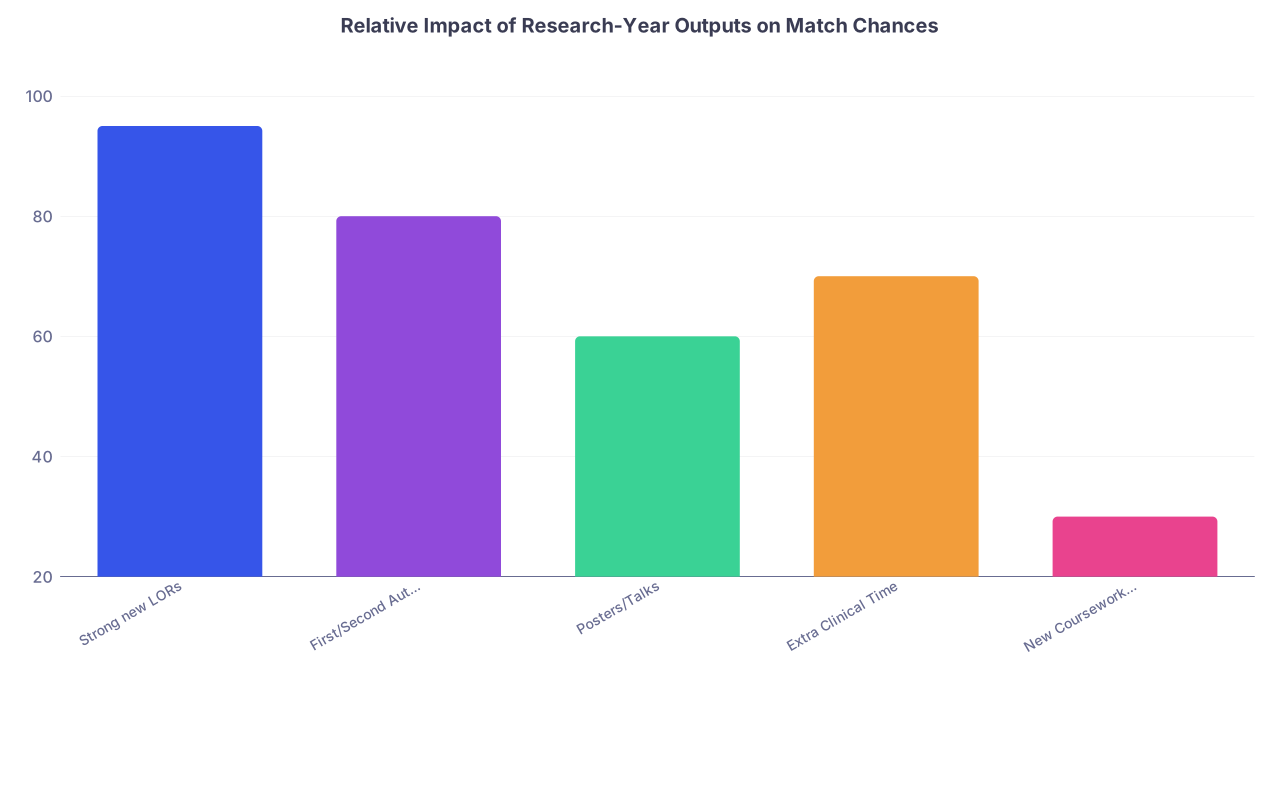
Interpretation: all of these things help, but strong new letters and concrete publications move the needle the most.
7. Fixing the Original Reasons You Did Not Match
A research year is not a magic eraser. If you do not directly address the issues that kept you from matching the first time, you will be right back here next March.
Common failure points and how to integrate them into your research year:
Weak Step/COMLEX performance
- If you failed or barely passed, and retake or Step 2/Level 2 is still in play, you must integrate exam study into your schedule. Block protected time weekly.
- Your mentor should know this is part of your year’s goals, not something you “do on weekends.”
- You want to come out of this year with either:
- A strong Step 2/Level 2 score offsetting Step 1/Level 1, or
- Demonstrated improvement on later exams plus strong faculty support.
Small number of applications or limited geography
If you previously applied to a narrow list (“only coastal university programs” or “only my city”), then this year you need a very different application strategy. Use your faculty to help revise your list.
I have watched chairs in small conference rooms say things like, “You are not competitive for X, but you have a real shot at Y and Z if we make some calls.” You want that conversation.
Weak personal statement and poor interviewing
Use this year to:
- Get brutally honest feedback on your prior personal statement.
- Practice interviews with actual faculty, not just peers.
- Develop a coherent explanation of your path: “I did not match initially because ___. So I structured this year to fix ___ and ___, and here is what I achieved.”
You must be able to say this without sounding defensive or vaguely wounded.
8. Converting the Research Year into a Strong Reapplication
Let’s zoom out and look at the full year as a pipeline, not a random collection of activities.

| Step | Description |
|---|---|
| Step 1 | Unmatched Applicant |
| Step 2 | Define Weaknesses |
| Step 3 | Choose Mentor and Projects |
| Step 4 | Structured Weekly Schedule |
| Step 5 | Research Outputs |
| Step 6 | Clinical Engagement |
| Step 7 | Department Visibility |
| Step 8 | Strong New Letters |
| Step 9 | Revised Application Strategy |
| Step 10 | Stronger ERAS File |
| Step 11 | Interviews and Match |
When you sit down to submit ERAS the second time, your CV should show very specific upgrades:
- Research section: multiple clearly described projects, at least some with submitted or accepted manuscripts.
- Publications/presentations section: new lines with this year’s date. PDs notice timelines.
- Experience section: research position with detailed bullet points showing initiative and outcomes.
- Letters: at least one powerful new letter from a well‑regarded faculty member at your own institution.
And your narrative across the entire application should be consistent:
- Past: Diagnosed weakness → Action taken (research year).
- Present: Concrete achievements, stronger relationships, more clarity about your goals.
- Future: How this makes you an asset to a residency program.
9. Common Mistakes That Waste a Research Year
I have seen all of these. More than once.
- Treating the year like a 9–5 office job. People who “log hours” instead of “chase outputs” end up with nothing to show but “assisted on projects.”
- Saying yes to everything. Being on 9 projects with no first authorship is less valuable than 2–3 projects where your role is central.
- No plan for letters. Waiting until January to wonder who will write your letters, then discovering nobody has much to say beyond, “they were present.”
- No clinical contact. Twelve months without seeing patients is a problem. Especially in procedural or acute care specialties.
- Not changing application strategy. Re‑applying with the same program list, same personal statement theme, same geography, and just a “research fellow” line. Then being surprised at similar results.
Avoid those, and your odds of converting this year into a match improve dramatically.
10. A Realistic Example: What “Done Well” Looks Like
Here is a composite (details changed, but pattern real).
Unmatched applicant in general surgery:
- Previous cycle: 6 interviews, 2 waitlists, no match; minimal research; decent but not standout letters; mid‑tier Step 2.
- Decision: Take a 1‑year research position with a high‑volume trauma surgeon at her home institution.
What she actually did:
- Month 1–2: Met weekly with mentor, joined 3 existing retrospective projects, helped finish IRBs, started data extraction.
- Month 3–4: Took ownership of one project (trauma resuscitation outcomes) as first author; started writing methods and introduction; abstract submitted to state surgical society.
- Month 5–6: Submitted first manuscript; presented a poster at institutional research day; picked up a second project with clear second‑author role.
- Clinical: Attended trauma call one night a week, did trauma clinic twice a month, was known by residents as “the research year person who actually shows up.”
- Month 7–9: Got acceptance for state meeting oral presentation; second manuscript drafted; began working on personal statement with mentor feedback.
- Letters: Mentor wrote a detailed letter: “She functions at the level of a strong PGY1 in our department,” with specifics on work ethic and initiative. Chair co‑signed.
- Reapplication: Expanded program list beyond coasts, targeted several community‑heavy programs, applied earlier, and documented research outputs clearly.
Outcome: >15 interviews; matched at a solid university‑affiliated general surgery program.
Was it guaranteed? No. Was the research year absolutely decisive? Yes.
11. Step-by-Step Plan You Can Start This Month
If you want something concrete to follow, here is a stripped‑down roadmap.
Month 0–1:
- Clarify why you did not match; write it out.
- Identify 2–3 potential mentors; meet them; choose one primary.
- Define 3 measurable goals: X manuscripts, Y presentations, Z letters.
Month 2–3:
- Make sure you are attached to at least 2 projects with clear roles.
- Set up a consistent weekly schedule including 0.5–1 day of clinical exposure.
- Start attending all key departmental conferences.
Month 4–6:
- Push one project to submission.
- Present internally at least once.
- Begin rough drafts of personal statement and CV updates.
Month 7–9:
- Submit abstracts to regional or national meetings.
- Request feedback about your performance (and how that would look in a letter).
- Finalize at least one first/second author manuscript submitted or accepted.
Month 10–12:
- Lock in letters of recommendation.
- Meet with PD or chair for candid advice on your application list.
- Submit ERAS early with a clearly updated CV and narrative.