

The biggest mistake MS3s and MS4s make about the Match is pretending it cannot go wrong.
If you want a real safety net, you build it early and adjust it often—not the week before rank lists are due.
Below is a month‑by‑month, then week‑by‑week playbook from early MS3 through post‑Match that shows you exactly when to prepare, what to document, and how to keep doors open if you do not match. Think of it as parallel planning: you move forward like you will match, but you quietly build an escape ladder at every step.
Big Picture: Your “Do Not Match” Safety Net Framework
Before we go chronologic, anchor on this:
There are only a few realistic safety‑net categories:
- Re‑applying to the same specialty (strongest when you were close the first time)
- Switching to a less competitive specialty (FM, IM, peds, psych, pathology in many regions)
- Doing a transitional year / prelim year then re‑applying
- Pursuing a research year or additional degree (MPH, MS, etc.)
- Non‑residency clinical or quasi‑clinical work (scribe supervisor, clinical research coordinator, industry roles, etc.)
Your task from MS3 onward is to systematically keep these options alive.
MS3: Quietly Building Optionality (Month‑by‑Month)
At this point you should stop thinking “Plan A vs Plan B.” You are building Plans A, B, and C in parallel.
MS3: July–September – Core Clerkships Begin
At this point you should:
- Treat each rotation as if it might become your backup specialty.
- Start tracking:
- Who likes your work
- Who gives you strong comments
- Where you are allowed back for an acting internship (AI/sub‑I)
Actions this quarter:
Document everything
Create a private doc:- Rotation
- Attending names and emails
- Mid‑rotation and final feedback highlights
- Procedures / responsibilities
- “Would ask for LOR?” Yes/No
Protect your clinical reputation
Programs will forgive an average Step 2. They will not forgive “difficult to work with.” If you are even thinking about a competitive specialty, your professionalism record is your fallback currency if you need to pivot later.Identify one or two backup specialties
Example:- Aiming for: Dermatology
- Reasonable backups: Internal Medicine, Transitional year + research
| Primary Specialty | Backup 1 | Backup 2 |
|---|---|---|
| Ortho | General Surgery | Transitional Yr |
| Dermatology | Internal Medicine | Pathology |
| EM | Family Medicine | IM Prelim |
If you cannot name at least one plausible backup specialty by the end of September, you are already behind.
MS3: October–December – Mid‑Year Reality Check
At this point you should have data: shelf scores, comments, approximate class rank.
Actions this quarter:
Run a quiet competitiveness audit
- Step 1 outcome (Pass / marginal / failed and remediated)
- Any red flags: professionalism, leaves of absence, remediation
- Honors vs Pass distribution
- Research output (submitted vs published, in what fields)
Meet with someone blunt
Not the always‑positive mentor. The honest one. Ask:- “If I applied to [specialty] right now, what are my odds?”
- “What backup specialty would you recommend for me?”
- “What would you do in my position if I did not match?”
Write their answers down. They matter later when emotions run high.
- Cultivate relationships in backup specialties
Concrete moves:
- Ask to be added to the IM or FM student interest group listserv.
- Attend 1‑2 noon conferences in those departments.
- Introduce yourself to one program director (PD) or associate PD in a backup specialty. No drama. Just: “I am interested in [X], want to learn about your program.”
You are not committing. You are building weak ties that can become strong if needed.
MS3: January–March – LOR and Sub‑I Positioning
At this point you should be setting up 4th year so you do not get trapped if Plan A collapses.
Actions this quarter:
- Secure at least one strong letter outside your primary specialty
Example:- Applying to ENT? Get a powerful IM or surgery letter.
- Applying to EM? Get IM or FM letter.
This is the letter that becomes gold if you have to rebrand yourself for another specialty.
- Plan 4th‑year schedule with flexibility built in
You want:
- 1–2 AIs in your primary specialty
- 1 AI in a realistic backup specialty
- Electives or research blocks that can pivot (clinical research, QI project, etc.)
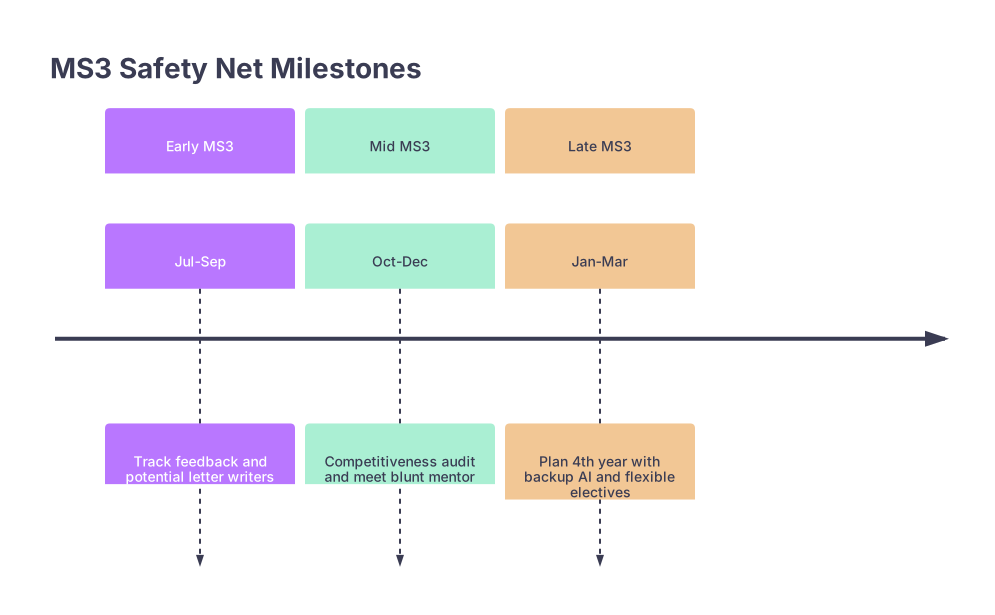
| Period | Event |
|---|---|
| Early MS3 - Jul-Sep | Track feedback and potential letter writers |
| Mid MS3 - Oct-Dec | Competitiveness audit and meet blunt mentor |
| Late MS3 - Jan-Mar | Plan 4th year with backup AI and flexible electives |
If your school demands schedule choices before you are ready, over‑request backup‑friendly rotations. You can always “go more competitive” later. It is harder to suddenly add an IM AI in October of MS4.
MS4 Pre‑Application Phase: April–June
By now, panic starts quietly in your classmates. That is fine. You are going to be systematic.
April–May of MS3 (rising MS4) – Final Strategy
At this point you should decide if you are going all‑in on one specialty or deliberately two‑track (primary + backup).
If you are a strong applicant for your chosen field:
- Still:
- Keep at least one backup AI.
- Maintain strong ties with IM/FM/another reasonable option.
If you are borderline or red‑flagged:
- You must choose:
- Option A: Apply broadly to one field plus prelim / transitional years.
- Option B: Dual apply (e.g., Radiology + IM; Ortho + Gen Surg prelim; EM + IM/FM).
Be honest here. I have watched students ignore this and then stand in the SOAP with zero internal medicine letters and no one who knows their name in FM. Brutal.
June–July of MS4 – ERAS Prep with Safety Net in Mind
At this point you should:
Write two versions of your personal statement
- Version 1: Primary specialty narrative.
- Version 2: Backup specialty or prelim/transition year narrative (IM‑centered, for example).
Curate your letter set strategically Aim for:
- 2–3 letters from primary specialty
- 1–2 letters from a core field (IM/FM/Surg/Peds/Psych) that could be used for backup or prelim programs
List programs into tiers
| Tier | Primary Specialty Programs | Backup/Prelim Programs |
|---|---|---|
| Reach | 10–20 | 5–10 |
| Target | 30–60 | 20–30 |
| Safety | 20–40 | 30+ |
If you are not sure you have any true safety programs in the primary specialty, that is your cue to beef up the prelim / backup side.
MS4 Application Season: August–December
Now the calendar matters. You cannot “wing” a safety net here.
Late August–September – ERAS Submission and Initial Wave
At this point you should:
Submit ERAS as early as possible within your school’s approved window.
For safety net:
- Apply to a meaningful number of prelim/transitional or backup specialty programs on Day 1 if you already know you are borderline.
- Or hold a small list ready to deploy if interview volume looks weak by late October.
Track interview invitations in a simple log:
- Date received
- Program
- Specialty / category (primary, prelim, backup)
- Whether you are genuinely willing to go there
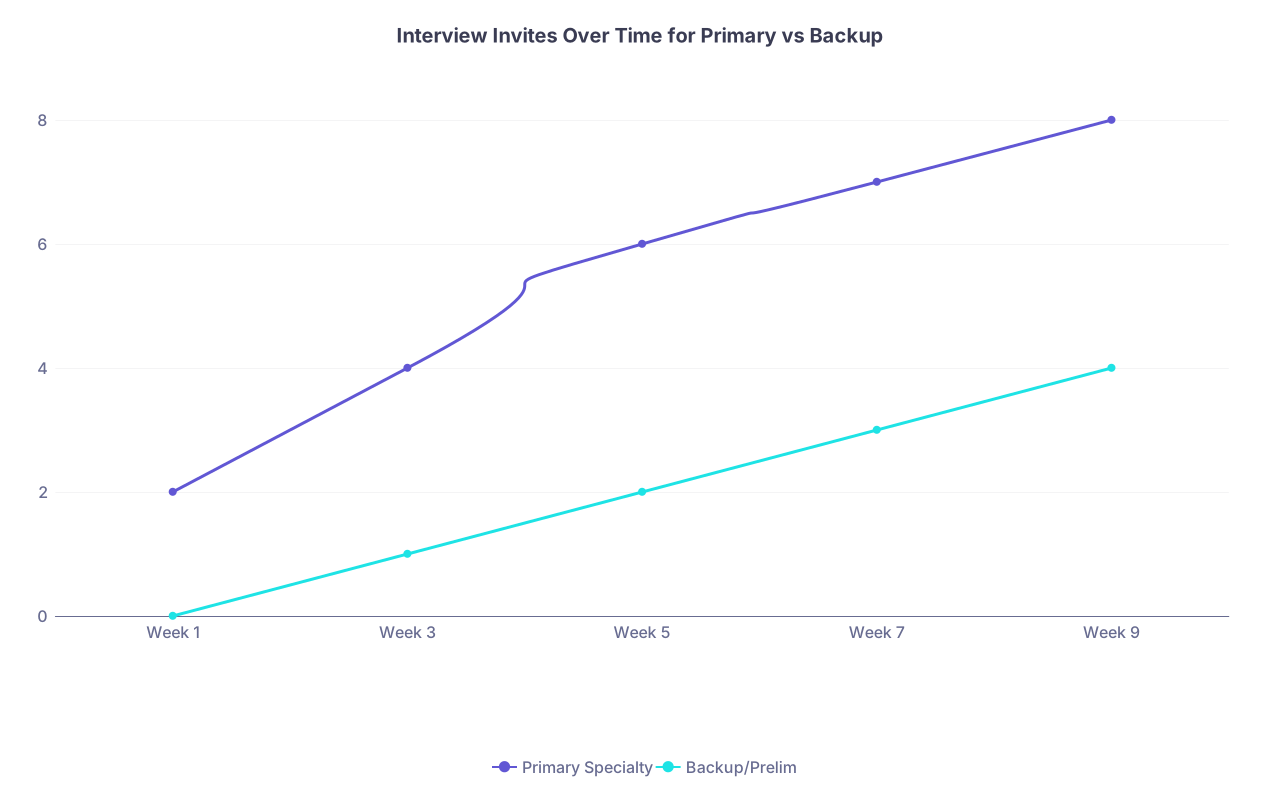
| Category | Primary Specialty | Backup/Prelim |
|---|---|---|
| Week 1 | 2 | 0 |
| Week 3 | 4 | 1 |
| Week 5 | 6 | 2 |
| Week 7 | 7 | 3 |
| Week 9 | 8 | 4 |
By late October, this chart tells you the truth about your odds. Not your friends. Not Reddit.
October–November – Mid‑Cycle Reality Check
At this point you should reassess ruthlessly.
Benchmark (rough, but useful):
- Competitive specialty (Derm, Ortho, ENT, PRS, Neurosurg, Rad Onc):
- Fewer than 6–8 interviews by mid‑November → High risk.
- Moderately competitive (EM, Anesthesia, Rads, OB‑GYN, many IM subspecialty‑heavy programs):
- Fewer than 8–10 interviews by mid‑November → Concerning.
- Less competitive (FM, many IM, Psych, Peds, Path):
- Fewer than 10–12 interviews by late November → You are not as safe as you think.
At this point you should:
If interviews are weak:
- Expand your programs list in:
- Community sites
- Less desirable regions
- Backup specialty or prelim programs
- Email PDs sparingly but strategically:
- Brief, respectful, and with updated CV or Step 2 score if it improved your profile.
- Expand your programs list in:
If you are dual applying:
- Make sure your narrative is coherent:
- You cannot tell one program “I have always wanted EM” and another “I have always wanted psychiatry” with no connective tissue. Build a story around patient populations, systems work, or broad interests that map onto both.
- Make sure your narrative is coherent:
You are essentially steering away from the iceberg before you hit it.
December – Early January – Ranking Strategy with Failure Contingency
At this point you should:
- Start drafting your rank list(s) weeks earlier than your classmates.
- Ask:
- “If I matched at my last rank on this list, would I still be willing to go?”
- If no → that program should not be on the list. It is fantasy.
For high‑risk applicants:
You should strongly consider:
- Ranking:
- All prelim / transitional programs you could tolerate
- Backup specialty categorical programs
- Accept that a prelim or backup in a less desired location is often better than no match at all. Re‑applying from nothing is much harder than re‑applying from a prelim or categorical IM year with strong evaluations.
Match Week and SOAP: 7‑Day Micro‑Timeline
This is where people freeze. You will not, because you are preparing before Friday.
1–2 Weeks Before Match Week
At this point you should:
Clarify your SOAP strategy on paper:
- Primary goal if you do not match:
- Categorical in backup specialty?
- Prelim year in surgery/IM/transitional?
- Any position with a salary and ACGME credit?
- Non‑negotiables (geography, specialty, night float systems, etc.) – and which ones you are willing to drop if the alternative is “no spot at all.”
- Primary goal if you do not match:
Update:
- Personal statement(s)
- CV
- Short paragraphs tailored for backup/prelim programs that you can paste into ERAS if SOAP opens.
Inform:
- Key faculty advocates that you may need quick help during SOAP (phone calls, emails).
Monday of Match Week – “You did not match” Email
At this point you should:
- Take 30–60 minutes completely offline. Then:
- Meet immediately with:
- Student affairs dean or equivalent
- Specialty advisor (if relevant)
- Confirm:
- If you partially matched (e.g., advanced but no prelim) or did not match at all.
Then the clock starts.
Monday Afternoon–Tuesday Morning – SOAP Application Setup
At this point you should:
- Get the unfilled programs list the second it is released.
- Filter:
- By specialty (IM, FM, prelim surg, prelim IM, TY, psych, etc.)
- By geography (but loosen this unless you have concrete constraints)
- Decide quickly:
- 1–2 priority specialties you will target (usually IM/FM/Psych/Prelim).
You generally cannot spray and pray across 10 specialties. SOAP is fast and unforgiving.
You and your dean should:
- Identify any faculty with ties to programs on the unfilled list.
- Ask them directly to:
- Call PDs
- Email PDs with a 2–3 sentence endorsement
You should:
- Tailor your personal statement for SOAP programs:
- Emphasize adaptability, strong work ethic, solid clinical performance.
- Address glaring red flags with 1–2 sober, non‑defensive sentences if necessary.
Tuesday–Thursday – SOAP Interviews and Offers
At this point you should:
- Treat every phone or video contact as an interview, no exceptions.
- Have a concise script ready:
- Who you are
- Why their specialty / program
- What you bring that makes you low risk and high yield for them
- Be fully reachable:
- Phone on loud
- Email monitored
- No long drives, flights, or procedures that make you unreachable
You should also mentally prepare for this reality:
You might not SOAP into an ideal program. You might accept a prelim spot far away. That is still a viable platform for regrouping.
If You Still Do Not Match After SOAP: 6–12 Month Recovery Plan
This is where your earlier groundwork pays off. Or not.
At this point you should accept that your next “application cycle” starts now, not in six months.
Immediately Post‑SOAP (Late March–April)
You should:
- Schedule:
- A hard debrief with your dean and a faculty mentor outside your desired specialty.
- Analyze:
- Application numbers (how many programs, which tiers)
- Board scores, red flags, gaps
- Interview performance (get honest feedback if any PDs will share)
Then choose a clear path:
- Research or fellowship year (with direct link to your target or backup field)
- Non‑residency clinical role while strengthening your CV and getting fresh letters
- Additional degree (MPH, MEd, etc.) only if it adds real value and is not just hiding
You must not drift. Six unstructured months kills momentum and credibility.
April–June – Locking in the Gap‑Year Structure
At this point you should:
Secure:
- A full‑time role that will generate:
- Strong, recent letters
- Concrete accomplishments (papers, QI projects, teaching, leadership)
- A full‑time role that will generate:
Examples:
- Clinical research coordinator with a respected PI in IM or FM
- Post‑doc research position in your target specialty
- Instructor role at your med school (clinical skills, anatomy, etc.) plus research or QI work
Clarify your re‑application specialty:
- Same as original, but with stronger profile?
- Or pivot to backup that better fits your stats and trajectory?
You should communicate frankly with your new mentors:
“I did not match this year. My goal is to re‑apply to [X] next cycle. I want to build the strongest application possible.”
July–December – Rebuilding and Reframing
At this point you should:
- Be accumulating:
- New letters that directly address your growth and reliability
- Measurable outputs: abstracts, posters, publications, QI projects completed
- Keep a detailed CV log:
- Start–end dates
- Specific tasks and outcomes
- Names of supervisors
When ERAS opens again, you will:
- Rewrite your personal statement:
- Own the previous non‑match without melodrama.
- Emphasize what you learned and how your skills have improved.
- Apply:
- Broadly and strategically. No half‑measures this time.
Quick Reality Check: Common Bad Moves to Avoid
At any stage, you should not:
- Hide from faculty when things look bad. Silence kills your options.
- Assume you can “fix everything in SOAP.” SOAP is a narrow doorway.
- Cling to an ultra‑competitive specialty with zero contingency planning.
- Spend a whole “gap year” doing nothing structured and then expect programs to be impressed by your “reflection time.”
I have seen all of these. They do not end well.
FAQ (exactly 2 questions)
1. If I am a strong student, do I really need a backup plan?
Yes. Strength helps, but it does not immunize you against bad luck, program closures, visa issues, or a mismatch between your application and what was in demand that year. Good applicants fail to match every cycle. A backup plan does not mean you lack confidence. It means you respect the numbers and protect your future.
2. If I do not match, should I re‑apply to the same specialty or switch immediately?
It depends on why you did not match. If your application was reasonably competitive and you simply under‑applied or applied poorly geographically, re‑applying with a stronger, more focused strategy can work. If you have significant red flags or numbers far below the average for that specialty, a pivot to a less competitive field or a prelim year plus re‑evaluation is usually smarter. The decision should be made with a blunt, data‑driven advisor—not alone at 2 a.m. with a ranking spreadsheet.
Key points:
- Start building your safety net early in MS3—through letters, relationships, and flexible 4th‑year scheduling.
- Use interview volume and honest feedback by mid‑MS4 to expand applications and solidify backup plans.
- If you do not match, move fast, choose a structured gap‑year or prelim path, and rebuild with purpose rather than drifting.


