The fastest way to destroy your post‑Match chances is not the gap year itself. It’s how you explain it.
You did not match. That alone does not end your career. But a sloppy, defensive, or panicked explanation of your unmatched year absolutely can. I’ve watched applicants with pretty average stats match on their second try because they handled the story well—and others with strong scores get quietly filtered out because their explanation set off alarms.
Let’s make sure you’re not in the second group.
The One Explanation That Will Sink You Every Time
The worst explanation for an unmatched year is also the most common:
“I don’t really know why I didn’t match. I did everything right.”
If you say anything that resembles that line—in an interview, in your personal statement, in an email—you are telling programs three things you really don’t want to say:
- You have poor insight.
- You do not take ownership.
- You have not improved your application.
That one sentence, or its cousins (“I was very surprised I didn’t match,” “I thought I’d be a strong candidate”), sounds harmless to you because it’s honest confusion. To a program director, it sounds like: this person has learned nothing.
You cannot walk into a second application cycle acting like the universe randomly punished you. Even if you genuinely were unlucky. Even if your dean and your mom swear you were competitive.
Programs don’t want to hear about fate. They want to hear about analysis and action.
Seven Self‑Sabotaging Ways People Explain an Unmatched Year
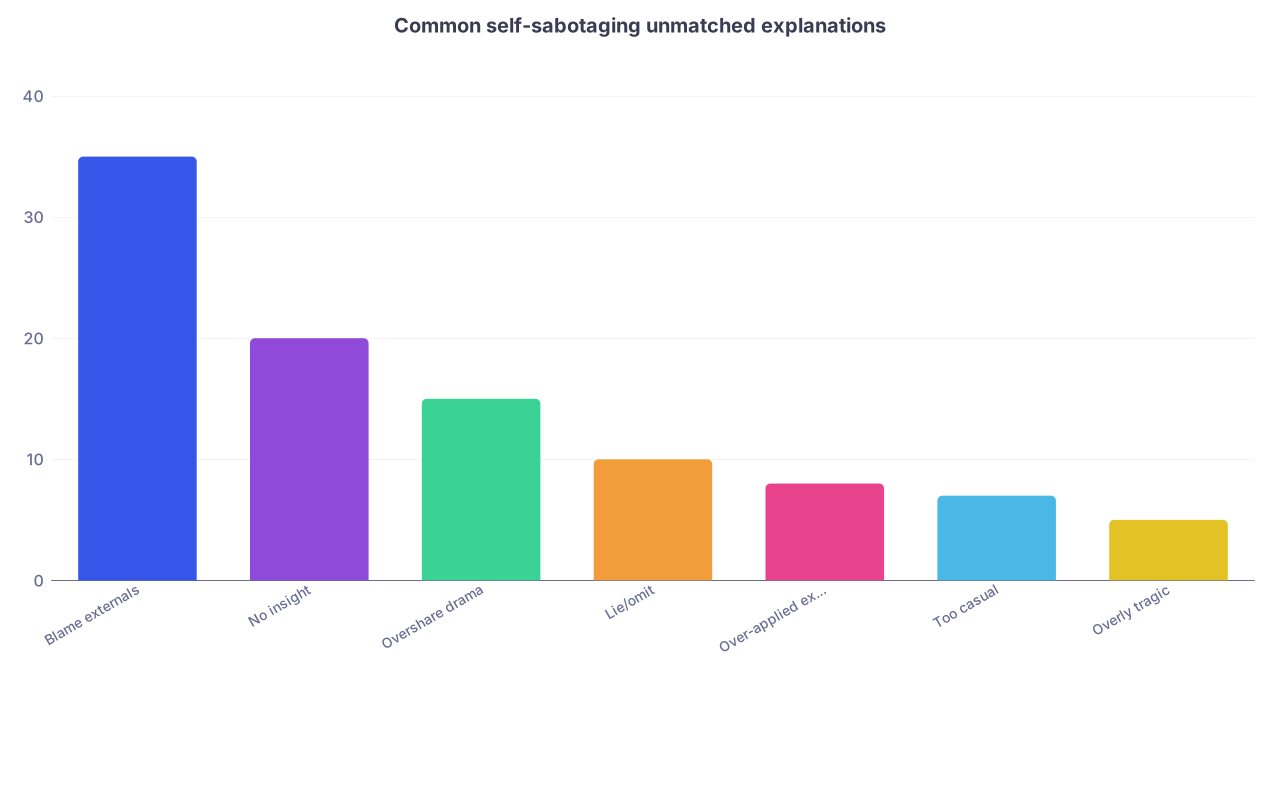
| Category | Value |
|---|---|
| Blame externals | 35 |
| No insight | 20 |
| Overshare drama | 15 |
| Lie/omit | 10 |
| Over-applied excuses | 8 |
| Too casual | 7 |
| Overly tragic | 5 |
Here’s what I’ve seen applicants do that kills their second shot.
1. Blaming Everyone and Everything Else
“I didn’t match because programs only care about Step scores now.”
“My school’s dean’s letter was weak.”
“My advisor misled me.”
You might be right about some of this. But if your explanation is 80% external blame and 0% self‑reflection, programs assume you’ll do the same when you struggle as a resident.
The red‑flag versions:
- Trashing your med school or home program.
- Criticizing the Match process itself (“It’s a broken system”).
- Blaming certain programs by name.
- Suggesting bias or discrimination without any careful, measured context.
Do not make the mistake of turning your explanation into a grievance list. Even if you were treated unfairly somewhere, that’s not the story they need in an initial interview.
A safer posture: acknowledge structural realities briefly and pivot hard to what you controlled and what you did next.
Bad:
“I applied to 60 programs, but they just want crazy Step scores now. It’s not really fair.”
Better (and shorter):
“This past cycle I aimed too high relative to my score distribution and didn’t build a sufficient safety tier into my list. Since then, I’ve met with mentors and restructured my application strategy, including a broader list of programs.”
One sentence of context. Then action.
2. Acting Like It Was Pure Random Bad Luck
“I ranked 12 programs. I really thought that was enough. I guess it was just bad luck.”
Programs hate the “shrug” explanation. It reads as:
- Poor understanding of competitiveness.
- Magical thinking.
- No clear reason to believe things will be different this time.
Yes, bad luck exists. Interviewer cancellations. An attending who tanked an SLOR. A sudden life event. But if you lean on “unfortunate luck” as your primary explanation, you’re announcing you have no plan.
You must dissect your previous cycle in at least three concrete areas:
- Application strategy (where you applied, timing, letters).
- Objective metrics (scores, attempts, red flags).
- Subjective impressions (interview performance, communication).
Then you must show what changed in each.
Lazy version:
“I think I was just unlucky; I had several interviews, but none worked out.”
Stronger version:
“I had four interviews and, in hindsight, didn’t present a coherent narrative about my interest in this specialty. Over the last year, I’ve worked with my advisor to clarify and practice that story, and I’ve gained additional clinical exposure that now backs it up.”
Don’t hide behind the word “unlucky.” Use it, at most, as seasoning. Not the dish.
3. Oversharing Drama and Personal Chaos
There’s a dangerous instinct to tell everything because you want to be “transparent.”
“I was dealing with a breakup, my dad was sick, and my roommate moved out, so I was really overwhelmed. Then my landlord increased the rent and I had to get a part‑time job…”
This might be true. It might explain your Step 2 dip or your weak interview season. But program directors are not your therapist. They’re not trying to decide if you’re a good person; they’re trying to predict if you’re a stable resident.
Too much chaos in your story—and too little evidence that your life is now stable—and they’ll move on. They’ve seen what happens when chaos walks into an intern year. It’s brutal for everyone.
The failure pattern:
- You give a long, emotional, nonlinear story.
- You sound like the crisis is still going on.
- You don’t show clear boundaries or support systems.
You must filter. Pick the one or two relevant personal factors, describe them simply, and then spend more words on how you stabilized and what’s different now.
Example of what not to do:
“In my fourth year, my grandmother died, then I got COVID twice, and I had to help with my younger siblings because my mom was overwhelmed, and I just couldn’t focus, and that’s why my Step 2 score dipped and my application wasn’t as strong.”
Cleaner, safer version:
“During my original application cycle, I was managing a significant family health crisis that impacted my Step 2 performance and my ability to focus on interview preparation. Since then, our family situation has stabilized, I’ve re‑taken Step 2 with a much stronger score, and I’ve built more robust support and time‑management systems that I’ve been using in my current clinical position.”
Notice the difference: same life, different signal.
4. Lying or Playing Hide‑and‑Seek With the Truth

The temptation to “soften” things is real. You leave out that you failed Step 1 on the first attempt. You vaguely reference “a leave of absence” but never state it was for academic difficulty. You say “personal reasons” and hope no one asks.
Here’s the problem: a lot of them already know. Or can easily find out. Or will find out when they call your dean’s office or your prior program.
And once they catch one omission or distortion, the whole story collapses. I’ve seen panels reject otherwise salvageable candidates purely because the explanation felt slippery.
Common dishonest or half‑truth moves:
- Claiming you “withdrew from the Match” when you actually went fully unmatched.
- Minimizing or hiding a professionalism issue that’s in your MSPE.
- Pretending your internship or preliminary year was voluntary when it wasn’t.
- Exaggerating the number of interviews you got previously.
You don’t need to lead with your worst facts. But if they come up—on paper or in conversation—you must be direct, concise, and consistent.
Bad:
“I decided not to rank any programs in the end because they weren’t a good fit.” (When in fact, you ranked and didn’t match.)
Better:
“I ranked 10 programs during my first cycle and did not match. After that, I went back and analyzed my application with my advisor and identified specific weaknesses in my Step 2 timing and my letters, which I’ve since addressed.”
Tell the truth, then redirect to what you learned and changed. No theatrics. No fairy tales.
5. Turning It Into a Tragedy Instead of a Professional Problem
Some applicants talk about an unmatched year like a life‑destroying catastrophe. They wear the pain on their sleeve in every sentence. They look like they’re about to cry when it’s mentioned in an interview.
I’m not questioning the emotion. Not matching feels like having your identity ripped open in public. I’ve seen grown adults stare at the wall for an hour on Match Day. It’s brutal.
But if, a year later, you still look like that every time the topic comes up, PDs worry about your resilience. Residency is relentless. If one professional setback shattered you, what will a bad rotation do?
The red‑flag behaviors:
- Voice trembling or teary when describing it (it happens, but try to have rehearsed enough that your emotions are under control).
- Using victim language: “I was devastated; it broke me,” “Everything fell apart.”
- Making the unmatched year the emotional center of your application.
You want a tone of sober realism, not tragedy.
Overly tragic:
“Not matching completely destroyed my confidence and made me question my worth as a future physician.”
More grounded:
“Not matching was extremely disappointing, but it forced me to honestly reassess my preparation and my approach. I took some time to regroup, sought feedback from faculty, and used this year to address specific gaps in my application.”
You’re allowed to say it was hard. Just don’t perform the wound. Show the scar.
6. Being Too Casual or Minimizing the Impact
The opposite mistake is pretending it was no big deal.
“Oh yeah, I didn’t match last year, but that’s fine, I just did some research instead.”
You sound like you didn’t care. Or like you’re trying to dodge responsibility. Either way, it looks immature.
I’ve heard people toss it out like they’re explaining a random gap on LinkedIn. This is not a six‑month “travel break.” It’s the central pivot point of your career so far. If you don’t treat it as serious, they’ll assume you won’t treat future failures seriously either.
Bad:
“It just didn’t work out last year, but I knew I’d get in this time so I just moved on and did other things.”
Better:
“I did not match on my first attempt, which led me to reassess my approach. I took this year to strengthen my clinical experience in [X], complete additional research, and work closely with mentors to improve how I present my goals and fit with the specialty.”
Calm. Serious. Responsible. That’s the voice you’re aiming for.
7. Giving a Vague, Content‑Free Explanation
A surprising number of applicants think they’re being professional when they say nothing.
“I had some challenges during my first application cycle, but I’ve grown a lot since then.”
Growth from what? Challenges of what type? This kind of cotton‑candy sentence evaporates instantly. PDs don’t trust it. If your explanation could apply to literally anyone, it won’t help you.
You don’t need a five‑minute monologue, but you do need at least a skeleton:
- What went wrong (1–2 specific factors).
- What you did during the gap/unmatched year (concrete activities).
- How that makes you a better candidate now.
Think in 3–5 clear sentences. If they want more, they’ll ask.
The Structure You Should Use—but Usually Don’t
Most people ramble when asked, “So tell me about your unmatched year.” They start at MS1 and never quite land the plane.
Use a simple, disciplined structure. And don’t wing this; script it and rehearse.

| Step | Description |
|---|---|
| Step 1 | Brief context |
| Step 2 | Specific reasons |
| Step 3 | Actions during unmatched year |
| Step 4 | How you improved |
| Step 5 | Confident close |
Here’s the skeleton you should follow, adapted to your situation:
One sentence of neutral context
“I applied to [specialty] in [year] and did not match.”One to two specific, non‑defensive reasons
“Looking back, my application had two main weaknesses: a late Step 2 score that limited my interview invitations, and limited specialty‑specific clinical experience.”Two to four sentences about what you did in the unmatched year
“Since then, I’ve completed a [research year / prelim year / clinical job] focused on [X]. I’ve worked closely with [mentor/department] to strengthen my [skills/letters]. I also re‑took [exam if relevant] and improved my score from [number] to [number].”One to two sentences connecting the dots
“This year has given me a more realistic understanding of the specialty and a chance to prove I can perform at the level expected of an intern. I’m coming back to the Match with a stronger record and a clearer sense of how I can contribute to a residency program.”
That’s it. You can adapt the content, but don’t improvise the structure on interview day. That’s how people wander into blame, tears, or tangents.
How Not to Write About It in Your Personal Statement
The personal statement is where unmatched applicants often blow themselves up.
They either dedicate 70% of the essay to the trauma of not matching, or they pretend it never happened and leave committees suspicious or confused.
Here’s how people tend to get it wrong:
Turning Your PS Into a Therapy Note
If your statement reads like:
- “I fell into a dark place,”
- “I’ve always struggled with impostor syndrome,”
- “This experience exposed deep insecurities I’ve carried since childhood,”
…you’ve overshared. Programs want to know:
- Why this specialty.
- Why you.
- What you’ve done.
- How you handle adversity.
They do not need your entire psychological history. You are not trying to prove vulnerability; you are trying to prove reliability.
Use the unmatched story as one short section (“Adversity and Growth”), not the entire essay. Half a page max.
Ignoring It Completely When It’s Obvious
On the other end: some people never mention it at all. Big red flag.
If you have a clearly unmatched year or a visible gap and your PS doesn’t even nod at it, programs feel you’re avoiding the topic. That’s almost worse than a clumsy explanation.
You don’t need a paragraph labeled “Why I didn’t match.” But you do need a small, clear acknowledgment, like:
“After not matching in 2024, I used this past year to strengthen my application and further confirm my commitment to [specialty]. I have been working as [role] at [institution], where I’ve [concrete contributions]. This experience has reinforced my desire to pursue [specialty] and given me a more mature perspective on residency training.”
Then move on. Do not stay there for three more paragraphs.
Red Flags by Post‑Match Path (And What NOT to Say)
Different post‑Match paths trigger different suspicions. If you’re not careful, your explanation will amplify those worries.
| Path | Red-Flag Explanation |
|---|---|
| Research year | "I just killed time doing research." |
| Prelim/TY year | "I only did prelim because I had to." |
| Non-clinical job | "I stepped away from medicine for a bit." |
| Observerships | "I just did some shadowing here and there." |
| Extended study | "I was mainly studying and recharging." |
Research Year
Program fear: you hid from clinical work or just padded your CV without fixing the core issue.
What not to say:
“I didn’t match so I just did a research year while I try again.”
You just told them you were drifting.
Better framing:
“After not matching, I accepted a research position in [field] at [institution]. This allowed me to remain engaged in [specialty], work closely with faculty who know my clinical abilities, and develop stronger letters. I also used the more structured schedule to re‑take Step 2 and improve from [X] to [Y].”
Prelim/TY Year
Program fear: you had performance issues or barely scraped through.
What not to say:
“I ended up in a prelim spot, but it wasn’t really where I wanted to be.”
That sounds ungrateful and signals potential attitude issues.
Better:
“I completed a preliminary year in internal medicine at [hospital]. I treated it as a full residency year, focusing on building my clinical skills, reliability, and teamwork. My evaluations reflect that growth, and my mentors from that year are strongly supporting my categorical application.”
Non‑Clinical Job or Time Outside Medicine
Program fear: you lost your clinical edge and maybe your commitment.
What not to say:
“I took some time away from medicine to figure things out and worked in [totally unrelated job].”
Even if that’s true, it needs more scaffolding.
Better:
“After not matching, I worked in [role] at [health‑related organization] while also maintaining clinical exposure through [per diem work, volunteering, observerships]. This allowed me to support myself financially and stay engaged with patient care. Over that time, I remained committed to returning to full‑time clinical training, which is why I’m reapplying now.”
The pattern across all paths: they want to see you stayed engaged, got stronger, and didn’t just hide.
Timing and Tone: When and How to Bring It Up
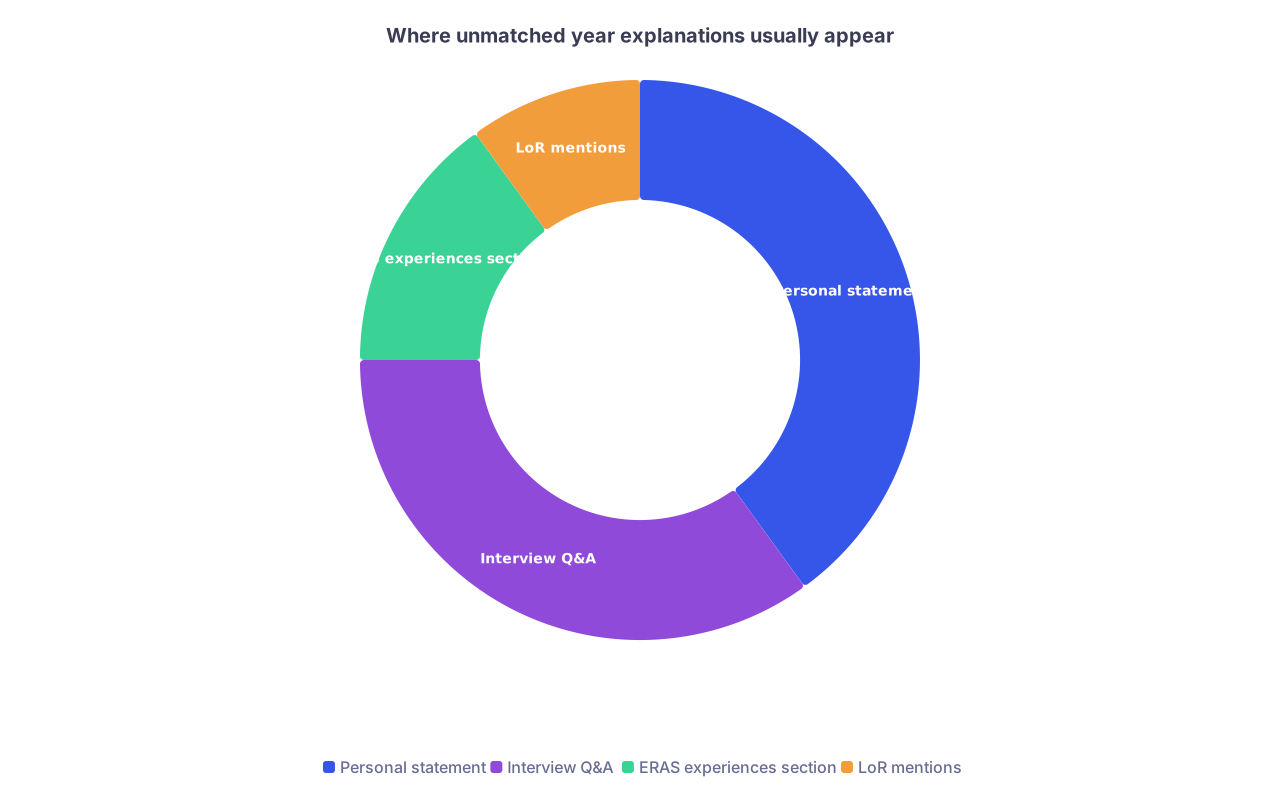
| Category | Value |
|---|---|
| Personal statement | 40 |
| Interview Q&A | 35 |
| ERAS experiences section | 15 |
| LoR mentions | 10 |
You don’t need to volunteer the whole story in the first five minutes of every interview. But you do need prepared language for each of these:
- The personal statement (short acknowledgment and growth).
- The “Tell me about yourself” opener (maybe a brief reference, depending on your arc).
- The direct question: “So tell me what happened with your previous Match.”
- Any vague question about “setbacks” or “challenges.”
Mistakes to avoid in delivery:
- Speed‑talking through it like you’re ashamed.
- Being so brief you sound evasive (“I just didn’t match, but I learned a lot” and then silence).
- Getting defensive when they probe: “Well, again, it was just a really competitive year.”
Practice out loud until you can say your explanation calmly, at a normal pace, without your voice cracking or your face flushing bright red. Yes, that may mean saying it 20–30 times at home. Do it anyway. This is not the story you want to improvise under stress.
Quick Recap: The Mistakes You Cannot Afford
You don’t need a perfect application to match after an unmatched year. But you cannot afford to mishandle the explanation.
Keep three things locked in:
- Don’t blame, minimize, or dramatize. Avoid external blame, “just bad luck” excuses, and emotional oversharing. Own specific factors and show stability.
- Don’t be vague or dishonest. Name concrete reasons, describe focused actions you took in the unmatched year, and keep your story consistent across statements, interviews, and letters.
- Don’t make the gap your identity. Acknowledge it clearly, show how you grew, then shift the spotlight back to your current strengths and readiness to be a solid, dependable resident.
You can recover from not matching. You usually cannot recover from sounding like you learned nothing from it.