
Not matching is not the end of your medical career. It is a forced redesign. If you handle the next 90 days correctly, you can turn a failed Match into a stronger application and a better fit next cycle.
I have seen people match into EM, Ortho, Derm, and competitive IM fellowships after going completely unmatched. The difference was not their Step score. It was what they did between March and June.
Let me walk you through exactly what to do. Day by day, then week by week. No fluff. Just a recovery protocol you can execute.
Step 0: Get Through Match Week Without Wrecking Next Year
You have about 72 hours of emotional chaos. You need a containment plan so you do not make desperate decisions that cripple your next cycle.
First 48 Hours: Stabilize and Gather Facts
Do this even if you are in shock.
Stop the shame spiral
- Do not call every friend to rehash.
- Do not post cryptic messages on social media.
- Do not email programs apologizing or begging. You feel like explaining yourself. Resist. Emotional broadcasting never ages well and sometimes gets screenshotted.
Write down the hard data On one page, no judgment, just the facts:
- USMLE/COMLEX scores (all attempts, all dates)
- Medical school, year of graduation, leave of absence yes/no
- Specialty you applied to, number of programs
- Number of interviews actually attended
- Any red flags: professionalism, leaves, Step failures, gaps, significant course failures
Decide SOAP vs skip SOAP If you are reading this mid–Match Week and SOAP is still happening, ask one question:
- “Is my goal A RESIDENCY POSITION THIS YEAR, ANY SPECIALTY?”
If yes → you SOAP aggressively into any specialties you could tolerate for 3+ years.
If no → you may skip SOAP and build a high-impact re-applicant year.
Bad idea: half-hearted SOAP into a specialty you clearly despise, just to “have something,” then reapply next year anyway. Programs remember.
- “Is my goal A RESIDENCY POSITION THIS YEAR, ANY SPECIALTY?”
Set a 7‑day rule for big decisions For the first 7 days:
- No permanent decisions
- No quitting medicine
- No signing multi-year non-clinical contracts
You are not thinking clearly yet. Put everything on a “review in one week” list.
Step 1: Brutal Post‑Match Autopsy (Days 3–10)
You are unmatched for specific reasons. Hand-waving with “the Match is random” is lazy. The Match has noise, but your file has patterns.
Your job this week: figure out why your application failed.
1. Identify the main failure category
There are usually 3 buckets:
Bucket A – Under-applied / bad strategy
- Applied to 20 programs in EM with 225 Step 1.
- Only applied to “Top 20 name-brand” programs.
- Geographic restrictions with no in-region ties.
Bucket B – Application quality issues
- Weak or generic personal statement.
- LORs that were lukewarm or from non-relevant specialties.
- Poorly structured experiences, no clear narrative.
- No advocacy from your school.
Bucket C – Objective red flags
- Step 1 or Step 2 failure, multiple attempts.
- Big gap in training, unaddressed.
- Professionalism issues / failed rotation.
- Very low scores for specialty competitiveness.
Usually it is a mix, but one dominates.
2. Get external, specific feedback
Do not do this alone. You are too biased about yourself.
You need:
- 1–2 faculty from your target specialty
- Your dean’s office or career advisor
- Optionally, a trusted resident who recently matched in that field
Send them:
- Your ERAS application PDF
- Personal statement
- Program list
- Interview count and where you interviewed
- Your scores and transcript
Then ask specific questions:
- “If you were PD, would you interview this application? Why or why not?”
- “What would you assume about this applicant at first glance?”
- “What is the single biggest reason I did not match?”
- “If I fix only 2 things this year, what should they be?”
You want harsh honesty. If they tell you “You probably just had bad luck,” push back:
“Pretend luck was not a factor. What are my weakest points on paper?”
3. Decide: same specialty, pivot, or dual‑apply
Based on that feedback, you choose one of three paths:
Stay in the same specialty
- Reasonable if:
- You had ≥8–10 interviews and still did not match
- Your scores are within typical range
- No major professionalism red flags
- Interpretation: list problem, interview performance, or minor deficits you can actually fix.
- Reasonable if:
Pivot to a less competitive specialty
- Reasonable if:
- You had 0–3 interviews
- You underperformed significantly on scores
- Your application is clearly not aligned with prior specialty (e.g., no research, no away rotations)
- Example: Reapplying from derm to IM, from ortho to FM, from plastics to anesthesia.
- Reasonable if:
Dual‑apply strategically
- Targeted at:
- Borderline scores for competitive specialty but strong overall candidate
- Risk-averse individuals who genuinely could see themselves in either specialty
- Example: EM + IM, Neuro + IM, Gen Surg + Prelim / TY.
- Targeted at:
Do not dual‑apply to specialties you would clearly hate. You will leak that in interviews.
Step 2: Build a 90‑Day Blueprint (Day 10–100)
Now the part that actually matters: what you do between now and ERAS opening.
You need three parallel tracks:
- Clinical relevance
- Application repair and enhancement
- Relationship-building with decision-makers
I am going to lay this out as a 90‑day framework, not a rigid calendar. You adjust based on your situation.
Track 1: Secure the Right Gap‑Year Position (Days 10–45)
If you do nothing else right, at least fix this. PDs care a lot about what you did in the year after not matching. Unstructured “I just studied and worked part‑time” is weak.
Best options, ranked
| Option Type | Impact on Reapplication | Notes |
|---|---|---|
| Home or external prelim/TY | Very High | Direct clinical, PD advocacy |
| Dedicated research year | High | Strong for competitive fields |
| Clinical fellow / J‑1 job | Moderate–High | Good for IM/FM/Neuro |
| Paid research assistant | Moderate | Better if in target specialty |
| Non-clinical job (scribing, etc.) | Low–Moderate | Only good if no other option |
1. Preliminary / Transitional year (if possible)
If you can land:
- A prelim medicine or surgery year
- Or a transitional year (TY)
Do it. This is the single strongest “recovery” move for many specialties.
Benefits:
- Fresh, U.S. clinical experience
- Real-time evaluations
- PD letter that can override older weaknesses
Action steps (Days 10–30):
- Email program coordinators at:
- Your home institution
- Community hospitals in your region
- Programs that previously interviewed you
- Subject: “Unmatched but available for prelim/TY – strong interest and immediate availability”
- Attach CV and brief 1-paragraph explanation of:
- You went unmatched
- Still highly motivated
- Interested in a one-year position with goal to reapply
You are aiming for any off‑cycle positions or sudden vacancies.
2. Specialty‑aligned research or clinical position
If prelim/TY is not realistic, you need a structured, supervised role that links directly to your target specialty.
Examples:
- For IM: research assistant on outcomes/QI projects in a busy hospitalist group.
- For Psych: clinical research on mood disorders, volunteer in partial hospitalization program.
- For EM: ED research associate, ultrasound RA.
Red flags:
- Completely non‑clinical, non-research jobs “for money.”
(DoorDash full‑time and vague plans to “study” are not going to impress anyone.)
Action steps (Days 10–45):
- Make a list of all departments in your target specialty within 1–2 hours of where you can live.
- Email:
- Department chairs
- Program directors
- Research directors
- Offer:
- To work as a full‑time research assistant
- To help with chart reviews, QI, database work
- To take call/assist on nights/weekends if allowed
Give them an easy “yes”:
- Clear start date
- Willing to work for modest salary or grant-funded rates
- Long‑term (at least until Match next year)
Track 2: Fix the Application Itself (Days 15–90)
Your ERAS this year cannot be a minor revision of last year’s. Unmatched applicants who “lightly edit” their file repeat the same outcome.
1. Scores and exams
If your Step 2 / COMLEX 2 score is mediocre and you still have an exam available (Step 3, COMLEX 3 if allowed), you use it.
For:
- IM, FM, Psych, Neuro, Peds, some Anesthesia:
- A strong Step 3 score can soften earlier marginal performance.
- Highly competitive fields:
- Step 3 is less of a game-changer, but still better than a blank.
If you already failed an exam once, get help:
- Formal prep course
- Weekly tutoring
- Strict schedule with full-length practice tests
You cannot afford a second failure. That becomes a permanent anchor.
2. Experiences and narrative
You must answer the quiet question every PD has:
“Why did this person not match last year, and why will things be different now?”
Your updated ERAS needs to show:
- A clear, coherent story:
- “I realized I am better suited for IM than EM because of X, Y, Z.”
- “I used the last year to deepen my skills in outpatient psychiatry and research.”
- New, concrete achievements:
- Posters, abstracts, small publications
- Leadership or project ownership (QI project, clinic initiative)
- Teaching or curriculum assistance
Do not just add:
- “Clinical research assistant” with vague bullet points. Be specific:
- “Abstract accepted for presentation at [named conference].”
- “Implemented new pre-rounding checklist used by 12 residents; reduced average discharge delay by 1.5 hours.”
3. Letters of recommendation: upgrade, do not recycle
Your old letters are not enough. The fact that they carried you into an unmatched year means they did not seal the deal.
You need at least one of these:
- Fresh letter from your gap‑year PD or direct supervisor
- New letter from a core rotation where you excelled (repeat, sub-I, or visiting)
Ask for strong letters only. When you request:
- “Would you feel comfortable writing a strong letter of support for my residency application in X specialty?”
If they hesitate or pivot to generic phrases, thank them and ask someone else.
4. Personal statement: address the elephant without obsessing
If you were unmatched:
- Do not write an essay titled “Why I did not match.”
- Do not ignore it entirely, either.
You handle it with:
- 1–2 sentences in the personal statement:
- “After an unsuccessful match cycle in 2025, I focused the following year on strengthening my clinical skills and confirming my commitment to internal medicine through a research assistant position with the hospitalist team.”
- Save specifics for:
- Interviews
- PD emails
- LoR writers describing your growth
Track 3: PD Relationship Strategy (Days 30–90)
People underestimate this. Programs are flooded with similar-looking PDFs. The difference is often who has an advocate.
Your mission in 90 days: create 5–15 real relationships with faculty or PDs who:
- Know your face and name
- Understand your story
- Are willing to go to bat for you
1. Start with your home institution
Even if you think they do not care about you. Push anyway.
Actions:
- Schedule meetings with:
- Your dean
- Chair of your target department
- Program director and associate PDs
- Agenda for those meetings:
- Own the unmatched outcome directly. “I did not match. I would like your help to make sure that never happens again.”
- Present your plan for the year in bullet form.
- Ask directly: “If I follow through on this, would you be willing to support me with a strong letter and possibly advocate to other programs?”
You want at least one person to say, “Yes, I will help you.”
2. Targeted outreach to outside programs
This is not mass emailing. That is spam. You do small volume, high signal.
Pick:
- 10–20 programs where:
- You have geographic ties
- Your stats are realistically in-range
- You could see yourself actually training
Then:
- Find one faculty per program with shared interests (research topics, medical school, region).
- Send a short, respectful email:
- Who you are, previous year’s outcome.
- What you are doing this year (gap‑year job).
- One line of connection (“I am very interested in your program’s X curriculum / Y clinic / Z track.”)
- Ask for 10–15 minutes of career advice, not a position.
If they respond and you get on Zoom or phone:
- Do not beg for an interview.
- Ask:
- “From your perspective as faculty/PD, what would you need to see in my file to feel comfortable ranking me?”
- “Does your program have any opportunities for visiting rotations, research involvement, or observerships that could help me get to know your environment better?”
You are planting seeds. When ERAS hits their inbox in September, they remember you.
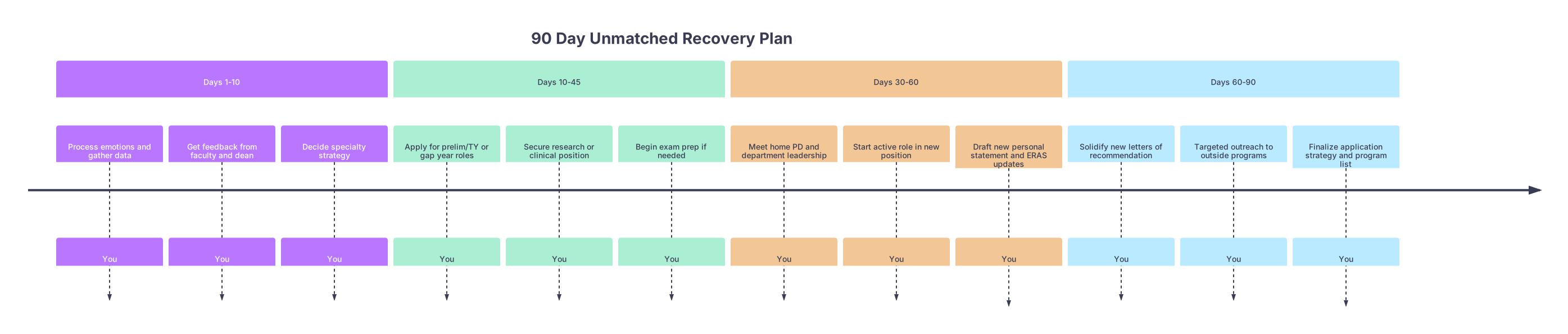
A Realistic 90‑Day Timeline
Let me put this into a structured plan you can actually follow.
| Period | Event |
|---|---|
| Days 1-10 - Process emotions and gather data | You |
| Days 1-10 - Get feedback from faculty and dean | You |
| Days 1-10 - Decide specialty strategy | You |
| Days 10-45 - Apply for prelim/TY or gap year roles | You |
| Days 10-45 - Secure research or clinical position | You |
| Days 10-45 - Begin exam prep if needed | You |
| Days 30-60 - Meet home PD and department leadership | You |
| Days 30-60 - Start active role in new position | You |
| Days 30-60 - Draft new personal statement and ERAS updates | You |
| Days 60-90 - Solidify new letters of recommendation | You |
| Days 60-90 - Targeted outreach to outside programs | You |
| Days 60-90 - Finalize application strategy and program list | You |
You will overlap tasks, but this is the right order of operations.
Specialty‑Specific Adjustments
Different fields handle unmatched applicants differently. A few quick riffs.
Internal Medicine / Family Med / Pediatrics
You have the most flexibility.
Priorities:
- Show continuous clinical engagement (prelim year, inpatient or outpatient role).
- Solid Step 2 / Step 3 scores.
- Demonstrable interest:
- QI projects
- Continuity clinic
- Vulnerable populations
A good IM PD will often say: “If they worked hard on our service this year and I have a strong letter, I do not care they went unmatched before.”
Psychiatry
Psych tolerates non-traditional paths but hates:
- Long unexplained gaps
- Poor interpersonal evaluations
Focus on:
- Strong, recent clinical psych exposure (inpatient, outpatient, PHP/IOP).
- Letters commenting on your empathy, communication, reliability.
Avoid:
- Year entirely in non-psych research without patient contact. It reads like you are not sure you actually like psychiatry.
Surgery and Surgical Subspecialties
Hard truth: unmatched once is not a death sentence. Unmatched twice almost is.
If you stay in surgery:
- You must land a prelim surgery year, ideally at a program that actually converts prelims to categoricals.
- Work like a beast:
- Be the earliest in, latest out.
- Make yourself the intern they cannot live without.
- Get:
- A glowing performance letter
- PDs making direct calls on your behalf
If you cannot secure that, you need to think seriously about:
- Pivot to anesthesia, radiology, or IM
- Or to a non-surgical specialty you could live with.
Competitive Specialties (Derm, Ortho, ENT, Plastics, Neuro, etc.)
If you are missing:
- Top-tier research
- Strong home/away rotation performance
- A “sponsor” (well-known faculty)
You either fix that or you pivot.
For those who truly cannot imagine another path:
- One year full‑time, high-output research in that specialty at a major institution.
- Aim for:
- Multiple abstracts / posters
- At least one publication
- Being known by name by several attendings
But understand: even then, there is still significant risk of not matching again. Have a Plan B you actually respect.
Avoid These Common Self‑Sabotaging Moves
I have seen these ruin good candidates:
Drift year
- Vague “studied, did some volunteering, spent time with family.”
- PD reading your app: “So you did nothing clinical or structured for 12 months?”
Angry, blameless narrative
- Blaming “the system,” “nepotism,” or “they just picked their own.”
- On paper or in interviews, this reads as: “difficult to work with.”
Doubling down without feedback
- Reapplying to the same 40 programs with the same profile.
- Hoping for different results. That is not resilience. That is denial.
Overselling tiny achievements
- Treating tiny posters as Nobel-level breakthroughs.
- PDs can smell desperation from a mile away.
No clear improvement to point to in the interview In your next interview, when they ask:
- “What have you done since going unmatched?”
You must have a crisp, confident answer that shows: - Insight
- Growth
- Concrete work
- “What have you done since going unmatched?”
Interview Strategy For Next Cycle
You will be asked about not matching. Repeatedly. You need a script that is honest, short, and shows maturity.
Use this structure:
Own it directly
- “I did not match last year.”
Name the main reasons concisely
- “Looking back, my application had two weaknesses: my limited exposure in internal medicine and my narrow program list.”
Describe what you did about it
- “Over the last year, I have been working as a research assistant with the hospitalist group, covering inpatient rounds, helping with QI projects, and strengthening my clinical reasoning. I also broadened my program list to better reflect where I would be a good fit.”
Close with your current readiness
- “This year I feel more prepared and much clearer that internal medicine is the right path for me.”
Then stop. Do not launch into a five-minute monologue.
Practice this out loud 20 times until it sounds natural, not rehearsed.
Mental Health: Staying Functional While You Rebuild
You are not a robot. This hurts. The goal is not to suppress that. The goal is to prevent it from silently wrecking your performance this year.
Quick rules:
- One person for emotional dumping (friend, partner, therapist). Not ten.
- One weekly ritual to disconnect (gym, run, game night, whatever actually works for you).
- If you notice:
- You stop responding to emails.
- You cannot sit down to study at all.
- You avoid any conversation about your career.
Then you get professional support. Early.
Residency demands resilience. Showing that you hit a wall, got help, and rebuilt is not weakness. It is the job.
If You Are Reading This After 90 Days
If you are already past the ideal window and did none of this yet, you still have options.
Compress the same plan:
- Get any structured, supervised clinical or research role now.
- Aim for 6–12 months of solid performance before programs rank you.
- Delay your application by a year if you must, rather than submitting another weak one.
Half-prepared reapplications are how people end up permanently outside the Match.
The Short Version: Your Recovery Priorities
You do not need 20 takeaways. You need three:
Do a ruthless post‑match autopsy and commit to a clear specialty strategy. No vague “try again and hope.” Understand exactly why you did not match and decide whether you are staying, pivoting, or dual‑applying.
Make this year impossible to ignore. Prelim/TY year if you can get it; otherwise a high-responsibility, specialty-aligned research or clinical role with strong supervision and new letters. Your ERAS must look clearly stronger, not just older.
Stop being anonymous. Build real relationships with your home institution and a handful of outside programs. Get people who will pick up the phone for you, and walk into interviews with a concise, confident story of what went wrong and how you fixed it.
Follow that, and “Unmatched in March” becomes a painful chapter, not your final outcome.