
It’s Monday of Match Week. 10:59 a.m. Eastern. You’re staring at your NRMP screen, stomach in your throat, and then the message hits:
“We are sorry, you did not match to any position.”
Two minutes later you’re in a ‘mandatory’ meeting with Student Affairs, someone is throwing around the word SOAP like it’s a rescue boat, and you’re trying not to shut down while they talk “strategy.”
Here’s what nobody around that conference table tells you:
On the other side of the screen, program directors and coordinators are also scrambling. And they are having very real, very candid conversations about “the SOAP kids.”
I’ve been in those rooms. I’ve watched PDs scroll through lists with 500+ unmatched applicants for 3 open spots. I’ve seen who gets taken seriously and who’s written off in the first 15 seconds.
Let me tell you what actually goes through their heads when they see you in the SOAP.
The Unspoken Categories: How PDs Sort SOAP Applicants
First truth: PDs do not look at “SOAP applicants” as one homogeneous, unlucky blob.
They mentally put you into buckets within minutes. Sometimes seconds.
Here’s roughly how it plays out behind closed doors.
, Career-changers / re-applicants, International / visa concerns, Completely misaligned applicants](https://cdn.residencyadvisor.com/images/articles_svg/chart-approximate-soap-applicant-buckets-in-pd-minds-5938.svg "Approximate SOAP Applicant Buckets in PD Minds")
| Category | Value |
|---|---|
| Strong but overreached | 25 |
| Average with [red flags](https://residencyadvisor.com/resources/post-match-options/the-real-difference-between-red-flag-and-recoverable-post-match) | 30 |
| Career-changers / re-applicants | 15 |
| International / visa concerns | 20 |
| Completely misaligned applicants | 10 |
Bucket 1: “Strong but overreached”
This is the group PDs are actually excited about.
These are the applicants who:
- Aimed at hyper-competitive programs or specialties
- Had decent to strong scores and solid evaluations
- Maybe limited home support, poor advising, or rank lists that were too top-heavy
You’ll literally hear PDs say things like:
“How the hell did this one not match? What happened here?”
Or:
“This kid must have shot way too high. I’ll happily take them.”
If your file shows:
- Reasonable Step scores
- Consistent clinical performance
- No major professionalism issues
- Coherent story and good letters
…PDs don’t care that you’re in the SOAP. You’re free talent they didn’t have to court in October.
This group can and does land good spots via SOAP. And PDs know many of them are just victims of bad strategy, not bad ability.
Bucket 2: “Average + something concerning”
This is the largest group. And the most debated in faculty rooms.
These are the “okay but…” files:
- Okay scores, but low shelf or a failed exam
- Decent clerkships, but one really rough evaluation
- Odd gaps on the CV
- Vague or generic letters suggest something is off
The conversation sounds like this:
“On paper they’re fine, but why didn’t they match anywhere? Something’s not adding up.”
Or:
“There’s smoke here. Do we have time to figure out if there’s fire?”
SOAP is frantic. Nobody has time for a 30-minute forensic analysis of your life. If your file raises questions that are not quickly explained by:
- Changing specialty late
- Having a geographic limitation
- Overly aggressive rank list
…many PDs just move on to the next clean file.
Bucket 3: “Re-applicants / career pivot people”
These get a different look.
PDs know that some applicants:
- Spent a year in research or prelim
- Tried one specialty and are now pivoting
- Are attempting to course-correct from a failed first match
Here’s the key: PDs want to see growth and clarity, not just desperation.
I’ve heard this more than once:
“I’m okay with someone who didn’t match last year. I’m not okay with someone who didn’t learn anything from it.”
If your SOAP application looks identical to last year’s but in a different specialty, that’s a red flag. If it shows:
- Better Step 2
- Clearer narrative
- Stronger letters from this new field
…now you’re interesting, not damaged.
Bucket 4: “Great on paper but logistical headaches”
These are often IMGs or visa-needing applicants. Sometimes strong, sometimes spectacular. But they come with administrative friction.
The private PD calculation here is brutal:
“Is this applicant so good that it’s worth the extra paperwork, delays, and GME headaches?”
If you need a visa, cost the GME office time, or come from a school they’ve never heard of, your file has to be stronger than a similarly qualified US grad to win that tiebreaker. Fair? No. Real? Yes.
Bucket 5: “What are you even doing here?”
This is the harsh one.
These are applicants wildly mismatched to the specialty or the reality of their file:
- 190s on Steps trying to SOAP into derm
- One passed Step with multiple failures into surgery prelims with zero surgical exposure
- Personal statements that read like generic copy-paste
These are deleted quickly. Sometimes with a comment. Sometimes with a shrug.
You don’t want to be in this bucket. And too many unmatched students end up here because their school SOAP “strategy” is: apply everywhere, to everything.
The Truth About the Stigma: How Bad Does “SOAP” Look Long-Term?
The question rolling around in your brain: “Am I marked forever because I SOAPed?”
Short answer: not nearly as much as you think. But the reason you SOAPed matters more than the fact that you did.
Here’s the off-the-record reality faculty talk about in hallways but never say on panels.

PD memory is short… unless you make it their problem
Most PDs are not hunting for whether you matched through SOAP 3 years ago. They care about:
- How you work
- How you fit
- Whether you cause trouble
If you show up as an intern, do solid work, no drama—no one cares that your position was filled on Wednesday instead of Monday of Match Week.
Where it does come up is:
- When you are clearly underprepared for residency
- When you arrive with unresolved issues (professionalism, communication, reliability)
- When you’re bitter and let that leak into your attitude
Then, yes, people start speculating: “Is this why they SOAPed?”
Future fellowship and job applications
Fellowship PDs sometimes ask: “Did this person SOAP or match initially?”
They’re not usually trying to punish you. They’re asking an unstated question: “Has this person been under-selected their whole career? Or was that a one-off early bump?”
If your trajectory after SOAP looks like:
- Strong intern year
- Good in-service scores
- Positive letters
…the SOAP thing gets framed as: “early setback, overcame it.”
If the trajectory is:
- Borderline performance
- Intermittent professionalism issues
- Minimal growth
…then SOAP becomes part of a story: “pattern of marginal performance.”
The SOAP event is neutral. How you perform after it is what charges it with meaning.
What PDs Actually Look At During SOAP (And What They Ignore)
SOAP is not October. They’re not reading your entire life story. There’s no leisurely committee review.
You’ve got minutes of their attention, not hours.
| Priority Level | Application Component |
|---|---|
| Highest | Step 2 score + failures |
| High | Clinical grades / MSPE |
| High | Letters from US clinicians |
| Medium | Personal statement (SOAP version) |
| Medium | CV / prior degrees / research |
| Low | Volunteer fluff / hobbies |
The ‘hard filters’ PDs quietly use
A lot of programs, especially in competitive specialties, still use simple internal filters. During SOAP, those filters get even cruder, because time is short.
Behind closed doors, I’ve seen screens like:
- “Show only US grads”
- “Hide anyone with >1 Step failure”
- “Only Step 2 > 220”
Nobody advertises this on a webinar. But when you’ve got 400 applicants for 2 preliminary spots, you’re not doing holistic review. You’re triaging.
So your Step 2 and failure history get scanned first. That’s the first gate.
If you have:
- A fail with a strong retake and explanation
- Or a single low score but clean since
…you’re not dead. But the file has to offset that with strong clinical evaluations and letters.
What surprises PDs (in a good way)
There are a few things that make PDs pause—in a positive way—during SOAP:
A clear, humble, targeted personal statement written for SOAP, not recycled from September.
When they see a statement that directly addresses the pivot (“I applied to X, realized Y, here’s why I now want Z, and here’s what I’ve done about it”), that stands out. Most SOAP statements are lazy and generic.Concrete evidence of reliability.
Extra year as a sub-I, strong continuity clinic note, “This student always stayed late and followed through” in a letter. PDs are wary of anyone who SOAPs and then no-shows, disappears, or flakes.Real connection to that specialty, even if late.
If you switched from OB to IM and your app shows one random IM letter and nothing else, they smell panic.
If you SOAP to IM but:- You did a strong IM sub-I
- Attended their noon conferences at your home program
- Have an IM mentor writing a serious letter
…now it looks like an informed pivot, not a desperate lunge.
What they mostly ignore during SOAP
- Long lists of generic volunteer work (“health fair, clinic, random leadership titles”)
- Most research unless it’s clearly within their field or at a high level
- Hobbies and extra-curricular fluff
They’re asking a brutally practical question:
“If this person shows up July 1, will they survive as an intern in my program?”
If what you’re emphasizing doesn’t answer that, you’re wasting their very limited mental bandwidth.
The Emotional Side: How PDs Feel About SOAP Applicants
This almost never gets said out loud.
There are three main emotional reactions PDs have to SOAP applicants. And it shapes decisions more than you’d think.
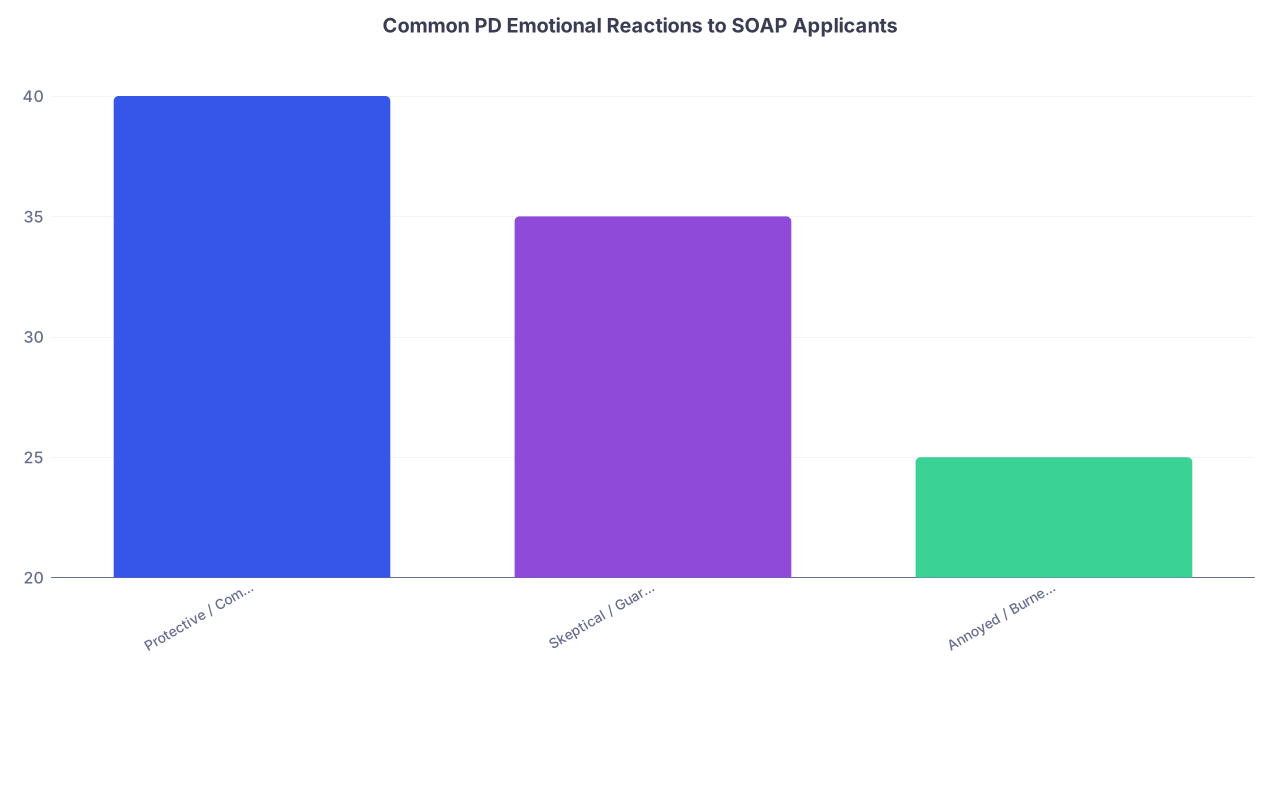
| Category | Value |
|---|---|
| Protective / Compassionate | 40 |
| Skeptical / Guarded | 35 |
| Annoyed / Burned before | 25 |
1. Protective
Most PDs remember being terrified as students. Many have seen excellent students sabotaged by bad advising.
Some PDs consciously think:
“I want to save a couple of good people who got screwed by this process.”
That’s when you hear:
“Look at this one—great letters, decent scores, just overshot. Let’s bring them in.”
If you look like a fundamentally strong trainee who just misplayed the match game, they like being the one to give you a chance.
2. Skeptical
SOAP also attracts applicants who:
- Ghost programs
- Say yes, then try to back out
- Come in with a chip on their shoulder
After getting burned once, PDs remember. A lot of them have a mental (or literal) list of:
“The last SOAP disaster we took.”
So when your email sounds entitled, or your behavior during a quick virtual interview is off, that skepticism kicks in hard. They’ll choose the slightly less qualified but clearly stable applicant every time.
3. Annoyed
Some PDs are just exhausted by SOAP.
They’re dealing with:
- Extra paperwork
- Scrambling call schedules
- GME breathing down their necks
If your application looks messy, if scheduling you is complicated, if your communication is chaotic—they’re more likely to say “no” just out of sheer bandwidth fatigue.
You combat that not by begging, but by being frictionless: responsive, organized, realistic, and clear.
Strategic Truths: How To Not Look Like a Desperate SOAP Applicant
Let’s cut through the “just be yourself” nonsense. In SOAP, you’re being judged in a compressed, chaotic window.
You want PDs to think:
“Unlucky this week, but solid overall.”
Not: “Desperate, confused, or risky.”

| Step | Description |
|---|---|
| Step 1 | Review applicant list |
| Step 2 | Reject quickly |
| Step 3 | Scan MSPE and scores |
| Step 4 | Check letters and fit |
| Step 5 | Invite for quick call |
| Step 6 | Rank to offer |
| Step 7 | Meets hard filters |
| Step 8 | Any major red flags |
| Step 9 | Plausible story for SOAP |
| Step 10 | Professional and stable |
Fix your story. Fast.
PDs are always asking themselves one core question:
“Does the story of this applicant make sense?”
During SOAP your story needs to answer, implicitly:
- Why you’re in SOAP
- Why this specialty now
- Why you’re not a risk
Bad story:
“I applied to ortho, didn’t get in, now I guess I’ll do Family Medicine.”
Good story:
“I’ve always been drawn to continuity of care and broad-spectrum medicine. I initially applied to EM but realized during my FM rotation that I preferred long-term relationships and primary care. I’ve since done X, Y, Z within FM. I didn’t match because my original rank list was EM-only and geographically narrow. I would be grateful and fully committed to build my career in Family Medicine.”
See the difference? One sounds like collapse. The other sounds like a reveal.
Clean up the obvious red flags in how you present
You can’t erase a Step failure in 24 hours. But you can decide how you talk about it.
Faculty notice:
- Are you honest but not defensive?
- Do you own it and show what changed?
- Or do you dance around it and blame everyone else?
SOAP is the worst time to be in denial. The PDs who do call you often ask one hard question on purpose just to see your reaction.
Handle it with:
- Brief explanation
- Concrete corrective actions
- Move on to strengths
Don’t monologue. Don’t cry. Don’t overshare. This is not therapy.
How Different Specialties Actually View SOAP Applicants
Let me give you a taste of the specialty-specific subtext, because yes, it differs. Dramatically.
Internal Medicine, Pediatrics, FM
These fields see SOAP every year. They’re used to it.
You’ll hear:
- “We always find a couple of great folks in SOAP.”
- “IM always picks up strong EM or neuro people who misfired.”
If your file is reasonable and your attitude is good, they’re open-minded. They know many excellent attendings started as SOAP interns.
Surgery and prelim years
In surgery prelims, it’s brutally pragmatic.
They’re asking:
- “Will this person do the work?”
- “Will they sink or swim on nights?”
- “Are they likely to quit mid-year?”
SOAP surgery prelims don’t want dreamers still secretly married to derm. They want grinders who will show up and not crumble.
If you sound like you’re using them as a holding pen while you regroup for ENT, they can smell it. And they hate it.
Competitive fields (derm, ortho, ENT, plastics, rad onc)
Most of these programs are not living in SOAP. When they are, it’s a very specific scenario.
They often prefer:
- Strong IMGs with proven derm/rad onc/ortho pedigree
- Or top-of-class US grads who narrowly missed
They are not typically hunting for “I changed my mind on Friday” people. If you’re aiming here in SOAP without a pre-existing strong profile, that’s usually admission that no one has been honest with you.
The One Thing PDs Respect Most in SOAP Applicants
Here’s the thing hardly anyone tells you:
Program directors are watching not just what happened to you, but how you handle it.
You just took a very public punch to the face. Some PDs are quietly watching for:
- Do you regroup or implode?
- Do you get organized or chaotic?
- Do you treat staff and coordinators with respect when you’re under stress?
Coordinators talk. A lot.
If their report is:
“They were very polite, responsive, and appreciative during this stressful week.”
That lands. If it’s:
“They were rude on the phone and acted like we owed them something.”
You’re done.
The secret is: PDs know SOAP is brutal. Many of them have former SOAP interns who became chiefs, stars, rock-solid colleagues. They’re not allergic to SOAP candidates.
They’re allergic to applicants who crumble under pressure and bring that chaos into their residency.
You can’t rewrite your Step score. You can absolutely control how you show up this week.
FAQ: What Program Directors Really Think of SOAP Applicants
1. Will I always have to disclose that I matched through SOAP?
Not formally. Your NRMP history isn’t tattooed on your forehead. But your start date, program type, and timeline sometimes make it obvious to insiders who care enough to piece it together. Most fellowship PDs don’t care how you matched as long as your residency performance is strong, your letters are glowing, and there’s no ongoing pattern of marginal performance.
2. Do PDs view SOAP applicants as “riskier” than regular Match applicants?
Some do, initially. The reasoning is: “The market already voted on this person once.” But that’s counter-balanced by the reality that SOAP also contains overreaching strong applicants and people who were poorly advised. If your file is strong and your behavior during SOAP is stable and professional, the “risk” label fades quickly once you start residency.
3. Is it better to SOAP into a less desired specialty or go unmatched and try again next year?
Behind closed doors, many PDs and deans will tell you this: if you SOAP into a reasonable, viable specialty where you can see yourself long-term (IM, FM, peds, psych, prelim-to-categorical paths), it’s usually better than rolling the dice on a reapplication from scratch—unless you’re an unusually strong candidate who clearly just mis-strategized. The worst option is going unmatched twice.
4. Do PDs look down on people who switch specialties during SOAP?
They do if it looks impulsive and desperate. They respect it when your pivot is coherent, grounded in actual clinical experience, and supported by letters from the new field. If your entire file screams derm and you SOAP into psychiatry with zero psych exposure or explanation, it reads as panic. If you can show a real connection and preparation for the new specialty, PDs can be surprisingly accepting.
5. Can a SOAP applicant become chief resident or get a top fellowship later?
Absolutely. I’ve seen multiple SOAP interns end up as chiefs, star fellows, and academic faculty. What separates them is not how they matched, but how they performed afterward—consistently solid work, maturity, no entitlement, and clear growth. Once you’ve built a real track record in residency, almost nobody cares how you spent four days in March years ago.
Years from now, you won’t remember the exact wording of that “You did not match” email. You’ll remember whether you let that week define you—or whether you used it as the moment you proved, to yourself and to everyone watching, that you could get hit hard and still stand up straight.