Most residents who match prelim-only are given vague, sugar‑coated advice. It gets people stuck. You cannot afford that.
You matched prelim only. No categorical spot. Now everything about your reapplication has extra layers that most advisors never bother to unpack.
Let me break those layers down precisely.
1. What “Prelim‑Only” Really Means For Your Next Match
You are not just “reapplying.” You are reapplying with:
- A new set of full‑time clinical attendings evaluating you
- A real ACGME track record (good or bad)
- A gap or continuity problem after this year if you do not land something
The NRMP does not label you with a scarlet letter for prelim status, but programs read your application differently. They immediately ask 4 questions:
- Why did this person only match prelim?
- What have they done with this prelim year?
- Are they a flight risk or a remediation project?
- Can they function at our PGY‑2 level on day one?
The reason reapplying after a prelim‑only match is such a niche problem is that you are caught between worlds:
- You are no longer a standard M4 applicant.
- You are not yet an experienced PGY‑2 with a clean categorical story.
You are in the awkward middle, and your application has to acknowledge that head‑on.
2. Understanding Your True Options: Categorical vs PGY‑2 vs Backup
You have more paths than people usually tell you, but they are not equal. You must be strategic rather than “apply to everything and hope.”
A. Categorical Reapplication (Same or Different Specialty)
You can absolutely reapply to categorical PGY‑1 spots. Common scenarios:
- Prelim in Surgery → reapply to categorical Surgery or switch to Anesthesia/IM
- Prelim in Medicine → reapply categorical IM, or pivot to Neurology, Psych, etc.
Pros:
- Cleanest narrative if you succeed (“I did a strong prelim and earned a cat spot”).
- You can enter as PGY‑1 or sometimes get PGY‑2 credit.
Cons:
- You are competing against fresh graduates.
- Some specialties (e.g., Ortho, Derm, ENT, PRS) will essentially see you as “already filtered out” unless your prelim year is stellar and you have strong departmental support.
Specific reality: If you did a Surgery prelim and are trying to re-enter categorical General Surgery, the bar is high. They will expect:
- Outstanding prelim evaluations
- Strong letters from surgeons in your current program
- No professionalism or performance concerns
- Clear reason your first cycle underperformed (late application, low Step score, visa issues, major personal event, etc.)
B. Advanced / PGY‑2 Positions
Here is the nuance most people miss: programs view an applicant for PGY‑2 differently than for PGY‑1.
- If you have completed or are completing an ACGME-accredited prelim year in the same or related field, you can apply for PGY‑2/advanced slots.
- This can occur through the Match or outside the Match (off‑cycle or “out‑of‑Match” positions).
Common moves:
- Prelim IM → PGY‑2 IM, Neurology, sometimes Anesthesia
- Prelim Surgery → PGY‑2 categorical Surgery (rare but possible), some subspecialties
- Prelim Transitional → PGY‑2 in Anesthesia, Radiology, Neuro, PM&R, etc.
You must verify two things explicitly:
- Will my prelim year count fully toward the categorical program’s training requirements?
- What does their program letter of agreement say about PGY credit transfer?
Do not assume. Email the program coordinator or PD and ask directly.
C. Alternative Specialty or “Safety” Specialty
Hard truth: If you matched only prelim after applying for a highly competitive specialty (e.g., Ortho, Derm, ENT, IR), your next cycle may require a pivot if you want stability.
Common pivots:
- Surgery prelim → categorical IM, Anesthesia, EM (varies by region), PM&R
- Medicine prelim → Neurology, Psych, PM&R, Family Medicine
- Transitional year → any of the above, depending on rotations and letters
You must decide early: Are you trying one more high‑risk cycle in your dream field, or are you locking down stability in a more attainable specialty?
Trying to do both “equally” in the same cycle usually reads poorly on your application. Programs notice when your story sounds generic and unfocused.
D. Non‑Match / Off‑Cycle Opportunities
Underrated and under‑discussed:
- Off‑cycle PGY‑2 openings due to attrition, resignation, or dismissal
- Newly funded positions mid‑year
- VA or community sites that add a slot quietly
These are usually advertised via:
- Program listservs
- Specialty‑specific forums and mailing lists
- Institutional GME offices
- Word of mouth: attendings who know other PDs
You want your PD and chief residents to know you are open to these so they can flag you early.
3. Timeline: What You Need To Do During Your Prelim Year
You do not have the luxury of “see how the year goes and decide later.” The timelines are concrete.
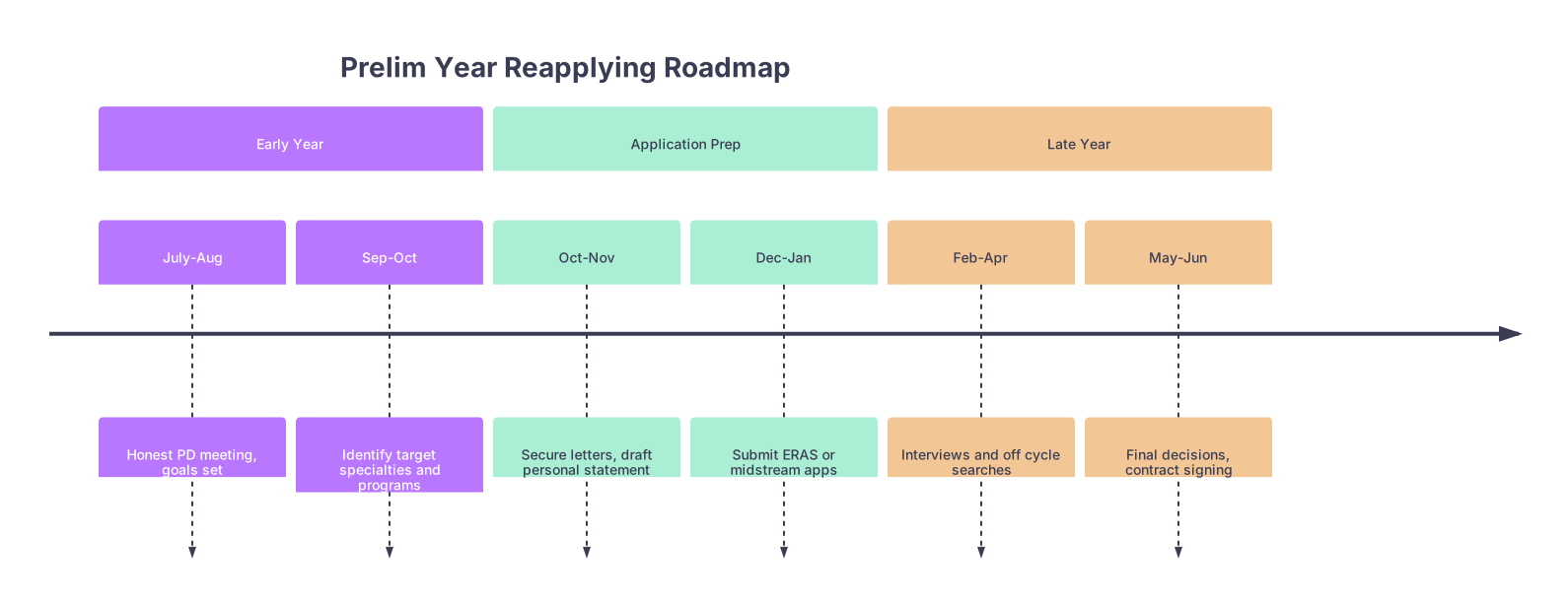
| Period | Event |
|---|---|
| Early Year - July-Aug | Honest PD meeting, goals set |
| Early Year - Sep-Oct | Identify target specialties and programs |
| Application Prep - Oct-Nov | Secure letters, draft personal statement |
| Application Prep - Dec-Jan | Submit ERAS or midstream apps |
| Late Year - Feb-Apr | Interviews and off cycle searches |
| Late Year - May-Jun | Final decisions, contract signing |
Let’s break that down more practically.
July–September: Reality Check and Positioning
Meet with your PD early (not in a hallway, an actual scheduled meeting).
Ask explicitly:- “Do you see me as someone you would recommend for a categorical/PGY‑2 spot?”
- “Are there any concerns I need to address now?”
- “Would you be open to supporting reapplications this fall?”
Start keeping a log of:
- Notable cases
- Positive feedback
- Any patient compliments, teaching awards, QI involvement
These will feed into your personal statement and MSPE‑equivalent updates.
October–December: Application Infrastructure
You will likely be dealing with ERAS again (or specialty‑specific systems).
Key tasks:
Decide primary target specialty and, if relevant, a secondary backup specialty.
Identify letter writers:
- PD or associate PD (non‑negotiable in most cases)
- At least one attending in your targeted specialty
- Possibly a subspecialist who worked closely with you on a rotation
Draft a new personal statement:
- Explain the prelim‑only outcome concisely, without self‑pity.
- Highlight what you have learned and how your performance as a resident validates your fit.
- Clarify your directional choice: staying with the same field or switching, and why.
January–March: Interviews, Match, and Plan B
While your co‑interns are just surviving the grind, you are doing that plus:
- Attending categorical/PGY‑2 interviews (live, virtual, or hybrid).
- Networking with visiting residents and faculty about potential openings.
- Monitoring specialty society job boards for off‑cycle PGY‑2 needs.
You must also think through the “what if I do not match again” scenario.
- Can you extend prelim training (rarely ideal; often not possible)?
- Can you pivot to research or a clinical instructor role to avoid a gap?
- Are you willing to accept a less‑desired geographic location for a stable spot?
Have this discussed with your mentors before February, not after you see a second NRMP “No match” screen.
4. How Programs Actually Read Your Application The Second Time
Most reapplicants misunderstand this completely. They think, “Now I have US clinical experience; that has to help.” It helps. But programs are also looking for signals of risk.
Here’s the thought process I have heard from PDs reviewing prelim‑only reapplicants:
- “Did this person grow from M4 to PGY‑1, or did their performance plateau or worsen?”
- “Does their PD’s letter sound like a true endorsement or an obligation?”
- “Are there red flags: professionalism, communication, repeated exam failures, big gaps?”
- “Is their story coherent, or does it feel opportunistic and scattered?”
Your job is to pre‑answer these concerns in your materials.

The PD Letter: Your Single Most Powerful Asset (or Liability)
A strong PD letter sounds like this:
“Dr. X has performed at or above the level of our categorical interns. I would rank them in the top third of our current class. I would absolutely reappoint them at our own institution if we had a categorical position available.”
A lukewarm letter sounds like:
“Dr. X successfully completed required rotations and has demonstrated adequate clinical skills. They have shown improvement over the year.”
Programs can tell the difference in one paragraph. If you sense your PD will be lukewarm, you must compensate with:
- Multiple strong subspecialty letters
- Direct communication about what has changed since your first application
- Explaining any early rough patches explicitly and showing a trajectory of improvement
Addressing the Elephant: Why You Matched Prelim Only
You cannot pretend this did not happen. You also do not need a multi‑page confession.
State it clearly and move on:
Example 1 (competitive specialty miss):
“I applied exclusively to categorical General Surgery positions last cycle and did not match. I was offered and accepted a Preliminary Surgery position at X Hospital, which has allowed me to confirm my interest in operative care and to demonstrate that I can perform at the level of a categorical intern.”Example 2 (late decision / application weakness):
“I decided on Internal Medicine late in my fourth year and submitted a limited number of applications. I matched to a Preliminary Medicine position at Y Program. Over this year I have strengthened my clinical foundation, addressed earlier weaknesses in time management and efficiency, and am now seeking a categorical home where I can continue this growth.”
Two or three sentences. Straightforward. No elaborate excuses.
5. Common Problem Scenarios and How To Handle Them
Let me walk through the patterns I see constantly.
| Scenario | Primary Focus | Backup Plan |
|---|---|---|
| Prelim Surgery → wants categorical Surgery | Strong PD letter, high case volume, apply broadly to community programs | IM or Anesthesia applications in parallel |
| Prelim IM → wants PGY-2 IM | PGY-2 and categorical PGY-1 apps, emphasize continuity clinic, QI | Psych, Neuro, or FM if IM market saturated |
| Transitional Year → wants Anesthesia | Board scores, strong Anesthesia letters, apply to advanced and categorical | Categorical IM or FM spots |
| Weak PD support | Build strong subspecialty letters, explicit remediation story | Broader specialty pivot + off-cycle PGY-2 search |
Scenario 1: Prelim Surgery, Wants Categorical Surgery
Reality: You are in a brutally competitive reapplication lane.
Your must‑haves:
- No major clinical deficiencies.
- Strong evidence that you handle volume, call, and the OR well.
- A PD or Chair letter that signals: “We would keep this person if we could.”
Smart strategies:
- Target more community and mid‑tier academic programs instead of only big‑name centers.
- Include smaller programs in less popular regions; they often value proven work ethic highly.
- Consider programs with a known history of accepting prelims into categorical spots.
You should also seriously consider a parallel track (IM or Anesthesia) if your Step scores, research history, or evaluations are not top tier.
Scenario 2: Prelim Medicine, Wants Categorical or PGY‑2 IM
You are in a better position compared with Surgery preliminary residents statistically. Medicine is broader, with more spots and more mid‑cycle movement.
Priorities:
- Continuity: show that your patients know you, that you can manage complex internal medicine across settings.
- QI / scholarly work: any poster or QI project during intern year plays well.
- Reliable, low‑maintenance intern reputation: this matters as much as research.
You should apply to:
- Categorical IM PGY‑1 spots through the Match
- Any PGY‑2 openings (even mid‑year) that accept prelim IM graduates
Stay in close communication with your PD/global GME office; they often know about PGY‑2 openings before they hit public job sites.
Scenario 3: Transitional Year → Still Exploring vs Now Decided
If you did a TY because you were undecided, you must not sound undecided again.
Example: You now want Anesthesia.
- Get at least one letter from an Anesthesia attending who worked directly with you in the OR.
- Emphasize decision‑making, vigilance, and crisis management from your intern year rotations.
- Demonstrate that you understand Anesthesia’s training structure and not just “I liked being in the OR.”
If you are still unsure between two specialties at the end of a TY, you are in trouble. Programs want clarity. Pick one primary field to present in your ERAS. If you blend two, you will look unfocused to both.
Scenario 4: You Had Performance Issues Early In The Year
This is where most people get paralyzed. Do not.
If you had:
- Early concerns about note efficiency, time management, or communication that improved
- A remediation plan that you successfully completed
You can address it like this in your personal statement or in interviews:
“I initially struggled with efficiency in managing cross‑cover pages on night float. My PD and I created a specific plan to improve my triage and task‑prioritization skills, including structured check‑ins and targeted feedback from senior residents. Over the next three months, my evaluations reflected this progress, and I have since been trusted with higher acuity patients and leadership roles on ward teams.”
Programs respect documented growth if it is concrete and corroborated by letters.
If you had major professionalism actions (formal probation, suspension), you must talk to your PD and possibly your school’s dean’s office / legal counsel about disclosure obligations. Do not guess here.
6. International and Non‑Traditional Applicants: Extra Landmines
If you are an IMG or non‑traditional reapplicant, prelim‑only status can intersect badly with:
- Visa dependence (J‑1, H‑1B)
- Graduation year drift (being >5 years out from med school)
- Limited geographic flexibility
Let me be very clear: If you require visa sponsorship and matched only prelim, you cannot approach the next cycle casually. Programs will worry about:
- Continuity of visa status
- Whether they can get PGY‑2 credit approved
- The bureaucratic hassle relative to a US grad they can pick up more easily
Practical steps:
- Start visa conversations early with your GME office. Ask what documentation a new program would need for a smooth transfer.
- Prefer institutions and specialties known to sponsor visas robustly (IM, FM, some Anesthesia and Psych programs).
- Avoid long gaps. If you cannot secure a categorical slot immediately after prelim, aim for research or clinical associate roles within the US system, so you are not “out of the game.”
Non‑traditional applicants (older students, career changers) should emphasize:
- Stability and commitment (you are not going to leave mid‑residency).
- Life skills that translated well to intern performance: leadership, team management, handling stress.
7. Communication Strategy: What You Say To Whom
You are being evaluated informally every day.
, Chief Residents, Specialty Attendings, Former Med School Dean](https://cdn.residencyadvisor.com/images/articles_svg/chart-key-advocacy-sources-for-prelim-reapplicants-6927.svg "Key Advocacy Sources for Prelim Reapplicants")
| Category | Value |
|---|---|
| [Program Director](https://residencyadvisor.com/resources/post-match-options/how-pds-decide-who-deserves-a-second-chance-next-cycle) | 40 |
| Chief Residents | 25 |
| Specialty Attendings | 25 |
| Former Med School Dean | 10 |
The people who can help you most:
- Program Director: Gatekeeper for letters, advocacy calls, and internal opportunities.
- Associate PDs: Often more available, can advocate strongly in rank discussions elsewhere.
- Chief Residents: They are often called informally by other programs: “Would you work with this person again?”
- Key Attendings: The person who tells their colleague at another institution, “Take this intern, you will not regret it.”
How to talk about your situation without sounding desperate:
Be clear about your primary goal.
“I am aiming for a categorical position in Internal Medicine starting next July.”Acknowledge your current status directly.
“I matched into a prelim position here and am very grateful for the training; I am hoping to continue in a categorical IM role.”Ask for specific support.
“Would you feel comfortable writing a letter on my behalf?” or
“If you hear of PGY‑2 or categorical openings, could you let me know?”
Do not corner people during sign‑outs or in busy hallways. Schedule short, focused meetings or catch them at natural slow points.
8. Mental Bandwidth: Surviving Intern Year While Reapplying
Most prelims underestimate how draining it is to:
- Work 70–80 hour weeks
- Study for Step 3 (if you are taking it)
- Rebuild an entire ERAS application
- Travel for interviews or virtual days that still obliterate your schedule
You will need some ruthless prioritization:
- Step 3 timing: Ideally before reapplying or at least have it scheduled. A pass can help mitigate older Step 1/2 issues. Do not delay so much that it interferes with interview season.
- Document organization: Keep a running folder with updated CV, case logs, procedure counts, and any certificates or evaluations.
- Burnout vigilance: If you start failing to meet basic intern responsibilities because of application stress, you will hurt the very evaluations you need.
This is also where having one or two trusted mentors (not twenty random advisors) matters. Too many cooks will paralyze you.

9. When To Cut Losses, Pivot, Or Take One More Shot
Nobody likes this part, but it is real.
You should seriously consider a specialty pivot or lower‑tier target if:
- You have reapplied once already and still have no categorical or PGY‑2 offers.
- Your PD letter cannot honestly be upgraded beyond “adequate.”
- You are accruing years since graduation without continuous training.
You can probably justify one more aggressive shot at your dream field if:
- You had a clear structural reason your first cycle failed (late application, geographic constraints, one poor Step score that you have now counterbalanced).
- Your intern year evaluations are very strong, with explicit top‑third or top‑quartile language.
- You have one or more PD‑level mentors in the target field willing to call other PDs directly on your behalf.
Silence from programs is feedback. After two cycles with minimal interview offers, the problem is not “bad luck.”
FAQ (Exactly 4 Questions)
1. Should I disclose in my personal statement that I only matched to a prelim position?
Yes. Keep it brief and factual. One or two sentences acknowledging that you matched prelim, what you gained from the year, and that you are now seeking a categorical or PGY‑2 role. Programs already see your training history; pretending otherwise looks evasive.
2. Is it better to aim for a PGY‑2 position or restart as a PGY‑1 categorical?
If your prelim year is in the same specialty and has been strong, PGY‑2 can be efficient and appealing. However, categorical PGY‑1 spots are more numerous, and some programs prefer to train you from day one. Apply to both unless you have a specific reason to avoid restarting (visa timing, financial or family constraints).
3. How many programs should I apply to when reapplying after a prelim year?
More than your original cycle in most cases, especially if your specialty remains competitive. For many prelim reapplicants: 60–100+ programs in IM or Psych, and broadly in Surgery or Anesthesia depending on your risk tolerance. The key is not just volume but strategic spread across academic, community, and geographic tiers.
4. What if my PD will not write a strong letter for me?
That is a serious obstacle but not necessarily fatal. You still need a PD‑level document for most applications, but you can offset a neutral letter with multiple strong specialty letters and a clear record of improvement. It may also be the signal to consider a specialty pivot or target programs that know and trust your other letter writers. Have an honest conversation with mentors outside your program about how your file reads and where your realistic lanes are.
You are not just fixing an application; you are rebuilding your trajectory in real time while carrying an intern’s workload. If you do this systematically—clear specialty choice, strong PD support, targeted programs, and ruthless honesty about your performance—you can convert a prelim‑only match into a stable categorical position.
You have one advantage over every M4 applying next cycle: you already know, viscerally, what residency demands. Use that. The next step is choosing where you are willing to train, how much you will pivot, and who will go to bat for you when programs start calling behind the scenes. That is the work of the coming months—and it can absolutely change your story.