

The lease is signed, the boxes are packed, and you just found out you did not match. That is brutal—but it is also fixable if you move fast and stop bleeding money and time.
I am going to walk you through what to do specifically if you already committed to housing near a program and then did not match (or SOAPed somewhere else, or SOAPed nowhere). This is not theoretical. I have watched people eat $10,000 in useless rent because they froze and hoped it would “work itself out.” Do not be that person.
We will deal with three fronts at once:
- Your housing and money situation
- Your professional next steps (SOAP, reapply, alternatives)
- How to tie those together into a coherent plan, not random panic moves
Step 1: Get Your Facts in Writing – Today
First move is not feelings. It is data.
You need four pieces of information:
Exact lease terms
Pull out your lease and actually read it, front to back. Do not just “remember” what the landlord said. Look for:- Start and end date
- Early termination clause
- Subletting clause
- Assignment clause (transferring lease to another tenant)
- Fees for breaking lease
- Notice requirements (30 days? 60 days?)
- Any “reletting” fee or requirement that new tenant be landlord-approved
Your start-date reality
- Did you match somewhere else in SOAP that is far away?
- Did you unmatch completely?
- Did you prelim match but not categorical?
You need to know where you physically need to be from July 1 onward—or if you have no fixed location obligation at all.
Your financial runway
Open a spreadsheet and be an adult:- Current savings
- Monthly loan payments (if in repayment)
- Current rent / utilities (where you are now)
- New lease rent / utilities near the program you did not match at
- Credit card debt and interest rates
You cannot plan your life if you do not know your burn rate.
Your timeline for next applications
- Are you reapplying this coming cycle?
- Are you aiming for an off-cycle PGY-1 spot if one opens during the year?
- Considering other work (research, MPH, non-clinical job) for a year?
Write this down. Not in your head. In a document you can update as you make decisions.
Step 2: Decide What This Lease Actually Is For You
You have three realistic ways to treat this lease:
- Use it
- Get out of it (with minimal damage)
- Turn it into an asset: sublet or assign
You cannot move forward until you pick a default direction—even if it changes later.
Scenario A: You Matched or SOAPed Somewhere Else Far Away
If you have a confirmed position in a different city, the lease near the original program is now a liability, not a “backup.” Treat it like that.
Your priorities:
- You need housing in your actual program city
- You must not double-pay rent for 6–12 months if you can avoid it
What to do:
Contact the landlord or property manager within 24–48 hours
Script it, do not ramble. Something like:“Hi [Name],
I’m a medical graduate who signed a lease at [address] starting [date]. I’ve just been assigned to train in a different city and will not be relocating to [city] this year. I’d like to work with you on a solution—either lease termination, finding a replacement tenant, or any options you typically offer in this situation.
Can we discuss what’s possible and what fees would apply? I’m trying to be proactive and minimize disruption for both of us.”
Be calm, be early, be collaborative. Landlords are more flexible with early, responsible people than with no-shows.
Ask directly about:
- Their standard early termination policy
- Whether they will allow subletting or assignment
- Whether they have a waitlist of tenants looking for units
- Whether there is a reletting fee (common: 1 month’s rent or a fixed fee)
Run the math
If they say:- “Pay two months’ rent and we will release you if we find a replacement” → Maybe worth it.
- “You’re on the hook for the whole year no matter what” → Often bluff or partial truth; in many states they must mitigate damages by trying to re-rent. Still, you may need legal advice.
If your program city rent is, say, $1,500/month, and this extra lease is $1,300/month:
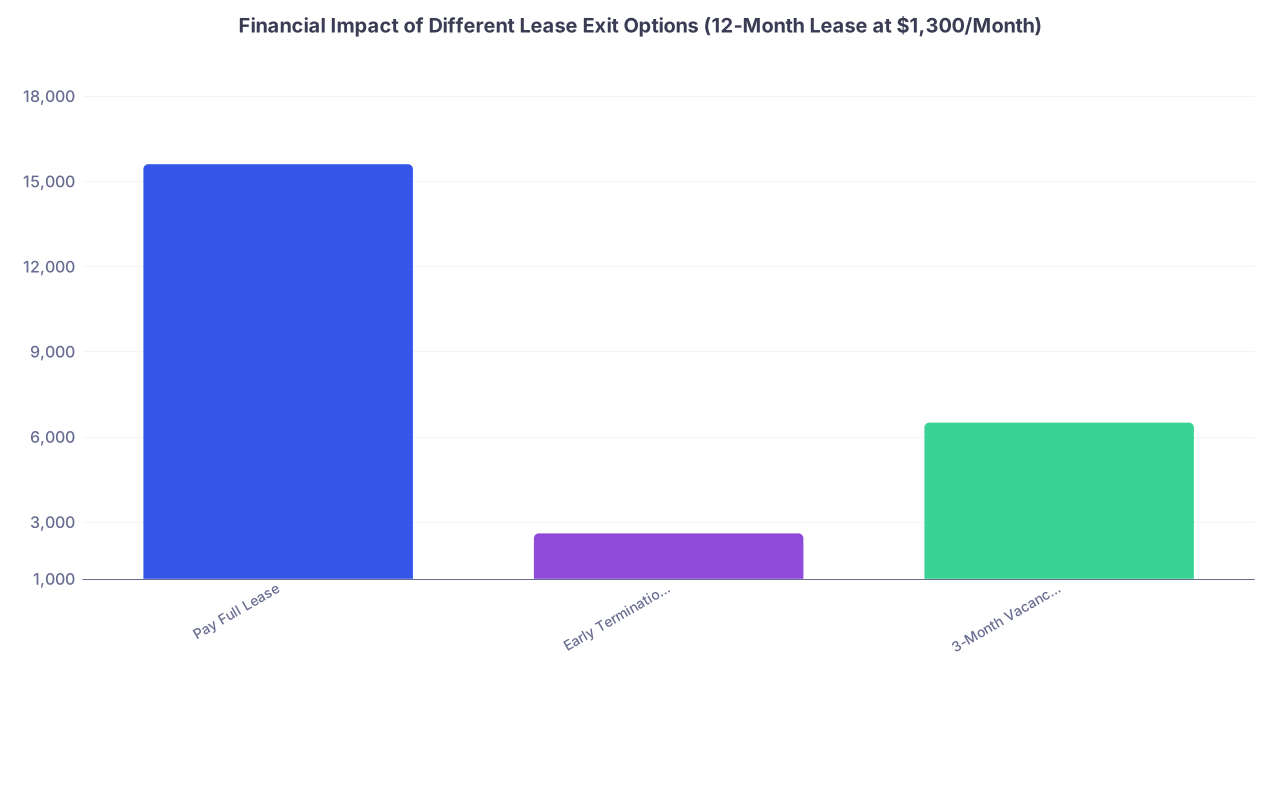
- Paying one-time $2,000 to exit is way cheaper than carrying $1,300 x 12 = $15,600.
Scenario B: You Did Not Match Anywhere
Now this lease near the program you hoped for becomes a more complicated decision. Ask yourself:
- Am I realistically going to be in this city next year?
Do you have any strong connections there? Faculty advocating for you? A near-promise like “If you strengthen X, we’d strongly consider you next cycle”? Or is this just a city you like?
If the answer is:
- “No clear advantage to being here” → This lease is likely a trap.
- “Yes, I have strong ties, mentorship, or a research job tied to this hospital/program” → You might actually use the apartment.
We will talk about strategic location in a bit. For now: do not default to “I guess I’ll move anyway” just because you signed a lease. That is sunk cost thinking.
Step 3: Know Your Legal & Practical Options with the Lease
I am not your lawyer. But I can tell you the moves I have seen work.
1. Early Termination
Check your lease. Common options:
- Flat early termination fee (e.g., 1–2 months rent)
- Pay until re-rented + a reletting fee
- No explicit clause (meaning governed by state/local law)
If there is an early termination clause:
- Use it. This is what it is there for, even if it hurts.
If there is no clause:
- Many states require landlords to “mitigate damages” by trying to rent it again, not just collect double.
- A local tenants’ rights site or quick consult with a tenants’ attorney may save you thousands.
2. Subletting
Subletting means you remain ultimately responsible, but someone else lives there and pays you (or the landlord, depending on how it’s set up).
You need:
- Written permission if the lease requires it
- Clear start/end date
- A solid, signed sublease agreement (do not just do this with a handshake or DM)
Ideal subtenants:
- Incoming residents at that same program
- Fellow grads from your school
- Nurses, techs, or staff at the hospital
- Students at a nearby university who start roughly when your lease does
3. Lease Assignment
Assignment is better for you if you can get it: you transfer the lease entirely to someone else, and you are off the hook.
Ask the landlord:
- “Do you allow lease assignment if you approve the new tenant?”
If they say yes:
- Advertise aggressively (we will get to how)
- Funnel leads directly to the landlord’s application process
- Once approved and assigned, you walk away.
Step 4: Turn That Empty Apartment into a Magnet (If You Keep/Sublet It)
If you decide subletting or assigning is the move, treat this like marketing, not wishful posting.
Where to advertise:
- Program-specific Facebook groups: “Incoming [Hospital Name] Residents,” “[City] Roommates for Healthcare Workers”
- Med school class chats: GroupMe, WhatsApp, Slack
- Hospital listservs: Ask a friendly resident or coordinator to share a short blurb
- Standard platforms: Facebook Marketplace, Zillow, Apartments.com, local university housing boards
Your listing should include:
- Distance to hospital (walking, biking, driving, shuttle)
- Exact rent, lease length, move-in date
- What is included (parking, utilities, furnished/unfurnished)
- Photos that are not terrible. Tidy the place or show empty, but well-lit.
Offer what you can:
- Flexibility on move-in date
- Willingness to leave some furniture
- Slight discount for a quick, stable tenant
If you can undercut similar listings by even $50–$100/month, you will fill it faster. Sometimes eating $600 over a year in “discount” is better than eating $6,000 in vacancy.
| Category | Value |
|---|---|
| Pay Full Lease | 15600 |
| Early Termination (2 Months) | 2600 |
| 3-Month Vacancy then Sublet | 6500 |
Step 5: Where Should You Actually Live This Year?
Step away from the lease for a second. Ask the more strategic question:
Where should you physically base yourself from now until next Match (or next job move)?
This depends on your goal.
If You Are Reapplying to the Same Program/Region
Then living near that program might actually make sense. But only if you turn proximity into actual value, not just vibes.
How to convert local presence into strength:
- Secure a research position with that department or affiliated institution
- Arrange consistent clinical exposure: observerships, paid clinical jobs (scribe, clinical research coordinator, etc.), quality improvement roles
- Show up professionally: M&M conferences, resident education sessions, relevant grand rounds (with permission)
You are trying to become:
- The local known quantity
- The person they have seen work, not just a name on ERAS
In that case, using the lease can be smart—if it positions you for:
- Stronger letters of recommendation
- Actual faculty advocates who will go to bat for you
- Concrete evidence on your CV for why next year is different
If You Are Pivoting Specialty or Region
Example: You did not match in Ortho in City A, you are pivoting to IM or FM and will apply very broadly next year.
In that case:
- There is no special advantage to being near that one program or that one city
- You are better off in a cheaper location or near family support or where you can get an easier job
In other words: do not pay big-city teaching-hospital prices for sentimental reasons.
Step 6: Align Your Professional Plan with the Lease Decision
Here is where people blow it: they treat housing choices and career decisions as separate. They are not.
Let’s map some common combos:
| Situation | Best Housing Move |
|---|---|
| Matched in different city | Negotiate early termination or assign lease ASAP |
| Unmatched, reapplying to same program | Consider staying local **only if** you secure meaningful role |
| Unmatched, pivoting specialty broadly | Minimize housing cost, exit lease if possible |
| SOAPed into prelim near old lease city | Use lease, minimize moving twice |
| Planning a research year at same institution | Keep lease and negotiate research salary/stipend |
If your plan is:
- “I’ll just see what happens” → You will waste money, time, and probably hurt your next Match chances.
- “I’m going to reapply, and here’s what I’m doing this year for my CV” → Then housing should support that plan, not dictate it.
Step 7: Plug the Financial Bleeding While You Sort It Out
This is where people quietly implode.
You are dealing with shock from not matching. Your brain wants to avoid spreadsheets and emails. That avoidance has a price tag.
Here is what to do financially, in plain steps:
Stop double commitments immediately
Do not sign a second lease in your new program city (if you SOAPed elsewhere) until you have written confirmation from the first landlord about your options.Call your loan servicer
- See if you qualify for economic hardship deferment or income-driven repayment while unmatched
- Get clarity on what your minimum payment will be if you do not start residency on time
Create a “disaster-year” budget
- Bare-minimum housing
- Food, insurance, transportation
- Application costs for next cycle
Look for short-term, flexible housing if you need to move
- Month-to-month places near the hospital if you SOAPed late and will start soon
- House shares with other residents or fellows
- Avoid 12-month commitments until you know you’re truly free of the first lease
If you keep the lease but cannot afford double rent
- Commit to subletting or assignment as a project this week, not “when I have time”
- Give yourself a deadline: If no tenant by X date, re-approach landlord for another solution
Step 8: Emotional Reality Check (So You Don’t Make a Dumb Move)
You are likely dealing with:
- Shame (classmates posting “Matched!” everywhere)
- Fear (loans, parents, visa issues if you’re IMG)
- Anger (especially if a program basically implied you were safe)
Here is where that kills you: you make housing decisions just to feel less awful, not because they make sense.
Classic bad moves I have seen:
- Moving into the lease apartment anyway “because I already paid and it’s near the hospital I love” even though you have no job, no research, no structured plan there.
- Refusing to talk to the landlord because you “feel bad” or are embarrassed.
- Avoiding making any decision and ending up paying 6 months before moving out in defeat.
You are allowed to be upset. You are not allowed to financially self-destruct out of pride.
If you need a script to talk to family:
- “I didn’t match, which obviously sucks. But I have a plan. I’m reviewing my lease, talking to the landlord about options, and setting up a concrete strategy for the next year—either research or a different route. I’ll keep you posted once I know the financial and housing side more clearly.”
Short, controlled, shows you’re not drifting.
Step 9: Parallel Track – Fixing Your Application Year
While you are handling the housing mess, you should not be in total residency limbo for months. Use this year deliberately.
Depending on why you did not match:
- Low Step scores
- No US clinical experience (for IMGs)
- Weak letters
- Late application
- Targeting ultra-competitive specialty without backup
Your “gap” year plan should generally include:
- Clinical or quasi-clinical work: scribe, research coordinator, hospitalist assistant, observerships
- New or stronger letters: from faculty who can say more than “pleasant and punctual”
- Concrete achievements: abstract, poster, paper, QI project, teaching, etc.
- Early, organized reapplication if that’s the path
The lease question is one spoke of the wheel—not the whole wheel. But if you let the lease dictate your geography, and the geography doesn’t support your plan, you will waste a year.
Step 10: A Simple Decision Framework
If you are stuck, use this crude but effective filter. Answer honestly.
Does living in this leased apartment increase my odds of matching next year in a tangible, direct way?
- “Yes, I have lined up research/mentorship there.” → Consider keeping.
- “No, it just feels like where I imagined my life.” → Get out if you can.
Is there a cheaper, more practical place I could live that supports my actual plan?
- Near family, with lower rent and emotional support
- Near a different institution that offered you real opportunities
- In the city of the program you SOAPed into
What is the total cost of keeping vs leaving the lease?
- Total remaining rent vs early termination/sublet hit
- Compare that number to: MCAT course cost, extra ERAS applications, flights for interviews
Sometimes burning $2,000 to fix a housing mistake is nothing compared to the long-term cost of underfunding your next application cycle.
Final Takeaways
- Treat the lease as a business problem, not an emotional anchor. Read it, talk to the landlord early, and quantify every option.
- Align where you live with what will actually help your next professional move—research, reapplication, new job—not with where you fantasized you’d be.
- Move fast: the earlier you negotiate, sublet, or reorient, the less money and time you waste, and the better your odds of turning this painful year into a strategic one instead of just a lost one.


