
The match process is brutally unforgiving to applicants with a leave of absence or disciplinary mark—unless you handle it with surgical precision.
You are not “like every other reapplicant.” You are carrying a red flag that every program director is trained to spot in three seconds: an unexplained gap, a professionalism note, a leave that looks like you disappeared when things got hard. If you try to hide it, minimize it, or spin it with vague nonsense, you will get filtered out or politely ignored.
Let me walk you through what actually works.
1. How Programs Really Read Your File After a LOA or Disciplinary Issue
First, stop guessing what programs think. I will tell you.
When a PD or associate PD opens your ERAS, they scan in roughly this sequence:
- Specialty, degree, grad year
- USMLE/COMLEX scores and attempts
- Medical school + class rank/percentile (if available)
- Training history / gaps (LOA, extension of training)
- MSPE (Dean’s Letter) “Noteworthy Characteristics” and any adverse actions
- Personal statement, then letters of recommendation if you are still in the running
If you have a leave of absence, professionalism violation, remediation, or dismissal/withdrawal, it usually shows up in:
- MSPE: “Adverse Action” or “Academic / Professionalism Concerns” section
- Transcript: repeated courses or delayed progression
- Chronology: graduation date shifted compared with entering class
- ERAS questions: “Have you ever… been placed on probation / dismissed / required to repeat coursework,” etc.
There are three immediate PD questions when they see that red flag:
- What exactly happened?
- Is this likely to happen again in my program?
- Who is willing to stake their reputation that this person is now reliable?
They do not care about your GPA rebound or how “passionate” you are about the specialty until those three questions are answered cleanly.
2. Types of Issues and How They Are Viewed
Not all “problems” are equal. Some are survivable with the right strategy; some close doors permanently.
| Issue Type | Program Perception (General) |
|---|---|
| Documented mental health LOA | Cautiously acceptable if stable, treated |
| Medical illness LOA | Generally acceptable if resolved/managed |
| Family crisis LOA | Acceptable with clear timeline |
| Academic failure/remediation | Concern about ability to keep up |
| Repeated Step failures | Major red flag; limits specialty options |
| Professionalism (lateness, absences) | Serious, but salvageable with evidence |
| Dishonesty/cheating | Very high risk; many doors closed |
Let me be blunt:
- Health-related LOAs can be survivable if framed correctly and if you demonstrate sustained function after the event.
- Single academic stumble can be overcome. Multiple failures are a pattern.
- Professionalism and integrity violations are the hardest to rehabilitate. Programs will ask: “What happens when this resident is tired, stressed, and unsupervised at 3 a.m.?”
- Dismissal and readmission, or transfer after dismissal, is not an automatic death sentence—but your strategy must be extremely tight.
3. Step One: Get Clear on Exactly What Is Documented
Before you start thinking about “narratives,” you need to know what is actually in your official record.
You should have in front of you:
- Your MSPE (Dean’s Letter) from the prior application cycle
- Medical school transcript
- Any formal letters/decisions regarding:
- Probation
- Suspension
- LOA approval
- Dismissal and reinstatement
- Previous ERAS application (PDF)
- Any professionalism remediation documentation
Do not rely on memory. I have watched people confidently say “My LOA isn’t mentioned” only to have the MSPE explicitly state “The student took a one-year leave of absence for personal reasons,” which is exactly the kind of fuzzy phrase that makes PDs suspicious.
If the MSPE is vague or misleading:
- You can request a meeting with Student Affairs / Dean’s Office and ask what can be clarified or updated for the new cycle.
- Some schools will revise language if circumstances have clearly changed (for example, resolving a health issue, completing remediation).
You cannot erase history, but you can sometimes sharpen the wording so it no longer reads like a mystery scandal.
4. Decide: Repair in Same Specialty or Pivot?
Reapplication after a red flag is not the time for wishful thinking. It is the time for brutal triage.
Ask yourself:
- Did I receive any interviews last cycle?
- If yes, did interviewers bring up the LOA/discipline, and how did those conversations go?
- How many programs did I apply to, and at what competitiveness tier?
If you applied to, say, 80 categorical IM programs, got 1–2 interviews that felt lukewarm, and your red flag is serious (probation or professionalism), you are not “one small tweak” away from matching into Derm or Ortho. You are fighting just to enter the system at all.
As a rule of thumb:
- For competitive fields (Derm, Plastics, Ortho, ENT, Ophtho, Rad Onc): a major disciplinary issue usually kills the attempt unless you have world-class research or truly exceptional backing. Reapplication should usually pivot.
- For mid-competitive (EM, Anesthesia, OB, Rad, some IM subtracks): you can salvage, but often by broadening to community-heavy lists and considering prelim/TY routes.
- For less competitive (Preliminary Surgery, Categorical IM community, FM, Psych, Peds): thoughtful reapplication and a coherent explanation can absolutely work, especially if your issue has a clear resolution.
If you insist on a hyper-competitive specialty with a major professionalism or honesty issue on your record, you will likely spin your wheels for years. I have seen it. Repeatedly. Do not do that to yourself.
5. Building the “Rehabilitation Year” (or Two)
Reapplying after a disciplinary/LOA situation without changing anything is pointless. You need new evidence.
Your goals in the interim period:
- Show continuous, accountable work in a clinical or academic environment.
- Find supervisors willing to write strong letters that explicitly address reliability and professionalism.
- Acquire objective markers of improvement (publications, strong evals, maybe a new Step 2 CK if relevant).
- Tighten your story into a clear, short, honest explanation.
Realistic options, depending on your context:
- Research year with patient contact: Best if you can get involved in clinical research where attendings see your work ethic, punctuality, and teamwork. This is especially valuable if you had an academic or professionalism issue.
- Postgraduate clinical job: Scribe, research coordinator, hospitalist extender (in some systems), quality improvement positions embedded on the wards. Programs like to see you showing up at 6:30 a.m. for a year with no problems.
- Additional rotations / observerships: For graduates, structured hospital-based observerships or non-ACGME fellowships where you receive evaluations that can be turned into LORs.
- Masters or certificate programs: Only helpful if linked to your narrative and if you crush it—GPA, publications, teaching, etc. “Extra degree, average performance” does not fix professionalism.
What does not impress PDs:
- Random online courses
- Brief volunteer gigs with no real supervision
- “Studying at home for a year” with nothing to show except practice questions
You want at least one year of solid, documentable, supervised activity post-issue before your next ERAS goes out.
6. How to Talk About a Leave of Absence or Disciplinary Issue
This is where most people sabotage themselves. They either:
- Over-disclose with gory detail and emotional oversharing, or
- Under-disclose with vague, corporate-speak deflection
You need three things: clarity, brevity, responsibility.
Think in a 4-part structure:
- What happened (one or two lines, factual)
- Why it happened (brief, without self-pity)
- What you did about it (specific actions, treatment, remediation, structure)
- Why it is unlikely to recur (concrete evidence, timeframe)
Example: Health-related LOA
Bad version:
“I struggled with significant anxiety and personal issues and needed time away from school to focus on my mental health. This experience has made me stronger and more empathetic.”
Better version:
“During my second year, I developed a treatable mental health condition that required a brief leave of absence under physician care. I engaged consistently in treatment, returned to full-time coursework, and completed all remaining clinical rotations without further interruption. For the last three years I have maintained stable functioning while working full-time in clinical environments and have not required any additional leave.”
Short, clear, and it answers the PD’s real question: “Are you going to fall apart under residency stress?”
Example: Academic difficulty
Bad version:
“I underestimated the volume of material and at times struggled with time management.”
Better version:
“In the preclinical curriculum, I failed one course during a period when I was using ineffective study strategies and did not seek help early. I remediated the course successfully and then adopted structured group review and regular meetings with faculty. I passed all subsequent coursework and core clinical rotations on schedule and have since demonstrated consistent improvement, including X on Step 2 CK and strong clinical evaluations.”
You acknowledge fault without making it a personality flaw.
Example: Professionalism probation (chronic lateness, incomplete notes)
This one has to be handled surgically.
Bad version:
“I had some professionalism concerns regarding time management but addressed them.”
Better version:
“During my third year I was placed on professionalism probation after repeated late arrivals to clinic and delayed completion of notes. This feedback was uncomfortable but fair. I worked with my advisor to implement concrete changes: earlier arrival times, pre-charting routines, and daily task lists. I successfully completed the probationary period without further incidents. Since then, my clinical evaluations and letters specifically highlight reliability and timely follow-through, including in my research coordinator role where I have managed early-morning enrollments and strict documentation deadlines for over 18 months.”
You admit the problem directly, use the word “probation,” and then show a long stretch of clean behavior.
Example: Honesty / cheating (the hardest)
If your record includes documented cheating or falsification, some programs will never touch you. The ones that might will need to see genuine ownership and significant time since the event.
A minimally viable version (if your Dean, advisor, and attorney all agree you should address it this way):
“In my second year I made a serious error in judgment by [very briefly: unauthorized collaboration, improper access to materials]. This resulted in a professionalism sanction documented in my MSPE. I accepted the consequences, including [remediation, course failure, probation]. I did not repeat this behavior. Over the last X years I have worked under close supervision in clinical research and patient-facing roles where I am trusted with sensitive data and responsibilities, without any further professionalism incidents. I understand that some programs may still have concerns, but I am committed to transparent communication and have asked my current supervisors to comment specifically on my integrity and reliability in their letters.”
This will not “solve” the issue. It will just keep the door slightly open for the right program.
7. Where to Place the Explanation: PS, ERAS Comments, or Both?
You have three main venues:
- Personal Statement
- ERAS “Additional Information” / “Explanation” text boxes
- Interview conversations
General strategy:
- Use the personal statement to briefly reference the issue if it significantly shaped your path or gap. Keep it to one short paragraph, not the entire essay.
- Use the ERAS explanation box (if present for your situation) for a more direct, factual version.
- Then, in interviews, have a polished 60–90 second spoken explanation that matches your written versions.
You should not:
- Write two completely different stories in different places. PDs will compare.
- Spend three-quarters of your personal statement on your LOA. The PS still needs to show who you are clinically and as a trainee, not just as a person who had a problem.
Think: same story, different levels of detail.
8. Letters of Recommendation: You Need the Right Kind of Backing
Programs will not just take your word for it that you have changed. They want someone with a title and institutional currency to vouch for you.
You want at least one letter that does all of the following:
- Comes from someone who has supervised you in a rigorous clinical or research setting post-incident
- Directly addresses your reliability, professionalism, and ability to work under pressure
- Reads like the writer would actually choose to work with you again
How to request such a letter:
You do not say: “Can you write me a strong letter?”
You say something closer to:
“I want to be upfront. I had a professionalism issue in medical school that is documented in my MSPE. Since then, I have been very intentional about addressing my weaknesses, particularly around punctuality, communication, and follow-through. You have seen me in [X context] for over a year. Would you feel comfortable writing a letter that comments specifically on my reliability, teamwork, and growth, and that you believe would support my application for residency?”
You are not asking them to “cover up” anything. You are asking them to speak concretely to the exact attributes PDs are afraid might be missing.
Ideal letter sources:
- Current research PI on a busy clinical project
- Clerkship director who worked with you post-remediation
- Program director from a prelim year or non-ACGME fellowship
- Hospitalist or service chief who has seen you daily on the wards
Avoid relying on:
- Distant basic science faculty who taught you years ago
- Famous name who barely knows you
- Anyone who was involved in the disciplinary process against you (unless the relationship was clearly rehabilitative and your Dean specifically suggests it)
9. Application Strategy: Volume, Targeting, and Backup Plans
You are not a standard applicant. You cannot use standard application numbers.
For most red-flag reapplicants, I recommend:
- Apply to a broader tier of programs than your classmates, heavy on community and mid-tier academic centers.
- Over-apply. Yes, your wallet will hurt. But if a typical IM applicant applies to 40–60 programs, you might be in the 80–120 range, depending on your issue and scores.
- Include prelim and TY spots strategically if:
- Your record has improved,
- You can realistically expect strong evaluations, and
- You are willing to use a good prelim year as proof of rehabilitation.
Do not apply to a hyper-competitive specialty and one or two “backup” IM programs on the side. That is fantasy.
10. What to Do Right After an Unmatched Cycle with a Red Flag
If you just went unmatched with a LOA/disciplinary issue and you are reading this in March:
- Participate in SOAP seriously if any acceptable specialty is open. A successful SOAP into a prelim or categorical spot, with strong performance, is the single best rehabilitation tool you can have.
- If SOAP fails, stabilize the rest of your life for the next 12–24 months. You need income, structure, and a plan.
- Immediately start working on:
- Clinical or research position
- Honest conversations with mentors / Student Affairs about your prospects and specialty choice
- Cleaning up any remaining administrative issues (graduation paperwork, ECFMG, etc.)
Do not rush back into ERAS in the next September with nothing changed except a new personal statement. That is a repeat disaster.
11. Legal and Privacy Boundaries: How Much Must You Disclose?
A few quick realities:
- If something is in your MSPE or transcript, you must assume every program will read it.
- ERAS professionalism questions are not optional. Answer them fully and truthfully.
- You are generally not required to disclose specific diagnoses (mental health or medical). “Treatable health condition” is often sufficient, as long as you can truthfully answer that you are currently able to perform the essential functions of a resident with or without reasonable accommodation.
If you have any concern that the way you plan to write about your issue could have legal, licensure, or visa implications, talk to:
- Your Student Affairs Dean
- Possibly an attorney familiar with medical licensure
- Your state medical board (later, when you approach licensure forms, which often ask about mental health, substance use, and disciplinary history in specific language)
Programs are less worried about “this person sought help” and more worried about “this person is not honest with us or the board.”
12. When It Might Be Time to Step Away From the Match
Not the feel-good section, but a necessary one.
There are scenarios where continued reapplication is an exercise in self-punishment:
- Multiple unmatched cycles with no major change in your file
- Severe professionalism or integrity issues that are heavily documented and fresh
- Very low board scores with multiple attempts plus disciplinary history
- Graduating many years ago (5–7+) with minimal recent clinical activity and red flags
In those settings, you should have unflinching conversations about alternative paths:
- Non-residency clinical roles (depending on country)
- Research careers
- Industry (pharma, biotech, consulting)
- Public health, informatics, education, or policy work
You are allowed to decide that constantly reliving your worst mistake for another five application cycles is not the life you want.
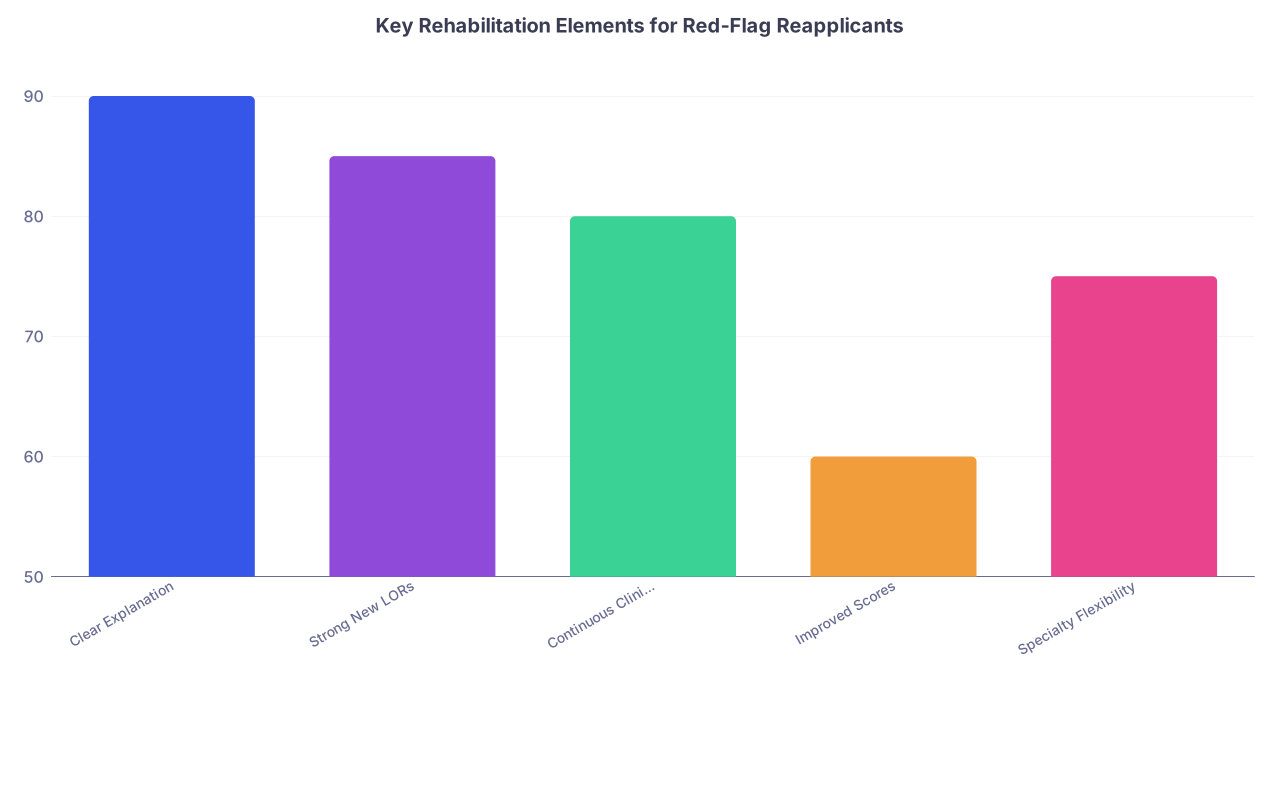
| Category | Value |
|---|---|
| Clear Explanation | 90 |
| Strong New LORs | 85 |
| Continuous Clinical Work | 80 |
| Improved Scores | 60 |
| Specialty Flexibility | 75 |

| Step | Description |
|---|---|
| Step 1 | Unmatched with LOA or Discipline |
| Step 2 | Collect MSPE and Records |
| Step 3 | Meet Dean or Advisor |
| Step 4 | Decide Specialty Strategy |
| Step 5 | Secure 12 to 24 months of Clinical or Research Work |
| Step 6 | Obtain Targeted Letters |
| Step 7 | Craft Clear Written Explanation |
| Step 8 | Submit Broad, Realistic ERAS |
| Step 9 | Interview with Consistent Narrative |
FAQ (Exactly 4 Questions)
1. Should I ever try to hide or minimize a leave of absence or disciplinary action on ERAS if my school’s documentation is vague?
No. If there is any official record, assume programs can access or infer it. A deliberate omission or misleading answer will look far worse than the underlying issue. You can be concise and protect some personal details (for example, not naming a specific diagnosis), but you should not contradict or “pretend away” what is in your MSPE, transcript, or ERAS professionalism questions.
2. How long should I wait before reapplying after a serious professionalism problem?
For anything beyond a very minor issue, one full year of clean, supervised work is the bare minimum. Two years with sustained, excellent evaluations is better, especially for more serious violations. Programs want a track record of stability, not just an apology and three good months. If the incident involved dishonesty, I lean toward a longer interval with very strong mentor backing before another application.
3. Can a strong Step 2 CK score or research portfolio “cancel out” a disciplinary flag?
It can help, but it does not cancel it. High scores and publications may get your file read instead of auto-screened out, but PDs will still focus on whether you are safe, reliable, and trustworthy. For a health or academic LOA, strong new metrics can be very reassuring. For professionalism or integrity violations, they are secondary; the quality of your letters and your day-to-day behavior in recent roles will matter more.
4. If I match into a prelim or TY year after a red flag, how do I use that to improve my future applications?
Treat it like a one-year audition. Be early, be prepared, finish notes, own your mistakes, and help your co-residents. Ask early in the year what is expected of a strong resident on that service. Then, near midyear, identify faculty and your program director who know your work and explicitly explain your history and goal of matching into a categorical spot. If they are impressed, ask for letters that specifically comment on your reliability and growth. A glowing PD letter after a tough prelim year is one of the strongest rehabilitation signals you can have.
Key points, so it sticks:
- You cannot out-essay or out-score a hidden red flag. You must confront it directly, concisely, and honestly.
- Your rehabilitation year(s) must generate concrete evidence: supervisors who trust you, strong letters, and a clean record of showing up and doing the work.
- Reapplication after a disciplinary issue is difficult but not impossible—if you pick a realistic specialty, build the right kind of support, and stop pretending this is a standard application cycle.