
The folklore about “red flags” after the Match is mostly wrong. Programs don’t use the term the way students do, and the line between “fatal” and “fixable” is not where you think it is.
I’ve sat in rooms where faculty argued for 20 minutes about whether someone’s failure, professionalism note, or SOAP outcome was a dealbreaker. I’ve heard the exact phrases they use. The difference between a true red flag and a recoverable one usually comes down to three things:
- Pattern
- Ownership
- Documentation
Not the event itself.
Let me walk you through how they actually think about you once the dust has settled after Match Week.
How PDs Really Talk About “Red Flags”
First reality check: most program directors don’t sit around saying “this applicant has a red flag.” They say things like:
- “What’s the story here?”
- “Is this a one-off or a pattern?”
- “Did anyone actually write this up?”
- “Would I trust this person at 3 a.m. with no supervision?”
You are thinking in categories: “I failed Step,” “I didn’t match,” “I have a leave of absence.”
They are thinking in risk: “Am I going to regret bringing this person into my program?”
A “red flag” to them is something that:
- Is documented in writing by an institution or licensing body
- Suggests ongoing risk to patient safety or team safety
- Or demonstrates a pattern of unreliability or dishonesty
Everything else is potentially recoverable. Not easy. But not automatically career-ending.
Let’s put some structure to this.
| Issue | How PDs Usually See It |
|---|---|
| Single Step/COMLEX failure, then pass | Recoverable |
| Failed clerkship, then strong repeats | Recoverable |
| SOAP-unmatched or fully unmatched | Recoverable (with context) |
| Documented professionalism violation | Borderline → depends on pattern |
| Unexplained long leave of absence | Red until explained → Recoverable with proof |
| Dishonesty in application (caught) | True Red Flag |
Notice something? The “big scary things” students obsess over—Step failures, SOAP, a bad rotation—often land in the “maybe” pile. The non-negotiables are usually about integrity and safety.
The Post-Match Landscape: What Programs Actually See
During and right after Match Week, here’s what faculty and PDs are staring at:
- Their own unfilled spots, SOAP chaos, and scrambling
- A flood of emails from unmatched applicants and advisors
- A list of graduates who didn’t match and now need plans
Nobody is zooming in on you with a sniper scope. They see categories:
- “Strong, unlucky – got squeezed by competitiveness”
- “Borderline – needs a different angle or extra year”
- “Serious concerns – may not be fixable”
They sort you into one of those buckets based on what’s already on paper and how you behave right after the Match.
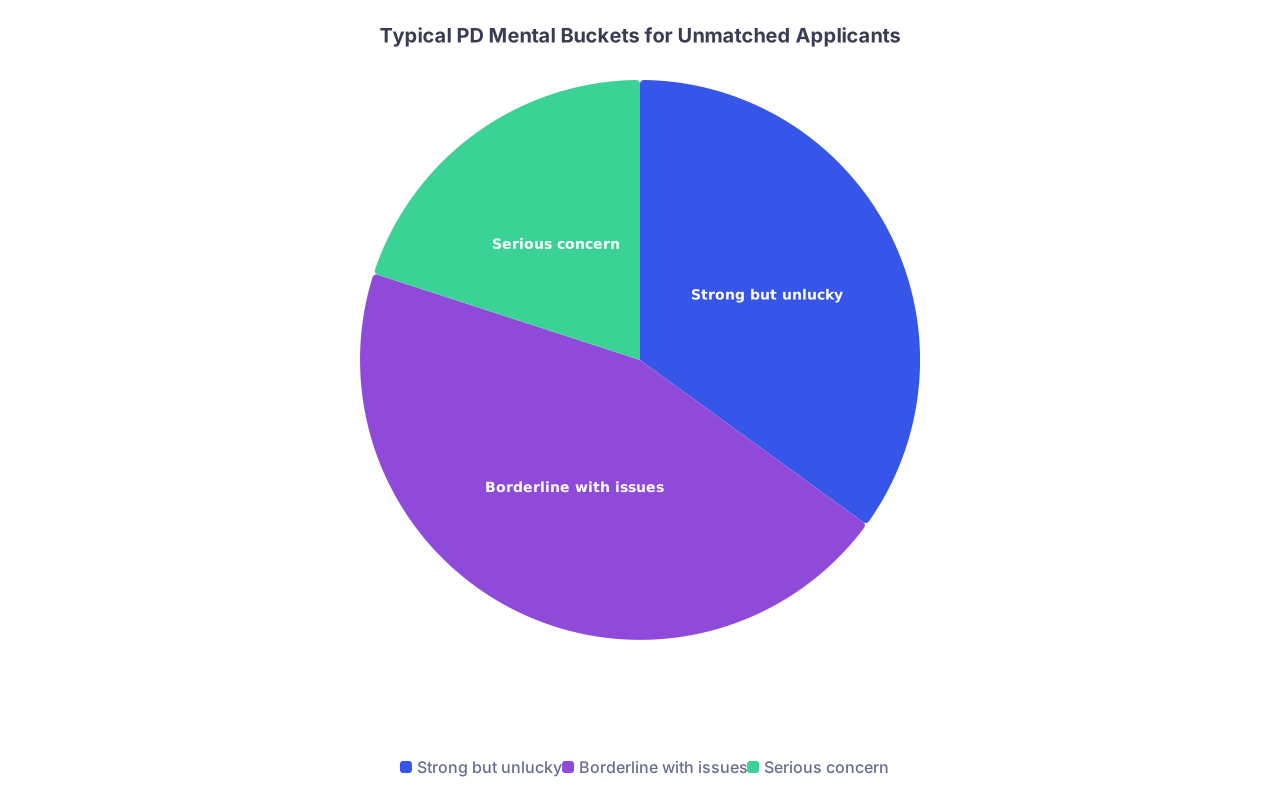
| Category | Value |
|---|---|
| Strong but unlucky | 35 |
| Borderline with issues | 45 |
| Serious concern | 20 |
Is that exact data? No. But those proportions match what I’ve heard at multiple institutions: most unmatched graduates are not radioactive; they’re in the “borderline but salvageable” group.
The key is understanding which group you’re actually in—and what PDs need to see to move you up a tier.
The Core Difference: “Red Flag” vs “Recoverable”
Let me be blunt.
A true, hard red flag is something a PD will not touch unless they are desperate and heavily reassured. Think:
- Repeated, unresolved professionalism issues
- Dishonest behavior with documentation (cheating, falsified notes, lying to faculty)
- Unexplained or contradictory stories between your MSPE, transcripts, and your narrative
- Substance impairment impacting patient care with no clear treatment/compliance path
- Board or institutional action that signals ongoing risk
Your Step 1 failure? Not automatically in that category.
Your SOAP result? Definitely not.
The recoverable stuff usually looks like this:
- You failed Step 1 once, then passed Step 2 with a strong score
- You needed a leave of absence for health/family/personal reasons, with documentation and clear resolution
- You struggled in one rotation, then performed fine or better later
- You switched specialties late and your portfolio doesn’t quite match yet
- You went unmatched once (even twice), but have been productive and professional in the interim
Programs will quietly tolerate a lot if they believe:
- They understand what happened.
- It’s not going to keep happening.
- You tell the same story your documents do.
The fatal mistake is not the event itself. It’s the combination of vagueness, defensiveness, and surprises.
Specific Scenarios: How They’re Really Judged
Let’s go case by case. This is where the myths and the reality really diverge.
1. Unmatched or SOAP Outcomes
Students treat “unmatched” like a giant red stamp on their forehead. PDs don’t.
In ranking meetings, I’ve heard:
- “This guy didn’t match last year. Why?”
- “His scores are fine. Wrong specialty, maybe?”
- “Anyone know him? Is he normal?”
They’re trying to figure out whether you’re a strategic mismatch or a liability.
Unmatched without SOAP placement is not a red flag by itself. It becomes one when:
- Your scores and app are weak and you still applied only to hyper-competitive specialties or programs
- Your personal statement or interview behavior worried multiple people
- There’s a professionalism whisper (“I heard he had issues on surgery…”) that nobody ever clarified
Recoverable when:
- Your story is consistent: “I applied too narrowly to Derm with a 230, underestimated the cycle, reapplied with more realistic targets and better prep.”
- You have done something real with your “gap” time: research, a prelim year, a MPH, a strong plan, and letters that say you show up and work.
- You’ve cleaned up your narrative. No drama, no bitterness. Just: “Here’s what happened, here’s what I learned, here’s what I’ve done since.”
SOAP outcomes are even more misunderstood.
Programs don’t see “SOAP = loser.” They see:
- “Were they flexible?”
- “Did they adapt to what was available?”
- “Did they end up somewhere that makes sense?”
If you didn’t SOAP into anything, they ask why. Sometimes, the honest answer is salvageable:
- “I realized I could either SOAP into a spot I truly didn’t want or take a deliberate year to reposition into X specialty. I chose the latter with my advisor and dean.”
That doesn’t read as a red flag. That reads as maturity—if you’ve actually used that time wisely.
2. Exam Failures (Step / COMLEX)
Let me be transparent: a single board failure is annoying to PDs. It’s a ding. But it’s a very common ding.
The real questions in the room are:
- “Did they pass on the second try?”
- “Did their Step 2 / Level 2 score show growth or barely scraping by?”
- “Did anyone address it in a way that makes sense?”
The failure is often recoverable if:
- The repeat score is solid (not necessarily stellar, but clearly competent)
- Your clerkship performance and narrative don’t show global struggle
- You have someone vouching for your work ethic and day-to-day reliability
When does an exam history start edging into true red-flag territory?
- Multiple failures across different exams
- Paired with poor clerkship comments (slow, unprepared, can’t synthesize)
- No clear change in study strategy, no insight, no ownership
What PDs hate is when they read, “I had test anxiety” and then see no evidence you did anything objective about it: no accommodations, no remediation plan, no structured change. That just sounds like an excuse.
You want to turn this into a recoverable narrative?
Say something like: “I failed Step 1 while juggling too much, and I didn’t have a structured strategy. I worked with my school, set dedicated time, changed resources, and passed Step 1 on the second attempt and scored X on Step 2, which better reflects my current level.”
Short. Clear. Owned. Documentable.
3. Failed Rotations or Bad Evaluations
Faculty love patterns. One off comment? Shrug. Three similar comments scattered over your MSPE? That’s a problem.
A single failed clerkship or remediation:
- If followed by strong repeats and better comments → usually recoverable.
- If aligned with failures, LOAs, and vague “professionalism” buzz → trending red flag.
The biggest thing PDs look for in MSPE narratives is consistency:
- Do multiple attendings hint at the same problem? (Slow, disorganized, defensive, unprofessional.)
- Or was there clearly a bad fit on one team and everyone else seemed fine?
I’ve watched full committees decide: “We’re going to ignore that one rotation; everything else says they’re solid.”
That happens more than you think.
You make it recoverable by:
- Facing it head-on in your advisor discussions and, if needed, in your personal statement.
- Getting at least one letter from someone after that event who can honestly say: “They improved. They listened. They function at the level expected.”
What doesn’t work: pretending it never happened and hoping no one reads the MSPE closely. They do. Especially if your application is borderline.
4. Leaves of Absence, Gaps, and “Missing Time”
Unexplained time is one of the fastest ways to trigger the word “red flag” in a room.
The LOA itself isn’t the issue. It’s the story (or lack of one).
Health reason? Family reason? Visa issue? Burnout? All of those can be recoverable if:
- The LOA is clearly documented.
- Your dean’s letter is consistent with what you say.
- You can convincingly state: “The issue is resolved and won’t interfere with residency.”
What scares PDs is ambiguity. When they see:
- “Personal reasons” with no further mention anywhere.
- A gap of 12–24 months with essentially nothing done and no explanation.
- A story you tell that doesn’t quite match what the school wrote.
I’ve heard versions of: “I don’t mind the LOA, I mind that I don’t know what actually happened.”
If your LOA is for a mental health reason, you don’t need to give the full psych note on yourself. But you do need a tight, credible arc: there was a problem, you got appropriate treatment/support, it worked, and you’ve successfully functioned since.
Again: pattern, ownership, documentation.
5. True Professionalism and Integrity Red Flags
This is the category there’s almost no coming back from, at least not quickly.
We’re talking about:
- Cheating on an exam or assignment
- Altering clinical data or notes
- Harassment, discrimination, or aggression that led to official action
- Being removed from a rotation for behavior
PDs will tolerate an exam failure. They’ll tolerate a rough year. They will not tolerate a risk to the culture and safety of their program. They’ve all lived through a bad resident before. None of them are eager to repeat it.
When this is on your record, whether it’s recoverable depends on:
- How long ago it was
- Whether there was formal remediation and documented closure
- How you talk about it (or avoid talking about it)
- Whether someone senior is willing to stick their neck out for you and say, “They are safe now. I would take them.”
If you have one of these, you don’t need optimism; you need surgical strategy and usually a multi-year rebuild. No spin.
How PDs Decide If You’re “Worth the Risk”
Let’s talk about the behind-closed-doors decision process.
A borderline file comes up. Someone says: “This is the one who failed Step and took an LOA.”
The group asks, explicitly or silently:
- Do we understand what happened?
- Do we trust their current level of function?
- Does someone in this room—or someone we know—actually know them?
- Can we defend this choice if it goes badly?
If you can get “yes” to the first two and at least a neutral on the fourth, you’re in play.
Here’s the dirty secret: every program takes risks. Every year. On people with less-than-clean histories. They justify it when the story feels complete and honest.

| Step | Description |
|---|---|
| Step 1 | Review Application |
| Step 2 | Proceed as usual |
| Step 3 | Seek Context |
| Step 4 | Consider Red Flag |
| Step 5 | High Risk - Likely Reject |
| Step 6 | Borderline but Recoverable |
| Step 7 | Rank with Caution |
| Step 8 | Reject or Hold |
| Step 9 | Issue Present |
| Step 10 | Clear Explanation |
| Step 11 | Evidence of Improvement |
| Step 12 | Program Needs / Open Spots |
Your job, post-Match, is to feed their “context” and “evidence of improvement” buckets so that when that flowchart runs in their head, you end up in “borderline but recoverable,” not “high risk.”
Turning “Recoverable” Into Actually Recovered
If you’re post-Match and worried you’re sitting on a red flag, the question is simple: how do you move it into the recoverable column in PDs’ minds?
Here’s what works behind the scenes.
Get a brutally honest advisor who knows the game.
Not just someone who “supports you.” Someone who has sat in rank meetings and is willing to say, “You cannot apply to that specialty this year,” or “You need real work in X before anyone will touch you.”Build a year that directly addresses your weakness.
- Exam failure? Show a strong pass and structured remediation.
- Academic struggle? Do a research year with heavy clinic or a prelim year and get letters on your reliability.
- Professionalism concern? Get yourself into environments where you can be watched and then endorsed: “They are solid. I would rehire them.”
Clean, consistent story. Everywhere.
The way you explain your LOA to your PD, advisor, and in your personal statement should all align. No dramatics. No martyrdom. No blaming. Just: “X happened, I did Y, here is Z outcome, and this is how I work now.”Letters that address the subtext, not just the surface.
PDs will read between the lines. A good letter for a “recoverable” applicant will quietly say the exact things programs are worried about:- “Shows up on time, prepared every day.”
- “Accepts feedback without defensiveness.”
- “I would trust them to manage patients independently at a PGY-1 level.”
That reassures risk-averse faculty more than any flowery adjectives.
The Quiet Stuff That Really Hurts You
You want to know what actually flips a “maybe recoverable” case into “we’re not touching this”? It’s often not the original issue. It’s how you behave afterward.
I’ve seen applicants sabotage themselves by:
- Sending unhinged or desperate emails to programs or PDs
- Blaming their school, an attending, or the “rigged process” in their narrative
- Refusing to adjust specialty choice despite multiple cycles and poor metrics
- Hiding information that later shows up in the MSPE or a background check
That last one is the killer. The fastest way to convert a recoverable issue into a career-ender is to lie or omit in a way that makes PDs feel deceived.
They’re physicians. They can handle imperfection. They cannot handle being blindsided.
Post-Match Mindset: Are You a “Risk” or a “Project”?
Here’s the framing faculty silently use: every resident is either a risk, a project, or a stable workhorse.
- Risk = Might blow up.
- Project = Needs support, may flourish, but requires attention.
- Workhorse = Will just do the job.
When you have a “red flag-ish” issue, you are never going to be seen as a pure workhorse immediately. That’s fine. Your aim is to be a “project,” not a “risk.”
Programs will absolutely take a project when:
- You fill a real need (geography, service load, research niche).
- You show humility and insight.
- They see clear signs that your worst days are behind you, not ahead.
That’s the real game after the Match: repositioning yourself from “unknown risk” to “known project with upside.”
FAQs
1. I went unmatched this year with no obvious “big red flag.” Is that itself now my red flag for next cycle?
No. Being unmatched once, in isolation, is not a red flag in the way students fear. Programs understand that some cycles are brutal, especially in competitive fields or for IMGs. It becomes concerning only if you: repeat the exact same strategy next year, have no meaningful activity or growth during your gap, or present an angry/defensive narrative about the process. If you can show smart changes, productive use of time, and a coherent explanation, most PDs will see you as “unlucky but fixable,” not “toxic.”
2. I had a professionalism concern in school that never made it into my MSPE. Should I bring it up, or let it stay buried?
If it truly never generated formal documentation and will not surface via your school or background checks, you don’t need to write a confession essay. But you absolutely must internalize whatever happened and change your behavior. Where you do need to be transparent is if an interviewer or PD asks directly about “any professionalism concerns or disciplinary actions.” In that moment, lying or omitting creates a brand-new, much worse red flag. If you’re unsure whether your incident is “on record,” ask your dean’s office quietly and plan from there.
3. How long does it realistically take to ‘wash out’ a red flag and be seen as safe again?
For exam or performance issues, one strong cycle (a year) with documented improvement and good letters can be enough. For significant LOAs or major personal crises, one to two years of stable performance usually reassures programs. For true professionalism violations or integrity issues, you’re looking at several years and often alternative paths—research, non-clinical work, sometimes another degree—before anyone will consider you, and some will never reconsider. Time alone isn’t enough; what matters is what you do during that time and who is willing to publicly vouch that you’re different now.
Years from now, you won’t measure your career by the worst line on your MSPE or the score report you still hate looking at. You’ll measure it by whether you learned how to face the damage honestly, rebuild with intention, and convince a room full of skeptical attendings that you were worth the bet.