
The majority of what applicants do in their “gap year” does not impress program directors—and some of it quietly hurts you.
If you’re planning post‑Match activities by asking, “What looks good?”, you’re already walking into the trap. You should be asking, “What actually changes how my application is read?” Because PDs are not impressed by the same things Reddit is impressed by.
Let’s walk through the biggest gap year traps I’ve seen people fall into, and how to avoid burning a year on activities that barely move the needle—or worse, raise red flags.
Trap #1: The “Any Research Is Good Research” Myth
Everyone hears the same lazy advice: “Just get research. PDs love research.”
Incorrect. PDs like evidence of productivity and relevance. They do not care that you spent 12 months as “Data Entry #4” on a project that never left SPSS.
Here’s where people go wrong:
- They accept any research position they can find, even if it’s totally unrelated to their target specialty.
- They do endless chart reviews with no clear plan for abstracts, posters, or publications.
- They show up late to a research team that already has 8 students ahead of them in line for authorship.
So they end up listing something like:
“Research assistant, Department of Pediatrics. Entered data for study on asthma admissions.”
That’s a line on ERAS, not a strength.
What PDs actually look for:
- Did you finish projects?
- Are there concrete outcomes—posters, presentations, publications, at least submitted abstracts?
- Is there a clear story that connects this research to your specialty interest?
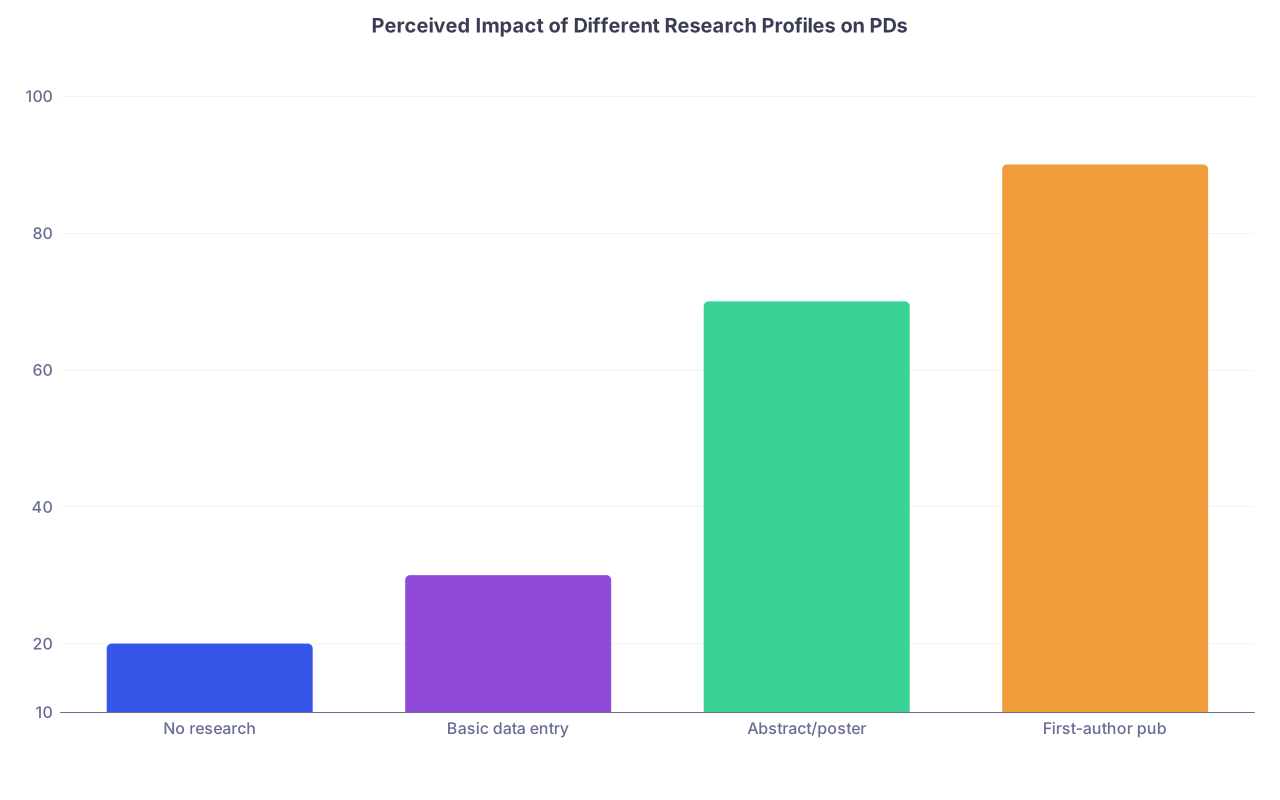
| Category | Value |
|---|---|
| No research | 20 |
| Basic data entry | 30 |
| Abstract/poster | 70 |
| First-author pub | 90 |
Those numbers aren’t literal data; they’re a very fair approximation of how applications are felt by readers.
Red flags that your gap‑year research is a trap:
- You’re more than 3 months in and:
- You have no clear project you “own.”
- You still can’t explain the study question in 2 sentences.
- Nobody has mentioned authorship or target conferences/journals.
- The PI is “too busy” to meet with you more than once every 2–3 months.
- Your only tasks are chart review, data entry, or “literature search” with no defined endpoint.
If that’s your setup, you’re not in a research year—you’re in a time sink.
What to do instead
If you’re going to do research, make it count:
- Before committing, ask directly: “What projects could I realistically get to abstract or manuscript stage within 10–12 months?”
- Get clear on ownership: “Would I be first or second author on any of these, assuming I do the bulk of the work?”
- Push for at least one tangible, submittable output by the time ERAS opens.
If no one can answer those questions clearly, don’t kid yourself. That’s not a productive gap year; that’s volunteering for a line item.
Trap #2: The Panic MPH / Extra Degree
The “panic MPH” is a classic move: you don’t match, feel lost, and think, “An MPH or MS will make me more competitive.” So you sink tens of thousands of dollars and a full year (or more) into a degree that PDs glance at for half a second.
Is an MPH always useless? No. But it’s massively overrated for residency selection, especially if:
- It’s from a random online program nobody’s heard of.
- It’s clearly a one‑year band‑aid with no prior interest in public health.
- You can’t articulate why you chose it beyond “to strengthen my application.”
Here’s how PDs often read this:
- “They didn’t match, so they bought a degree.”
- “Are they running from clinical medicine into a classroom?”
- “Is this just another year away from direct patient care?”

I’ve sat in rooms where someone says out loud, “So they did an MPH this year—ok, but what did they do clinically?” That’s the real question: what did you do that shows you didn’t atrophy as a clinician?
When a degree can help (and when it’s a trap)
Legit situations where an MPH/other degree might help:
- You’re aiming for academic IM, preventive medicine, or a field where population health/research is central, and you already had that interest and work pre‑gap.
- You’re actually using the degree to generate a thesis, grants, or real research output that will show up on ERAS.
- The school is well‑known, and the training gives you skills that match your stated career path.
It’s a trap when:
- You start browsing degrees in April out of pure anxiety.
- You enroll because “everyone says PDs like advanced degrees.”
- You’re about to take on serious debt without a plan to monetize or integrate that training.
If you’re already deep into an MPH, make sure you’re building:
- At least one strong project or thesis with potential for publication.
- Relationships with faculty who can write powerful letters.
- Some clinical or volunteer contact on the side so it’s not “classroom only” for a whole year.
If you haven’t started yet, seriously ask: “Would I apply for this degree if I had matched?” If the answer is no, that’s telling you something.
Trap #3: The Empty “Observership Year”
Too many unmatched grads think: “I’ll stack my year with observerships. That’ll show commitment.” Then they spend 12 months:
- Standing in corners of exam rooms.
- Watching residents place orders.
- Writing exactly zero notes.
- Getting one generic letter that says, “They observed patient care and were punctual.”
Most PDs are not fooled. A year made entirely of low‑level observerships screams: “I couldn’t get anything more substantial.”

| Step | Description |
|---|---|
| Step 1 | Do not Match |
| Step 2 | Search online observerships |
| Step 3 | Pay for multiple short observerships |
| Step 4 | Minimal clinical responsibility |
| Step 5 | Generic letters |
| Step 6 | ERAS shows 12 months observerships |
| Step 7 | PD questions clinical readiness |
Also, remember: PDs know the hierarchy. A 4‑week unpaid “observership” that costs you $3,000 in some private clinic is not equal to a structured hands‑on sub‑internship.
Signs you’re in an observership trap:
- You’re paying significant money to “participate.”
- You’re not allowed to write notes in the EHR (even as unofficial drafts).
- Your name never appears in any patient documentation.
- The attending is clearly cycling through observers every month and barely knows you.
One or two short observerships can be fine, especially for international grads who need US exposure. A full year of nothing but observation is a different story. That reads like stagnation.
How to make clinical time actually count
Aim for:
- Formal sub‑I / acting intern roles if your status allows.
- Research + clinic combined, where you see patients part of the week.
- Longitudinal experiences (e.g., 6–12 months in one clinic) where you become part of the team and get a detailed, specific letter.
Ask explicitly before committing:
- “Will I be able to see patients directly, present cases, or draft notes?”
- “Do past students from this role commonly receive strong letters that comment on clinical reasoning?”
If all you hear is, “You’ll get great exposure,” that’s code for: you’ll be barely involved.
Trap #4: The “I’ll Just Work and Explain It” Fantasy
Another common story: “I’ll take a year off, work as a scribe/assistant/whatever, save money, then I’ll explain it in my personal statement. They’ll understand.”
Sometimes they do. Many times they don’t.
Working as a scribe or MA can be fine—especially if:
- You’re in your chosen specialty.
- You get a meaningful letter.
- It’s 6–12 months continuous, showing reliability and clinical exposure.
It’s a problem when:
- You’re jumping between unrelated jobs every 2–3 months.
- None of your employment is medically adjacent.
- You can’t show any academic or clinical growth during that time.
| Gap-Year Role | Typical PD Reaction |
|---|---|
| Specialty-aligned scribe | Mildly positive if letter is strong |
| Research assistant | Depends entirely on output |
| Random retail/customer | Neutral at best, questions commitment |
| Tutoring/USMLE coaching | Neutral unless combined with other wins |
| Non-clinical office job | Often seen as drifting away from medicine |
Again, PDs are human. They understand you need to survive financially. But when your main gap‑year item is, say, “Sales associate at Best Buy,” your file has to work that much harder elsewhere. You’ve done nothing to reassure anyone that your clinical gears are still turning.
If you have to work non‑clinical for money, then:
- Pair it with something clinically or academically meaningful: one research project, one longitudinal clinic, ongoing volunteering in a relevant setting.
- Be ready with a clear, non‑defensive explanation: “I supported myself by doing X while spending Y hours per week in [specific clinical/academic activity].”
Just working and hoping they “get it” with no clinical context is how you end up in the “maybe later” pile.
Trap #5: The Year of Scattered, Shallow Activities
This might be the single most common pattern: the “busy but unimpressive” year.
From the applicant side, it sounds like:
- “I did some research.”
- “I helped in a clinic.”
- “I volunteered.”
- “I went to a couple conferences.”
On ERAS, though, it looks like:
- 2 months research, no products.
- 3 months of once‑a‑week clinic volunteer.
- 6 different 2‑week observerships.
- Random virtual “leadership” role that’s really just attendance.
None of these are terrible individually. Together they send one loud message: no depth.
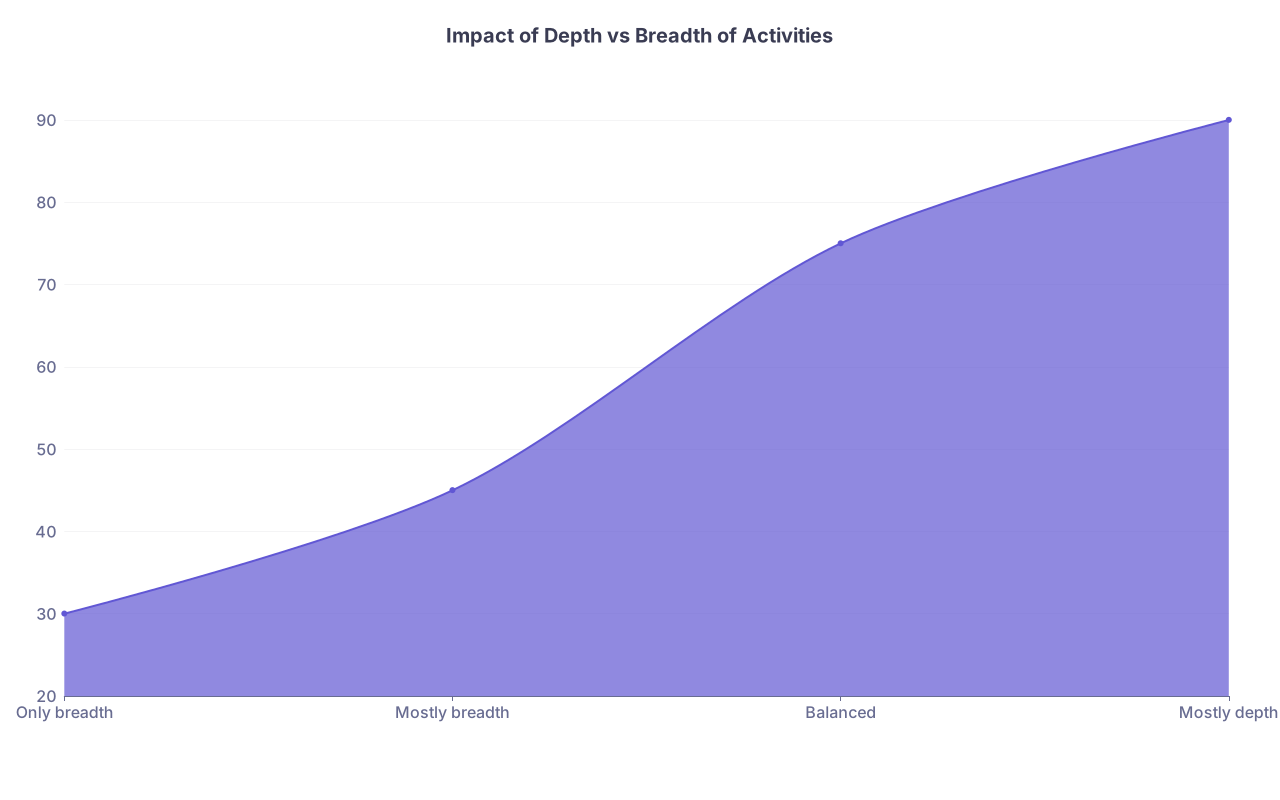
| Category | Value |
|---|---|
| Only breadth | 30 |
| Mostly breadth | 45 |
| Balanced | 75 |
| Mostly depth | 90 |
The applicant thinks: “Look at all the lines I filled on ERAS.”
The reader thinks: “I don’t see a single thing this person really owned.”
What impresses more than 10 scattered items:
- One research project you drove from idea → data → abstract → submission.
- One clinic where you were functionally part of the team for 9–12 months.
- One meaningful leadership or teaching role with real responsibilities.
Depth looks like commitment, reliability, and the ability to finish something. Breadth without depth looks like you’re trying to pad your CV because you know nothing stands out.
Trap #6: Ignoring Step 2 / Exams To “Focus on Activities”
This one is brutal. Someone doesn’t match, decides to “strengthen the application” with extra activities, and quietly ignores the one thing PDs are absolutely looking at: their exam profile.
If you have:
- A borderline Step 1 (or failed attempt)
- A mediocre or no Step 2 score
- Weak or no shelf performance
…then your number one job in a gap year isn’t “get more experiences.” It’s: fix your testing story.
Yet I’ve seen too many people say:
- “I’ll retake later; I want to show PDs more commitment first.”
- “If they see how much I did this year, the scores won’t matter as much.”
Wrong. For many programs, scores are the coarse filter that determines whether anyone even reads about your activities.
If Step 2 is pending, low, or missing, and your gap year is packed with research and observerships but no improved exam performance, you’ve ignored the most obvious lever.
If you struggled with exams:
- Dedicate real, structured time first to Step 2 (or OET/other required exams).
- Use tutoring, NBME baselines, and a clear study schedule.
- Aim to demonstrate improvement, not just say “I studied harder this time.”
You can tack on activities around that, but if you sacrifice exam rescue just to “look active,” that’s a costly mistake.
Trap #7: Pretending the Gap Year Didn’t Happen
One last quiet trap: doing a whole year of something and then barely explaining it.
PDs hate question marks. If your timeline has gaps or vague descriptions, people will invent explanations, and they’re rarely flattering.
Common errors:
- Labeling 10 months of heavy research as just “Research assistant” with a two‑line description.
- Compressing 3 different part‑time roles into a generic “Clinical experience” entry.
- Not addressing the reapplication or gap at all in your personal statement.
That makes decision‑makers ask:
- “Why so vague?”
- “What exactly did they do all year?”
- “Are they hiding weak performance or conflicts?”
You do not need to overshare personal crises, but you do need to claim your story.
Explain clearly and briefly:
- What you did.
- Why you chose it.
- What concrete output or growth came from it.
- How it makes you more ready for residency right now.
If you had a year that was honestly messy or low‑yield, own that too, and show how the upcoming year is different and more focused.
What PDs Actually Want Your Gap Year To Show
They’re not looking for perfection. They’re looking for signals:
- You didn’t drift away from medicine.
- You can stick with something long enough to produce results.
- You understand your own weaknesses and actually did something about them.
- You will show up in July ready to see patients, not relearn how to hold a stethoscope.
The most impressive gap years usually have some mix of:
- One or two substantial, completed research projects with tangible outcomes.
- Consistent clinical contact in the desired specialty (or close neighbor).
- Evidence of exam improvement if that was a prior weakness.
- One or two strong new letters from people who actually know your work.
Not glamorous. Not exotic. Just solid, focused, and adult.
The trap is thinking you need to look “impressive.” You don’t. You need to look ready.

How to Audit Your Gap-Year Plan Right Now
Here’s the blunt test I’ve used with applicants:
Imagine a PD has 90 seconds with your ERAS. No personal connection. No bias. Just the facts.
Can they answer, from your gap‑year entries alone:
- What did you actually produce this year?
- Where did you consistently show up, week after week?
- How are you more prepared for residency now than last cycle?
If the honest answers right now are:
- “Not sure.”
- “A little of everything.”
- “I guess I tried to show interest.”
Then you’re walking into the trap.
Fix it by:
- Dropping low‑yield, unstructured activity that’s “nice” but not transformative.
- Doubling down on 1–2 experiences where you can generate real outcomes or strong letters.
- Building in time for exam rescue if your test record is shaky.
- Making sure at least one attending can describe your current clinical abilities in painful detail.
Gap years don’t automatically hurt you. Wasted gap years do.
Action step for today:
Write down every current or planned gap‑year activity with estimated hours/week and expected concrete outcome (publication, abstract, letter, score, defined skill). Then cross out anything that has no realistic, specific outcome by ERAS submission. If that leaves you with almost nothing, good—you just caught the trap in time.