
The uncomfortable truth is this: once you go unmatched, you are never just a “regular applicant” again. You become a file people remember—or at least think they remember. And committees absolutely do treat reapplicants differently, even if they will never say it publicly.
I’ve sat on those rank list meetings. I’ve watched PDs scroll past names and say, “Didn’t we see this one last year?” I’ve heard, “What changed?” followed immediately by, “If nothing changed, why would the outcome?”
Let me walk you through what really happens to your file after you do not match—and what you can do so you are not quietly written off as “same applicant, different year.”
How Programs Actually Track and Flag Reapplicants
First myth to kill: there is no giant, national “blacklist” of unmatched applicants. That part is nonsense. But locally? At the program level? Yes—your name sticks.
The mechanics are not glamorous. It’s spreadsheets, memory, and patterns.
Most places do one of three things:
- They let ERAS do the work. ERAS shows prior applications to that program. We see your previous cycle. Same name, same med school. It’s right there.
- The coordinator keeps a “Reapplicants” tab in Excel. Names, year, what happened (interviewed, ranked, rejected pre-interview).
- Faculty remember your story. Especially if you interviewed. “That’s the IMG who missed Step 2 the first year.” “That was the couples match pair that only ranked five places.”
So when you submit again, you are not entering as an anonymous new file. You are coming in with a tag in our heads:
- “Never interviewed but applied last year”
- “Interviewed but not ranked high enough”
- “Ranked, but didn’t match here—so what’s different now?”
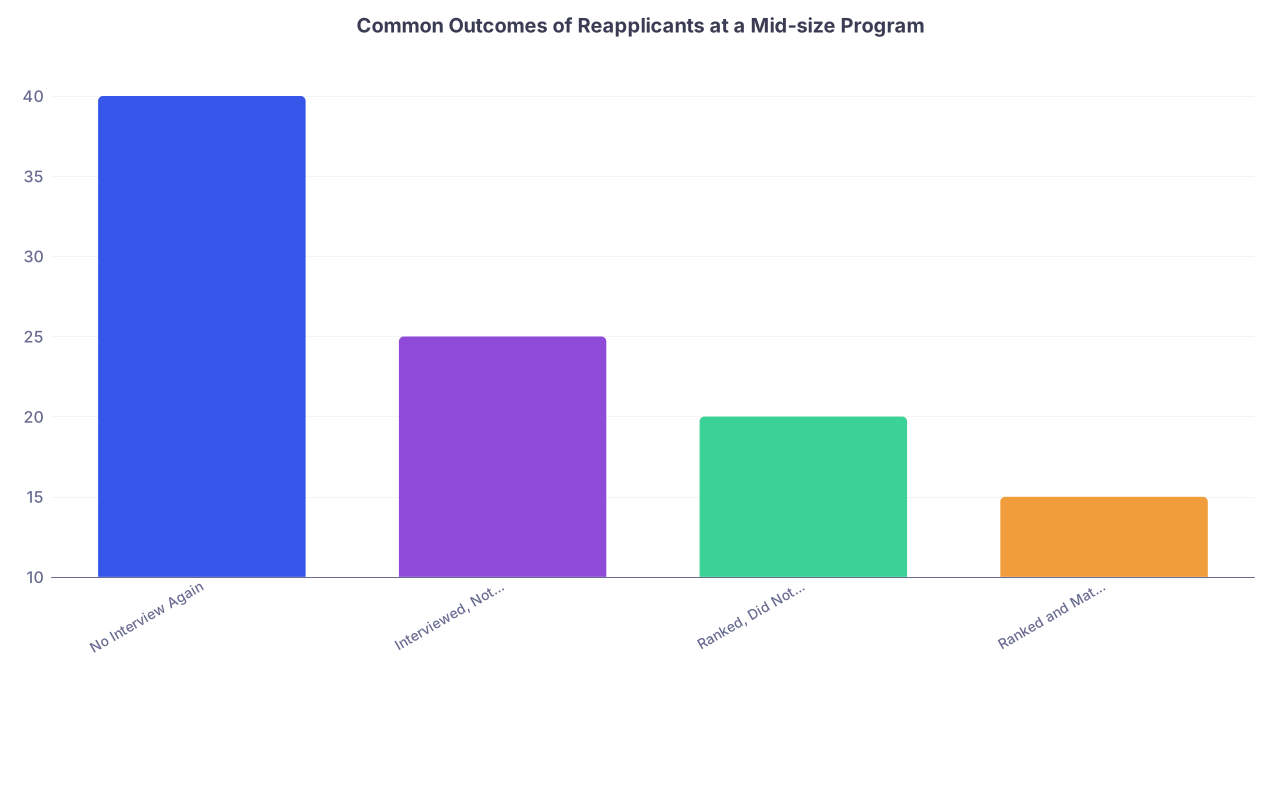
| Category | Value |
|---|---|
| No Interview Again | 40 |
| Interviewed, Not Ranked | 25 |
| Ranked, Did Not Match | 20 |
| Ranked and Matched | 15 |
Those numbers aren’t official, but they’re in the right ballpark for many moderately competitive specialties. Reapplying can work. But the baseline assumption is skeptical: you already had a shot—prove you’re not the same file.
The First Question Every Committee Asks: “What Changed?”
On paper, the committee only has one real question about you as a reapplicant:
Are you meaningfully stronger than the last time we said no?
That’s it. That’s the filter.
Here’s how that plays out internally:
The coordinator opens your ERAS. PD looks at the summary page, scrolls to prior scores and dates, and says something like:
“Weren’t they 210 Step 1, 222 Step 2 last year? What’s new this cycle?”
If the answer is, “Well, they got one poster and did some tutoring,” you’ve lost the room already. You just look persistent, not improved. Persistence alone doesn’t move a committee.
The “what changed?” test operates in a few predictable buckets:
- Objective metrics
- Clinical credibility
- Professionalism / red flags
- Insight and judgment (how you talk about being unmatched)
- Fit and strategy (did you learn from last year’s rank list behavior?)
If you do not show clear movement in at least one of those, most programs quietly put you in the “no upside to interviewing again” pile.
How They Compare Your Old File to Your New One (Step by Step)
Let’s be concrete. Here’s how your reapplicant file is usually reviewed at a program that saw you before.
1. Quick status check
PD asks: “Did we interview them last year? Rank them?”
If you were previously:
- Rejected pre-interview: Bar is higher. They’ve already decided once that you were not worth an interview spot.
- Interviewed but unranked: PD will want a reason to believe you won’t crash and burn again.
- Ranked but you matched elsewhere: Different scenario—this is actually a mild positive. They once thought you were rankable.
Programs that keep detailed notes (and many do) may literally pull prior interview feedback. Comments like “quiet, generic answers” or “red flags: evasive about failed exam” do not disappear. They follow you.
2. Snapshot of “delta” (changes)
The PD or APD will scroll your new file side-by-side with the mental (or actual) memory of the last one:
- New scores?
- New degree (prelim year, research year, MPH, etc.)?
- New letters?
- New setting (U.S. experience vs none before)?
- Any evidence that another program trusted you enough to hire you (transitional year, prelim, research fellow with clinical duties)?
If nothing big jumps out, they move on fast. There are hundreds of applicants. No one has time to squint to find micro-changes.
3. Hard filter on obvious holes
Reapplicants with no real plan are common. We see:
- Same weak Step 2 score, no Step 3, no significant research, no relevant job. Just “reapplying after a year off for family reasons.”
- A non-clinical, random job not tied to medicine, with no explanation that we trust.
The internal thought is unkind but real: “If you couldn’t find anything meaningfully related to medicine in a year, how are you going to function in residency?”
4. Are they now “safe” or “less risky” than before?
A huge driver of decisions on reapplicants is risk.
Programs are not thinking, “Is this the most brilliant applicant?” They’re asking, “Can I hire this person and not regret it?”
Reapplicants can lower perceived risk if they:
- Passed Step 3 with a solid score
- Completed an intern year without incident
- Have strong letters saying “ready for PGY-2/PGY-1, excellent reliability”
They raise risk if they:
- Sat out with vague explanations
- Have fragmented or inconsistent U.S. clinical experience
- Accumulated additional failures or withdrawals
I’ve watched discussions where a PD said: “Look, last year we were nervous about his Step 1 and language barrier. Now he passed Step 3 and has a letter from a VA program director saying he’s strong on wards. I’m more comfortable now than I was before.”
That’s the game. Show them you are safer than last time.
How Different Specialties View Reapplicants
Not all specialties treat the unmatched file the same way. The culture matters.
| Specialty | General Attitude Toward Reapplicants |
|---|---|
| Internal Medicine | Relatively open if clear improvement |
| Family Medicine | Very open, especially with US work |
| Pediatrics | Open but values narrative & fit |
| General Surgery | Cautious; wants strong objective gains |
| Radiology | Data-driven; scores/research matter |
| Psych | Mixed; likes insight, hates vagueness |
Surgery: If you reapply with the same Step 2, no new research, no new surgical exposure, you’re done. If you show up a year later with Step 3 done, strong surgical prelim letters, and a couple of solid publications, suddenly you’re in the “maybe” column.
Internal Medicine and Family Med: Often more forgiving, especially if you used your year intelligently—hospitalist scribe, research assistant, observerships turning into hands-on work, strong U.S. letters.
Psych: Weirdly sensitive to how you talk about failure. They scrutinize your narrative harder than your CV sometimes. Self-awareness sells; bitterness kills you.
Radiology/competitive fields: Reapplying without a different specialty choice or major upgrade is usually a fantasy. They’ve got too many first-timers with cleaner stories.
The Red Flags Committees Look for in Reapplicants
Here’s the part people don’t talk about openly. There are a few patterns that instantly poison a reapplicant file in committee discussions.
Vague or self-pitying explanation of the unmatched year
If your personal statement reads like:
“Unfortunately I did not match due to the increasingly competitive nature of the field, but I have always been passionate about…”
You’ve told us nothing. You’ve dodged responsibility. That’s a softer red flag.
Worse is the blame-the-system tone:
“Despite my strong application, I fell victim to biases against IMGs and the chaotic nature of the Match…”
I’ve heard PDs say flatly: “Pass. I don’t want that attitude in my program.”
The better version sounds like:
“I did not match last cycle. When I reviewed my application with mentors, three issues emerged: late application, limited U.S. clinical experience, and an unpolished interview style. Over the past year, I addressed each…”
You own it. You show insight and a plan. Very different reaction in the room.
Chaotic or unconvincing timeline
If your chronology does not make sense, committees assume the worst.
Gaps with no explanation. Multiple short-term clinical experiences with nothing stable. Jumping between countries every 4–6 weeks.
It reads as instability and, frankly, desperation.
No change in specialty but no justification
If you applied to Dermatology last year, unmatched, and now you’re applying Derm again with minimal change, people roll their eyes.
If you pivot to Internal Medicine or Family Med without explaining the shift in a credible way, they worry you’re applying “down” just to get any spot and you’ll be miserable.
Your narrative has to explicitly connect the dots: how you thought about your career, what you experienced clinically this year, why this specialty is now actually a better fit than the original one.
Letters that quietly damn with faint praise
Reapplicants love to think “any new letter helps.” Not true.
We see a lot of this: “X worked as an unpaid observer in our clinic. She was punctual and eager to learn.”
That’s not a letter. That’s a courtesy paragraph.
Good letters for reapplicants explicitly compare you favorably to current residents or strongly recommend you as “ready for intern responsibilities.” If they don’t, committees notice.
How Programs React if You Interviewed There Before
This is the part people really misunderstand. If you interviewed at a program and didn’t match there, you are neither automatically screwed nor automatically safe.
The committee thinking breaks into a few scenarios.
Scenario 1: You interviewed, were ranked, but matched elsewhere
If they ranked you last time, they already decided you were acceptable. When you reappear as unmatched the next cycle, the question becomes: what happened?
I’ve heard conversations like:
“Did we rank them last year?”
“Yeah, mid-list. They matched at [other program]. Now they’re back? Did that fall through?”
If a contract imploded, a program closed, you had visa issues, etc.—you must explain this clearly. Programs can be sympathetic if they understand the story and you have clean references from that prior institution.
In this case, you can actually have a slight advantage: they liked you once. You’re a known quantity.
Scenario 2: You interviewed, were not ranked
People remember this more actively. The default attitude is: “We already passed for a reason.”
Programs with good documentation will have a line or two in a spreadsheet: “Awkward interview. Poor communication.” Or “Seemed uninterested in our program.”
You want to know the brutal truth? Most of those programs will not bring you back unless your objective portfolio changed dramatically—new degree, outstanding new letters, strong PGY-1 performance with glowing PD letter.
Even then, during rank meetings you’ll see the hesitation: “We already tried to like them and couldn’t.”
Scenario 3: You did a second look, were very enthusiastic, and still did not match
Then you reapply to them again.
This is where it gets tricky. Committees will ask themselves: “Why did they not match anywhere? Or did they rank us too low?” Programs are not keen on being someone’s back-up twice.
You handle this by being honest and strategic in your communication if they ask. A lot of PDs actually appreciate hearing: “I overreached my first cycle and did not rank enough realistic programs. This year I adjusted and would be very happy here.”
It’s not about groveling. It’s about persuading them that your rank list this time won’t be self-destructive.
What Actually Impresses Committees in a Reapplicant
You’re not trying to be perfect. You’re trying to be obviously better and more grounded than your last run.
Here are the upgrades that actually move the needle inside a selection meeting.
1. Clean, successful clinical year with strong PD-level letter
This is the gold standard: you did a prelim or transitional year somewhere, you have:
- No major professionalism issues
- No leaves of absence for suspicious reasons
- A PD letter that says variants of “hard-working,” “reliable,” “excellent team member,” and “I would rehire them”
When a reapplicant shows up with that, the conversation changes. You’re no longer an unknown risk. Someone already bet on you and didn’t regret it.
2. Step 3 passed, ideally with a respectable score
Not all programs demand Step 3 from reapplicants. But I’ve seen PDs say, “He passed Step 3 and is already licensed material. That makes my life easier.”
It signals seriousness and decreases risk that you’ll chew up time and money failing down the line.
3. A focused, believable narrative about the year
Committees respect applicants who clearly dissected their failure.
You are not trying to show that you “deserved” to match the first time. You’re showing that you learned why you didn’t.
A good unmatched narrative sounds like something you’d say to a friend after a hard attending feedback session: blunt, honest, and forward-looking.
4. Evidence that you now understand the market
This is subtle, but committees look for it.
Did you:
- Apply earlier this time?
- Apply to a realistic spread of programs and specialties?
- Stop chasing a world that doesn’t align with your record (e.g., second Derm attempt with average scores and zero new research)?
Programs can smell a fantasy application. They can also see when you’ve recalibrated and grown up a bit.
How Your Application Strategy Signals Maturity or Denial
Reapplicants often obsess over rewriting the personal statement and beefing up a CV. They forget the part committees never see directly but infer: your strategy.
They can figure out a surprising amount from:
- What specialty you chose this time
- Whether you dual-applied
- How your experiences line up with that choice
- What you say in emails or interviews about last year
For example, if you were an unmatched categorical surgery applicant and now you apply to Internal Medicine with:
- A surgery-heavy portfolio
- A personal statement that barely mentions medicine
- No new medicine exposure
Committees read that as: “still wants surgery, just using us as a safety net.”
If instead, your year includes:
- Significant inpatient medicine exposure
- A mentor in IM who writes a strong, specific letter
- A statement that traces how your interests genuinely shifted from OR to longitudinal care
Now you look like someone with insight, not desperation.
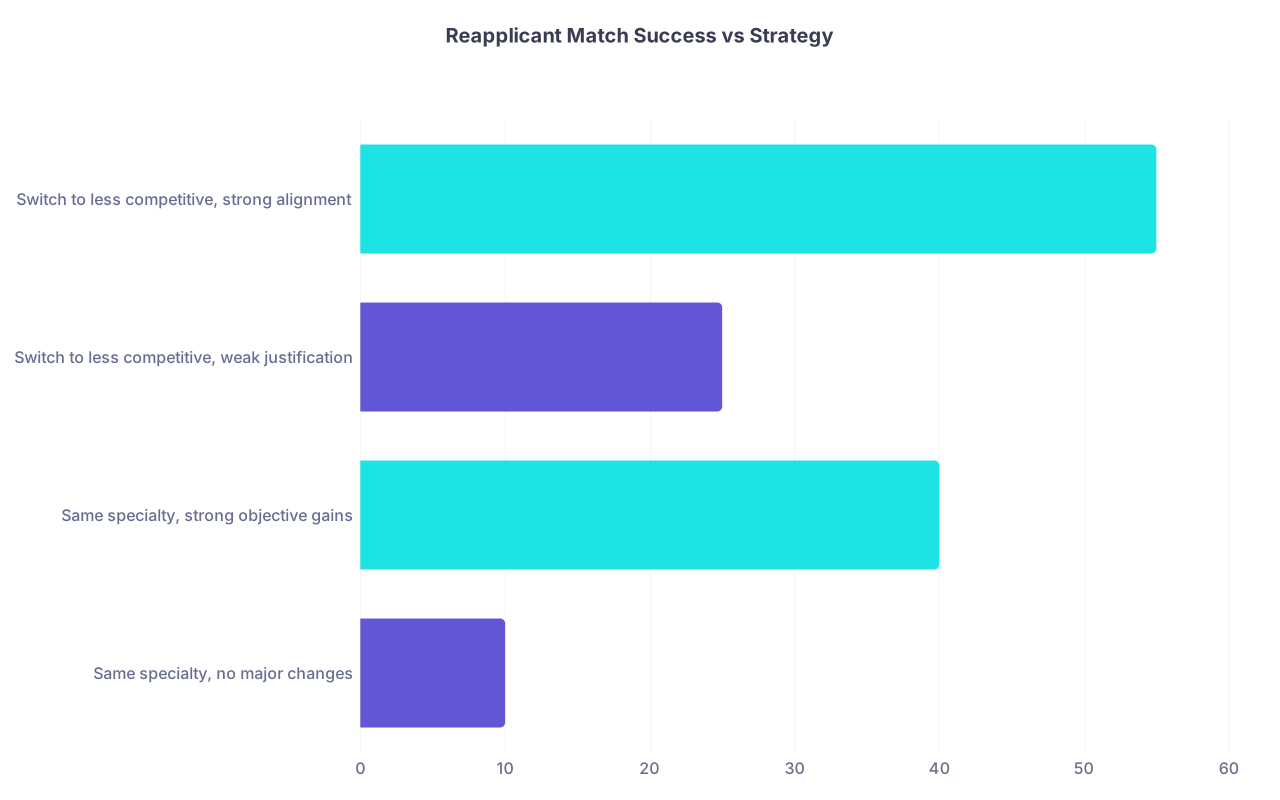
| Category | Value |
|---|---|
| Same specialty, no major changes | 10 |
| Same specialty, strong objective gains | 40 |
| Switch to less competitive, weak justification | 25 |
| Switch to less competitive, strong alignment | 55 |
Again—the numbers are illustrative, but you get the point. Strategy and story shape whether committees see you as a maturing professional or just a repeat gambler.
The Unspoken Reality About “Courtesy Consideration”
There’s one more behind-the-scenes detail you should understand.
Some programs feel a moral tug about reapplicants they met and liked. You’ll hear PDs say:
“We should at least look at them again. They were nice.”
This turns into what I call “courtesy consideration.” Your name makes it onto a shortlist to review, maybe even into the interview pool, not because you are objectively at the top of the stack, but because they feel a residual obligation.
If you squander that by submitting almost the same file as last year, the reaction is harsher than with a brand-new applicant. People feel you wasted their time twice.
On the other hand, if you show:
- Concrete improvement
- Humility
- Specific interest in that program
You can convert courtesy into genuine advocacy. I’ve seen APDs fight for reapplicants they interviewed twice, saying, “They’ve grown a ton; we should give them a shot.”
You are never entitled to that. But you can earn it.
How to Frame Yourself as a “Comeback Story,” Not a “Problem”
You are selling a comeback story. Not a sob story.
Three moves make the difference:
Be explicit about your diagnosis of the first cycle.
Do not make committees guess. Tell them: “I applied too narrowly; I underestimated the importance of U.S. experience; my interview skills were not where they needed to be.”Show the treatment plan and the response.
Year of structured clinical work, feedback-seeking, formal communication coaching, whatever is real. Make the cause–effect chain obvious.Project forward, not backward.
Stop trying to convince them that last year was unfair. They don’t care. Convince them they’ll want you in their workroom at 2 a.m. next January.
You want the PD to look at your file and think: “They took a hit, figured it out, came back stronger. That’s the kind of resilience I want.”

| Step | Description |
|---|---|
| Step 1 | Unmatched |
| Step 2 | Honest Self Review |
| Step 3 | Identify Weaknesses |
| Step 4 | Targeted Year Plan |
| Step 5 | Clinical or Research Year |
| Step 6 | New Metrics and Letters |
| Step 7 | Rebuild Application |
| Step 8 | Clear Narrative in PS |
| Step 9 | More Strategic Rank List |
The Bottom Line: How Committees Really See You
Let me strip it down.
Programs are not sitting around trashing reapplicants. They’re not inherently biased against you for being unmatched once. They are biased against wasting time on people who have not changed.
Reapplicants fall into two mental buckets in the room:
- “Same person as last year, just older”
- “Clearly stronger, more self-aware version of last year’s person”
Everything you do in the unmatched year, and everything you put in your ERAS, pushes you into one of those two.
So remember these three points:
- Committees always ask “What changed?” If you cannot answer that clearly and convincingly, you will be treated like the same file they already passed on.
- Objective upgrades (Step 3, clinical year, strong PD letter) plus a brutally honest narrative are what shift you from “risky repeat” to “safer bet.”
- Your strategy—the specialty you choose, how you explain the gap, the realism of your choices—signals whether you’ve grown or you’re just trying again and hoping for different results.
You do not need perfection to come back from an unmatched year. But you do need a real transformation, not cosmetic edits. Program directors can tell the difference in about thirty seconds.